






Regulate for What? A Closer Look at the Rationale and Goals of Digital Competition Regulations
For more on this topic, see the ICLE Issue Spotlight “Digital Competition Regulations Around the World.”
Executive Summary
Inspired by the European Union’s Digital Markets Act (DMA), a growing number of jurisdictions around the globe either have adopted or are considering adopting a framework of ex-ante rules to more closely regulate the business models and behavior of online platforms.
These digital competition regulations (“DCRs”) share two key features. The first is that they target so-called “gatekeepers” who control the world’s largest online platforms. Such regulations assume that these firms have accumulated a degree of economic and political power that allows them to harm competition, exclude rivals, exploit users, and possibly inflict a broader range of social harms in ways that cannot be adequately addressed through existing competition laws. Typically cited as examples of gatekeepers are the main platforms of Google, Amazon, Facebook/Meta, Apple, and Microsoft.
The second common features of these DCR regimes is that they impose similar, if not identical, per-se prohibitions and obligations on gatekeepers. These often include prohibitions on self-preferencing and the use of third-party party data, as well as obligations for interoperability and data sharing. These two basic characteristics set DCRs apart from other forms of “digital regulation”—e.g., those that concern with AI, privacy, or content moderation and misinformation.
This paper seeks to understand what digital competition regulations aim to achieve and whether a common rationale underpins their promulgation across such a broad swatch of territories.
A. Multiple and Diverging Goals?
We find that DCRs pursue multiple goals that may vary across jurisdictions. Some DCRs are guided by the same goals as competition law, and may even be embedded into such laws. Such is the case, e.g., in Germany and Turkey. Other regulations address competition concerns under differing or modified standards. Examples here include the “material-harm-to-competition” standard in the United States and, arguably, digital competition regulation in the UK and Australia—where traditional competition-law goals such as the protection of competition and consumer welfare comingle with an increased emphasis on “fairness.”
DCRs sometimes pursue a much broader set of goals. For instance, a prospective digital competition regulation in South Africa seeks greater visibility and opportunities for small South African platforms and increased inclusivity of historically disadvantaged peoples, along with other more competition-oriented objectives (this duality is a common feature of South African legislation). Similarly, a bill proposed in Brazil attempts to reduce regional and social inequality, as well as to widen social participation in matters of public interest, alongside its stated effort to protect competition.
In the United States, apart from protection of competition, proponents of the (now-stalled) DCR bills have invoked a broad set of potential benefits, including fairness; fair prices; a more level playing field; reduced gatekeeper power; protections for small and medium-sized enterprises (“SMEs”); reduced costs for consumers; and boosts to innovation.
Some DCRs, however, are not promulgated in pursuit of competition-oriented objectives at all—at least, not explicitly or not in the sense in which such objectives are understood in traditional competition law. The clearest example is the EU’s DMA itself, which openly eschews traditional competition-related goals and instead seeks to make digital markets “fair” and “contestable.”
B. A New Form of Competition Regulation
Regardless of the overarching goals, it is evident that DCRs incorporate themes and concepts familiar to the competition lawyer, such as barriers to entry, exclusionary conduct, competitive constraints, monopolistic outcomes, and, in some cases, even market power. This may, at first blush, hint at a close relationship between digital competition regulation and competition law. While not entirely incorrect, that assessment must come with a number of caveats.
DCRs diverge in subtle but significant ways from mainstream notions of competition law. We posit that DCRs are guided by three fundamental goals: wealth redistribution among firms, the protection of competitors of incumbent digital platforms, and the “leveling down” of those same digital platforms.
C. Rent Redistribution Among Firms
The notion of “gatekeepers” itself presumes asymmetrical power relations between digital platforms and other actors, which are further presumed both to lead to unfair outcomes and to be insurmountable without regulatory intervention. Thus, the first commonality among the DCRs we study is that they all seek to transfer rents directly from gatekeepers to rival firms, complementors, and, to a lesser extent, consumers. This conclusion follows inexorably from the DCRs’ stated goals, the prohibitions and obligations they promulgate, and the public statements of those who promote them.
While the extent to which various groups are intended to benefit from this rent re-allocation might not always be identical, all DCRs aim to redistribute rents generated on digital platforms away from gatekeepers and toward some other group or groups—most commonly the business users active on those platforms.
D. Protection of Competitors
Another important feature that DCRs share is the common goal not just to protect business users, but to directly benefit competitors—including, but not limited to, via rent redistribution. DCRs are concerned with ensuring that competitors—even if they are less efficient—enter or remain on the market. This is evidenced by the lack of overarching efficiency or consumer-welfare goals—at the very least, for those regulations not based on existing competition laws—that would otherwise enable enforcers to differentiate anticompetitive exclusion of rivals from those market exits that result from rivals’ inferior product offerings.
This focus on protecting competitors can also be seen in DCRs’ pursuit of “contestability.” As defined by DCRs, promoting contestability entails diminishing the benefits of network effects and the data advantages enjoyed by incumbents because they make it hard for other firms to compete, not because they are harmful in and of themselves or because they have been acquired illegally or through deceit. In other words, DCRs pursue contestability—understood as other firms’ ability to challenge incumbent digital platforms’ position—regardless of the efficiency of those challengers or the ultimate effects on consumers.
E. ‘Leveling Down’ Gatekeepers
The other way that DCRs seek to balance power relations and achieve fairness is by “leveling down” the status of the incumbent digital platforms. DCRs directly and indirectly worsen gatekeepers’ competitive position in at least three ways:
- By imposing costs on gatekeepers not borne by competitors;
- By negating gatekeepers’ ability to capitalize on key investments; and
- By facilitating third parties’ free riding on those investments.
For example, prohibitions on the use of nonpublic (third-party) data benefit competitors, but they also negate the massive investments that incumbents have made in harvesting that data. Similarly, data-sharing obligations impose a cost on gatekeepers because data-tracking and sharing is anything but free. Gatekeepers are expected to aid and subsidize competitors and third parties at little or no cost, thereby diminishing their competitive position and dissipating their resources (and investments) for the benefit of another group. The same can be said, mutatis mutandis, for other staples of digital competition regulation, such as prohibitions on self-preferencing and sideloading mandates.
F. The Perils of Redistributive and Protectionist Competition Regulation
It should be noted, of course, that direct rent redistribution among firms is generally not the goal of competition law. Rent redistribution entails significant risks of judicial error and rent seeking. Regulators may require firms to supply their services at inefficiently low prices that are not mutually advantageous, and may diminish those same firms’ incentives to invest and innovate. Those difficulties are compounded in the fast-moving digital space, where innovation cycles are faster, and yesterday’s prices and other nonprice factors may no longer be relevant today. In short, rent redistribution is difficult to do well in traditional natural-monopoly settings and may be impossible to do without judicial error in the digital world.
Protecting competitors at the expense of competition, as DCRs aim to do, is equally problematic. Competition depresses prices, increases output, leads to the efficient allocation of resources, and encourages firms to innovate. By facilitating competitors—including those that may have fallen behind precisely because they have not made the same investments in technology, innovation, or product offerings—DCRs may dampen incentives to strive to become a so-called gatekeeper, to the ultimate detriment of consumers. Protecting competition benefits the public, but protecting competitors safeguards their special interests at the public’s expense.
This is not only anathema to competition law but also to free competition. As Judge Learned Hand observed 80 years ago in his famous Alcoa decision: “the successful competitor, having been urged to compete, must not be turned upon when he wins.” Critiques of digital competition regulation’s punitive impulse against incumbent platforms flow from this essential premise—which, we contend, is the cornerstone of good competition regulation. The multiplicity of alternative justifications put forward by proponents of such regulations are generally either pretextual or serve as a signal to the voting public. To paraphrase Aldous Huxley: “several excuses are always less convincing than one.”
We end by speculating that digital competition regulation could signal more than just a digression from established principles in a relatively niche, technical field such as competition law. If extended, the DCR approach could mark a new conception of the roles of companies, markets, and the state in society. In this “post-neoliberal” world, the role of the state would not be limited to discrete interventions to address market failures that harm consumers, invoking general, abstract, and reactive rules—such as, among others, competition law. It would instead be free to intercede aggressively to redraw markets, redesign products, pick winners, and redistribute rents; indeed, to function as the ultimate ordering power of the economy.
Ultimately, however, we conclude that it is too early to make any such generalizations, and that only time will tell whether digital competition regulation was truly a sign of things to come, or merely a small but ultimately insignificant abrupt dirigiste turn in the zig-zagging of antitrust history.
Introduction
Inspired by the European Union’s Digital Markets Act (“DMA”),[1] a growing number of jurisdictions around the globe either have adopted or are considering adopting a framework of ex-ante rules to more closely regulate the business models and behavior of online platforms.
These “digital competition regulations”[2] (“DCRs”) share two key features. The first is that they target so-called “gatekeepers” who control the world’s largest online platforms. Such regulations assume that these firms have accumulated a degree of economic and political power that allows them to harm competition, exclude rivals, exploit users, and possibly inflict a broader range of social harms in ways that cannot be adequately addressed through existing competition laws.[3] Typically cited as examples of gatekeepers are the main platforms of Google, Amazon, Facebook/Meta, Apple, and Microsoft.
The second common feature these DCR regimes share is that they impose similar, if not identical, per-se prohibitions and obligations on gatekeepers. These often include prohibitions on self-preferencing and the use of third-party party data, as well as obligations for interoperability and data sharing. These two basic characteristics set DCRs apart from other forms of “digital regulation”—e.g., those dealing with AI,[4] privacy,[5] or content moderation and misinformation.[6]
It is not, however, always entirely clear what DCRs aim to achieve. A cursory survey suggests that these rules pursue different goals, without an immediately apparent unifying theme. For example, some DCRs have been integrated into existing competition laws and ostensibly pursue the same goals: the protection of competition and consumer welfare. Others aim for a range of goals—including, but not limited to, competition—such as the protection of small and medium-sized enterprises (“SMEs”); regional equality; social participation; and improving the lot of business users who operate on online platforms. Some DCRs purposefully and explicitly sidestep competition-oriented considerations, aiming instead for such adjacent but ultimately distinct goals as “fairness” and “contestability.”[7]
What emerges is a seeming patchwork of goals and objectives. In this paper, we seek to assess those disparate goals and objectives, drawing on many of the major proposed and enacted DCRs.
Part I examines the goals that DCRs claim to pursue. It takes those goals at face value and offers a largely descriptive account of the objectives offered. Where necessary (such as, for example, where those goals are cryptic or not clearly articulated), reference is made to public statements by those who promulgated them.
Part II argues that DCRs are best understood as a new form of law, grounded in ideas that have found limited success in competition law itself. To some extent, DCRs are based on a common narrative that has transformed some of the core principles and themes of antitrust law. As such, DCRs partially jibe with antitrust law, but ultimately diverge from it in subtle but consequential ways.
Part III argues that, despite superficial differences, DCRs share three common goals. The first is a desire to redistribute rents from some companies to others. At the most fundamental level, DCRs all seek to address what are perceived to be extreme power imbalances between digital platforms and the rest of society—especially business users and competitors. Thus, they seek to redistribute rents away from so-called “gatekeepers” and toward the business users that operate on those platforms, and to promote competitors (including, but not limited to, via rent redistribution).
DCRs are particularly concerned with ensuring that competitors, even if they are less efficient, enter or remain in the market. This is evidenced by a lack of overarching efficiency or consumer-welfare goals—even in those regulations that are based on existing competition laws—that would otherwise enable enforcers to differentiate between anticompetitive exclusion of rivals and market exit that results from rivals’ inferior product offerings. The focus on protecting competitors also stems from DCRs’ pursuit of “contestability.” In this context, promoting contestability entails diminishing the benefits of the network effects and the data advantages enjoyed by incumbents on the theory that they make it difficult for other firms to compete—not because they are harmful to consumers or because they have been acquired illegally or through deceit.
The third way that DCRs seek to balance power relations and achieve fairness is by “leveling down” the status of the incumbent digital platforms. DCRs worsen the competitive position of gatekeepers in at least three ways:
- By imposing costs on gatekeepers not borne by competitors;
- By negating their ability to capitalize on key investments; and
- By helping third parties to free ride on those investments.
Essentially, gatekeepers are expected to aid and subsidize competitors and third parties at little or no cost. This, in turn, diminishes their competitive position and dissipates their resources (and investments) for the benefit of another group.
Part IV concludes. It speculates that DCRs might signal the advent of a new paradigm in political economy: a redrawing of the existing lines and roles between states, markets, and firms, with greater emphasis on the role of the state as the ultimate ordering power of the economy. In hindsight, one expression of this could turn out to be the overturning (if only partial) of the essential principles of modern competition policy: the protection of competition rather than competitors, a policy emphasis on maximizing economic output rather than rent redistribution among firms, and a commitment to merit, rather than fairness and equity. It is difficult to overstate how deeply at loggerheads this conception of the role of competition is from the existing, predominant paradigm long found in competition law.
I. A Cacophony of Goals in Digital Competition Regulation
Most DCRs pursue multiple overlapping objectives. The global picture is even more complex, as there is only partial overlap among the various goals pursued by DCRs in different jurisdictions.
Some DCRs are an extension of competition-law frameworks and are sometimes even formally embedded into existing competition laws. In principle, this means that the standard goals and rationale of competition law apply. Germany, for instance, recently amended its Competition Act, emphasizing the need to “intervene at an early stage in cases where competition is threatened by certain large digital companies.”[8] According to the Bundeskartellamt:
The newly introduced Section 19a probably represents the most important change as the Bundeskartellamt will now be able to intervene at an early stage in cases where competition is threatened by certain large digital companies. As a preventive measure the Bundeskartellamt can prohibit certain types of conduct by companies which, due to their strategic position and their resources, are of paramount significance for competition across markets.[9]
Similarly, Turkey currently is looking to amend the Turkish Competition Act with the objectives of promoting competition and innovation in digital markets; protecting consumer and business rights; and ensuring that gatekeepers do not engage in anticompetitive practices.[10] Proponents argue that the current Turkish Competition Act is not adequately equipped to address anticompetitive conduct in digital markets—such as, e.g., that the process of defining relevant markets is inappropriate for dynamic and global digital ecosystems and that specific regulations are needed due to the network effects that digital platforms confer.[11] These are all nominally competition-related concerns.[12] Other proposed changes to the Turkish Competition Act similarly reflect an increased emphasis on competition. For instance, in merger analysis, the current “dominance test” would be substituted with a “significant impediment to effective competition test,” similar to that in the EU merger-control regime. A “de minimis” rule would also be added to Article 41 to exempt agreements “that do not significantly impede competition.”
Other DCRs appear, at least to some extent, to pursue competition-law-inspired goals, despite not being formally incorporated into existing competition laws. In South Korea, for example, the Korean Fair Trade Commission (“KFTC”) recently proposed a draft DMA-style bill, the Platform Competition Promotion Act, whose purpose is establish ex-ante rules to restore competition rapidly in designated markets “without the tedious process of defining a relevant market through economic analysis.”[13] According to the KFTC, digital competition regulation is necessary to combat monopolization in digital markets, where monopolies tend to become entrenched.[14] As some observers have noted,[15] the Platform Competition Promotion Act covers conduct already addressed by South Korea’s existing Monopoly Regulation and Fair Trade Act.[16] Thus, while the draft bill is likely to be passed as a separate piece of legislation, there appears to be a continuum between it and South Korean competition law.
In the United Kingdom, the 2023 Digital Markets, Competition, and Consumer Bill (“DMCC”) is in the final stages of legislative approval.[17] The DMCC aims to “provide for the regulation of competition in digital markets” and, in theory, dovetails with goals pursued by competition law (it even invokes familiar competition-law themes, such as market power).[18] The DMCC would grant the UK antitrust enforcer, the Competition and Markets Authority (“CMA”), power to take “pro-competition interventions” where it has reasonable grounds to believer there may be an adverse effect on competition.[19]
The DMCC has, however, also been touted as a tool to “stamp out unfairness in digital markets.”[20] This could refer to the bill’s consumer-protection provisions, which would prohibit, inter alia, unfair commercial practices.[21] But it may also suggest that the DMCC goes beyond the remit of traditional competition law, in which “unfairness” is generally not central, except within the relatively narrow confines of the abuse-of-dominance provision under S.18 of the Competition Act.[22]
Further, in a press release welcoming the DMCC draft, the CMA enumerated the bill’s benefits as falling into the three categories of “consumer protection,” “competition,” and “digital markets.”[23] The second category grants the CMA increased powers to “identify and stop unlawful anticompetitive conduct more quickly.”[24] The third, however, proposes that the bill will “[enable] all innovating businesses to compete fairly.”[25] This could imply that competition rules in “digital markets” would be governed by different principles than those that apply in “traditional” markets—that is, those that do not involve the purchase or sale of goods over the internet, or the provision of digital content.[26] The DMCC’s provisions on “digital markets” are also formally separate from those on “competition.”[27]
In Australia, the Australian Competition and Consumers Commission (“ACCC”) is conducting a five-year digital-platform-services inquiry (“DPS Inquiry”), set to be finalized in March 2025.[28] The ACCC recommended, as part of the inquiry’s fifth interim report, service-specific obligations (similar to the UK’s proposed ex-ante rules) for “designated” digital platforms.[29] These would serve to address “anticompetitive conduct, unfair treatment of business users and barriers to entry and expansion that prevent effective competition in digital platform markets.”[30] Thus, alongside competition law’s traditional concerns (e.g., harms and benefits to consumers, innovation, efficiency, and “effective competition”), the ACCC would also incorporate concerns over “fairness” and, especially, the protection of business users.
In the United States, several bills have been put forward that are formally separate from existing antitrust law, but cover some of the same conduct as would typically be addressed under U.S. antitrust law—albeit with seemingly different goals and standards. Some of these new goals and standards represent only slight variations on the usual goals of competition law. Three main pieces of legislation have so far been put forward: the American Innovation and Choice Online Act (“AICOA”),[31] the Open App Market Act (“OAMA”),[32] and the Augmenting Compatibility and Competition by Enabling Service Switch Act (“ACCESS Act”)[33] (together, “U.S. tech bills”).
Although the U.S. tech bills largely fail to describe their underlying goals, the titles of the bills and statements made by their sponsors suggest a set of overlapping concerns, such as preventing “material harm to competition,”[34] reducing “gatekeeper power in the app economy,”[35] and “increasing choice, improving quality, and reducing costs for consumers.”[36] These goals appear to fall relatively well within the traditional remit of antitrust law.
But there are others. According to U.S. Sen. Amy Klobuchar (D-Minn.), the primary sponsor or cosponsor of several of the U.S. tech bills, AICOA is intended to “restore competition online by establishing commonsense rules of the road,” “ensure small businesses and entrepreneurs still have the opportunity to succeed in the digital marketplace,” and “create a more even playing field,” all “while also providing consumers with the benefit of greater choice online.”[37] “Fairness,” “fair prices,” and “innovation” all have also been invoked by the bills’ supporters.[38]
At the same time, for three out of the 10 types of challenged conduct, AICOA would require demonstrating “material harm to competition,” which would suggest that one of that bill’s goals is to protect competition. As the American Bar Association’s Antitrust Section has observed, however, there is no “material harm to competition” standard in U.S. antitrust law.[39] This suggests that AICOA may posit a different interpretation of what it means to protect competition, or of what sort of competition should be protected, than does traditional U.S. antitrust law.
OAMA, on the other hand, aims to open competitive avenues for startup apps, third-party app stores, and payment services in existing digital ecosystems.[40] Its title reads: “to promote competition and reduce gatekeeper power in the app economy, increase choice, improve quality, and reduce costs for consumers.” Unlike AICOA, however, OAMA would not require a showing of harm to competition—material or otherwise—to establish liability, which appears to suggest that competition might be less of a concern than the bill’s title implies.
Finally, the ACCESS Act is intended to “promote competition, lower entry barriers and reduce switching costs for consumers and businesses online.”[41] U.S. Sen. Mark Warner (D-Va.), the bill’s primary sponsor, has said that the ACCESS Act will promote competition, allow startups to “compete on equal terms with the biggest social media companies,” and “level the playing field between consumers and companies” by giving them more control over who manages their privacy.[42] Again, these are antitrust-adjacent objectives, but with a flavor (“equal terms,” “level playing field,” etc.) that is largely foreign to U.S. antitrust law.
Other DCRs pursue a mix of competition and noncompetition goals. The South African Competition Commission’s (“SACC”) Final Report on the Online Intermediation Platforms Market Inquiry, for example, found that remedial actions similar to the ex-ante rules contemplated in the DMA and elsewhere are needed to grant “[g]reater visibility and opportunity for smaller South African platforms” to compete with international players; “[e]nabl[e] more intense platform competition,” offer “more choice and innovation”; reduce prices for consumers and business users; “[p]rovid[e] a level playing field for small businesses selling through these platforms, including fairer pricing and opportunities”; and “[p]rovid[e] a more inclusive digital economy” for historically disadvantaged peoples.[43]
In a similar vein, Brazil’s proposed law PL 2768/2022 (“PL 2768”) pursues an expansive grab-bag of social and economic goals.[44] Article 4 states that targeted digital platforms must operate based on the following principles: freedom of initiative, free competition, consumer protection, a reduction in regional and social inequality, combatting the abuse of economic power, and widening social participation in matters of public interest.[45] In addition, PL 2768 also states as objectives that it will enable access to information, knowledge, and culture; foster innovation and mass access to new technologies and access models; promote interoperability among apps; and enable data portability.[46]
Finally, there are those DCRs that claim not to pursue competition-oriented goals at all. The DMA has two stated goals: “fairness” and “contestability,”[47] and explicitly denies being bound by, or even pursuing, the traditional goals of competition law: protecting competition and consumer welfare.[48] According to the DMA, competition, consumer welfare, and efficiency considerations such as those that underpin antitrust law are not relevant under the new framework. This is, according to the DMA’s text, because the goals of competition law and the DMA “are complimentary but ultimately distinct.”[49]
Interestingly, however, few other DCRs have so steadfastly disavowed competition considerations, even those that copy the DMA’s provisions verbatim. India is a case in point. In 2023, a report by the Standing Committee on Finance argued that, if digital competition regulation was not passed, “interconnected digital markets will rapidly demonstrate monopolistic outcomes that prevent fair competition. This will restrict consumer choice, inhibit business users, and prevent the rise of dynamic new companies.”[50] These concerns jibe with traditional antitrust goals, as indicated inter alia by the report’s title (“anti-competitive practices by big tech companies”). Later, another report—the Report of the Committee on Digital Competition Law (“CDC Report”)—proposed a Draft Digital Competition Bill (“DCB”).[51] According to the CDC Report, DMA-style digital competition regulation was needed to supplement the 2002 Indian Competition Act (“ICA”),[52] which—and here is the interesting part—supposedly also aims to promote “fairness and contestability.”[53]
But the ICA’s stated aims were the protection of competition, the interests of consumers, and free trade.[54] The Report of the High-Powered Expert Committee on Competition Law and Policy (“Raghavan Committee Report”),[55] which served as the basis for the ICA, modernized Indian competition law by moving it away from the structure-based paradigm of the earlier Anti-Monopolies and Restrictive Trade Practices Act of 1969 and toward an economic-effects-based analysis. The Raghavan Committee Report was unequivocal in its support of consumer welfare as the system’s ultimate goal.[56] Moreover, the report advised against a plurality of goals, including, specifically, “bureaucratic perceptions”[57] of equity and fairness, which, it argued, were mutually contradictory, difficult to quantify, and potentially opposed to the sustenance of free, unfettered competition.[58] It is therefore curious, to say the least, that the CDC Report would now, in hindsight, recast the ICA’s goals to support essentially the opposite idea.
The multiplicity of goals and their unclear, partially overlapping relationship with competition law raises questions about how we should think about these laws and, indeed, whether we can even think of them as a coherent, unified group. In the next section, we seek to untangle the nature and classification of digital competition regulation.
II. A New Form of Competition Regulation
DCRs are likely best understood as a new form of competition regulation. As some authors have noted, the precise relationship between competition law and the EU’s DMA is difficult to pinpoint.[59] In a similar vein, it is evident that many DCRs incorporate themes and concepts familiar to the competition lawyer, such as barriers to entry, exclusionary conduct, competitive constraints, monopolistic outcomes, and, in some cases, even market power. At first blush, this may suggest a direct relationship between digital competition regulation and competition law. While not entirely incorrect, that assessment comes with considerable caveats.
In this section, we argue that DCRs are a new form of competition regulation that diverges in subtle but definitive ways from mainstream notions of competition law. In essence, DCRs take plausible competition-law themes and alter and subvert them in fundamental ways, creating what could be described as sector-specific[60] or enforcer-friendly[61] competition laws. Due to their blend of competition principles and prescriptive, top-down regulatory provisions, we have opted for the term “digital competition regulation.” To understand their nature, we must start with their underlying assumptions and the ills they claim to address.
A. The DCR Narrative
A starting assumption of all DCRs is that there is an extreme imbalance of power between large digital platforms and virtually every other stakeholder with whom they deal—from other industries to the businesses that operate on digital platforms to their competitors to, finally, end-users.[62] Even governments are often presumed to be virtually powerless in the face of the depredations of so-called “Big Tech.”[63] The adage that “big tech has too much power” has been almost universally endorsed by proponents of DCRs and strong antitrust enforcement;[64] is explicitly or implicitly embedded into those DCRs;[65] and now also permeates popular discourse, media, and entertainment.[66] The corollary is that asymmetric regulation is needed to help those other actors that have been “dispossessed” by big-tech platforms.
This notion is widespread and underpins a range of other policy proposals, not just DCRs. For example, the EU is considering a “Fair Share” regulation that would address the supposed power imbalance between tech companies and telecommunications operators, by forcing the former to pay for the infrastructure of the latter.[67] Similarly, various “bargaining codes” either already have been adopted or are currently under consideration to force tech companies to pay news publishers. In Australia, the Treasury Laws Amendment (News Media and Digital Platforms Mandatory Bargaining Code) Act 2021 (“Bargaining Code”) was put in place to address the supposed bargaining-power imbalance between digital platforms and news-media businesses.[68] According to the ACCC, digital-advertisement regulation was necessary to support the sustainability of the Australian news-media sector, “which is essential to a well-functioning democracy.”[69] Laws with a similar rationale have also been passed or are under consideration in other jurisdictions.[70]
All these initiatives originate from the same foundational assumption, which is that tech companies are more powerful than anyone else, and are therefore able to get away with imposing draconian conditions unilaterally that allow them to benefit disproportionately at the expense of all other parties, business users, complementors, and consumers. While it is not always easy to identify a coherent thread running through the rules and prohibitions contained in DCRs and other initiatives to regulate “Big Tech,” a good rule of thumb to understand the unifying logic behind these initiatives is that digital platforms should have less “power,” and other stakeholders should have more “power.”
Sometimes—but by no means always—this also encompasses familiar notions of “market power,” i.e., firms’ ability to profitably raise prices because of the absence of sufficient competition. In fact, in most DCRs, “power” stems from the fact that an online platform is an important gateway for business users to reach consumers.[71] This is considered manifestly evident by the platform’s size, turnover, or “strategic” importance.[72] As Bundeskartellamt (the German competition authority) President Andreas Mundt has put it: “we shouldn’t talk about this narrow issue of price, we should talk about power.”[73]
DCRs embody this principle. They seek to extract better deals for the party or parties that are considered to suffer from an imbalance of bargaining power vis-à-vis digital platforms—such as, for instance, through interoperability and data-sharing mandates. As we argue in Section III, these beneficiaries are intended to be the platform’s business users and competitors.
The reasoning is as follows. The asymmetrical power relations between digital platforms and other actors are presumed to lead to unfair outcomes in how these stakeholders are treated and the ways that rents are allocated across the supply chain. As the DMA explains in its preamble:
The combination of those features of gatekeepers is likely to lead, in many cases, to serious imbalances in bargaining power and, consequently, to unfair practices and conditions for business users, as well as for end users of core platform services provided by gatekeepers, to the detriment of prices, quality, fair competition, choice and innovation in the digital sector.[74]
Once it is accepted that power relations between digital platforms and other stakeholders are unfairly skewed, any outcome resulting from the interaction of the two groups must also, by definition, be “unfair.” For example, under the DMA, “unfairness” is broadly defined as “an imbalance between the rights and obligations of business users where the gatekeeper obtains a disproportionate advantage.”[75] A “fair” outcome would be one in which market participants—including, but not limited to, business users—“adequately” capture the benefits from their innovations or other efforts, something the DMA assumes is currently not taking place due to gatekeepers’ superior bargaining power.
In the world of digital competition regulation, “unfairness” is a foregone conclusion. And, sure enough, the concept of “fairness” is the central normative value driving these regulations. Proponents liberally invoke it[76] and it features prominently in DCRs.[77] This narrative, however, is built on premises that differ markedly from those of antitrust law. We discuss these below.
B. Key Differences in First Principles
The DMA is the original blueprint for all digital competition regulation that has followed in its wake. The DMA’s text states that it is distinct from competition law:
This Regulation pursues an objective that is complementary to, but different from that of protecting undistorted competition on any given market, as defined in competition-law terms, which is to ensure that markets where gatekeepers are present are and remain contestable and fair, independently from the actual, potential or presumed effects of the conduct of a given gatekeeper covered by this Regulation on competition on a given market. This Regulation therefore aims to protect a different legal interest from that protected by those rules and it should apply without prejudice to their application.[78]
Other DCRs are rarely so candid about their break with competition law. On the contrary, some are even outwardly couched in competition-based terms. But in the end, DCRs replicate all or most of the prohibitions and obligations pioneered by the DMA.[79] DCRs also apply largely to the same companies as the DMA or, at the very least, use the same thresholds to establish which companies should be subject to regulation.[80]
This leads to a curious “Schrödinger’s DCR” scenario, where the same substantive rules simultaneously are and are not competition law. In the EU, for example, they are not; but in Turkey and Germany, they are. India’s DCB is a verbatim copy of the DMA, yet it is presented as a specific competition law.[81] This apparent contradiction is salvageable only if one thinks of digital competition regulation neither as competition law, strictu sensu, nor as an entirely separate regulation, but rather, as a partially overlapping tool that regulates competition and competition-related conduct in a different—and sometimes fundamentally different—manner.
Consider the example of the EU. EU competition law seeks to protect competition and consumer welfare. The DMA, on the other hand, is guided by the twin goals of “fairness” and “contestability.” As such, under the DMA (as under all other DCRs) the relevant standards are inverted. Under most DCRs, market power—understood as a firm’s ability to raise praises profitably—is either immaterial or not essential to establish whether a firm is a gatekeeper.[82] The competition-law practice of defining relevant markets on a case-by-case basis to determine whether a company has market power is, therefore, likewise moot.[83]
That approach is instead substituted for a list of pre-determined “core platform services,” which are thought to be sufficiently unique that they necessitate special and more stringent regulation.[84] Notably, and unlike in competition law, this presumption admits no evidence to the contrary. Once a good or service is marked as a core platform service, all a company can do to escape digital competition regulation is to argue either that it is not a gatekeeper, or that its services do not fall into the definition of a core platform service.
A corollary of this is that it is typically irrelevant whether a firm is dominant, or even a monopolist. Instead, DCRs apply to companies with high turnover and many business- or end-users—in other words, to “big” companies or companies people currently rely on or like to use.
Lastly, consumer-welfare considerations, which are central under competition law,[85] play only a marginal role in digital competition regulation, both in imposing prohibitions and mandates and in exempting companies from fulfilling those prohibitions or obligations.[86] While DCR supporters applaud this shift toward a broader conception of power,[87] it is important to understand how this approach differs from competition law.[88]
Competition law generally does not engage companies for being big or “important”—even if they are of “paramount importance”—except in very narrow instances, such as those prescribed by the essential-facilities doctrine.[89] Rather, antitrust targets conduct that restricts competition to the ultimate detriment of consumers. To establish whether a company has the ability and incentive to restrict competition, an assessment of market power is typically required, and definitions of relevant product and geographic markets are instrumental to that end.
Even the concept of dominance in competition law eschews crude arithmetic in favor of evidence-based analysis of market power, including the dynamics of the specific market; the extent to which products are differentiated; and shifts in market-share trends over time.[90] As one leading EU competition-law textbook puts it:
The assessment of substantial market power calls for a realistic analysis of the competitive pressure both from within and from outside the relevant market. A finding of a dominant position derives from a combination of several factors which, taken separately, are not necessarily determinative.[91]
Well-established competition-law principles—such as the prevention of free-riding,[92] the protection of competition rather than competitors,[93] and the freedom of even a monopolist to set its own terms and choose with whom it does business[94]—all preclude the imposition of hard-and-fast prohibitions and obligations without a robust case-by-case analysis or consideration of countervailing efficiencies. The narrow exceptions are those few cases where (substantive) experience shows that per-se prohibitions are warranted. But note that even cartels, “the cancers of the market economy,”[95] can generally be exempted under EU competition law.[96]
There exists no such consensus about the harms inflicted by the sort of gatekeeper conduct covered by DCRs.[97] Yet in digital competition regulation, strict (often per-se) prohibitions and obligations based on a company’s size are the norm.
C. The Transformation of Familiar Antitrust Themes
Even those DCRs that explicitly allude to competition-related objectives—such as the protection of competition and consumers—modify those objectives in subtle, but important ways. The U.S. tech bills are a case in point. AICOA would introduce a new “material harm to competition” standard. This facially sounds like it could be an existing standard under U.S. antitrust law, but it is not.[98]
DCRs also combine traditional competition-law objectives with considerations that would not be cognizable under antitrust law. For example, Brazilian competition law is guided by the constitutional principles of free competition, freedom of initiative, the social role of property, consumer protection, and prevention of the abuse of economic power.[99] PL 2768, however, would add two exogenous elements to these relatively mainstream antitrust goals: a reduction in regional and social inequality and increased social participation in matters of public interest.[100]
Other DCRs—like the UK’s or Australia’s prospective efforts to regulate digital platforms—also combine “fairness” goals with consumer welfare and competition considerations.[101] India’s DCB even offers an ex-post rationalization of competition law that brings it in line with the “fairness and contestability” goals of the new digital competition regulation.[102]
It is also questionable whether the protection of consumers and business users under DCRs accords with antitrust notions of “consumer welfare.” It should be noted that competition law, unlike consumer-protection law, protects consumers only indirectly, through the suppression of anticompetitive practices that may affect them through increased prices or decreased quality. Thus, antitrust law is generally uninterested in a company’s deceptive practices, unless they stem directly from a competitive restraint or the misuse of market power.[103] In this scenario, market power acts as a filter to determine where a company’s conduct can be corrected by market forces, and where intervention may be necessary.[104]
By contrast, most DCRs that claim to protect consumers[105] seek to do so through mandates of increased transparency, explicit consent, choice screens, and the like, imposed independently of market power.[106] While some of the focus on consumers remains (at least nominally), the ways in which DCRs protect consumers are more in line with consumer-protection law than competition law.
As for the protection of business users, according to some interpretations, antitrust law protects both consumers and other trading parties (customers).[107] This could, in principle, also include “business users.” Unlike digital competition regulation, however, antitrust law does not generally protect a predetermined group of businesses such that, for example, business users of online platforms would be afforded special protection. Any trading party—regardless of size, industry, or position in the supply chain, and whether a small developer or a large online platform—could theoretically benefit from the protection afforded by antitrust law to those harmed by the misuse of market power.
D. Partial Conclusion: When Failed Antitrust Doctrine Becomes ‘Groundbreaking’ New Regulation
While digital competition regulation’s approach to competition diverges from that of mainstream competition law, and may even be anathema to it, the arguments it espouses are not new. To the contrary, digital competition regulation, in many ways, codifies ideas that have been repeatedly tried and spurned by competition law.
The fountainhead of these ideas is that size alone should be the determining factor for antitrust action and liability.[108] On this historically recurring view—which is championed today most fervently by American “neo-Brandeisians” and European “ordoliberals”—big business inherently harms smaller companies, consumers, and democracy. It is therefore the role of antitrust law to combat this pernicious influence through structural remedies, merger control, and other interventions intended to disperse economic power.[109]
In a similar vein, digital competition regulation targets companies that, a priori, have little in common. Digital competition regulation applies to information-technology firms that specialize in online advertising, such as Google and Meta, but also to electronics companies that focus on hardware, such as Apple.[110] It covers voice assistants and social media, which are vastly different products. Cloud computing, another “core platform service,” is arguably not even a platform; yet, it was included in the DMA at the 11th hour.[111] In the end, what these “gatekeepers” have in common is that they all enjoy significant turnover, large user bases, are disruptors of legacy industries (such as, for example, news media), and are—possibly for these precise reasons—politically convenient targets.[112]
One corollary of this school of thought is that antitrust law should abandon (or, at least, drastically reduce) its reliance on the consumer-welfare standard as the lodestar of competition.[113] The law’s fixation on consumer welfare, the argument goes, has turned a blind eye to rampant economic concentration and to any form of abuse or exploitation that does not result in decreased output or higher prices.[114] Instead of this “myopic” focus on economic efficiency, proponents argue, antitrust law should strive to uphold a pluralistic market structure, which necessarily implies protecting companies from more efficient competitors.[115] This, they claim, was the Sherman Act’s original intent, which was subverted, in time, by the Chicago School’s emphasis on economic efficiency.[116]
Shunning consumer welfare also has implications for the role of market power in antitrust analysis. At the most fundamental level, competition law is concerned with controlling market power.[117] However, on the neo-Brandeisian view, antitrust’s historical concern with delineating efficient and inefficient market exit gives way to the unitary goal of controlling size and maintaining a certain market structure, regardless of companies’ ability to restrict competition and profitably raise prices.[118] This disenfranchises market power or, at the very least, redefines it as synonymous with size and market concentration.[119] This is familiar ground for digital competition regulation, which, as we have seen, generally does not target companies with market power, but companies with a certain size and “economic significance.”
Throughout antitrust law’s storied history, it has often been argued that antitrust law pursues, or should pursue, a plurality of goals and values.[120] Today, these arguments posit that antitrust law must look beyond a “narrow focus” on consumer welfare,[121] which is still enshrined as the dominant paradigm in most jurisdictions. Some of the alternative goals posited to inform the adjudication of competition-law cases include, but are not limited to, democracy, protection of competitors (especially SMEs), pluralism, social participation, combating undue corporate size, and equality. In turn, many of these goals are mentioned in digital competition regulation. In Section III, we argue that wealth redistribution (equality), the protection of competitors, and combatting size are truly shared goals of DCRs.
Digital competition regulation is a bridge between competition law and regulation. That bridge is built on old but persistent ideas that have found limited success in antitrust law and that have largely been precluded by decades of case-law and the progressively mounting exigencies of robust, effects-based economic analysis.[122] It is therefore perhaps unsurprising that digital competition regulation spurns both in favor or new legislation and per-se rules.
Its break with antitrust law, however, is not total, and was arguably never intended to be. Instead, digital competition regulation revises modern competition law to bring it in line with the regulatory philosophy it seeks to resuscitate, selectively plucking those bits and pieces that conform to that vision, and discarding those that do not.
The partial continuity between competition law and digital competition regulation is not merely hypothetical, either. Consider the example of the DMA. According to EU Commissioner of Competition Margrethe Vestager, “the Digital Markets Act is very different to antitrust enforcement under Article 102 TFEU. First, the DMA is not competition law. Its legal basis is Article 114 TFEU. Therefore, it pursues objectives pertaining to the internal market.”[123]
But observe that the DMA covers conduct identical to that which the Commission has pursued under EU competition law. For instance, Google Shopping is a self-preferencing case that would fall under Article 6(5) DMA.[124] Cases AT.40462 and AT.40703, which related to Amazon’s use of nonpublic trader data when competing on Marketplace, and its supposed bias when awarding the “Buy Box,” would now be caught by Articles 6(2) and 6(5) DMA.[125] The fine issued against Apple for its anti-steering provisions, which would be prohibited by Article 5(4) DMA, mere days before the law’s entry into force, is another case in point.[126]
This casts doubt on the assertion that the DMA and EU competition law are two distinctly different regimes. It suggests instead that the DMA is simply a more stringent, targeted, and enforcer-friendly form of competition regulation, intended specifically to cover certain products, certain companies, and certain markets. Or, as some have put it, “the DMA is just antitrust law in disguise.”[127] Indeed, Australia’s ACCC may have said the quiet part out loud when it contended that its proposed DCR would be both a “compliment to, and an expansion of, existing competition rules.”[128]
Or consider the example of India. In India, digital competition regulation would also be implemented though separate legislation. According to a 2023 report of the Standing Committee on Finance, a “Digital Competition Act”[129] is needed to prevent monopolistic outcomes and anticompetitive practices in “digital markets,” which are thought to differ in important ways from “traditional” markets:
India’s competition law must be enhanced so that it can meet the requirements of restraining anti-competitive behaviours in the digital markets. To that end, it is also necessary to strengthen the Competition Commission of India to take on the new responsibilities. India needs to enhance its competition law to address the unique needs of digital markets. Unlike traditional markets, the economic drivers that are rampant in digital markets quickly result in a few massive players dominating vast swathes of the digital ecosystem.[130]
But it seems that, based on the relevant Report of the Standing Committee on Finance, this new regime would be inspired by goals similar to Indian competition law. One important difference is that, according to Indian ministers, the new Digital Competition Act would adopt a “whole government approach.”[131] Pursuant to the Digital Competition Act, the government would have the power to override any decisions taken by the Competition Commission of India on public-policy grounds. This, again, underscores the “subtle” but significant differences between the competition regimes that would essentially apply in parallel to digital platforms and all other companies, as India’s Competition Act does not otherwise adopt a “whole government approach” to anticompetitive conduct.[132]
A separate question, beyond the scope of this paper, is whether the sui generis logic of digital competition regulation will eventually be transferred to standard competition law. Now that they have the weight of the law—in jurisdictions like Turkey and Germany, even formally incorporated into competition law—ideas that have hitherto remained at the fringes of mainstream competition law may start to be seen as more respectable. Further, the goals of competition law may even be reconfigured, a posteriori, in accordance with the rationale of digital competition regulation.
This possibility cannot be discarded as entirely hypothetical. For example, Andreas Mundt recently remarked that competition law “has always been about fairness and contestability,”[133] thus de facto extrapolating the logic of the DMA’s sector-specific competition regulation to all competition law.
When populist arguments about equality, fairness, and “anti-bigness” previously have reared their head in competition law, they have largely (though not entirely) failed. It is thus somewhat ironic that such ideas should now be spurred by passage of the DMA, a regulation that is—by its own terms—not even a competition law, sensu proprio.
III. The Real Goals of Digital Competition Regulation
Notwithstanding certain differences, DCRs are largely animated by a common narrative and seek to achieve, on the whole, similar goals. At the most basic level, DCRs seek to tip the balance of power away from digital platforms (see Section IIA); to scatter rents, especially toward app developers and complementors; and to make it easier for potential competitors to contest incumbents’ positions. In this context, traditional antitrust conceptions of competition and consumer welfare are afforded, at best, a ceremonial role.
A. Redistributing Rents Among Firms
Despite the apparent discrepancies identified in Section I, it becomes evident on closer examination that DCRs share a common set of assumptions, rationales, and goals. The first of these goals is direct rent redistribution among firms.
The central conceit of DCRs is that asymmetrical power relations between digital platforms and virtually everyone else produce “unfair” outcomes where, in a zero-sum game, “big tech” gets a big slice of the piece of the pie at the expense of every other stakeholder.[134] Thus, DCRs must step in to reallocate rents across the supply chain, so that other actors receive a share of benefits in line with regulators’ understanding of what constitutes a “fair” distributive outcome.
Indeed, as the OECD has noted, the concept of “fairness” is strongly tied to redistribution.[135] As Pablo Ibanez Colomo wrote of the then-draft DMA: “the proposal is crafted to grant substantial leeway to restructure digital markets and re-allocate rents.”[136] This notion is accepted even by DCR proponents, who have admitted that “the regime is not designed to regulate infrastructure monopolies, but rather to create competition as well as to redistribute some rents.”[137]
As to whom should benefit principally from such interventions, the answer varies across jurisdictions, and may depend on the effectiveness of various groups’ rent-seeking efforts, or the particular country’s political priorities.[138] In countries like Korea and South Africa, there has been an explicit emphasis on SMEs, with attempts made to “equalize” their bargaining position vis-à-vis large digital platforms.[139] Other jurisdictions, such as the EU, emphasize competitors (see Section IIIB) and companies that “depend” on the digital platform to do business—such as, e.g., app developers and complementors that “depend” on access to users through iOS; logistics operators that “depend” on Amazon to reach customers; and shops that “depend” on Google for exposure.[140] Granted, these companies may also be SMEs, but they need necessarily not be.[141] In fact, many of the DMA’s expected beneficiaries, including Spotify, Booking.com, Epic, and Yelp,[142] are not small companies at all.[143]
Elsewhere, it is explicitly recognized that DCRs seek to abet the market position of national companies. Prior to the DMA’s adoption, many leading European politicians touted the act’s text as a protectionist industrial-policy tool that would hinder U.S. firms to the benefit of European rivals. As French Minister of the Economy Bruno Le Maire stated:
Digital giants are not just nice companies with whom we need to cooperate, they are rivals, rivals of the states that do not respect our economic rules, which must therefore be regulated…. There is no political sovereignty without technological sovereignty. You cannot claim sovereignty if your 5G networks are Chinese, if your satellites are American, if your launchers are Russian and if all the products are imported from outside.[144]
This logic dovetails neatly with the EU’s broader push for digital and technology sovereignty, a strategy intended to reduce the continent’s dependence on technologies that originate abroad. This strategy has already been institutionalized at different levels of EU digital and industrial policy.[145] In fact, the European Parliament’s 2020 briefing on “Digital Sovereignty for Europe” explicitly anticipated an ex-ante regulatory regime similar to the DMA as a central piece of that puzzle.[146]
The fact that no European companies were designated as gatekeepers lends credence to theories about the DMA’s protectionist origins.[147] But while protectionism is not explicitly embedded in EU law, it likely will be in South Africa’s digital competition regulation. The understanding of “free competition” that underpins the SACC’s DCR proposal hinges on forcing large, foreign digital platforms to elevate local competitors and complementors, even if it means granting them unique advantages.[148] Moreover, unlike other DCRs, SACC’s proposal explicitly notes that its proposed remedies are designed to redistribute wealth from the targeted digital companies or downstream business users toward certain social groups—namely, South African companies, historically disadvantaged peoples (“HDPs”), and SMEs, especially those owned by HDPs.
For instance, to address the “unfair” advantage enjoyed by larger competitors who are displayed more prominently in Google’s search results and are able to invest in search-engine optimization,[149] the SACC would oblige Google to introduce “new platform sites unit (or carousel) to display smaller SA platforms relevant to the search (e.g., travel platforms in a travel search) for free and augment organic search results with a content-rich display.”[150] In addition, Google would be forced to add a South African flag identifier and South African platform filter to “aid consumers to easily identify and support local platforms in competition to global ones.”[151]
The SACC’s proposal is chock full of similar, blatantly redistributive policies that—despite being formally integrated into competition law—flip its logic on its head by requiring distortions of competition in order to (putatively) preserve undistorted competition. Thus, the SACC’s proposal would require gatekeepers to give free credit to South African SMEs; offer promotional rebates; waive fees; provide direct funding for the identification, onboarding, promotion, and growth of SMEs owned by HDPs; force app stores to have a “local curation of apps” aimed at circumventing “automated curation based on sales and downloads for the SA storefronts, and some geo-relevance criteria”; and ban both volume-based discounts that benefit larger companies (relative to SMEs) and promotions that would otherwise “decimate” local competitors.[152]
One reading is that the SACC’s report deviates from the “standard” in digital competition regulation. Another is that the SACC is simply more forthright about accomplishing the goals implicit in the DMA. Indeed, the SACC targets the same types of digital platforms as the DMA, includes many of the same prohibitions and obligations (e.g., self-preferencing, interoperability, cross-use of data, price parity clauses), and openly references the DMA.[153]
In conclusion, despite some distributional differences, the overarching implication of digital competition regulation is generally the same: competitors and business-users (e.g., app store and app developers in the case of Apple’s iOS; sellers and logistics operators in the case of Amazon’s marketplace; competing search and service providers in the case of Google search) should be propped up by gatekeepers. These parties, DCR proponents argue, should get more and easier access to the platforms, feature more prominently therein, be entitled to a larger slice of the transactions facilitated by those platforms,[154] and pay gatekeepers less (or nothing at all).
In some countries, the beneficiaries are intended to be primarily national companies or SMEs. Ultimately, like many other questions surrounding digital competition regulation, the question of cui bono—who benefits?—is not an economic, but a political one, hinging on whatever parties lawmakers want to favor, and at the expense of whatever parties they wish to disfavor.[155] The bottom line, however, goes back to the same, simple idea: gatekeepers should get less, and other businesses should get more.
Consider, for example, the reaction to Apple’s DMA-compliance plan.[156] Most of the backlash concerned the (frustrated) expectations that Apple would, as a result of the obligations imposed by the DMA, take a smaller cut from in-app payments and paid downloads on its platform.[157] If one strips away the rhetoric, the reaction was not about competitive bottlenecks, competition, fairness, contestability, or any other such lofty ambitions, but about the very simple arithmetic of rent seeking, whereby those who invest in lobbying legislators expect a return on their investments.[158]
Or consider the UK’s DMCC. The DMCC includes a “final offer mechanism” that the CMA can use in some cases where a conduct requirement relating to fair and reasonable payment has been breached, and where the CMA considers other powers would not resolve the breach within a reasonable time period.[159] A key aspect of the mechanism is that the two parties to a transaction (at least one of them being a gatekeeper, or a firm with “strategic market status”) submit suggested payment terms for the transaction. The CMA then decides between the two offers, with no option to take a third or intermediate course.
Under the DMCC, however, this mechanism could be applied to any SMS business relationship with third parties. While, as the British government says, this does not involve “direct price setting,”[160] it does mean the CMA would be empowered to decide between two alternative offers and, thus, will determine the distribution of revenues between gatekeepers and, potentially, any third party.[161]
B. Facilitating Competitors and the Duality of Contestability
DCRs share a common aim not just to protect business users, but to benefit competitors directly.[162] In contrast with modern notions of competition law, which readily accept that protecting competition often forces less-efficient competitors to depart the market,[163] DCRs are chiefly concerned with ensuring that even inferior competitors enter or remain on the market. Simply put: if a designated digital platform acts “unfairly,” its actions are illegal. But it is generally—save limited exceptions—irrelevant whether its behavior is efficient or if it enhances consumer welfare. These are the very questions that typically serve to delineate pro-competitive from anti-competitive conduct in the context of competition law (and competition on the merits from anti-competitive conduct).[164]
This makes sense if one recognizes that digital competition regulation and competition law have fundamentally different goals: the former seeks to make it easier for nonincumbent digital platforms to succeed and stay on the market, regardless of the costs either to consumers or to the regulated platforms; the latter seeks to protect competition to the ultimate benefit of consumers, which often implies (and requires) weeding out laggard competitors (see Section II).[165]
As former Federal Trade Commission (“FTC”) Commissioner Maureen Ohlhausen has observed:
Some recent legislative and regulatory proposals appear to be in tension with this basic premise. Rather than focusing on protection of competition itself, they appear to impose requirements on some companies designed specifically to facilitate their competitors, including those competitors that may have fallen behind precisely because they had not made the same investments in technology, innovation or product offerings. For example, the Digital Markets Act (DMA) would force a ‘gatekeeper’ company to provide business users of its service, as well as those who provide complementary services, access to and interoperability with the same operating system, hardware, or software features that are available to or used by the gatekeeper. While this would restrain gatekeepers and presumably facilitate the interests of the gatekeeper’s rivals, it is not clear how this would protect consumers, as opposed to competitors.[166]
That is because the two kinds of legislation pursue mutually exclusive goals. DCRs aim to facilitate competitors by making covered digital markets more “contestable.” The assumption is that, because consumers consistently use certain dominant platforms, “digital markets” must not contestable, or not sufficiently contestable.[167] The putative reason for this low level of contestability allegedly lies in certain advantages that have accrued to incumbent platforms and that competitors purportedly cannot reasonably replicate, such as network effects, data accumulation, and data-driven economies of scale. Consumer cognitive biases and lock-in are asserted as further cementing incumbents’ positions. Because digital markets are also said to be “winner-takes-all,” the corollary is that currently dominant firms will remain dominant unless regulators intercede swiftly and decisively to bolster contestability.
DCRs seek to achieve this state of contestability by “equalizing” the positions of gatekeepers and competitors in two interconnected ways: by diminishing incumbents’ advantages and by forcing them to share some of those advantages with competitors. Making digital markets more contestable therefore requires undercutting the benefits of network effects and advantages enjoyed by “data-rich” incumbents,[168] not because data harvesting is inherently bad or because incumbents have acquired such data illegally or through deceit; but because it makes it hard for other firms to compete. Contestability—understood as other firms’ ability to challenge incumbent digital platforms’ positions—is therefore put forward as a goal in itself, regardless of those challengers’ relative efficiency or what effects the contestability-enhancing obligations have on consumers (see Section IIID).
It is not hard to see how the deontological focus on contestability is narrowly connected to the protection of competitors. Many, if not most, of the obligations and prohibitions in DCRs are best understood as attempts to improve contestability by facilitating competitors, while stifling incumbents. For instance, data-sharing obligations—such as those included in Article 19a of the German Competition Act and Art.6(j) DMA—make it harder for incumbents to accumulate data, while also forcing them to share the data they harvest with competitors. The objective is clearly not to tackle data harvesting because it is noxious, but to disperse users and data across smaller competitors and thereby make it easier for those competitors to stay on the market and contest the incumbents’ position.
Similarly, so-called “self-preferencing” provisions seek to prohibit designated companies from preferencing their own products’ position ahead of that granted to competitors, even if consumers ultimately benefit from such positioning (e.g., because the incumbent’s package is more convenient).[169]
Interoperability obligations likewise require incumbents to make their products and services compatible with those offered by competitors, often with very limited scope for affirmative defenses grounded solely in objective security and privacy considerations. The logic is that interoperability reduces switching costs and allows competitors to attract more easily the previously “locked-in” users.
There are also prohibitions on the use of data generated by a platform’s business users, which essentially ignore the potentially pro-competitive cost reductions and product improvements that may result from the cumulative use of such data. Instead, the goal is to preclude gatekeepers from outperforming—including through more vigorous competition, such as better products or more relevant offers—the third parties who have generated such data on gatekeepers’ platforms.
Ultimately, what all these provisions have in common is that they primarily seek to increase the number of competitors on the market and to enhance their ability to gain market share at the incumbent’s expense, regardless of the effects on the quality of competition, end products, or concerns related to free-riding on incumbents’ legitimate business investments, superior management decisions, or product design (all of which are considerations that would be cognizable under antitrust law—on which, see Section II).[170] “Contestability” in digital competition regulation thus means an erosion, through regulatory means, of incumbents’ competitive advantages, regardless of how those competitive advantages have been achieved.
Digital competition regulation is therefore inherently competitor-oriented, regardless of its stated goals, and this focus is often enshrined in law in other, subtler ways. For instance, the DMCC explicitly invites potential or actual competitors to provide testimony to the CMA before it imposes or revokes a conduct requirement. It requires the CMA to initiate consultations on the imposition or removal of such conduct requirements (S. 24), as well as on “procompetitive interventions” (S. 48).
The proposed ACCESS Act in the United States likewise gives competitors a privileged seat at the table.[171] According to Sec.4(e) of the bill, if a covered platform wishes to make any changes to its interoperability interface, it must ask the FTC for permission. In deciding the question, the FTC is to consult with a “technical committee” formed by, among others, representatives of businesses that utilize or compete with the covered platform.[172] Representatives of the covered platform also would sit on the technical committee, but have no vote.[173]
Importantly, the FTC’s decision in these matters would be dependent on whether competitors’ interests have been harmed—i.e., “that the change is not being made with the purpose or effect of unreasonably denying access or undermining interoperability for competing businesses or potential competing businesses.”[174] This is tantamount to asking competitors for permission to make product-design decisions on a company’s own platform, based on the vested interests of those competitors.
Finally, less than a month after the DMA’s entry into force, the European Commission launched investigations into four gatekeepers for noncompliance. Critical to the Commission’s decision to investigate these companies was feedback received from stakeholders,[175] most of whom are competing firms who hoped to benefit from its provisions.
C. ‘Levelling Down’ Gatekeepers
There are two ways to promote equality: one is to lift up Party A, the other is to drag down Party B.[176] DCRs typically do both, all in service of suppressing the presumably illegitimate levels of gatekeeper power. In the previous subsection, we argued that DCRs facilitate competitors. But it is just as important to note that they also—sometimes concomitantly and sometimes separately—seek to worsen gatekeepers’ competitive position in at least three ways: by imposing costs on gatekeepers that are not borne by competitors, by negating their ability to capitalize on key investments, and by facilitating free riding by third parties on those investments.
For example, prohibitions on the use of nonpublic third-party data benefit competitors, but they also negate the massive investments made by incumbents to harvest that data. They preclude gatekeepers from monetizing the investments made in their platforms by, say, using that data to improve their own products and product lineup in response to new information about users’ changing tastes. This directly undermines gatekeepers’ competitive position, which depends on their ability to improve and adapt their products (see Section IIID). But this is a feature, not a bug, of DCRs. DCRs seek to dissipate gatekeepers’ “power,” where power does not necessarily mean “market power,” but simply their ability to compete effectively. For example, even if allowing gatekeepers to use nonpublic data would improve their products, to consumers’ ultimate benefit, it would also “harm” competitors in the sense that it would make it harder for them to compete with the gatekeeper. In other words, it would not be anticompetitive, but it would be “unfair.” By contrast, in the moral lexicon of digital competition regulation, free riding and effectively expropriating gatekeepers’ investments is not considered “unfair.”
Nor are data-sharing obligations. Data-sharing obligations clearly impose costs on gatekeepers: tracking and sharing data is anything but free. Nonetheless, gatekeepers are expected to aid and subsidize competitors and third parties at little or no cost,[177] thereby diminishing their competitive position and dissipating their resources (and investments) for the benefit of another group.
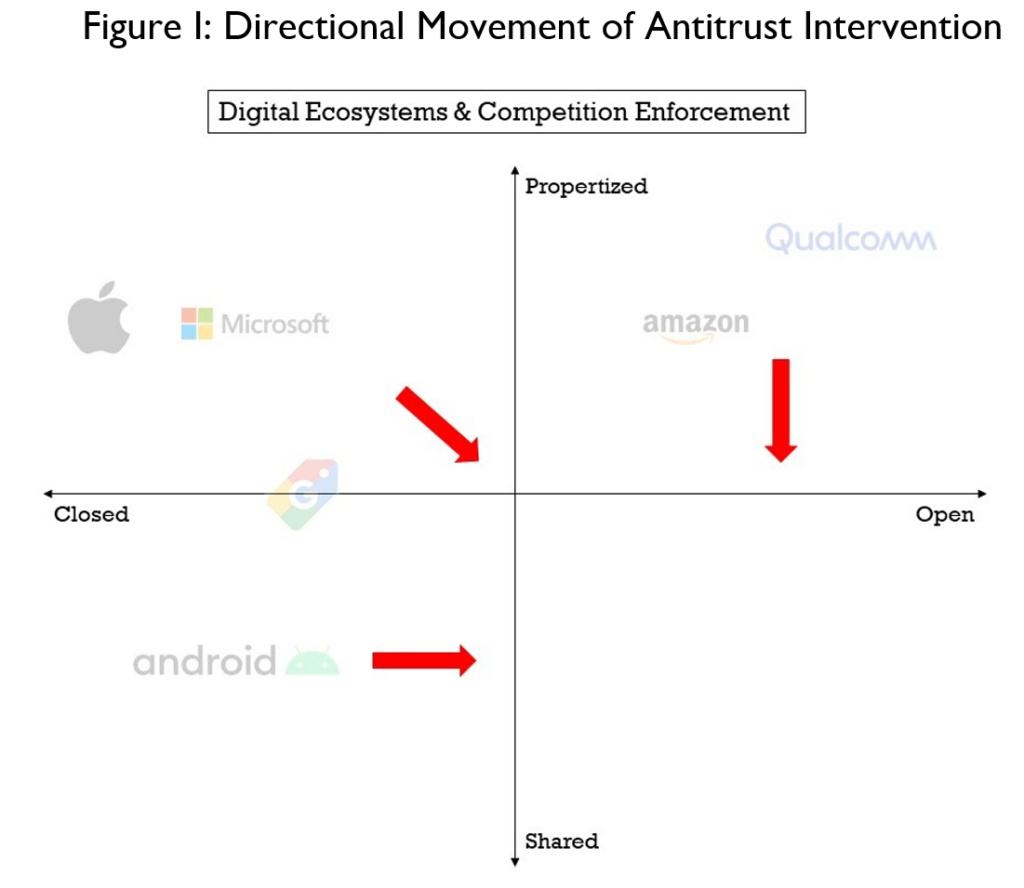
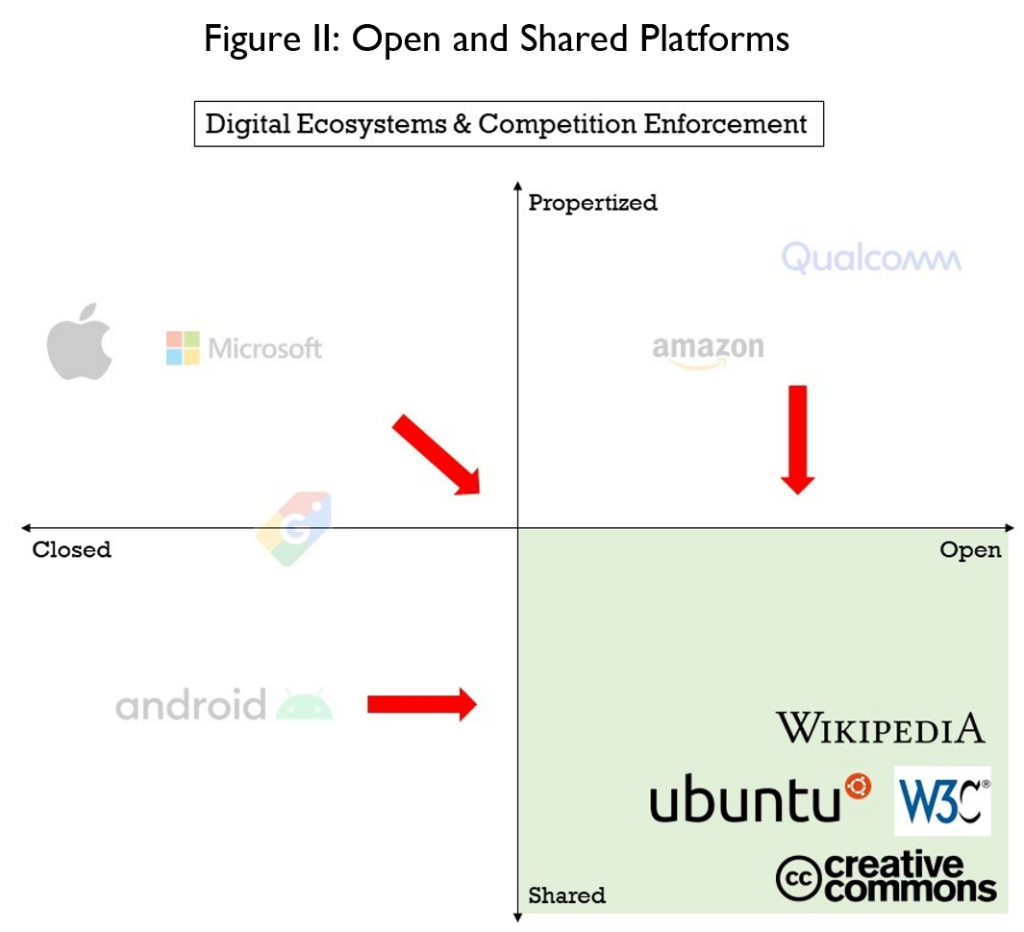
Similar arguments can be made about the other prohibitions and obligations that form part of the standard DCR package. Sideloading mandates allow third parties to free ride on gatekeepers’ investments in developing popular and functioning operating systems.[178] Insofar as they worsen gatekeepers’ ability to curate content and monitor safety and privacy risks, they also deprecate platforms’ overall quality and integrity, thereby potentially harming even the very companies they seek to aid.[179] Sideloading and interoperability mandates also essentially turn closed platforms into open ones (or, at the very least, they bring the two much closer together), thus forcing closed platforms to forfeit their competitive benefits relative to the primary alternatives.[180]
Antitrust law is unequivocal in its preference for inter-brand over intra-brand competition.[181] But under digital competition regulation, this principle gives way to a de-facto harmonization toward the model preferred by regulators—i.e., the one that makes every successful platform as open and accessible to competitors as possible, regardless of tradeoffs.
For example, self-preferencing prohibitions destroy one of the primary incentives for (and benefits of) vertical integration, which is the ability to prioritize a company’s own upstream or downstream products.[182] Such prohibitions also allow third parties that without the foresight to invest in a platform to accrue the same benefits as those that have. They also limit a platform’s ability to offer goods whose quality and delivery it can more readily guarantee,[183] another bane for competitiveness recast as a desirable symptom of “fairness and contestability.”
Some DCRs are considerably more candid than others about their intent to hamstring gatekeepers. The Turkish E-Commerce Law includes some provisions that differ from the DMA, despite being evidently inspired by it.[184] Among those provisions are regulations that would not only prevent electronic-commerce intermediary-service providers (“ECISPs”) from gaining significant market power, but also require that those already in a dominant position must lose this power.[185] Moreover:
Another example of atypical regulations envisaged in the E-Commerce Law is the limitations imposed on the advertising and discount budgets of large-scale ECISPs. Under Additional Article 2/3(a), the annual advertising budget of large-scale ECISPs is limited to the sum of 2% of the amount of 45 Billion Turkish Liras of the net transaction volume of the previous calendar year applied to the twelve-month average Consumer Price Index change rate for the same calendar year and 0.03% of the amount above 45 Billion Turkish Liras. This limit constitutes the total advertising budget for all ECISPs within the same economic unit and for all ECSPs operating in the e-commerce marketplace within the same economic unity.[186]
According to Kadir Bas and Kerem Cen Sanli:
The amended E-Commerce Law goes beyond prohibiting gatekeepers’ behavior that restricts fair and effective competition, and introduces provisions that prevent undertakings in the e-commerce sector from gaining market power through organic internal growth without distorting competition or committing any unfair practices. In this context, the E-Commerce Law gradually imposes obligations and restrictions on undertakings based on their transaction volumes, which are not directly related to market power, and some restrictions significantly limiting the ability to compete are imposed on all undertakings in the sector. When those features of the E-Commerce Law are evaluated together, it can be said that the legislator aims to structurally design the competition conditions and business models in the Turkish e-commerce sector.[187]
Bas and Sanli argue that this distinguishes the E-Commerce Directive from the DMA. While it technically true that the DMA does not impose measures that would, e.g., directly limit a firm’s advertising expenditure or tax additional transactions beyond a certain threshold, it does nevertheless “level down” gatekeepers’ ability to compete and grow organically in other ways. On this view, the Turkish E-Commerce Directive takes the DMA’s logic to its natural conclusion and, much like the SACC’s proposal, simply says the quiet part out loud.
Similarly, the UK’s DMCC is designed to foreclose activities that would otherwise bolster gatekeepers’ “strategic significance.”[188] A company with strategic significance is defined as one that fulfills one or several of the following conditions: has achieved significant size or scale; is used by a significant number of other undertakings in carrying out their business; has a position that allows it to determine or substantially influence the ways in which other undertakings conduct themselves; or is in a position to extend its market power to different activities. At least three of these conditions (the first three) can easily result from organic growth or procompetitive behavior. There are many investments and innovations that would, if permitted, benefit consumers—either immediately or over the longer term—but which may enhance a platform’s “strategic significance,” as defined by the DMCC.[189] Indeed, improving a firm’s products and thereby increasing its sales will often naturally lead to increased size or scale.
The inverse is also true: product improvements, innovation, and efficiencies can result from size or scale.[190] This is especially relevant in the context of digital platforms, where a product’s attractiveness often comes precisely from its size and scope. In two-sided markets like digital platforms, product quality often derives from the direct and indirect network effects that result from adding an additional user to the network. In other words, the more consumers use a product or service, the more valuable that product or service becomes to consumers on both sides of the platform.[191] Capping scale and size thus curtails one of the primary (if not the main) spurs of digital platforms’ growth and competitiveness.
Which, of course, arguably was the intent behind DCRs all along. In this context, some DCRs contain provisions that allow enforcers to impose a moratorium on mergers and acquisitions involving a gatekeeper, even where such concentrations would not ordinarily fall within the scope of merger-control rules.[192]
This degree of animosity may seem puzzling.[193] but one’s priors matter quite a bit here. If one accepts, tout court, the dystopian narrative that casts digital platforms as uniquely powerful, unfair, and abusive (see Section IIA),[194] this punitive approach[195] is understandable and, in a sense, even required.
D. Consumers as an Afterthought
DCRs affect wealth transfers from gatekeepers to other firms (see Section IIIA). But DCRs also affect—or, at least, tacitly accept—wealth transfers from consumers to other firms. First, DCRs generally do not require a finding of consumer harm to intercede. Second, DCRs provide limited scope for efficiency defenses. Generally, only defenses rooted in objective privacy and security concerns are allowed,[196] and even these are subject to a high evidentiary burden.[197]
On the other hand, justifications related to product quality, curation, or that otherwise seek to preserve the consumers’ experience are not typically permitted. For example, the quality-of-life improvements that may come from better curation and selection of apps in a closed platform (e.g., one that does not allow for the sideloading of apps or third-party app stores) are not relevant under the DMA, nor is any other dimension of consumer welfare, including price, quality, aesthetics, or curation. The Turkish DCR goes even further than the DMA, in that does not appear to allow for any exemptions (even on the basis of safety and privacy).[198] The SACC’s proposal likewise does not appear to provide scope for affirmative defenses.
In Australia, the DPI states that exemptions should be put in place to mitigate “unintended consequences.” This could, in principle, include consumer-welfare considerations, but the DPI’s explicit reference to the DMA[199] and various public statements by the ACCC suggest that this is unlikely to be the case. The ACCC said in its Fifth Interim Report that “[t]he drafting of obligations should consider any justifiable reasons for the conduct (such as necessary and proportionate privacy or security justifications).”[200]
The narrow and strict exceptions to the above DCRs confirm the downgraded status of consumer welfare in digital competition regulation (vis-à-vis competition law). German Article 19a, for example, allows for exemptions where there is an “objective justification.”[201] But unlike in every other instance under the German Competition Act, Article 19a reverses the burden of proof and requires the gatekeeper, not the Bundeskartellamt, to prove that the prohibited conduct is objectively justified.
In a similar vein, the AICOA bill in the United States would only require that the plaintiff show “material harm to competition” in provisions related to self-preferencing and service discrimination provisions.[202] The remaining provisions do not contain affirmative-effects requirements, but would not apply if the defendant shows a lack of “material harm to competition.” In other words, the burden of proof is shifted from the plaintiff to the defendant — who must prove a negative.[203]
The UK’s DMCC allows for a “countervailing benefits exception,”[204] which would apply when behavior that breaches a conduct requirement is found to provide sufficient other benefits to consumers without making effective competition impossible, and is “indispensable and proportionate” (s. 29(2)(c)) to the achievement of the benefit.[205] Again, this sets a high bar to clear.[206] For example, a limitation on interoperability might provide a benefit to user security and safety. But the exemption would apply only if the CMA were persuaded that this limitation was the only way to achieve such protection, which could be very hard or impossible to demonstrate.
The marginality of consumer welfare as a relevant policy factor is compounded in the UK by the fact that CMA decisions would only be subject to judicial review. Firms will thus be unable to challenge the authority’s factual assessments on questions such as indispensability and proportionality.[207] Even the chance that such a thing could be shown will be of little value to affected firms since the exemption can apply only once an investigation into a breach of a conduct requirement is underway.[208]
Finally, the Brazilian proposal states that costs, benefits, and proportionality should be observed when establishing an obligation under Art.10, [209] although there is no telling what this would mean in practice, or whether it encompasses consumer welfare (Arts. 10 and 11 of PL 2768 do not mention consumer welfare).[210]
The broader question, however, is whether a pro-consumer approach is even compatible with the overarching goals of digital competition regulation. A corollary of facilitating competitors and levelling down gatekeepers is that successful companies and their products are made worse—often at consumers’ expense. For instance, choice screens may facilitate competitors, but at the expense of the user experience, in terms of the time taken to make such choices. Not integrating products might give a leg up to competing services, but consumers might resent the diminished functionality.[211] Interoperability may similarly reduce the benefits an incumbent enjoys from network effects, but users may prefer the improved safety, privacy, and curation that typically comes with closed or semi-closed “walled-garden” ecosystems, like Apple’s iOS.[212]
In sum, proponents of DCRs appear to see losses in consumer welfare as a valid and potentially even desirable tradeoff for competitors’ increased ability to contest the incumbents’ position, as well as for wealth transfers across the supply chain that are seen as inherently just, equitable, and fair.
E. Partial Conclusion: The Perils of Redistributive and Protectionist Competition Regulation
While competition enforcement can affect the allocation of rents among firms, this is generally not the goal of competition policy. The only rent redistribution that is, in principle, relevant in competition law is the one between companies that misuse their market power and consumers (or, in some cases, trading parties). But the overarching goal is to prevent distortions of competition that result in deadweight loss and transfer consumer surplus to the monopolist, not to allocate resources among a set of hand-picked “big” firms and their smaller rivals in way that legislators or regulators consider “fair.” It is the market, not the government, that determines what is “fair.” Competition laws exist to preserve, not to rewrite, that outcome.
Indeed, even some advocates of incorporating political goals into antitrust law, such as Robert Pitofsky, have opposed using the law to protect small businesses and redistribute income to achieve social goals.[213] This is for good reason. Rent redistribution among firms entails significant risks of judicial error and rent seeking. Regulators may require firms to supply their services at inefficiently low prices that are not mutually advantageous, which may in turn diminish those firms’ incentives to invest and innovate.
DCR backers may retort that rent redistribution is the goal of most natural-monopoly regulations (such as those in the telecommunications and energy-distribution industries), which generally rely on both price regulation and access regimes to favor downstream firms and (ultimately) consumers.[214] But digital markets tend to be very different to those traditionally subject to price regulation and access regimes. And even in those industries, price regulation and access regimes raise many difficulties—such as identifying appropriate price/cost ratios and fleshing out the nonprice aspects of the goods/services or regulated firms.
Those difficulties are compounded in the fast-moving digital space, where innovation cycles are faster and yesterday’s prices and other nonprice factors may no longer be relevant today.[215] In short, rent redistribution is difficult to do well in traditional natural-monopoly settings, and may be impossible to do without judicial error in the digital world.
Assuming that such redistribution was to take place, what would a fair redistribution entail? “Fairness” is subjective and, as such, in the eye of the beholder.[216] Moreover, reasonable people may and often do disagree on what is and is not fair. What is “unfair” for the app distributor who pays a commission to use in-app payments may seem “fair” to the owner of the operating system and the app store that makes significant investments to maintain them.[217] Because fairness is such an inherently elusive concept,[218] DCRs ultimately define “fair” and “unfair” by induction—i.e., from the bottom up, in a “you know it when you see it” approach that is difficult to square with any cogent normative theory or limiting principle.[219]
For example, in response to claims that Apple must allow competing in-app purchases (“IAPs”) on its App Store in order to make its 30% IAP fee more competitive (cheaper), Apple could allow independent payment processors to compete, charge an all-in fee of 30% when Apple’s IAP is chosen and, in order to recoup the costs of developing and running its App Store, charge app developers a reduced, mandatory per-transaction fee (on top of developers’ “competitive” payment to a third-party IAP provider) when Apple’s IAP is not used. Indeed, where such a remedy has already been imposed, that is exactly what Apple has done. In the Netherlands, where Apple is required by the Authority for Consumers and Markets (“ACM”) to uncouple distribution and payments for dating apps, Apple adopted the following policy:
Developers of dating apps who want to continue using Apple’s in-app purchase system may do so and no further action is needed…. Consistent with the ACM’s order, dating apps that . . . use a third-party in-app payment provider will pay Apple a commission on transactions. Apple will charge a 27% commission on the price paid by the user, net of value-added taxes. This is a reduced rate that excludes value related to payment processing and related activities.[220]
The company responded similarly to the DMA.[221] It is not hard to see the fundamental problem with this approach. If a 27% commission plus competitive payment-provider fee permits more “competition,” or is fairer, than complete exclusion of third-party providers, then surely a 26% fee would permit even more competition, or be even fairer. And a 25% fee fairer still. Such a hypothetical exercise logically ends only where a self-interested competitor or customer wants it to end, and is virtually impossible to measure.[222]
Even if it were possible, it would entail precisely the kind of price management that antitrust law has long rejected as being at loggerheads with a free market.[223] Without a measurable market failure, what is the frontier of fairness? When does a complaint stop being a competition or gatekeeper issue and become a private dispute about wanting to pay less—or nothing—for a service?[224]
Another obvious problem with facilitating competitors and levelling down gatekeepers is that it discourages investment, innovation, and competition on the merits. Having been encouraged to bring new, innovative products to market and compete for consumers’ business, successful companies—now branded with the “gatekeeper” epithet—are subject to punitive regulation.[225] The benefits that they have legitimately and arduously acquired are dissipated across the supply chain and their competitors, who lacked the foresight and business acumen to make the same or similar investments, are rewarded for their sluggishness.[226] This stifles the mechanisms that propel competition. As Justice Learned Hand observed almost 80 years ago, “the successful competitor, having been urged to compete, must not be turned upon when he wins.”[227] There is no reason why digital competition regulation should be impervious to that logic.
The abrupt shift from competition law to digital competition regulation also sends investors the wrong message by creating commitment issues.
Commitment issues arise where a government commits itself in one period to behaving in certain ways in the future but, when it comes to a future point in time, reneges on the earlier commitment to reflect its preferences at that later point in time.[228]
For example, today’s gatekeepers have made significant investments in data processing, vertical integration, scaling, and building ecosystems. Many of these investments are sunk, meaning that they can no longer be recouped or can be recouped only partially. With the various DCRs’ entry into force, however, gatekeepers can no longer fully utilize those investments. For instance, they cannot self-preference and thereby reap the full benefits of vertical integration;[229] they cannot use third-party data generated on the platforms they have built and in which they have invested; and they must now allow third-parties and competitors to free ride on those investments in a plethora of ways, ranging from allowing sideloading to mandated data sharing (see Section IIIB).
In dynamic contexts, time-inconsistency can obviously affect firms’ actions and decisions, leading to diminished investments.[230] From a less consequentialist and more deontological perspective, however, it is also questionable how “fair” (to use the mot du jour of digital competition regulation) it is to expropriate a company’s sunk-cost investments by abruptly shifting the regulatory goalposts under a new paradigm of competition regulation that essentially subverts the logic of the previous one, and penalizes what was until recently seen as permissible and even desirable conduct (see Section II).
IV. Conclusion: Beyond Digital Competition Regulation
Aldous Huxley once wrote that several excuses are always less convincing than one.[231] His point was that multiple justifications may often conceal the fact that none of them are entirely convincing in their own right. This maxim aptly captures the doubts that persist surrounding DCRs.
On the surface, DCRs pursue a variety of sometimes overlapping, sometimes contradictory, and sometimes disparate goals and objectives (Section I). Some of these goals and objectives hearken back to familiar antitrust themes, but it would be a mistake to treat DCRs as either an appendix to or extension of competition law (Section II). Unlike mainstream competition laws, DCRs address a moral, rather than an economic failure. DCRs emphasize notions of power that are foreign to competition law, essentially promulgating a new form of competition regulation that subverts the logic, rationale, and goals of the existing paradigm.
This approach to regulating competition may be new, but it is not original. To the contrary, the use of antitrust law to castigate concerns seen as “too big and powerful,” promote visions of social justice, and facilitate laggard competitors (even if it comes at the expense of competition, total, or consumer welfare) have been around since the inception of the Sherman Act.[232] In this sense, those who say that digital competition regulation is not competition law, and should therefore not be judged by competition-law standards, [233] are correct on the form but wrong on the substance.[234] They miss the bigger and more important point, which is that—regardless of its legal classification—digital competition regulation is competition regulation, just not the kind we have known for (at least) the last half a century.
The rationale that underpins digital competition regulation can be explained as follows. (Section III). Competition is no longer about consumer-facing efficiency, but about fairness, equality, and inclusivity. In practice, this means improving the lot of some, while “levelling down” others—regardless of the respective merits or demerits of each group (or their products). In this world, “contestability” is not so much the ability to displace an incumbent through competition on the merits, but very much the reverse. It is about lowering the competitive bar to increase the number of companies on the market—full stop. Whether or not this benefits consumers is largely immaterial, as the normative lodestars of digital competition regulation—fairness and contestability—are seen as having inherent and deontological value and thus removed from any utilitarian calculi of countervailing efficiencies (except, arguably, increases in competitors’ market shares).
Ultimately, however, this “new” approach to competition will have to reckon with the same problems and contradictions as the erstwhile antitrust paradigms from which it draws inspiration. The minefield of redistributive policies is likely to hamstring investment and innovation by targeted digital platforms significantly, while simultaneously encouraging rent-seeking behavior by self-interested third parties. Enabling competitors and purposefully harming incumbents also sends the message that equitable outcomes are preferred to excellence, which could encourage even more free riding and rent seeking and further stifle procompetitive conduct.
Finally, the irony is likely not lost on even the most casual observer that, for regulations so obsessed with “fairness,” it is fundamentally unfair for DCRs to syphon rents away from some companies and into others by fiat; and to force those companies to share their hard-earned competitive advantages with others who have not had the foresight or business acumen to make the same investments in a timely fashion.
It is difficult to overstate how big of a departure from competition law this approach to competition regulation is. But digital competition regulation is potentially more than just a digression from established principles in a relatively niche, technical field like competition law. Under the most expansive version of this interpretation, digital competition regulation heralds a new conception of the role and place of companies, markets, and the state in society.
In this “post-neoliberal” world,[235] the role of the state would not be to address market failures that harm consumers through discrete interventions guided by general, abstract, and reactive rules (such as competition law). Instead, it would be to intercede aggressively to redraw markets, redesign products, pick winners, and redistribute rents; indeed, to act as the ultimate ordering power of the economy.[236] It is not difficult to see how “old” competition-law principles, such as the consumer-welfare standard, effects-based analysis, and the procedural safeguards designed to cabin enforcers’ discretion could disrupt this system.
But for now, this remains just a hypothesis, and some would say—perhaps rightly so—an alarmist one. Yet there are unmistakable signs—as unmistakable as social science will allow—that a new paradigm of political philosophy is in the making: from the rehabilitation of once-maligned industrial policy to the rise of neo-Brandeisianism to recurrent proclamations of the “death of neoliberalism”[237] and its “idols,” including the consumer-welfare standard in antitrust law.[238]
Only time will tell if the digital competition regulation is truly sign of things to come, or merely a small but ultimately insignificant and abrupt dirigiste turn in the zig-zagging of antitrust history.[239] And only time will tell whether the approach to competition regulation promulgated by digital competition regulation will stay confined to the activities of a few large concerns and a handful of core platform services, or whether its logic will, in the end, seep into other spheres of policy and social life.
[1] Regulation (EU) 2022/1925 of the European Parliament and of the Council of 14 September 2022 on Contestable and Fair Markets in the Digital Sector and amending Directives (EU) 2019/1937 and (EU) 2020/1828, 2022 O.J. (L 265) 1 (hereinafter “Digital Markets Act” or “DMA”).
[2] “Digital competition regulation” or “DCR” will be used throughout to refer both to rules already in place and to rules currently under consideration. Context on legislative status will be given where available and appropriate.
[3] The terms “competition law” and “antitrust law” will be used interchangeably.
[4] See, e.g., Proposal for a Regulation of the European Parliament and of the Council Laying Down Harmonised Rules on Artificial Intelligence (Artificial Intelligence Act) and Amending Certain Union Legislative Acts, COM (2021) 206 final (Apr. 21, 2021).
[5] Regulation (EU) 2022/2065 of the European Parliament and of the Council of 19 October 2022 on a Single Market for Digital Services and Amending Directive 2000/31/EC, 2022, O.J. (L 277) 1 (hereinafter “Digital Services Act” or “DSA”).
[6] Regulation (EU) 2016/679 of the European Parliament and of the Council of 27 April 2016 on the Protection of Natural Persons with Regard to the Processing of Personal Data and on the Free Movement of Such Data, and Repealing Directive 95/46/EC, 2016 O.J. (L 119) 1 (hereinafter “General Data Protection Regulation” or “GDPR”).
[7] See, e.g., DMA, supra note 1.
[8] Press Release, Amendment of the German Act Against Restraints of Competition, Bundeskartellamt (Jan. 19, 2021), https://www.bundeskartellamt.de/SharedDocs/Meldung/EN/Pressemitteilungen/2021/19_01_2021_GWB%20Novelle.html.
[9] Id.
[10] The Act on the Protection of Competition No. 4054, Official Gazette (Dec. 13, 1994) (Turk.).
[11] See, E-Pazaryeri Platformari Sektor Incelemesi Nihai Raporu, Turkish Competition Authority (2022), available at https://www.tpf.com.tr/dosyalar/2022/06/e-pazaryeri-si-raporu-pdf.pdf (Turkish language only).
[12] Arguably, however, there is an increased emphasis on “business rights.”
[13] See, KFTC Proposes Ex-Ante Regulation of Platforms Under the “Platform Competition Promotion Act,” Legal 500 (Jan. 4, 2024), https://www.legal500.com/developments/thought-leadership/kftc-proposes-ex-ante-regulation-of-platforms-under-the-platform-competition-promotion-act.
[14] Park So-Jeong & Lee Jung-Soo, S. Korea Speeds Up to Regulate Platform Giants Such as Google or Apple, The Chosun Daily (Feb. 4, 2024), https://www.chosun.com/english/national-en/2024/02/04/MCCJQZTJ3ZC5JJ7NVDM46D6R2I.
[15] Id.
[16] Monopoly Regulation and Fair Trade Act, Act. No, 3320, Dec. 31, 1980, amended by Act No. 18661, Dec. 28, 2021 (S. Kor.).
[17] Digital Markets Competition and Consumer Bill, 2023-24, H.L. Bill (53) (U.K.) (hereinafter “DMCC”).
[18] See, e.g., id. at Part 1, S. 2, which defines companies with “strategic market status” as those with “substantial and entrenched market power.” By contrast, Recital 5 of the DMA states: “Although Articles 101 and 102 of the Treaty on the Functioning of the European Union (TFEU) apply to the conduct of gatekeepers, the scope of those provisions is limited to certain instances of market power, for example dominance on specific markets and of anti-competitive behaviour, and enforcement occurs ex post and requires an extensive investigation of often very complex facts on a case by case basis. Moreover, existing Union law does not address, or does not address effectively, the challenges to the effective functioning of the internal market posed by the conduct of gatekeepers that are not necessarily dominant in competition-law terms.”
[19] DMCC, supra note 18, at Part 1, Chapter 4.
[20] Press Release, New Bill to Stamp Out Unfair Practices and Promote Competition in Digital Markets, UK Competition and Markets Authority (Apr. 25, 2023), https://www.gov.uk/government/news/new-bill-to-stamp-out-unfair-practices-and-promote-competition-in-digital-markets.
[21] DMCC, supra note 18, at Part 4.
[22] Competition Act 1998 c.41 (U.K.).
[23] See Press Release, supra note 21.
[24] Id.
[25] Id. (emphasis added).
[26] The DMCC defines “digital activities” as those involving the purchase or sale of goods over the internet, or the provision of digital content. DMCC, Part 1, S.3.
[27] The provisions on digital markets are covered in Part 1 of the DMCC. DMCC, Part 2 covers competition.
[28] Digital Platform Services Inquiry 2020-25, Australian Competition and Consumer Commission, https://www.accc.gov.au/inquiries-and-consultations/digital-platform-services-inquiry-2020-25 (last accessed May 13, 2024).
[29] Digital Platform Services Inquiry, Interim Report 5, Australian Competition and Consumer Commission (2022), at 5 (“The ACCC recommends a new regulatory regime to promote competition in digital platform services. The regime would introduce new competition measures for digital platforms.”). The term “digital regime” has also been used to describe the authority granted to the UK’s newly created Digital Markets Unit. See Moritz Godel, Mayumi Louguet, Paula Ramada, & Rhys Williams, Monitoring and Evaluating the Digital Markets Unit (DMU) and New Pro-Competition Regime for Digital Markets, London Economics (Jan. 2023), available at https://assets.publishing.service.gov.uk/media/64538076c33b460012f5e65d/monitoring_and_evaluating_the_new_pro-competition_regime_for_digital_markets.pdf.
[30] Digital Platform Services Inquiry, Interim Report 5, id. at 5.
[31] American Innovation and Choice Online Act, S. 2992, 117th Cong. (2022), (hereinafter “AICOA”).
[32] Open App Market Act, S. 2710, 117th Cong. (2022), (hereinafter “OAMA”).
[33] ACCESS Act of 2021, H.R. 3849, 117th Cong. (2021).
[34] AICOA, § 3.
[35] OAMA.
[36] Id.
[37] Press Release, Klobuchar, Grassley, Colleagues to Introduce Bipartisan Legislation to Rein in Big Tech, U.S. Sen. Amy Klobuchar (Oct. 14, 2021), https://www.klobuchar.senate.gov/public/index.cfm/2021/10/klobuchar-grassley-colleagues-to-introduce-bipartisan-legislation-to-rein-in-big-tech. The bill’s title is somewhat ambiguous, as it reads: “to provide that certain discriminatory conduct by covered platforms shall be unlawful, and for other purposes.” See AICOA, supra note 36.
[38] See id.
[39] Comments of the American Bar Association Antitrust Law Section Regarding the American Innovation and Choice Online Act (S. 2992), American Bar Association Antitrust Law Section (Apr. 27, 2022) at 5, available at https://appliedantitrust.com/00_basic_materials/pending_legislation/Senate_2021/S2992_aba_comments2022_04_27.pdf (hereinafter “ABA Letter”).
[40] Press Release, Klobuchar Statement on Judiciary Passage of Legislation to Set App Store Rules of the Road, U.S. Senator Amy Klobuchar (Feb. 3, 2022), https://www.klobuchar.senate.gov/public/index.cfm/2022/2/klobuchar-statement-on-judiciary-committee-passage-of-legislation-to-set-app-store-rules-of-the-road.
[41] This is stated in the title of the bill. The ACCESS Act also claims to “encourage entry by reducing or eliminating the network effects that limit competition with the covered platform.” See ACCESS ACT at § 6(c).
[42] Press Release, Lawmakers Reintroduce Bipartisan Legislation to Encourage Competition in Social Media, U.S. Sen. Mark R. Warner (May 25, 2022), https://www.warner.senate.gov/public/index.cfm/2022/5/lawmakers-reintroduce-bipartisan-legislation-to-encourage-competition-in-social-media; see also, The ACCESS Act of 2022, U.S. Senator Mark R. Warner, available at https://www.warner.senate.gov/public/_cache/files/9/f/9f5af2f7-de62-4c05-b1dd-82d5618fb843/BA9F3B16A519F296CAEDE9B7EFAB0B7A.access-act-one-pager.pdf.
[43] Online Intermediation Platforms Market Inquiry, Summary of Final Report and Remedial Actions, South African Competition Commission (2023), 13, available at https://www.compcom.co.za/wp-content/uploads/2023/07/CC_OIPMI-Summary-of-Findings-and-Remedial-action.pdf.
[44] Projeto de Lei PL 2768/2022, https://www.camara.leg.br/proposicoesWeb/fichadetramitacao?idProposicao=2337417 (Braz.) (Portuguese language only).
[45] Id. at Art. 4.
[46] Id. at Art. 5.
[47] DMA, supra note 2 at recitals 2, 31. On the two objectives being intertwined, see Recital 34.
[48] Id., at Recital 10.
[49] Id.
[50] Anti-Competitive Practices by Big Tech Companies, Fifty Third Report, Standing Committee on Finance, 17th Lok Sahba (India), (2022-23), available at https://eparlib.nic.in/bitstream/123456789/1464505/1/17_Finance_53.pdf, at 29.
[51] Report of the Committee on Digital Competition Law (India), Annexure IV: Draft Digital Competition Bill (2024), https://www.mca.gov.in/bin/dms/getdocument?mds=gzGtvSkE3zIVhAuBe2pbow%253D%253D&type=open.
[52] The Competition Act, No. 12 of 2003, INDIA CODE (1993).
[53] CDC Report, at 4, 42.
[54] ICA, preamble. The ICA does not mention “contestability.”
[55] Report of the High-Powered Expert Committee on Competition Law and Policy (India) (1999), available at https://theindiancompetitionlaw.wordpress.com/wp-content/uploads/2013/02/report_of_high_level_committee_on_competition_policy_law_svs_raghavan_committee.pdf.
[56] Raghavan Committee Report, at 1.1.9. “The ultimate raison d’être of competition is the interest of the consumer”; see also at 1.2.0.
[57] Raghavan Committee Report, at 2.4.1.
[58] Raghavan Committee Report, at 3.2.8. “If multiple objectives are allowed to rein in the Competition Policy, conflicts and inconsistent results may surface detriment to the consumers… In addition, such concerns as community breakdown, fairness, equity and pluralism cannot be quantified easily or even defined acceptably… it needs to be underscored that attempts to incorporate such concerns may result in inconsistent application and interpretation of Competition Policy, besides dilution of competition principles. The peril is that the competitive process may be undermined, if too many objectives are built into the Competition Policy and too many exemptions/exceptions are laid down in dilution of competition principles.”
[59] See, e.g., Pelle Beems, The DMA in the Broader Regulatory Landscape of the EU: An Institutional Perspective, 19 Eur. Comp. J. 1, 27 (2023); Pierre Larouche & Alexandre De Streel, The European Digital Market: A Revolution Grounded on Traditions, 12 J. Eur. Comp. L. & Practice 542, 542 (2021) (arguing that the DMA’s conceptual nature is in a “difficult epistemological position”).
[60] See Nicolas Petit, The Proposed Digital Markets Act (DMA): A Legal and Policy Review, 12 J. Eur. Competition L. & Practice 529, 530 (2021) (“The DMA is essentially sector-specific competition law.”). The DMA’s competition-law DNA is also explicitly reflected in Section 1.4.1 of the Legislative Financial Statement, which is annexed to the DMA proposal. See id. (“The general objective of this initiative is to ensure the proper functioning of the internal market by promoting effective competition in digital markets.”). See also Beems, supra note 62, at 27 (“In my view, it could be desirable to qualify the DMA as a specific branch of competition law that applies to gatekeepers.”).
[61] See Giuseppe Colangelo, The European Digital Markets Act and Antitrust Enforcement: A Liaison Dangereuse, 5 Eur. L. Rev., 597, 610 (2022) (“In service of this goal of speedier enforcement, the DMA dispenses with economic analysis and the efficiency-oriented consumer welfare test, substituting lower legal standards and evidentiary burdens.”). See also Pablo Iba?n?ez Colomo, The Draft Digital Markets Act: A Legal and Institutional Analysis, 12 J. Eur. Competition L. & Practice 561, 566 (2021).
[62] It should be underscored that “power” here means something much broader and general than the narrow concept of “market power” under competition law. Unlike “market power,” assertions that so-called “Big Tech” wield “power” are not intended to invoke a state-of-the art term, but rather are general references to companies’ size, resources, and capacity. Neo-Brandeisians like Lina Khan and Tim Wu often refer to the “power” of Big Tech in such terms. See generally Tim Wu, The Curse of Bigness: Antitrust in the Gilded Age (2018). For Wu, like Khan, the harmful “power” of Big Tech refers not just to concentrated economic power or market power, but to a range of other mechanisms by which these firms allegedly hold sway over democracy, elections, and society at-large. See also Zephyr Teachout & Lina Khan, Market Structure and Political Law: A Taxonomy of Power, 9 Duke J. Const. L. & Pub. Pol’y 37,74 (2014).
[63] See, e.g., Joshua Q. Nelson, Joe Concha: “Big Tech is More Powerful than Government” in Terms of Speech, Fox News (Jan. 27 2021), https://www.foxnews.com/media/joe-concha-big-tech-more-powerful-government-speech; How 5 Tech Giants Have Become More like Governments than Companies, Fresh Air (Oct. 26, 2017), https://www.npr.org/2017/10/26/560136311/how-5-tech-giants-have-become-more-like-governments-than-companies (“New York Times tech columnist Farhad Manjoo warns that the ‘frightful five’—Amazon, Google, Apple, Microsoft and Facebook—are collectively more powerful than many governments.”).
[64] See, e.g., Press Release, Klobuchar, Grassley Statements on Judiciary Committee Passage of First Major Technology Bill on Competition to Advance to Senate Floor Since the Dawn of the Internet, U.S. Sen. Amy Klobuchar (Jan. 20, 2022), https://www.klobuchar.senate.gov/public/index.cfm/2022/1/klobuchar-grassley-statements-on-judiciary-committee-passage-of-first-major-technology-bill-on-competition-to-advance-to-senate-floor-since-the-dawn-of-the-internet (“Everyone acknowledges the problems posed by dominant online platforms.”).
[65] See, e.g., DMA recitals 3, 4, 33, and 62.
[66] See, e.g., The Social Dilemma (Exposure Labs, Argent Pictures & The Space Program, 2020); Tech Monopolies: Last Week Tonight with John Oliver (HBO, 2022); Yanis Varoufakis, Technofeudalism: What Killed Capitalism (2023); Shoshana Zuboff, The Age of Surveillance Capitalism: The Fight for a Human Future at the New Frontier of Power (2019).
[67] See Luca Bertuzzi, EU Commission Launches Connectivity Package with ‘Fair Share‘ Consultation, EurActiv (Feb. 28, 2023), https://www.euractiv.com/section/digital/news/eu-commission-launches-connectivity-package-with-fair-share-consultation; see also Daniele Condorelli, Jorge Padilla, & Zita Vasas, Another Look at the Debate on the “Fair Share” Proposal: An Economic Viewpoint, Compass Lexecon (2023), available at https://www.telefonica.com/en/wp-content/uploads/sites/5/2023/05/Compass-Lexecon-Report-on-the-fair-share-debate.pdf. On the supposed bargaining-power imbalance between large traffic originators and telecommunications companies, see id. at point 1.34(d). “There is a risk that the current unregulated arrangements result in no payments from LTOs due to asymmetries of information between industry participants, free-riding among LTOs, and the large imbalance in bargaining power between LTOs and TELCOs.” See also id. at points 3.77, 3.78 and 3.79-3.84 for the argument that the power imbalances require intervention. For a different view of “fair share,” see Giuseppe Colangelo, Fair Share of Network Costs and Regulatory Myopia: Learning from Net Neutrality Mistakes, Int’l. Ctr. for Law & Econ. (Jul. 18, 2023) (forthcoming in Law, Innovation and Technology), available at https://ssrn.com/abstract=4452280.
[68] See Treasury Laws Amendment (News Media and Digital Platforms Mandatory Bargaining Code) Act 2021 (Austl.); for a defense of legislation forcing digital platforms to compensate media companies, see Zephyr Teachout, The Big Unfriendly Tech Giants, The Nation (Dec. 25, 2023), https://www.thenation.com/article/society/big-tech-nondiscrimination.
[69] News Media Bargaining Code, Australian Competition and Consumer Commission, https://www.accc.gov.au/focus-areas/digital-platforms/news-media-bargaining-code/news-media-bargaining-code (last accessed May 14, 2024).
[70] See, e.g., Journalism and Competition Preservation Act of 2023, S. 1094, 118th Cong. (2023); Online News Act (S.C. 2023, c.23) (Can.).
[71] See, e.g., DMA at recitals 1, 15, 20, 62, and Art.1(b); DMCC at s.6(b); PL 2768 at Art. 2, which defines the regulation’s targets as companies with the “power to control essential access”; Competition Act in the version published on 26 June 2013 (Bundesgesetzblatt (Federal Law Gazette) I, 2013, p. 1750, 3245), as last amended by Article 1 of the Act of 25 October 2023 (Federal Law Gazette I, p. 294), Art.19(a) (1)5 (Ger.) (hereinafter “German Competition Act”).
[72] See, e.g., DMA at Recital 23, Art.3 and Art.3(8)(a); DMCC at s.6(a); German Competition Act, Art.19(a); but see DSA, Section 5, which imposes special obligations on “very large online platforms.”
[73] “From Price to Power”? Reorienting Antitrust for the New Political Economy, panel at Antitrust, Regulation and the Next World Order conference, Youtube.com (Feb. 2, 2024), https://www.youtube.com/watch?v=rWNIhGA8Rx8&ab_channel=Antitrust%2CRegulationandtheNextWorldOrder.
[74] DMA, at recital 4 (emphasis added).
[75] DMA, at recital 33.
[76] See Press Release, Digital Markets Act: Commission Welcomes Political Agreement on Rules to Ensure Fair and Open Digital Markets, European Commission (Mar. 25, 2022), https://ec.europa.eu/commission/presscorner/detail/en/ip_22_1978 (“What we want is simple: Fair markets also in digital. We are now taking a huge step forward to get there—that markets are fair, open and contestable…. This regulation, together with strong competition law enforcement, will bring fairer conditions to consumers and businesses for many digital services across the EU.”) (emphasis added); see also Press Release, Klobuchar, Grassley, Colleagues to Introduce Bipartisan Legislation to Rein in Big Tech, U.S. Sen. Amy Klobuchar (Oct. 14, 2021), https://www.klobuchar.senate.gov/public/index.cfm/2021/10/klobuchar-grassley-colleagues-to-introduce-bipartisan-legislation-to-rein-in-big-tech (joint statement by Sens. Amy Klobuchar and Chuck Grassley with references to “fair competition,” “fair prices,” “unfairly preferencing their own products,” “fairer prices,” “unfairly limiting consumer choices,” “fair rules for the road”).
[77] For example, the DMA mentions the term “fairness,” or some variation thereof, 90 times in 66 pages.
[78] DMA, at Recital 11 (emphasis added).
[79] See DMA, Arts. 5-7.
[80] See DMA, Art. 3.
[81] CDC Report, at 2.
[82] See, e.g., German Competition Act, at Section 19a(1), stating that, in determining the paramount significance for competition across an undertaking’s markets, there shall be particular account taken of its dominant position; financial strength or access to other resources; vertical integration; access to data relevant to competition; and the relevance of its activities for third-party access to supply and sales markets. See also DMCC, at S. 5 and S.6 (substantial and entrenched market power is a cumulative criterion, together with a position of strategic significance); DMA, at Recital 5 and Art. 3 (market power is irrelevant because the criteria for designation are (a) having a significant impact on the internal market; (b) providing a core platform service that is an important gateway for business users to reach end users; and (c) enjoying an entrenched and durable position). PL 2768 does not mention market power, and instead references control of essential access; the U.S. tech bills do not define covered platforms on the basis of market power either.
[83] The DMA explicitly rejects it. See Recital 23.
[84] Examples include online-intermediation services, online search engines, online social-networking services, and video-sharing platform services. See DMA, at Art. 2.
[85] See Elise Dorsey, Geoffrey A. Manne, Jan M. Rybnicek, Kristian Stout, and Joshua D. Wright, Consumer Welfare & the Rule of Law: The Case Against the New Populist Antitrust Movement, 47 Pepp. L. Rev. 861, 916 (2020).
[86] There are some exceptions to this. Some digital competition regulations seem to incorporate consumer-welfare considerations. One example is the KFTC’s recently proposed digital competition regulation, which is putatively aimed at protecting business users and consumers, and would allow for an efficiency defense. See Lee & Ko, supra note 21.
[87] See supra note 76.
[88] See infra Sections II.C and II.D.
[89] On the essential-facilities doctrine in the United States, see Philip K. Areeda, Essential Facilities: An Epithet in Need of Limiting Principles, 58 Antitrust L.J. 841 (1990); ever since the Supreme Court’s ruling in Trinko, no plaintiff has successfully litigated an essential-facilities claim to judgment. See, Verizon Communications, Inc. v. Law Offices of Curtis V. Trinko, LLP, 540 U.S. 398 (2003) (“As a general matter, the Sherman Act “does not restrict the long recognized right of [a] trader or manufacturer engaged in an entirely private business, freely to exercise his own independent discretion as to parties with whom he will deal.’”) (citations omitted).
[90] Communication from the Commission — Guidance on the Commission’s enforcement priorities in applying Article 82 of the EC Treaty to abusive exclusionary conduct by dominant undertakings (2009), at recital 13.
[91] Richard Whish & David Bailey, Competition Law (10th ed. 2021), at 142-3.
[92] See, e.g., Christopher M. Seelen, The Essential Facilities Doctrine: What does it Mean to be Essential? 80 Marq. L. Rev. 1117, 1123 (1997), discussing free-riding and the moral-hazard considerations implicit in defining essential facilities as essential to a competitor, rather than to competition. (“[A]pplication of the doctrine often focuses unduly on the effect of the denial of access on the plaintiff’s ability to compete-not on the infringement of competition which is the objective of the antitrust law.” (citations omitted), and at 1124 (“There exists a moral hazard when plaintiffs bring an essential facility claim against a single competitor. Indeed, firms might try to use the doctrine to take a ‘free ride’ on the efforts of a competitor.”). See also, Verband Deutscher Wetterdienstleister v. Google, Reference No. 408 HKO 36/13, Court of Hamburg (Apr. 4, 2013), 4, available at http://deutschland.taylorwessing.com/documents/get/150/court-order-googleweatherinbox-english-unofficial-translation.pdf (“[A]pplicant’s members have been participating and will continue to participate in Google Search as ‘free riders.’ They demand favorable positioning without offering compensation.”); Continental T.V., Inc. v. GTE Sylvania Inc., 433 U.S. 36 (1977) (applying the rule of reason to territorial restrictions because they might be imposed by a manufacturer who wishes to prevent dealers from free-riding on point-of-sale services provided by another dealer).
[93] See, e.g., Brown Shoe Co. v. United States, 370 U.S. 294, 344 (1962) (“It is competition, not competitors, which the Act protects.”). See also Donna E. Patterson and Carl Shapiro, Transatlantic Divergence in GE/Honeywell: Causes and Lessons, Antitrust 18 (2001); Maureen K. Ohlhausen & John M. Taladay, Are Competition Officials Abandoning Competition Principles?, 13 J. Comp. L. & Practice 463 (2022).
[94] See, e.g., Trinko at 408; Pac. Bell Tel. Co. v. Linkline Commc’ns, Inc., 555 U.S. 438, 448 (2009); Chavez v. Whirlpool Corp., 113 Cal. Rptr. 2d, 182-83 (Ct. App. 2001); Foremost Pro Color, Inc. v. Eastman Kodak Co., 703 F.2d 534, 545 (9th Cir. 1983) (“The antitrust laws [do] not impose a duty on [firms] . . . to assist [competitors] . . . to ‘survive or expand.’”) (citations omitted).
[95] Mario Monti, Speech at the Third Nordic Competition Policy Conference, Stockholm: Fighting Cartels Why and How? Why Should We be Concerned with Cartels and Collusive Behaviour? (Sept. 11, 2000); see also Trinko at 408 (characterizing cartels as “the supreme evil of antitrust”).
[96] Although there is a rebuttable presumption to the contrary, undertakings can argue that agreements containing hardcore restrictions should benefit from an individual exemption under Article 101(3) TFEU. See Judgment of 13 October 2011, Pierre Fabre, C?439/09, ECLI:EU:C:2011:649. Moreover, “hardcore restrictions,” like cartels, need to be restrictions of competition “by object,” within the meaning of Art. 101(1) TFEU. Undertakings can hence try to demonstrate that a given hardcore restriction, examined in its economic and legal context, is objectively justified and does not fall within the prohibition laid down in Article 101(1) TFEU. See Opinion of Advocate General Wahl delivered on 16 July 2017, Coty, C-230/16, ECLI:EU:C:2017:603.
[97] For an extensive set of views opposing those endorsed by proponents of digital competition regulations, see, e.g., The Global Antitrust Institute Report on the Digital Economy (Joshua D. Wright & Douglas H. Ginsburg, eds., Nov. 11, 2020), https://gaidigitalreport.com.
[98] See ABA letter, supra note 41.
[99] Law No. 12.529 of 30 November, 2011 (Braz.), available at https://www.icao.int/sustainability/Documents/Compendium_FairCompetition/LACAC/LAW_12529-2011_en.pdf.
[100] PL 2768, art. 4.
[101] See Section I.
[102] See Section I.
[103] See, e.g., Rambus v. Fed. Trade Comm’n, 522 F.3d 456, 459 (D.C. Cir. 2008) (“[D]eceit merely enabling a monopolist to charge higher prices than it otherwise could have charged—would not in itself constitute monopolization.”). See also Judgment of 4 August 2023, Meta Platforms v. Bundeskartellamt, Case C 252-21, ECLI:EU:C:2023:537.
[104] For example, where a small company increases prices or downgrades its product, this can generally be corrected through competition, as the company will lose market share and be forced out of the market unless it changes its behavior. But when the same outcome is achieved through restrictions of competition or the misuse of market power, the market may be unable to respond effectively, and intervention may become necessary.
[105] We question whether this was ever the true intent behind digital competition regulation, see Section IIII.C.
[106] See also Section IIB.
[107] See, e.g., Svend Albaek, Consumer Welfare in EU Competition Policy, in Aims and Values in Competition Law, 67, 75 (Caroline Heide-Jørgensen, Ulla Neergaard, Christian Bergqvist, & Sune T. Poulsen eds., 2013) (“In practice it turns out that we should understand ‘consumers’ as customers rather than ‘real’ or ‘final’ consumers. Paragraph 84 of the General Guidelines takes a first step towards clarifying this: ‘[C]onsumers within the meaning of Article 81(3) are the customers of the parties to the agreement and subsequent purchasers.”); see also Article 102 (c) TFEU, which prohibits dominant companies from “applying dissimilar conditions to equivalent transactions with other trading parties, thereby placing them at a competitive disadvantage” (emphasis added). For a U.S. perspective, see, e.g., Kenneth Heyer, Welfare Standards and Merger Analysis: Why Not the Best? 2 Comp. Pol’y Int’l 29 (2006).
[108] In the United States, the clearest exponent of these ideas was Justice Louis D. Brandeis, who coined the term “curse of bigness” to refer to the material, social, and political ills that accompanied large corporations. See, e.g., Louis D. Brandeis, The Curse of Bigness: Miscellaneous Papers of Louis D. Brandeis (Osmond K. Fraenkel ed., 1934); in Europe, the notion is associated with the ordoliberal school. See, e.g., Wilhelm Roepke, A Humane Economy: The Social Framework of the Free Market (2014) at 32 (“If we want to name a common denominator for the social disease of our times, then it is concentration”).
[109] See, e.g. Wu, 2018 supra note 65; Sally Lee, Tim Wu Explains How Big Tech is Crippling Democracy, Columbia Magazine (Spring 2019) https://magazine.columbia.edu/article/how-mega-corporations-are-crippling-democracy. Asked whether bigness must be bad by its very nature, Tim Wu replies: “well, it’s designed to put its own interests over human interests, to grow like a cancer, and to never die. I once heard someone say that if a corporation were a person, it would be a sociopath. Which brings us to the real question: who is this country for? For humans or these artificial entities?”; See also Khan & Teachout, 2014, supra note 65, at 37. “Ever-increasing corporate size and concentration undercut democratic self-governance by disproportionately influencing governmental actors, as recognized by campaign finance reformers.”; and at 40-1. “Antitrust means, for us, government power to limit company size and concentration; this incarnation is an ethos, not a legal term.”
[110] See, e.g., Amanda Lotz, “Big Tech” Isn’t One Big Monopoly — It’s 5 Companies All in Different Businesses, The Conversation (Mar. 23, 2018), https://theconversation.com/big-tech-isnt-one-big-monopoly-its-5-companies-all-in-different-businesses-92791; Isobel A. Hamilton, Tim Cook Says He‘s Tired of Big Tech Being Painted as a Monolithic Force That Needs Tearing Apart, Business Insider (May 7, 2019), https://www.businessinsider.com/apple-ceo-tim-cook-tired-of-big-tech-being-viewed-as-monolithic-2019-5. (“Tech is not monolithic. That would be like saying ‘all restaurants are the same,’ or ‘all TV networks are the same.’”) See also Nicolas Petit, Big tech and the Digital Economy: The Moligopoly Scenario (2022); Frank H. Easterbrook, Cyberspace and the Law of the Horse, 1996 U. Chi. Leg. Forum 207 (1996).
[111] See Friso Bostoen, Understanding the Digital Markets Act, 68 Antitrust Bull. 263, 282 (2023) (“It is difficult to find a common thread here. For starters, NIICS and cloud services are one-sided rather than multisided, so they can hardly be core platform services”).
[112] See Lazar Radic, Gatekeeping, the DMA, and the Future of Competition Regulation, Truth on the Market (Nov. 8, 2023), https://truthonthemarket.com/2023/11/08/gatekeeping-the-dma-and-the-future-of-competition-regulation. On tech disruption of traditional industries, see Adam Hayes, 20 Industries Threatened by Tech Disruption, Investopedia (Jan. 23, 2022), https://www.investopedia.com/articles/investing/020615/20-industries-threatened-tech-disruption.asp; on the bipartisan hostility toward “Big Tech” in the United States, see Nitasha Tiku, How Big Tech Became a Bipartisan Whipping Boy, Wired (Oct. 23, 2017), https://www.wired.com/story/how-big-tech-became-a-bipartisan-whipping-boy.
[113] See, e.g., Lina Khan, Amazon’s Antitrust Paradox, 126 Yale L.J. 710 (2017); Zephyr Teachout & Lina Khan, Market Power and Political Law: A Taxonomy of Power, 9 Duke J. Const. L. & Pub. Pol’y 37 (2014); Kirk Ott, Event Notes: The Consumer Welfare Standard is Dead, Long Live the Standard, ProMarket (Nov.1, 2022), https://www.promarket.org/2022/11/01/event-notes-the-consumer-welfare-standard-is-dead-long-live-the-standard; Zephyr Teachout, The Death of the Consumer Welfare Standard, ProMarket (Nov. 7, 2023), https://www.promarket.org/2023/11/07/zephyr-teachout-the-death-of-the-consumer-welfare-standard.
[114] See, e.g., Rana Foohar, The Great US-Europe Antitrust Divide, Financial Times (Feb. 5, 2024), https://www.ft.com/content/065a2f93-dc1e-410c-ba9d-73c930cedc14.
[115] Neo-Brandeisians often argue that antitrust law should strive to uphold a dispersed market structure and protect small business. See, e.g., Lina Khan & Sandeep Vaheesan. Market Power and Inequality: The Antitrust Counterrevolution and its discontents, 11 Harv. L. & Pol’y Rev. 235 (2017), at 237. “Antitrust laws must be reoriented away from the current efficiency focus toward a broader understanding that aims to protect consumers and small suppliers from the market power of large sellers and buyers, maintain the openness of markets, and disperse economic and political power.”
[116] See Khan & Vaheesan, supra note 122 at 236-7 (2017). “Antitrust laws historically sought to protect consumers and small suppliers from noncompetitive pricing, preserve open markets to all comers, and disperse economic and political power. The Reagan administration—with no input from Congress—rewrote antitrust to focus on the concept of neoclassical economic efficiency”; and, at 294, “It is important to trace contemporary antitrust enforcement and the philosophy underpinning it to the Chicago School intellectual revolution of the 1970s and 1980s, codified into policy by President Reagan. By collapsing a multitude of goals into the pursuit of narrow ‘economic efficiency,’ both scholars and practitioners ushered in standards and analyses that have heavily tilted the field in favor of defendants.”
[117] See, e.g., Nicolas Petit, Understanding Market Power (Robert Schuman Centre for Advanced Studies Working Paper No. RSC 14, 1, 2022) (“Antitrust laws are concerned with undue market power. In an economic conception of the law, antitrust rules of liability strike down anticompetitive business conduct or mergers that represent illegitimate market power strategies.”).
[118] On inefficient and efficient market exit, see Dirk Auer & Lazar Radic, The Growing Legacy of Intel, 14 J. Comp. L. & Prac. 15 (2023).
[119] According to some, the interpretation of market power as synonymous with size and concentration is the European reading of the concept. See Petit, supra note 124, at 1 (“When European antitrust lawyers think about market power, they do not direct their attention to consumer prices. They think about corporate size and industrial concentration, see giant American firms, and deduce that they have a domestic market power problem.”).
[120] See, e.g., Or Brook, Non-Competition Interests in EU Antitrust Law: An Empirical Study of Article 101 TFEU (1st ed. 2023), discussing the different goals and values of EU competition law throughout the years; Konstantinos Stylianou & Marcos Iacovides, The Goals of EU Competition Law: A Comprehensive Empirical Investigation, 42 Legal Studies 1, 17-8 (2020). “EU competition law is not monothematic but pursues a multitude of goals historically and today;” In the United States, see Robert H. Bork, The Antitrust Paradox: A Policy at War with Itself, 7 (1978) (finding the collection of socio-political goals at the time to be “mutually incompatible”); Joshua D. Wright & Douglas H. Ginsburg, The Goals of Antitrust: Welfare Trumps Choice, 81 Fordham L Rev 2405, 2405 (2013). “The Court interpreted the Sherman and Clayton Acts to reflect a hodgepodge of social and political goals…”; Thomas A. Lambert & Tate Cooper, Neo-Brandeisianism’s Democracy Paradox, University, 49 Journal of Corporation Law, 18 (2023).“In the mid-Twentieth Century, U.S. courts embraced the sort of multi-goaled deconcentration agenda Neo-Brandeisians advocate;” and Joshua D. Wright, Elyse Dorsey, Jonathan Klick, & Jan M. Rybnicek, Requiem for a Paradox: The Dubious Rise and Inevitable Fall of Hipster Antitrust, 51 Ariz. St. L. J. 293, 300-1 (2019) (discussing multi-goaled approach of mid-20th-century antitrust).
[121] See, e.g., Ioannis Lianos, Polycentric Competition Law, 71 Current Legal Problems 161 (2019); Maurice E. Stucke, Reconsidering Antitrust’s Goals, 53 B.C.L. Rev. 551, 551 (2012), “[t]he quest for a single economic goal has failed…this article proposes how to integrate antitrust’s multiple policy objectives into the legal framework.”; The Consumer Welfare Standard in Antitrust: Outdated or a Harbor in a Sea of Doubt?: Hearing Before the Subcomm. on Antitrust, Competition and Consumer Rights of the S. Comm. on the Judiciary, 115th Cong. (2017) (statement of Barry Lynn), arguing for the return to a “political antitrust”; Dina I. Walked, Antitrust as Public Interest Law: Redistribution, Equity, and Social Justice, 65 Antitrust Bull 87, 87 (2020), “[o]nce we frame antitrust as public interest law, in its broadest sense, we are empowered to use it to address inequality;” Saksham Malik, Social Justice as a Goal of Competition Policy, Kluwer Competition Law Blog (Feb. 23, 2024), https://competitionlawblog.kluwercompetitionlaw.com/2024/02/23/social-justice-as-a-goal-of-competition-policy.
[122] It is no coincidence that critics of the “status quo” consistently attempt to cast economic analysis and (certain) antitrust case-law as a mistake brought about by judges adhering to the ideology of “neoliberalism,” rather than as the result of organic, piecemeal progression. See Khan & Vaheesan, supra note 122.
[123] Magrethe Vestager, Keynote of EVP Vestager at the European Competition Law Tuesdays: A Principles Based Approach to Competition Policy (Oct. 25, 2022), https://ec.europa.eu/commission/presscorner/detail/en/SPEECH_22_6393; See also Ohlhausen & Taladay, supra note 70 at 465.
[124] See, supra note 8.
[125] See also Press Release, Antitrust: Commission Accepts Commitments by Amazon Barring It from Using Marketplace Seller Data and Ensuring Equal Access to BuyBox and Prime, European Commission (Dec. 20, 2022), https://ec.europa.eu/commission/presscorner/detail/en/ip_22_7777.
[126] For commentary, see Lazar Radic, Apple Fined at the 11th Hour Before DMA Enters into Force, Truth on the Market (Mar. 5 2024), https://truthonthemarket.com/2024/03/05/apple-fined-at-the-11th-hour-before-the-dma-enters-into-force.
[127] Giuseppe Colangelo (@GiuColangelo), Twitter (Oct. 5, 2023, 2:37 PM), https://x.com/GiuColangelo/status/1709910565496172793?s=20.
[128] Digital Platform Services Inquiry, supra note 18 at 14.
[129] Standing Committee on Finance, supra note 22, at 28, 38-39.
[130] Id. at 30.
[131] Shivi Gupta & Mansi Raghav, Digital Competition Law Committee to Finalise Report by August 2023, Lexology (Jul. 31, 2023), https://www.lexology.com/library/detail.aspx?g=70b95f94-1ee2-4b11-bfc2-96155a8c333d; Whole Government Approach to be Adopted for Digital Competition Laws, The Economic Times (Jul. 4 2023), https://economictimes.indiatimes.com/tech/technology/whole-government-approach-to-be-adopted-for-digital-competition-laws/articleshow/101495358.cms.
[132] The Competition Act, 2002, No.12 of 2003 (India), available at https://www.cci.gov.in/images/legalframeworkact/en/the-competition-act-20021652103427.pdf.
[133] Antitrust, Regulation, and the Next World Order, supra note 53.
[134] See, e.g., the DMA’s definition of “fairness.” DMA, Recital 4.
[135] Ex Ante Regulation in Digital Markets – Background Note, DAF/COMP(2021)15, 16, OECD (Dec. 1, 2021) (“Framing regulations in terms of fairness may therefore also refer to redistribution, better treatment of users, or a host of other goals”). See also id. at 19.
[136] Pablo Ibanez Colomo, The Draft Digital Markets Act: A Legal and Institutional Analysis, 12 Journal of Competition Law & Practice 561, 562 (2021). See also id. at 565(“The driver of many disputes that may superficially be seen as relating to leveraging can be more rationalised, more convincingly, as attempts to re-allocate rents away from vertically-integrated incumbents to rivals”).
[137] See, e.g., Fiona Scott Morton & Cristina Caffarra, The European Commission Digital Markets Act: A Translation, VoxEU (Jan. 5, 021), https://cepr.org/voxeu/columns/european-commission-digital-markets-act-translation. We contest the assertion that the DMA and other digital competition regulations aim to create competition, rather than aid competitors, in Section IIIB.
[138] On the relationship between rent seeking and ex-ante regulation, see generally Thom Lambert, Rent-Seeking and Public Choice in Digital Markets, in The Global Antitrust Institute Report on the Digital Economy (Joshua D. Wright & Douglas H. Ginsburg, eds., Nov. 11, 2020). https://gaidigitalreport.com/2020/08/25/rent-seeking-and-public-choice-in-digital-markets.
[139] See, e.g., Making the Digital Market Easier to Use: The Act on Improving Transparency and Fairness of Digital Platforms (TFDPA), Japanese Ministry of Economy, Trade, and Industry (Apr. 23, 2021), https://www.meti.go.jp/english/mobile/2021/20210423001en.html. The Ministry of Economy, Trade, and Industry specifically links the TFDPA to benefits for SMEs; see also Ebru Gokce Dessemond, Restoring Competition in ”Winner-Took-All” Digital Platform Markets, UNCTAD (Feb. 4, 2020), https://unctad.org/news/restoring-competition-winner-took-all-digital-platform-markets (“Competition law provisions on unfair trade practices and abuse of superior bargaining position, as found in competition laws of Japan and the Republic of Korea, would empower competition authorities in protecting the interests of smaller firms vis-à-vis big platforms”).
[140] See DMA, Recital 2, referring to a significant degree of dependence of both consumers and business users. See, in a similar vein, DMA Recitals 20, 43, 75. On self-inflicted dependence, see Geoffrey A. Manne, The Real Reason Foundem Foundered, Int’l. Ctr. for Law & Econ. (2018), available at https://laweconcenter.org/wp-content/uploads/2018/05/manne-the_real_reaon_foundem_foundered_2018-05-02-1.pdf.
[141] For commentary on how bans on self-preferencing benefit large, but less-efficient competitors, see Lazar Radic & Geoffrey A. Manne, Amazon Italy’s Efficiency Offense, Truth on the Market (Jan. 11, 2022), https://truthonthemarket.com/2022/01/11/amazon-italys-efficiency-offense.
[142] Adam Kovacevich, The Digital Markets Act’s “Statler & Waldorf” Problem, Medium (Mar. 7 2024), https://medium.com/chamber-of-progress/the-digital-markets-acts-statler-waldorf-problem-2c9b6786bb55 (arguing that the companies who lobbied for the DMA are content aggregators like Yelp, Tripadvisor, and Booking.com; big app makers like Spotify, Epic Games, and Match.com; and rival search engines like Ecosia, Yandex, and DuckDuckGo).
[143] For example, Epic Games’ revenue in 2023 was roughly $5.6 billion. In 2023, Epic Games employed about 4,300 workers. See, respectively, https://www.statista.com/statistics/1234106/epic-games-annual-revenue and https://www.statista.com/statistics/1234218/epic-games-employees. According to the OECD, a small and medium-sized enterprise is one that employs fewer than 250 people. Enterprises by Business Size (Indicator), OECD https://data.oecd.org/entrepreneur/enterprises-by-business-size.htm#:~:text=In%20small%20and%20medium%2Dsized,More, (last accessed May 14, 2024).
[144] Mathieu Pollet, France to Prioritise Digital Regulation, Tech Sovereignty During EU Council Presidency, EurActiv (Dec. 14, 2021), https://www.euractiv.com/section/digital/news/france-to-prioritise-digital-regulation-tech-sovereignty-during-eu-council-presidency.
[145] See, e.g., Matthias Bauer & Fredrik Erixon, Europe’s Quest for Technology Sovereignty: Opportunities and Pitfalls, ECIPE (2020), https://ecipe.org/publications/europes-technology-sovereignty; see also Dennis Csernatoni et al., Digital Sovereignty: From Narrative to Policy?, EU Cyber Direct (2022), https://eucyberdirect.eu/research/digital-sovereignty-narrative-policy.
[146] Digital Sovereignty for Europe, European Parliament (2020), available at https://www.europarl.europa.eu/RegData/etudes/BRIE/2020/651992/EPRS_BRI(2020)651992_EN.pdf. For further discussion, see Lazar Radic, Gatekeeping, the DMA, and the Future of Competition Regulation, Truth on the Market (Nov. 8, 2023), https://truthonthemarket.com/2023/11/08/gatekeeping-the-dma-and-the-future-of-competition-regulation.
[147] Press Release, Digital Markets Act: Commission Designates Six Gatekeepers, European Commission (Sep. 6, 2023), https://ec.europa.eu/commission/presscorner/detail/en/ip_23_4328.
[148] Online Intermediation Platforms Market Inquiry, Summary of Final Report, South African Competition Commission (2023), https://www.compcom.co.za/online-intermediation-platforms-market-inquiry.
[149] Note that the unfairness here stems from having the resources to invest in search-engine optimization.
[150] Id. at 3.
[151] Id.
[152] Id. at 10.
[153] Id, at 6, 9, 23, 32, and 67.
[154] It is becoming clearer and clearer that the test for compliance with DMA’s rules will be whether competitors and complementors enjoy an increase in market share. See Foo Yun Chee & Martin Coulter, EU’s Digital Markets Act Hands Boost to Big Tech’s Smaller Rivals, Reuters (Mar. 11 2024) https://www.reuters.com/technology/eus-digital-markets-act-hands-boost-big-techs-smaller-rivals-2024-03-08. The public-policy chief of Ecosia, one of Google’s competitors in search, had this to say about the implementation of the DMA: “the implementation of these new rules is a step in the right direction, but the proof of the pudding is always in the eating, and whether we see any meaningful changes in market share.”
[155] Even the DMA’s supporters accept that the regulation is not grounded in economics. Cristina Caffarra, Europe’s Tech Regulation is Not Economic Policy, Project Syndicate (Oct. 11, 2023), https://www.project-syndicate.org/commentary/european-union-digital-markets-act-will-not-tame-big-tech-by-cristina-caffarra-2023-10?barrier=accesspaylog.
[156] Press Release, Apple Announces Changes to iOS, Safari, and the App Store in the European Union, Apple Inc., (Jan. 25, 2024), https://www.apple.com/newsroom/2024/01/apple-announces-changes-to-ios-safari-and-the-app-store-in-the-european-union.
[157] Andy Yen, Apple’s DMA Compliance Plan Is a Trap and a Slap in the Face for the European Commission, Proton (2024), https://proton.me/blog/apple-dma-compliance-plan-trap; Press Release, Apple’s Proposed Changes Reject the Goals of the DMA, Spotify (Jan. 26, 2024), https://newsroom.spotify.com/2024-01-26/apples-proposed-changes-reject-the-goals-of-the-dma; Morgan Meaker, Apple Isn’t Ready to Release Its Grip on the App Store (Jan. 26, 2024), https://www.wired.com/story/apple-app-store-sideloading-europe-dma.
[158] See, supra note 125 (discussing who lobbied for the DMA).
[159] DMCC, S. 38-45.
[160] See, A New Pro-competition Regime for Digital Markets: Policy Summary Briefing, UK Department for Business & Trade & Department for Science Innovation & Technology (2023), https://www.gov.uk/government/publications/digital-markets-competition-and-consumers-bill-supporting-documentation/a-new-pro-competition-regime-for-digital-markets-policy-summary-briefing; see also, A New Pro-Competition Regime for Digital Markets. Consultation Document, UK Department for Culture, M. S. and Department for Business Energy & Industrial Strategy (2022), available at https://assets.publishing.service.gov.uk/government/uploads/system/uploads/attachment_data/file/1003913/Digital_Competition_Consultation_v2.pdf.
[161] Dirk Auer, Matthew Lesh, & Lazar Radic, Digital Overload: How the Digital Markets, Competition and Consumers Bill’s Sweeping New Powers Threaten Britain’s Economy, Institute of Economic Affairs (Sep. 18, 2023), https://iea.org.uk/publications/digital-overload-how-the-digital-markets-competition-and-consumers-bills-sweeping-new-powers-threaten-britains-economy.
[162] See also Alfonso Lamadrid & Pablo Ibáñez Colomo, The DMA – Procedural Afterthoughts, Chillin’ Competition (Sep. 5, 2022), https://chillingcompetition.com/2022/09/05/the-dma-procedural-afterthoughts (“Unlike competition law, the DMA is not so much about protecting consumers, but competitors/ third parties”); Chee & Coulter, supra note 137. “As the world’s biggest tech companies revamp their core online services to comply with the European Union’s landmark Digital Markets Act, the changes could give some smaller rivals and even peers a competitive edge.”
[163] See, e.g., Judgment of 6 September 2016, Intel v. Commission, Case C?413/14 P, EU:C:2017:632, para. 134 (“Thus, not every exclusionary effect is necessarily detrimental to competition. Competition on the merits may, by definition, lead to the departure from the market or the marginalisation of competitors that are less attractive to consumers from the point of view of, among other things, price, choice, quality or innovation”) (emphasis added).
[164] See, Auer & Radic, supra note 91.
[165] See, e.g., Competition on the Merits, DAF/COMP(2005)27, 9, OECD (2005), available at https://www.oecd.org/competition/abuse/35911017.pdf (“It is widely agreed that the purpose of competition policy is to protect competition, not competitors”).
[166] Ohlhausen & Taladay, supra note 70 at 465.
[167] See e.g., Questions and Answers, Digital Markets Act: Ensuring Fair and Open Digital Markets, European Commission (Sep. 6, 2023), https://ec.europa.eu/commission/presscorner/detail/en/qanda_20_2349 (“[Gatekeepers] will therefore have to proactively implement certain behaviours that make the markets more open and contestable”).
[168] Jan Krämer & Daniel Schnurr, Big Data and Digital Markets Contestability: Theory of Harm and Data Access Remedies, 18 Journal of Competition Law & Economics 255 (2021).
[169] On self-preferencing in the context of antitrust, see Radic & Manne, supra note 113.
[170] On data portability and free-riding, see Sam Bowman, Data Portability: The Costs of Imposed Openness, Int’l. Ctr. for Law & Econ. (2020), available at https://laweconcenter.org/wp-content/uploads/2020/09/ICLE-tldr-Data-Portability.pdf.
[171] H.R. 3849, supra note 29.
[172] Id. at § 7.
[173] Id. at § 7(b)(4).
[174] Id. at § 4(e)(1).
[175] Remarks by Executive-Vice President Vestager and Commissioner Breton on the Opening of Non-Compliance Investigations under the Digital Markets Act, European Commission (Mar. 25 2024), https://ec.europa.eu/commission/presscorner/detail/es/speech_24_1702. “Stakeholders provided feedback on the compliance solutions offered. Their feedback tells us that certain compliance measures fail to achieve their objectives and fall short of expectations.”
[176] The terms “levelling down” and “levelling up” are, to our knowledge, not normally deployed in the fields of antitrust law and digital competition regulation. They are, however, used frequently in areas of constitutional law, such as equality and free speech. In the context of equality law, see generally Deborah L. Brake, When Equality Leaves Everyone Worse Off: The Problem of Levelling Down in Equality Law, 46 Wm. & Mary L. Rev. 513 (2004). Examples include achieving equality between men and women by levelling down men’s opportunities until they reach parity with women’s, or levelling down public spending in wealthier school districts to reach equality with poorer districts.
[177] See, e.g., DMA Art. 6(7), establishing a duty to provide interoperability with the gatekeepers’ services, free of charge; see also arts.5(4), 5(10), 6(8), 6(9), and 7(1).
[178] See, e.g., Dirk Auer & Geoffrey A. Manne, TL;DR: Apple v Epic: The Value of Closed Systems, Int’l. Ctr. for Law & Econ. (Apr. 20, 2021), available at https://laweconcenter.org/wp-content/uploads/2021/04/tldr-Apple-v-Epic.pdf.
[179] This argument was accepted in the context of in-app payment systems by the U.S. District Court in Epic Games, Inc. v. Apple Inc., 4:20-cv-05640-YGR (N.D. Cal. Nov. 9, 2021). On the security and privacy risks posed by sideloading and interoperability, see, e.g., Mikolaj Barczentewicz, Privacy and Security Implications of Regulation of Digital Services in the EU and in the U.S., Stanford-Vienna Transatlantic Technology Law Forum TTLF Working Papers No. 84 (2022); Bjorn Lundqvist, Injecting Security into European Tech Policy, CEPA (2023), https://cepa.org/comprehensive-reports/reining-in-the-gatekeepers-and-opening-the-door-to-security-risks.
[180] “Open” and “closed” platforms are not synonymous with “good” and “bad” platforms. These are legitimate differences in product design and business philosophy, and neither is inherently more restrictive than the other. Andrei Haigu, Proprietary vs. Open Two-Sided Platforms and Social Efficiency, Harvard Business School Strategy Unit Working Paper No. 09-113 (2007), 2-3 (explaining that there is a “fundamental welfare tradeoff between two-sided proprietary . . . platforms and two-sided open platforms, which allow ‘free entry’ on both sides of the market” and thus “it is by no means obvious which type of platform will create higher product variety, consumer adoption and total social welfare”); see also Jonathan M. Barnett, The Host’s Dilemma: Strategic Forfeiture in Platform Markets for Informational Goods, 124 Harv. L. Rev. 1861, 1927 (2011).
[181] See, e.g., Bus. Elecs. Corp. v. Sharp Elecs. Corp., 485 U.S. 717, 748– 49 (1988) (Stevens, J., dissenting) (“A demonstrable benefit to interbrand competition will outweigh the harm to intrabrand competition that is caused by the imposition of vertical nonprice restrictions on dealers”); Leegin Creative Leather Products, Inc. v. PSKS, Inc., 551 U.S. 877 (2007) (“For, as has been indicated already, the antitrust laws are designed primarily to protect interbrand competition, from which lower prices can later result”).
[182] Issue Spotlight: Self-Preferencing, Int’l. Ctr. for Law & Econ. (last updated Nov. 10, 2022), https://laweconcenter.org/spotlights/self-preferencing.
[183] Sam Bowman & Geoffrey A. Manne, Platform Self-Preferencing Can be Good for Consumers and Even Competitors, Truth on the Market (Mar. 4, 2021), https://laweconcenter.wpengine.com/2021/03/04/platform-self-preferencing-can-be-good-for-consumers-and-even-competitors.
[184] Kadir Bas & Kerem Cem Sanli, Amendments to E-Commerce Law: Protecting or Preventing Competition?, Marmara University Law School Journal (2024) (forthcoming).
[185] Id. at 10.
[186] Id. at 21.
[187] Id. at 5 (emphasis added).
[188] DMCC, S. 20(3)(c).
[189] Auer, Lesh, & Radic, supra note 128.
- [190] Joseph A. Schumpeter, Capitalism, Socialism, and Democracy, 100-1 (Harper and Row, New York 1942), 100-1 (“[t]here cannot be any reasonable doubt that under the conditions of our epoch such [technological] superiority is as a matter of fact the outstanding feature of the typical large-scale unit of control”); Hadi Houlla & Aurelien Portuese, The Great Revealing: Taking Competition in America and Europe Seriously, ITIF 23 (2023). (“In highly innovative industries, greater firm size and concentration lower industry-wide costs. A European study shows that larger high-tech firms could increase technological knowledge better than smaller ones…When economies of scale or network effects are large, firms must be sufficiently large to be efficient”); William Baumol, The Free Market Innovation Machine (2002), 196 (“Oligopolistic competition among large, high-tech, business firms, with innovation as a prime competitive weapon, ensures continued innovative activities and, very plausibly, their growth. In this market form, in which a few giant firms dominate a particular market, innovation has replaced price as the name of the game in a number of important industries.”).
[191] Two-sided markets connect distinct sets of users whose demands for the platform are interdependent—i.e., consumers’ demand for a platform increases as more products are available and, conversely, sellers’ demand for a platform increases as additional consumers use the platform, increasing the overall potential for transactions. These network effects can be direct (more consumers on one side attract more consumers on the same side), or indirect (more consumers on one side attract more consumers on the other side). See Bruno Jullien, Alessandro Pavan, & Marc Rysman, Two-Sided Markets, Pricing and Network Effects, 4 Handbook of Industrial Organization 485, 487 (2021)(“A central aspect of platform economics is the role of network effects, which apply when a product is valued based on the extent to which other market participants adopt or use the same product”); OECD Policy Roundtables, Two-Sided Markets 11 (Dec. 17, 2009), available at https://www.oecd.org/daf/competition/44445730.pdf.
[192] Art. 14 DMA establishes a duty to report mergers that would ordinarily fall under the relevant EU merger-control rules threshold. Art. 18(2) also empowers the Commission to prohibit gatekeepers from entering into future concentrations concerning core platform services or any digital products or services, in cases where gatekeepers have engaged in “systematic non-compliance.” Systemic noncompliance occurs when a gatekeeper receives as few as three noncompliance decisions within eight years (Art. 18(3)); S. 55 of the DMCC mandates companies with SMS to notify certain mergers, even though the UK does not have a compulsory notification regime.
[193] For a tongue-in-cheek remark, see Herbert Hovenkamp (@Sherman1890), Twitter (Jan. 15, 2024, 7:22 AM), https://x.com/Sherman1890/status/1746870481393762534?s=20; see also Robert Armstrong & Ethan Wu, What Big Tech Antitrust Gets Wrong, An Interview with Herbert Hovenkamp, Financial Times (Jan. 19, 2024), https://www.ft.com/content/4eec8bc3-c892-4704-ae66-a4432c6d4fd7 (“With Big Tech, we’re looking at probably the most productive part of the economy. The rate of innovation is high. They spend a lot of money on R&D. They are among the largest patent holders. There’s very little evidence of collusion. They seem to be competing with each other quite strongly. They pay their workers relatively well and have fairly educated workforces. None of this is a sign that these are industries we should be pursuing. That doesn’t mean they don’t do some anti-competitive things. But the whole idea that we should be targeting Big Tech strikes me as fundamentally wrong-headed”). It should be noted that Hovenkamp’s comment is made within the context of antitrust law. But the general sentiment about the unique hostility of certain regulators and legislatures toward certain tech companies could be extrapolated, mutatis mutandis, to digital competition regulation, especially with respect to the competition-oriented elements of DCRs (see Section II).
[194] See also Dirk Auer & Geoffrey Manne, Antitrust Dystopia and Antitrust Nostalgia: Alarmist Theories of Harm in Digital Markets and their Origins, 28(4) Geo. Mason L. Rev. 1279 (2023), https://lawreview.gmu.edu/print__issues/antitrust-dystopia-and-antitrust-nostalgia-alarmist-theories-of-harm-in-digital-markets-and-their-origins.
[195] Oles Andriychuk, Do DMA Obligations for Gatekeepers Create Entitlements for Business Users?, 11 Journal of Antitrust Enforcement 123 (2022) (Referring to the DMA as “punitive” and “interventionist,” and suggesting that exceptionally demanding obligations are put in place to slow down gatekeepers). See also at 127 (“the means for allowing the second-tier ersatz-Big Tech to scale up is punitive: to slow down the current gatekeepers by imposing upon them a catalogue of exceptionally demanding obligations”) and at 131 (“This punitive nature of the DMA also means that the obligations can be blatantly arduous and interventionist”) (emphasis added).
[196] DMA, Art. 7(9). There is also a limited exemption in which the gatekeeper can show that, due to exceptional circumstances beyond its control, complying with the obligations of the DMA endangers the economic viability of its operation in the EU. DMA, Art. 9(1).
[197] Id. (“…provided that such measures are strictly necessary and proportionate and are duly justified by the gatekeeper”) (emphasis added).
[198] Digital Markets Regulation Handbook, Cleary Gottlieb (Thomas Graf, et al., eds. 2022), 59, https://www.clearygottlieb.com/-/media/files/rostrum/22092308%20digital%20markets%20regulation%20handbookr16.
[199] See Digital Platform Services Inquiry, supra note 18 at § 7.2.4.
[200] Id. at 123 (emphasis added).
[201] German Competition Act, supra note 50 at Art. 19a(7).
[202] As discussed in Section II, “material harm to competition” already establishes a lower (but also fundamentally different) threshold for the plaintiff than the standard typically applied in antitrust law, as it implies a showing of harm to competitors, rather than to competition.
[203] Cleary Gottlieb, supra note 162 at 76.
[204] DMCC at S. 29; see also, A New Pro-Competition Regime for Digital Markets: Advice for the Digital Markets Taskforce section 4.40, CMA (2020), available at https://assets.publishing.service.gov.uk/media/5fce7567e90e07562f98286c/Digital_Taskforce_-_Advice.pdf (“Conduct which may in some circumstances be harmful, in others may be permissible or desirable as it produces sufficient countervailing benefits”).
[205] Auer, Lesh, & Radic, supra note 128.
[206] Id.
[207] Id.
[208] This is implied by the fact such an exemption arises only in S. 29, which concerns investigations into breaches of conduct requirements.
[209] PL 2768, supra note 32 at Art. 11.
[210] As discussed in Section I, PL 2768 pursues a multiplicity of goals, and there is no telling how much weight would be afforded to consumer protection under Art. 10.
[211] There is some evidence that this has already happened with Google and Google Maps. See Edith Hancock, “Severe Pain in the Butt”: EU’s Digital Competition Rules Make New Enemies on the Internet, Politico (Mar. 25 2024), https://www.politico.eu/article/european-union-digital-markets-act-google-search-malicious-compliance (“Before [the DMA], users could search for a location on Google by simply clicking on the Google Map link to expand it and navigate it easily. That feature doesn’t work in the same way in Europe anymore and users are irritated.”).
[212] For the importance of interbrand competition between closed and open platforms, see ICLE Brief for the 9th Circuit in Epic Games v. Apple, No. 21-16695 (9th Cir.), ID: 12409936, Dkt Entry: 98, Int’l. Ctr. for Law & Econ. (Mar. 31, 2022), https://laweconcenter.org/resources/icle-brief-for-9th-circuit-for-epic-games-v-apple. See also id. at 26 (“Even if an open platform led to more apps and IAP options for all consumers, some consumers may be better off as a result and others may be worse off. More vigilant users may avoid downloading apps and using IAP systems that are unreliable or which impose invasive data-sharing obligations, but less vigilant users will fall prey to malware, spyware, and other harmful content invited by an open system. The upshot is, “a more competitive market may be better at delivering to vigilant consumers what they want, but may end up exploiting more vulnerable consumers”). See also Mark Armstrong, Interactions Between Competition and Consumer Policy, Competition Policy International (2008), https://ora.ox.ac.uk/objects/uuid:ff166fcf-c3c1-4057-9cf5-10e295b66468/files/m4cc2cf988db14b5da92bb20f1f1a838b.
[213] Robert Pitofsky, The Political Content of Antitrust, 127 Penn. L. Rev. 1051, 1058 (1979).
[214] See, generally, Christopher Decker, Modern Economic Regulation (2014).
[215] In the context of the DMCC, see Auer, Lesh, & Radic, supra note 128.
[216] Pinar Akman, Regulating Competition in Digital Platform Markets: A Critical Assessment of the Framework and Approach of the EU Digital Markets Act, 47(1) European Law Review 85, 110 (2023) ( “The description of “(un)fairness” as provided for in the DMA cannot be said to improve upon the position of the concept in competition law, as it, too, relies on an assessment that is ultimately subjective and involves a value judgement”). See also id. at n. 134 (“This is because it involves establishing what counts as an ‘imbalance of rights and obligations’ on the business users of a gatekeeper and what counts as an ‘advantage’ obtained by the gatekeeper from its business users that is ‘disproportionate’ to the service provided by the gatekeeper to its business users’; see DMA (n 2) Article 10(2)(a) DMA. On the vagueness of the ‘fairness’ concept embodied in the DMA from an economics perspective, see also Monopolkommission (n 38) [23].”). The report Akman references is: Recommendations for an Effective and Efficient Digital Markets Act, Special Report 82, Monopolkommission (2021), https://www.monopolkommission.de/en/reports/special-reports/specialreports-on-own-initiative/372-sr-82-dma.html.
[217] On the in-app payment commission being a legitimate way to recoup investments, see ICLE Brief in Epic Games v. Apple, supra note 177.
[218] Giuseppe Colangelo, In Fairness we (Should Not) Trust. The Duplicity of the EU Competition Policy Mantra in Digital Markets, 68 Antitrust Bulletin 618, 622 (2023) (“Despite its appealing features, fairness appears a subjective and vague moral concept, hence useless as a tool in decisionmaking”).
[219] As an example, Chapter III of the DMA is appropriately entitled: “Practices of Gatekeepers that Limit Contestability or are Unfair.” The chapter sets out practices that are, by definition, unfair.
[220] Distributing Dating Apps in the Netherlands, Apple Developer Support, https://developer.apple.com/support/storekit-external-entitlement (last visited Mar. 10, 2024),
[221] Press Release, Apple Announces Changes to IOS, Safari, and the App Store in the European Union, Apple Inc. (Jan. 25, 2024), https://www.apple.com/newsroom/2024/01/apple-announces-changes-to-ios-safari-and-the-app-store-in-the-european-union.
[222] Adam Kovacevich has referred to this as the “Stalter and Waldorf” problem. See, supra note 125.
[223] Trinko at 407 (2003) (“The mere possession of monopoly power, and the concomitant charging of monopoly prices, is not only not unlawful; it is an important element of the free-market system […] Firms may acquire monopoly power by establishing an infrastructure that renders them uniquely suited to serve their customers […] Enforced sharing also requires antitrust courts to act as central planners, identifying the proper price, quantity, and other terms of dealing—a role for which they are ill-suited”); see also Brian Albrecht, Imposed Final Offer Arbitration: Price Regulation by Any Other Name, Truth on the Market (Dec. 7, 2022), https://truthonthemarket.com/2022/12/07/imposed-final-offer-arbitration-price-regulation-by-any-other-name.
[224] See, ICLE Brief in Epic Games v. Apple, supra note 174 (“In essence, Epic is trying to recast its objection to Apple’s 30% commission for use of Apple’s optional IAP system as a harm to consumers and competition more broadly”); on a similar trend in antitrust that we believe is even more relevant in the context of DCRs, see Jonathan Barnett, Antitrustifying Contract: Thoughts on Epic Games v. Apple and Apple v. Qualcomm, Truth on the Market (Oct. 26 2020) https://truthonthemarket.com/2020/10/26/antitrustifying-contract-thoughts-on-epic-games-v-apple-and-apple-v-qualcomm.
[225] Andriychuk, supra note 159.
[226] See also Ohlhausen & Taladay supra note 69.
[227] United States v. Aluminum Co. of America, 148 F.2d 416, 430 (2d Cir. 1945).
[228] Decker, supra note 176.
[229] Many companies vertically integrate to have the ability to preference their own downstream or upstream products or services. See generally Eric Fruits, Geoffrey Manne, & Kristian Stout, The Fatal Economic Flaws of the Contemporary Campaign Against Vertical Integration, 68 Kan. L. Rev. 5 (2020), https://kuscholarworks.ku.edu/handle/1808/30526; Sam Bowman & Geoffrey Manne, Tl;DR: Self-Preferencing: Building an Ecosystem, Int’l. Ctr. for Law & Econ. (Jul. 21, 2020).
[230]Decker, supra note 176 at 190-1.
[231] Aldous Huxley, Point Counter Point (1928).
[232] As discussed, these ideas are, at least to some extent, redolent of the neo-Brandeisian school of thought in the United States and ordoliberalism in Europe. See e.g., Joseph Coniglio, Why the “New Brandeis Movement Gets Antitrust Wrong, Law360 (Apr. 24, 2018), https://www.law360.com/articles/1036456/why-the-new-brandeis-movement-gets-antitrust-wrong (“The [neo-Brandeisian movement] is not a new entrant in the marketplace of ideas”); see also Daniel Crane, How Much Brandeis Do the Neo-Brandeisians Want?, 64 Antitrust Bulletin 4 (2019).
[233] See, e.g., Rupprecht Podszun, Philipp Bongartz, & Sarah Langenstein, Proposals on How to Improve the Digital Markets Act, 3, (Feb. 18, 2021), https://ssrn.com/abstract=3788571 (“Critics who wish to place the tool into the realm of competition law miss the point that this is a fundamentally different approach”).
[234] In the EU, for example, the DMA was proposed on the basis of Article 114 TFEU, rather than Article 352 TFEU. The consequence is that, for the purpose of EU law, the DMA is considered internal market regulation, rather than competition legislation. It has been argued that Article 352 TFEU, or Article 114 TFEU in conjunction with Article 103 TFEU, would have been the more appropriate legal mechanism. See, e.g., Alfonso Lamadrid de Pablo & Nieves Bayón Fernández, Why the Proposed DMA Might be Illegal Under Article 114 TFEU, and How to Fix It, 12 J. Competition L. & Prac. 7, (2021). One reason why the Commission might have preferred to use Art.114 TFEU over Art.352 TFEU is that the process under Art.114 TFEU is less cumbersome. Unlike Art. 114 TFEU, Article 352 TFEU requires unanimity among EU member states and would not enable the European Parliament to function as co-legislator. Alfonso Lamadrid de Pablo, The Key to Understand the Digital Markets Act: It’s the Legal Basis, Chilling Competition (Dec. 03, 2020), https://chillingcompetition.com/2020/12/03/the-key-to-understand-the-digital-markets-act-its-the-legal-basis.
[235] The term is used often in the literature and media. For an example of the former, see William Davies & Nicholas Gane, Post-Neoliberalism? An Introduction, 38 Theory, Culture & Soc’y 3 (2021); for an example of the latter, see Rana Fohar, The New Rules for Business in a Post-Neoliberal World, Financial Times (Oct. 9, 2022), https://www.ft.com/content/e04bc664-04b2-4ef6-90f9-64e9c4c126aa.
[236] Thomas Biebricher and Frieder Vogelmann have used the term in describing the views of ordoliberals on the role of the market and the state. Thomas Biebricher and Frieder Vogelmann, The Birth of Austerity: German Ordoliberalism and Contemporary Neoliberalism, 138-139 (2017).
[237] Davies and Gane, supra note 198 at 1 (“While events of 2020–21 have facilitated new forms of privatization of many public services and goods, they also signal, potentially, a break from the neoliberal orthodoxies of the previous four decades, and, in particular, from their overriding concern for the market”); see also Edward Luce, It’s the End of Globalism As We Know It, Financial Times (May 8, 2020), https://www.ft.com/content/3b64a08a-7d91-4f09-9a31-0157fa9192cf (“The past 40 years have been predicated on a complex system of neoliberalism that is slowly but surely coming undone, but as of yet, we don’t have any global replacement”); Paolo Gerbaudo, A Post-Neoliberal Paradigm is Emerging: Conversation with Felicia Wong, El Pais (Nov. 4, 2022), https://agendapublica.elpais.com/noticia/18303/post-neoliberal-paradigm-is-emerging-conversation-with-felicia-wong.
[238] Zephyr Teachout, The Death of the Consumer Welfare Standard, ProMarket (Nov. 07, 2023), https://www.promarket.org/2023/11/07/zephyr-teachout-the-death-of-the-consumer-welfare-standard.
[239] After Hillary Clinton lost the 2016 U.S. presidential election to Donald Trump, Barack Obama referred to history and progress in the United States as zig-zagging, rather than moving in a straight line. See, Statement by the President, White House Office of the Press Secretary (Nov. 09, 2016), https://obamawhitehouse.archives.gov/the-press-office/2016/11/09/statement-president.