Open Banking Goes to Washington: Lessons from the EU on Data-Sharing Regimes

Open Banking Goes to Washington: Lessons from the EU on Data-Sharing Regimes

Once the jurisdiction that most clearly embraced a market-led approach to open banking, the United States appears on the verge of shifting to a . . .

Abstract

Once the jurisdiction that most clearly embraced a market-led approach to open banking, the United States appears on the verge of shifting to a regulator-driven regime, with mandated sharing of financial data. More specifically, the U.S. Consumer Financial Protection Bureau (CFPB), relying on Section 1033 of the Dodd-Frank Act, recently proposed rules governing “personal financial data rights.” The rulemaking appears to follow the lead of the European Union (EU), which has long been at the forefront of government-led open banking. This paper seeks to analyze the CFPB proposal through the prism of the EU experience. A review of the EU’s regulatory framework, and particularly its implementation in the United Kingdom, may offer useful insights about the challenging tradeoffs posed by open banking, and thus permit an assessment of whether the CFPB proposal would add value, or simply represent an unnecessary regulatory burden

I. Introduction

Following instructions laid out by President Joe Biden in his 2021 executive order on “Promoting Competition in the American Economy,”[1] the U.S. Consumer Financial Protection Bureau (CFPB) in October 2023 promulgated a “Personal Financial Data Rights” rulemaking to facilitate the portability of consumer banking and financial data.[2] The proposal would activate a to-date dormant provision of Section 1033 (the Consumer Financial Protection Act) of the Wall Street Reform and Consumer Protection Act of 2010 that was intended to accelerate a shift toward so-called “open banking.”[3] Open banking—a term that, in the United States, is frequently used to encompass “open finance” more broadly—refers to a financial-services environment built on interoperability and data-driven services that allows customers to leverage their transaction and financial data, and imposes on financial institutions a duty to share such data, on customers’ request, with third-party providers (TPPs).

Under open banking, financial institutions’ customers gain effective control of their data, as well as the opportunity to benefit from more competitive services enabled by the application of technological innovation to banking and finance (“fintech”). Given access to, and the ability to process, large troves of data (including nonfinancial data—e.g., digital footprints), fintech-enabled products can serve to promote financial inclusion, mitigate consumers’ unwillingness or inability to switch among firms, and help financial consumers to make informed choices and to shop around for the most convenient deals.[4] Open banking is therefore broadly expected to generate substantial benefits for businesses, consumers, and the economy as a whole.

Alongside those opportunities, however, financial innovation also poses several new concerns about consumer protection. Notably, the systematic digitization of financial transactions introduces potential for discrimination, manipulation, and exploitation of vulnerable customers.[5] Considering both consumers’ generally low levels of digital and financial literacy, and the opaque nature of algorithmic decisionmaking, they could be forced to make exceedingly complex choices among tradeoffs, and may be exposed to novel privacy and security risks. Even in cases of truly informed consent, the consumer-welfare impact of the enhanced fintech competition enabled by data sharing could be ambiguous.[6] Further, the emergence of new participants in the delivery of banking and financial services may negatively affect both competition and the financial system’s stability.

For all these reasons, designing a regulatory framework fit for purpose requires sensitive policy decisions about common standards for customer data and technical interfaces; solutions to allow customers to manage data permissions; eligibility rules and requirements for third parties seeking access to data; and the role of data aggregators.

The EU and UK have been at the forefront of the open-banking movement, having inspired other countries to follow their direction (e.g., Australia, Brazil, India, Mexico, Singapore). Those two jurisdictions are also currently evaluating proposals to extend their open-banking regulatory frameworks to “open finance” more broadly. A comparative analysis of the approaches adopted and models developed the EU and UK would therefore aid U.S. policymakers looking to strike the proper balance in the promises and perils of open banking.[7] Among the notable lessons to draw from the EU and UK experience include how those jurisdictions have sought to adopt a harmonized application programming interface (API) standard; to facilitate data access and create incentives to develop high-quality APIs; to define a regulatory framework for access to financial-information data; and whether to make banking and financial data available to nonfinancial companies (in particular, to so-called “Big Tech” platforms).

By taking stock of the EU experience and focusing on those provisions most relevant to innovation and competition, this paper aims to assess the CFPB’s proposal by investigating open banking’s challenging tradeoffs, identifying key features for its effective functioning, and providing policy suggestions for the forthcoming U.S. implementation.

The paper is structured as follows: Section II illustrates the economic rationale and challenges of regulatory-driven open-banking processes. Section III provides an overview of the  EU and UK frameworks, while also analyzing recent proposals to facilitate open finance. Section IV analyzes the U.S. proposal, drawing attention to relevant differences from the EU context. Section V concludes.

II. The Open Banking Conundrum: Rationale, Goals, and Challenges

Legislative initiatives to promote open banking belong to a more general wave of regulatory interventions intended to empower individuals with more control over data and to thereby unlock competition and innovation in both new and traditional markets.

The details vary from jurisdiction to jurisdiction and sector to sector, but data-sharing obligations generally include both data portability and interoperability. The former describes the ability to port from one platform to another any bulk data created through an individual’s use of a particular service. Data portability does not require systemic use of APIs, as it is accomplished via a one-time transfer at a specified point in time.[8] In contrast, open banking involves the creation of an in situ data right; i.e., rather than moving data among platforms, users are permitted to use their data within a given platform ecosystem and determine when and under what conditions third parties can access that in situ data.[9] Therefore, it represents a form of interoperability and, more specifically, belongs to the subcategory of data interoperability. Data interoperability refers to the ability to share and access data on a continuous and real-time basis, usually through APIs.[10]

Because market dynamics are shaped by consumer behavior, open-banking advocates assert that enhancing consumer engagement can play a crucial role in fostering effective competition. The fundamental policy objective of such data-sharing regulatory initiatives is to lower switching costs and avoid personal data lock-in by allowing consumers to switch smoothly or multi-home across platforms. In the case of open banking, this consumer empowerment is believed to strengthen their bargaining position with respect to banks. By gaining effective control of their own transaction data and allowing select TPPs to access such data, it is believed that consumers would be able to make informed choices among various banking and financial products and, with the help of data-driven tools, that they could receive personalized suggestions with the help of big-data analytics applied to their own economic behavior.

In summary, the goal of open banking is to increase competition, spur innovation, and make the market more contestable through data sharing. This is well-illustrated by the UK experience where, as we will see (infra Section III.C), the antitrust authority put forward data-sharing requirements as a regulatory remedy after a market investigation of the retail and business-banking sectors found weak competitive dynamics, including a high degree of market concentration and an extremely low switching rate.[11] UK authorities have even sought to measure the “loyalty penalty” that longstanding customers tend to pay for their inertia, estimating average annual gains they could realize from switching.[12]

Some open-banking proponents therefore seek to justify regulatory intervention on traditional market-failure grounds, noting that the banking sector in many countries suffers chronic deficiencies in its competitive dynamics. Without a legislative obligation to share date, banks may have valid reasons to decline access to or withhold sensitive information from TPPs, due to concerns about intellectual property, security, potential reputational risks, and liability issues.[13]

Nonetheless, it should also be noted that “open banking” does exist even where there is no regulatory mandate to share data. Indeed, even where banks are unwilling to collaborate with TPPs, third parties may gain access to customers’ accounts via screen scraping.[14] Screen scraping happens when consumers share their credentials with TPPs, who in turn impersonate the consumer, leaving them without control regarding what data is collected and how it is used and disclosed. The practice is known to increase the risks of inaccuracies, fraud, and data breaches. Indeed, the prevalence of screen-scraping practices may provide additional justification for open-banking regulations, as they represent a risky data-collection practice inconsistent with cyber-security best practices.

These concerns are further heightened by the fact that screen scraping allows TPPs access to all consumer data, rather than only those needed to provide payment and financial services. Therefore, open-banking proposals have also been advanced to guarantee consumer protection by providing a secure framework and ensuring a shift from screen scraping to developer interfaces (usually, credential-free APIs maintained by data providers or their service providers) as the most common means to access consumer data.[15] This would, it is argued, further enhance consumer trust in data sharing.

While there is consensus that developer interfaces should supplant screen scraping, significant disagreements have emerged around API standardization. Advocates particularly disagree about whether policymakers should mandate adoption of a common API standard or embrace a market-led approach that would leave banks free to develop their own interfaces or participate in privately led standardization initiatives.[16]

On the one hand, a common API standard could jeopardize dynamic competition among standards and undermine market incentives to innovate and develop high-quality interfaces. On the other hand, fragmented API standards could exacerbate the costs of interoperability, which in turn could translate into higher barriers for new entrants.[17] The unintended consequences that may arise from the absence of standardization are arguably worsened by conflicting interests among market participants—notably the lack of incentives for banks to grant access to TPPs.

Moreover, doubts have been expressed about how effective mandatory data sharing actually is in promoting competition. Growing concerns have emerged about financial-stability and monetary-policy risks generated by the entry of new players into the banking and financial-services industries.[18] Indeed, while open-banking regulations were intended primarily to create opportunities for fintech startups, whose services are otherwise constrained by lack of access to customer transaction data, the data-sharing obligations imposed on banks also tend to benefit unregulated financial-services players.

Notably, data-access rules have favored the entry of “Big Tech” firms, which initially entered the finance sector through payment services, but have swiftly diversified their offerings to include credit, insurance, and savings and investment products. While it remains unclear whether fintech startups will be able to compete effectively with legacy banks, rather than cooperate with them by providing complementary services,[19] Big Tech may represent a significant competitive threat to banks. The large tech platforms may be able to scale up quickly in financial markets by exploiting proprietary datasets derived from their non-financial operations (as well as analytical skills and advanced technologies) in order to provide consumers with personalized offers.[20] In this regard, from a competitive standpoint, there have also been questions about the asymmetric nature of data-sharing provisions that, in contrast with the goal of ensuring a level informational playing field, impose on banks a duty to grant access to TPPs without including a reciprocal obligation on the latter that would equally allow banks to enhance digital services.[21]

Further shortcomings and perils are associated with the role played by data aggregators (also known as API aggregators or API hubs). Emerging in response to the multiplicity of bank APIs available on the market, data aggregators act as intermediaries between banks and TPPs by integrating various APIs to offer a single implementation point for TPPs. From a technical perspective, data aggregators bring enhancements to the open-finance ecosystem. Indeed, providing a standardized API—irrespective of the specific APIs or services integrated—allows TPPs to seamlessly connect with various APIs without the need to handle the configuration and formatting intricacies of data and interfaces.

Data aggregators, however, also pose risks of market dominance.[22] Notably, due to their advantageous scale and extensive access to consumer financial data, the market might favor only a handful of major players. In other words, especially in a highly fragmented financial-services market, such as the United States, data aggregators may attract a critical mass of API-software developers that benefit from the same data-accumulation economics that may favor industry concentration and the entrenched dominant position of some Big Tech firms (i.e., strong economies of scale, scope, and network effects).[23] In addition, the API connection service delivered by aggregators can be viewed as a factor contributing to inefficiency, as it elongates transaction chains and introduces costs due to the fact that it is provided against compensation.

By and large, open banking’s rationale, aims, and tradeoffs suggest that one size does not fit all. Therefore, jurisdictions evaluating policy interventions to facilitate data sharing in banking and finance should adopt a tailored approach, taking stock of other countries’ experiences to carefully assess the benefits and drawbacks of market-led and regulatory-led regimes, respectively.

III. The EU Regulatory Framework and Its UK Implementation

From a regulatory perspective, the EU led the way in open banking by introducing a sector-specific data-access right in 2015. The jurisdiction is now on the verge of further extending its legal framework to embrace open finance. While based on the same framework, the UK adopted a different technological model for standardizing data-sharing interactions between banks and TPPs, which has become noteworthy as one of the most advanced examples of mandated interoperability. Further, the EU’s ongoing review of its regulatory regime may offer some useful insights about both the successes and shortcomings of open banking, as well as how it compares to the UK regime.

The EU and UK therefore represent useful benchmarks for U.S. policymakers interested in incorporating the lessons learned from those experiences. Recent proposals in both the EU and UK to go beyond payment-account data in order to promote access to financial data could be equally relevant to the United States, as the CFPB’s rulemaking aims to facilitate a form of open finance.

A. PSD2 and Its Reform

The EU’s 2015 Directive on Payment Services (PSD2) introduced the access-to-account rule (XS2A rule), which requires account-servicing payment-service providers (ASPSPs) to share, upon user request, real-time data on customers’ accounts with TPPs—both payment-initiation service providers (PISPs) and account-information service providers (AISPs)[24]—as well as to execute payment orders.[25] PSD2 enables access without need for a contractual relationship between the ASPSPs and TPPs, and thus without compensation.

While open banking existed in the EU prior to PSD2, the directive’s aim was to provide a secure regulatory framework. Previously, TPPs operated in a largely unregulated environment and accessed customers’ accounts primarily by screen scraping.[26]

Under PSD2, data access is facilitated either through APIs, or by granting TPPs direct access to payment data using the interface that banks employ for customer interactions (customer-facing interface). In order to safeguard business continuity for TPPs, PSD2 requires ASPSPs that opt for a dedicated interface (PSD2 API) to also provide an alternative interface to TPPs (a fallback interface) in the event of malfunction or other issues with the dedicated interface. To facilitate the objective of promoting competition and innovation, PSD2 and its implementing regulatory technical standards (RTSs) chose not to impose a unique API standard; nearly 10 years later, there is still no single pan-European open-banking API standard.

A recent evaluation report concluded that PSD2 has been successful in reducing fraud via the introduction of strong customer authentication (SCA), which involves two authentication factors based on either knowledge (e.g., a password), possession (e.g., a card) or inherence (e.g., a fingerprint).[27] The report, however, also found that PSD2 was only somewhat effective in achieving a level playing field, and was a mixed success in the uptake of open banking in the EU.[28] Indeed, there have been recurrent issues as regards TPPs lacking effective and efficient access to data held by ASPSPs, with a particular imbalance between bank and nonbank service providers.[29]

Notably, the review found that neither ASPSPs nor TPPs are fully satisfied with the current situation.[30] The latter regularly complain about the performance of data-access interfaces, reporting that they experience difficulties in providing basic services due to inadequate and low-quality PSD2 APIs.[31] TPPs also note that, as API standards are set by the industry, this fragmentation leaves them in the disadvantageous position of bearing the costs of developing separate solutions to access different banks’ APIs.[32]

For their part, ASPSPs also express dissatisfaction, reporting significant implementation costs to develop APIs, as well as objections that PSD2 precludes them from charging TPPs for access to customer data.[33] In other words, banks perceive open banking purely as a regulatory burden, and argue that the free access does not offer incentives to create the best possible APIs.[34] Banks are similarly dissatisfied with the low use of their APIs, raising complaints that API aggregators pass on user data to unregulated third parties.[35]

Despite these findings on the imperfect functioning of open banking in the EU, the European Commission has chosen not to pursue radical changes.[36]

With regard to TPPs’ complaints, while acknowledging that a different solution might offer better access to data, the Commission’s proposed amendments to PSD2 do not include imposing a fully standardized EU data-access interface, on belief that the costs of introducing a new single API standard would outweigh the benefits.[37] Indeed, the Commission notes that, despite the existence of different API standards in the EU, the existing PSD2 API standards have substantially converged over time toward two primary solutions (i.e., the Berlin Group standard and the STET standard).[38] In addition, even if not envisaged by PSD2, the emergence of API aggregators that offer a paid alternative to a PSD2 API standard has lowered frictions arising from fragmented API standards.[39]

Nonetheless, starting from the premise that screen scraping should be out of bounds,[40] the proposal suggests streamlining the regime by removing the two interface requirements (i.e., a principal interface and a fallback interface) and imposing, as a general rule, mandatory use of APIs designed and dedicated for open-banking purposes to provide data access to TPPs.[41] Moreover, to ensure TPPs’ business continuity and ability to provide high-quality services to clients, the proposal would grant them the right to benefit from “data parity,” with the customer interface provided by ASPSPs to their users.[42]

In the same way, in response to banks’ requests to modify the PSD2 to allow for compensation to facilitate access to data, the proposed amendments would safeguard the current regime (i.e., TPPs benefiting from the PSD2 baseline services without contractual agreement or charging) but would allow contractual relationships to be established, accompanied by compensation for services that go beyond those required by the PSD2.[43] This would allow the development of “premium” APIs to provide transaction information from other types of accounts (e.g., savings accounts) and allow the schedule of recurring payments.[44]

Finally, to increase trust in open banking and empower consumers to be in full control of their data, the proposal would require ASPSPs to make a dashboard available for customers to monitor data access granted to open-banking service providers, and to easily withdraw or re-establish that access.[45]

B. Open Finance Proposal

Alongside proposals to revise PSD2, the European Commission has also delivered a legislative proposal on data access to financial information (FIDA), which would complement the XS2A rule with an obligation to provide access to financial data.[46]

The FIDA proposal builds on the same rationale as PSD2—i.e., promoting competition and innovation in a data-driven ecosystem by entrusting customers of financial institutions (i.e., both consumers and firms) with effective control over their financial data to benefit from financial products and services tailored to their needs.[47] The wording of the aims section of the proposal clearly resembles PSD2. According to the proposal, the lack of personalized financial products hinders the potential for innovation, as it restricts the ability to provide a broader range of choices and financial services to consumers who could otherwise gain advantages from data-driven tools that help them make informed decisions, easily compare offerings, and switch to more favorable products aligning with their preferences based on their data.[48] A particular emphasis is placed on small players, as they are assumed to suffer most from existing barriers to business-data sharing.[49]

In addition, the FIDA proposal adopts the same approach as PSD2 (confirmed by its proposed revision) toward the lack of reciprocity in data-access obligations. As mentioned above, this approach has garnered criticism for being at-odds with the proclaimed goal of leveling the informational playing field. Against the risk of favoring Big Tech firms over financial incumbents and new fintech entrants, the Commission notes that the Digital Markets Act (DMA)[50] would ensure reciprocity in data access between financial-sector firms and large technology companies.[51] Indeed, under the DMA, gatekeeper platforms are required to ensure real-time access to data provided or generated on the platform by business users and consumers in the context of core platform services.

But to safeguard financial stability, market integrity, and consumer protection, the proposal lays down eligibility rules on access to customer data, establishing that the latter can be accessed only by regulated financial institutions or firms authorized as financial-information service providers (FISPs).[52] The provision applies the principle of “same activity, same risks, same rules,” according to which all financial-market participants that carry out the same activity and generate the same risks ought to be subject to the same standards for consumer protection and operational resilience.[53]

In a nutshell, the FIDA initiative is intended to extend the open-banking framework to open finance, and it proceeds from the same customer-centric approach, building on the lessons learned in the PSD2 review.[54] Therefore, while the FIDA proposal includes the same amendments related to data-access permission dashboards for customers,[55] it differs significantly from the proposed revision of PSD2 with regard to envisaged solutions against the risk of a low-quality and fragmented API landscape.

Notably, the FIDA proposal explicitly acknowledges that making data available via high-quality APIs is essential to facilitate seamless and effective access to data. Seeking to safeguard incentives for data holders to invest toward this aim, the proposal declares that is appropriate to allow them to request reasonable compensation from data users.[56] Such a solution would be in line with the principle recently introduced in the Data Act of a contractual data-sharing model.[57] Accordingly, under the FIDA proposal, a data holder may claim compensation only if the customer data is made available to a data user in accordance with the rules and modalities of a financial-data-sharing scheme.[58]

Moreover, as the consultation strongly indicated that the lack of standardization is a major obstacle to data sharing in finance,[59] the FIDA proposal imagines that market participants would be required to jointly develop common standards for customer data and interfaces as part of these financial-data-sharing schemes.[60] The option to empower European supervisory authorities to develop a single EU-wide standard for the entire financial sector was discarded because of its perceived drawbacks, complexity, and overall costs. More specifically, it was considered unlikely that a single standard would satisfy the diverse needs of data users in different segments of the financial-services industry, and that it would be challenging for public authorities to keep pace with technical developments by updating standards in a timely manner.[61]

The explanation proffered for this apparent discrepancy between open banking and open finance in the EU is simply one of path dependence. As open finance is an emerging market that would be regulated for the first time, it has no legacy compensation regime and no investments in APIs already made; therefore, it is believed there would be no risk of disruption.[62]

C. The UK Regime

Building on the same framework as PSD2, the UK opted for a more extensive and invasive implementation of the XS2A rule. Indeed, while PSD2 is technology-agnostic, the UK promoted a standardized model of open banking. Notably, the UK Competition and Markets Authority (CMA) required the nation’s nine largest banks (CMA9) to agree on common and open API standards, data formats, and security protocols that would allow TPPs to connect to customers’ bank accounts according to a single set of specifications.[63] Further, a special-purpose entity, funded by the CMA9, was created to oversee the rollout of API standards and support parties in the use of such standards.

The CMA decided to promulgate this remedy after a review of the retail-banking sector found perceived structural and longstanding competitive weaknesses.[64] In particular, the UK antitrust authority investigated whether there were barriers constraining banks’ ability to enter or expand competition in personal current accounts (PCAs), whether weak customer response was a result of lack of engagement and/or barriers to searching and switching that dampened banks’ incentives to compete, and whether the level of concentration had an adverse effect on customers. The investigation revealed that the market was concentrated and, despite variations among banks in prices and quality, market shares remained stable over time. Indeed, the four largest UK banks accounted for more than 70% of consumers’ primary PCAs and had collectively lost less than 5% market share since 2005.[65] Further, the market study found that a substantial proportion of customers were paying above-average prices for below-average service quality, thus suggesting they would be better off switching products.[66]

Despite these premises, customer engagement was low. The survey reported that more than a third of respondents had been with their primary PCA provider for more than 20 years, over a half for more than 10 years, and only 8% of customers had switched PCAs to a different bank over the past three years.[67] Such results were even more significant when compared to switching rates in other sectors.[68]

Seven years since its introduction, the UK celebrates the success of its open-banking model, claiming significant take-up and accelerating growth. Today, more than 7 million consumers and businesses (of which 750,000 are small to medium-sized enterprises) use open-banking-enabled products and services.[69] The data show that customers show positive sentiment toward open banking, believing they are in better control of their personal finances. Most TPPs likewise find that the API-standardized implementation has been particularly effective.[70] For these reasons, the UK Government has announced the launch of open finance—i.e., its intention to extend its open-banking model beyond payment accounts to a broader range of financial services and products.[71]

The perceived success of the UK version of open banking was confirmed when an identical model was adopted in Australia, where the Australian Competition and Consumer Commission required the four major banks to share product-reference data with accredited data recipients and mandated the adoption of a single set of API standards for data sharing.[72] Australia’s open-banking requirements are part of an ambitious legislative initiative to introduce an economy-wide data-sharing framework, tested initially in banking and energy, and expected to eventually be extended to telecommunications, pensions, insurance, and other areas.

IV. The CFPB’s Rulemaking on ‘Personal Financial Data Rights’

Once the jurisdiction that most clearly embraced a market-led approach to open banking and open finance, the United States appears on the verge of shifting toward the EU’s prescriptive and regulator-driven regime, with mandated sharing of financial data.

In 2021, the White House encouraged the CFPB to intervene in the banking market to “promote competition” consistent with the objectives stipulated in Section 1021 of the Dodd-Frank Act and, in particular, to consider commencing rulemaking under Section 1033 of the Dodd-Frank Act to facilitate the portability of consumer-financial-transaction data.[73] Section 1021 entrusts the CFPB with ensuring that all consumers have access to markets for consumer financial products and services, and that these be “fair, transparent, and competitive.” Section 1033 establishes that, subject to certain exceptions, any person that engages in offering or providing a consumer financial product or service shall make available to a consumer, upon request, information in its control concerning that product or service that the covered person obtained from said consumer. In addition, the CFPB shall prescribe standards applicable to covered persons to promote the development and use of standardized formats for information, including through the use of machine-readable files, to be made available to consumers under this section.

As a consequence of the White House’s 2021 executive order on competition, the CFPB in October 2023 proposed a Personal Financial Data Rights rule to activate the aforementioned provisions enacted by the U.S. Congress more than a decade ago.[74] Notably, in addition to ensuring that consumers can access covered data in electronic form from data providers, the proposed regulation would delineate the scope of data that TPPs can access on a consumer’s behalf, the terms on which data are made available, and the mechanics of data access.

First, the CFPB chose to prioritize certain types of consumer accounts. The scope of the rulemaking includes as covered entities those providing asset accounts subject to the Electronic Fund Transfer Act and Regulation E; credit cards subject to the Truth in Lending Act and Regulation Z; and related payment-facilitation products and services, and, as covered data, transaction information; account balances; information to initiate payment to or from a Regulation E account; terms and conditions; upcoming bill information; and basic account-verification information.[75]

The rulemaking also requires data providers to establish and maintain a developer interface for third parties to access consumer-authorized data under certain performance and security specifications.[76] In particular, the CFPB established that the performance of a developer interface cannot be commercially reasonable unless it has a response rate of at least 99.5 percent within 3.5 seconds. Despite the costs incurred to meet these requirements, the CFPB suggested forbidding data providers from imposing access caps and levying any direct fee for fulfilling a request.[77]

Further, the rulemaking seeks to promote standardization by supporting industry standards appropriately developed within a data-access framework (“qualified industry standard”).[78] Due to concerns about the pace of technological change,[79] rather than dictating technical standards, the CFPB suggested that indicia of compliance with certain provisions must include conformance to an applicable industry standard issued by a fair, open, and inclusive standard-setting body.[80]

A. Absence of Justifications for Regulatory Intervention

The CFPB’s rulemaking builds on Section 1033 of the Dodd-Frank Act. As noted by some scholars, however, Section 1033 is “silent” on the core principles of open banking.[81] Indeed, the provision creating a data-access right for consumers does not expressly impose on financial institutions a duty to share such data with third parties. Therefore, in contrast with the EU PSD2, it is far from clear whether there is a legislative mandate authorizing the CFPB to promote open banking via interoperability obligations. Indeed, the lack of a clear regulatory mandate is arguably what has allowed a market-driven approach to open banking to emerge in the United States over the last 14 years.

More importantly to the present analysis, the U.S. context differs significantly from the EU, raising questions about the justification for regulatory intervention. These doubts involve both the spread of poor technological-data-access solutions and the respective markets’ structural competitive weaknesses. Regarding the former, the CFPB proposal places significant emphasis on screen scraping. CFPB Director Rohit Chopra has described the current regime as “broken,” with consumer access based on a set of unstable and inconsistent norms across market participants and with many companies accessing consumer data through activities like screen scraping.[82] The proposal thus seeks to move the market away from these risky data-collection practices.[83]

But while acknowledging that screen scraping has allowed open banking to grow quickly in the United States,[84] the CFPB also reports that a large and growing number of consumers currently access their financial data through consumer-authorized third parties, and that the share of access attempts made through screen scraping has declined by a third since 2019.[85] According to the CFPB, the recent growth in traffic through credential-free APIs reflects the technology’s adoption by some of the largest data providers, covering tens of millions of covered accounts.[86] The bureau estimates that API use has grown substantially over the last five years, as the annual number of consumer-authorized access attempts approximately doubled from 2019 to 2022.[87] The U.S. market therefore already appears to be moving away from screen scraping and toward the use of APIs.

Moreover, the U.S. banking and financial-services sector is characterized by a large degree of fragmentation. As noted in the literature, such extreme fragmentation is “stark” when compared with the EU and other jurisdictions that have adopted open banking and open finance.[88] In response, U.S. financial institutions have undertaken initiatives to promote API standards, which already include private standard-setting bodies such as the Financial Data Exchange (FDX). The result has been a commingling of financial institutions, data aggregators, fintechs, payment networks, and consumer groups with the objective of “unifying the financial services ecosystem around a common, interoperable and royalty-free technical standard for user-permissioned financial data sharing.”[89]

But such efforts for industry-supported API standards have been controversial.[90] Indeed, an additional peculiar feature of the U.S. financial-services industry is the emergence of a relatively concentrated data-aggregation market, where a handful of players serve the entire sector.[91]

In summary, while the two primary rationales for regulator-driven open banking in other jurisdictions are chronic deficiencies in market contestability and the widespread use of screen scraping, neither of these features are present in the U.S. scenario. Since regulatory intervention is context-dependent and entails complex tradeoffs and sensitive choices (see supra Section II), the absence of these justifications raises doubts about the potential added value of the CFPB’s initiative—specifically, whether any benefits to innovation, competition, and consumer choice will outweigh regulatory costs.

B. Insights from the EU’s Shortcomings

While the marked differences between the U.S. and EU landscapes raise questions about the rationale for a U.S. shift toward regulator-led open banking, a glance at the EU’s recent review of its open-banking regime underscores the degree to which the proposed CFPB framework may represent an unnecessary regulatory burden. In particular, there should be significant doubts about the competitive implications of the proposed rules, and particularly about the degree to which they would serve to ensure quality data-sharing and a level informational playing field.

Indeed, the CFPB’s primary justification for top-down intervention is to outlaw screen scraping, which is unanimously considered worrisome for data privacy, security, and accuracy.[92] The EU FIDA proposal highlights data accuracy as especially key for competition, noting that making data available via high-quality APIs is essential to facilitate effective access.[93] The CFPB proposal likewise assumes that the quality of data provided through open-banking APIs is greater than that collected through screen scraping.

But the recent review of the EU PSD2 noted TPPs’ dissatisfaction with the performance of data-access interfaces.[94] Notably, many TPPs complained that, despite the high costs of implementation, APIs are implemented differently and don’t always work.[95] At the same time, banks complain about the costs of PSD2 compliance, arguing that the mandated free access leaves them no incentive to offer the best possible APIs.[96] Given the significant implementation costs to develop high-quality APIs, the European Commission has supported a proposal to allow data holders to request reasonable compensation from data users.[97] More generally, the EU Data Act affirms that it is desirable to provide remuneration for data under fair, reasonable, and non-discriminatory (FRAND) terms in order to promote investment and safeguard appropriate incentives to develop high-quality interfaces.[98] Such compensation might include not only the costs incurred to make the data available, but also a margin to account for such factors as the volume, format, or nature of the data. By contrast, the CFPB proposal would impose performance specifications for the developer interface while forbidding any fee or charge in connection with establishing the required interface or receiving requests to make covered data available.[99]

Other CFPB provisions are inconsistent with open banking’s procompetitive goal of levelling the informational playing field. Notably, the CFPB replicates the asymmetric treatment imposed on financial institutions by the PSD2 (as well as by the current EU proposals), under which banks and other lenders have a duty to share account data, while no reciprocal obligation is imposed on data recipients. Restricting access and use of data may serve to hinder development of innovative products or services, and a bidirectional access-to-data-account rule in PSD2 could have been used to enhance digital-payment services. A system in which all eligible entities participate would be more dynamic and promote greater competition. Therefore, in principle, there is good reason to establish that accredited data recipients in a designated sector should also be obliged to provide equivalent data in an equivalent format, in response to a consumer request.[100] Further, an unbalanced data-sharing burden risks over-empowering new players (i.e., fintechs, Big Tech, and data aggregators) relative to legacy banks.

In a similar vein, the CFPB’s blanket prohibition on secondary data use could yield further anticompetitive shortcomings by imposing limits on data flows—namely on the use of covered data for targeted advertising and cross-marketing, even when those data are de-identified.[101] Indeed, such restrictions are at odds with core open-banking principles. As open banking is consumer-centric and aims to promote consumer empowerment to spur innovation and competition, it should abandon purely paternalistic approaches focused only on consumers’ vulnerabilities. Instead, open-banking principles inherently endorse a proactive strategy based on consumers’ ability to manage their data and choose which parties should use it to offer new products and services.[102] An outright ban on targeted advertising and cross-marketing instead reduces consumer choices and their opportunities to discover new products and services. By further hindering the level informational playing field, such a prohibition would favor incumbents over newcomers and challengers.

Finally, following the EU, the CFPB would adopt an open-banking regime with mandatory data sharing, but without regulator-supplied technical standards. Similar to EU policymakers—and in contrast with UK and Australian regulators—the CFPB argues that detailed technical standards are too complex and unsuited to the pace of technological change, even though they would be particularly well-suited to the excessively fragmented U.S. market.[103] In supporting the development of common standards through standard-setting organizations, the CFPB’s proposal is similar to the European FIDA proposal, although the latter mandates participation by financial institutions, data holders, and data users in data-sharing schemes. Indeed, under the FIDA proposal, data that falls within the scope of the sharing obligation would only be available to members of a financial-data-sharing scheme.

The concerns about whether such an invasive intervention will be “future proof” are compelling, especially given the size of the U.S. financial market. But a UK-style remedy would at least be effective against the only potential risk of market dominance—that of a small handful of data aggregators emerging as a response to the peculiar fragmentation of the U.S. market. In this regard, there should be doubts about whether it will be effective to entrust standard-setting bodies to develop “qualified” standards within the CFPB’s framework.[104] In particular, it is unclear what value would be added relative to the way that market-led open banking is currently delivered in the United States, as it already includes industry standard-setting initiatives (e.g., FDX). Subjecting standard-setting organizations to CFPB vetting regarding their fairness, openness, and inclusiveness does not seem like a game changer. On the contrary, it appears to be just another unnecessary regulatory burden, apparently unfit to address the purported risks of standards controlled by dominant incumbents or intermediaries, thus “enabl[ing] rent-extraction and cost increases for smaller participants.”[105]

V. Conclusion: Does the CFPB’s Open Banking Fall Short?

Following the EU and the UK, about 80 countries have recently engaged in government-led open-banking initiatives.[106] The United States is on the brink of joining the club. But even without a regulatory framework to mandate data sharing, open banking is already flourishing in the U.S. market. Therefore, it’s important to understand why the country that has been at the forefront of market-driven open banking would shift to a compulsory regime, as well as what model inspired this change.

The EU’s regulator-driven open-banking regime relies on the twofold rationale of promoting fintech competition and safeguarding consumers from screen-scraping practices. But the EU’s background differs significantly from the U.S. scenario. Rather than being highly concentrated, the U.S. market seems paradoxically to suffer from the opposite problem—namely, excessive fragmentation. As a result, the competitive issue that has emerged in the United States is one of market concentration at the intermediary level (i.e., data aggregators), rather than upstream (i.e., banks). Moreover, as the CFPB acknowledges, the U.S. market has already been moving away from screen scraping, as testified by the exponential increase in the number of consumer-authorized access attempts in recent years.

The state of the U.S. open-banking ecosystem also flies in the fact of the traditional market-failure justification for regulatory intervention. In disregarding the peculiar features of the U.S. context, the CFPB’s proposal may miss badly in selecting effective technical solutions. Indeed, by replicating the EU approach, rather than the UK implementation, the CFPB discards the option of imposing  single U.S.-wide standard because of its cost, complexity, and dynamic innovation shortcomings. While these concerns are well-founded, at the very least, an invasive technological solution would address the only potential competitive issue in the U.S. market, which is the role of data aggregators. Moreover, the CFPB ignores some useful insights from the recent review of the EU experience, which recommends allowing incentives to develop high-quality APIs by compensating banks for their efforts.

For all these reasons, there should be significant concerns about whether the CFPB’s initiative is needed and to extent to which such a top-down intervention would add value in the U.S. market.

Despite the ambiguous effects and challenging tradeoffs of open banking, it has been trendy of late and the government-led version has become widespread around the world. It is worth remembering, however, that regulatory models do not work in a vacuum. They are context-dependent and can be more or less effective depending on the particular features of the markets and countries involved. More importantly, regulation is not inherently preferable to market-led solutions. Regulation is just a pill for a disease—ideally, the cure for a market failure. If the latter is missing or is not properly detected, consumers effectively be asked to pay the price for an unneeded dress, however stylish it might be.

[1] Executive Order on Promoting Competition in the American Economy, White House (Jul. 9, 2021), https://www.whitehouse.gov/briefing-room/presidential-actions/2021/07/09/executive-order-on-promoting-competition-in-the-american-economy.

[2] Required Rulemaking on Personal Financial Data Rights, Docket No. 2023-CFPB-0052, U.S. Consumer Financial Protection Bureau (Oct. 19, 2023), https://www.consumerfinance.gov/rules-policy/notice-opportunities-comment/open-notices/required-rulemaking-on-personal-financial-data-rights.

[3] Dodd-Frank Wall Street Reform and Consumer Protection Act of 2010, 12 USC 53 (2010), §1033.

[4] See, e.g., Tania Babina, Saleem Bahaj, Greg Buchak, Filippo De Marco, Angus Foulis, Will Gornall, Francesco Mazzola, & Tong Yu, Customer Data Access and Fintech Entry: Early Evidence from Open Banking (NBER Working Paper 32089, Jan. 2024), http://www.nber.org/papers/w32089; Tobias Berg, Valentin Burg, Ana Gombovic, & Manju Puri, On the Rise of Fintechs: Credit Scoring Using Digital Footprints, 33 Rev. Financ. Stud. 2845 (Sep. 12, 2019); Thomas Philippon, On Fintech and Financial Inclusion (NBER Working Paper No. 26330, Sep. 2019), https://www.nber.org/papers/w26330.

[5] See, e.g., Access to Finance for Inclusive and Social Entrepreneurship. What Role Can Fintech and Financial Literacy Play? (OECD Local Economic and Employment Development (LEED) Papers, 2022), https://www.oecd-ilibrary.org/industry-and-services/policy-brief-on-access-to-finance-for-inclusive-and-social-entrepreneurship_77a15208-en; Isil Erel & Jack Liebersohn, Can Fintech Reduce Disparities in Access to Finance? Evidence from the Paycheck Protection Program, 146 J. Financ. Econ. 90 (Oct. 2022); Yoke Wang Tok & Dyna Heng, Fintech: Financial Inclusion or Exclusion? (IMF Working Paper No. 80, May 6, 2022), https://www.imf.org/en/Publications/WP/Issues/2022/05/06/Fintech-Financial-Inclusion-or-Exclusion-517619.

[6] See, e.g., Zhiguo He, Jing Huang, & Jidong Zhou, Open Banking: Credit Market Competition When Borrowers Own the Data, 147 J. Financ. Econ. 449 (Feb. 2023); Christine A. Parlour, Uday Rajan, & Haoxiang Zhu, When FinTech Competes for Payment Flows, 35 Rev. Financ. Stud. 4985 (Apr. 27, 2022).

[7] For an overview of the international landscape, see Babina et al., supra note 4; Shifting from Open Banking to Open Finance: Results from the 2022 OECD Survey on Data Sharing Frameworks (OECD Business and Finance Policy Papers, 2023), https://doi.org/10.1787/9f881c0c-en.

[8] Daniel Schnurr, Switching and Interoperability Between Data Processing Services in the Proposed Data Act, Centre on Regulation in Europe (Dec. 2022), 11, available at https://cerre.eu/wp-content/uploads/2022/12/Data_Act_Cloud_Switching.pdf.

[9] Bertin Martens, Geoffrey Parker, Georgios Petropoulos, & Marshall van Alstyne, Towards Efficient Information Sharing in Network Markets (Bruegel Working Paper No. 12, Nov. 10, 2021), https://www.bruegel.org/2021/11/towards-efficient-information-sharing-in-network-markets.

[10] On the various degrees of interoperability, see Jacques Crémer, Yves-Alexandre de Montjoye, & Heike Schweitzer, Competition Policy for the Digital Era, European Commission Directorate-General for Competition (2019), 58-59, https://op.europa.eu/en/publication-detail/-/publication/21dc175c-7b76-11e9-9f05-01aa75ed71a1/language-en.

[11] The Retail Banking Market Investigation Order 2017, UK Competition and Markets Authority (Feb. 2, 2017), https://www.gov.uk/government/publications/retail-banking-market-investigation-order-2017.

[12] See Oscar Borgogno & Giuseppe Colangelo, Consumer Inertia and Competition-Sensitive Data Governance: The Case of Open Banking, 9 EuCML 143 (2020).

[13] Impact Assessment Accompanying the Proposal for a Directive on Payment Service in the Internal Market, European Commission (Staff Working Document, 288 final, 2013), 137.

[14] Report on the Review of Directive 2015/2366/EU of the European Parliament and of the Council on Payment Services in the Internal Market, European Commission (COM(2023) 365 final), 4.

[15] See, e.g., Screen Scraping – Policy and Regulatory Implications, Australian Government – The Treasury (2023), https://treasury.gov.au/consultation/c2023-436961.

[16] For a literature review on the different modes of the standardization process, see Dize Dinçkol, Pinar Ozcan, & Markos Zachariadis, Regulatory Standards and Consequences for Industry Architecture: The Case of UK Open Banking, 52 Res. Policy 104760 (Jul. 2023).

[17] See, e.g., OECD, supra note 7, 32; Press Release, Final Report on the Sector Inquiry into Financial Technologies, Hellenic Competition Commission (Dec. 27, 2022), https://epant.gr/en/enimerosi/press-releases/item/2460-press-release-publication-of-the-final-report-of-the-fintech-sector-inquiry.html; Opinion on the Sector of New Technologies Applied to Payment Activities, French Competition Authority (Apr. 29, 2021), https://www.autoritedelaconcurrence.fr/en/opinion/sector-new-technologies-applied-payment-activities.

[18] See, e.g., Giulio Cornelli, Fiorella De Fiore, Leonardo Gambacorta, & Cristina Manea, Fintech vs Bank Credit: How Do They React to Monetary Policy?, 234 Econ. Lett. 111475 (Jan. 2024); Karen Croxson, Jon Frost, Leonardo Gambacorta, & Tommaso Valletti, Platform-Based Business Models and Financial Inclusion: Policy Trade-Offs and Approaches, 19 J. Compet. Law Econ. 75 (Mar. 2023); Claudio Borio, Stijn Claessens, & Nikola Tarashev, Entity-Based vs Activity-Based Regulation: A Framework and Applications to Traditional Financial Firms and Big Techs (FSI Occasional Paper No. 19, Aug. 3, 2022), https://www.bis.org/fsi/fsipapers19.htm; Johannes Ehrentraud, Jamie Lloyd Evans, Amelie Monteil, & Fernando Restoy, Big Tech Regulation: In Search of a New Framework (FSI Occasional Paper No. 20, Oct. 3, 2022), https://www.bis.org/fsi/fsipapers20.htm; Raihan Zamil & Aidan Lawson, Gatekeeping the Gatekeepers: When Big Techs and Fintechs Own Banks – Benefits, Risks and Policy Options (FSI Insights No. 39, Jan. 20, 2022), https://www.bis.org/fsi/publ/insights39.htm.

[19] See, e.g., Oskar Kowalewski & Pawel Pisany, The Rise of Fintech: A Cross-Country Perspective, 122 Technovation 102642 (Apr. 2023); Emma Li, Mike Qinghao Mao, Hong Feng Zhang, & Hao Zheng, Banks’ Investments in Fintech Ventures, 149 J. Bank. Financ. 106754 (Apr. 2023); Victor Murinde, Efthymios Rizopoulos, & Markos Zachariadis, The Impact of Fintech Revolution on the Future of Banking: Opportunities and Risks, 81 Int. Rev. Financ. Anal. 102103 (May 2022); Arnoud Boot, Peter Hoffmann, Luc Laeven, & Lev Ratnovski, Fintech: What’s Old, What’s New?, 53 J. Financ. Stab. 100836 (Apr. 2021); Luca Enriques & Wolf-Georg Ringe, Bank-Fintech Partnerships, Outsourcing Arrangements and the Case for a Mentorship Regime, 15 Cap. Mark. Law J. 374 (Jul. 31, 2020); Anjan V. Thakor, Fintech and Banking: What Do We Know?, 41 J. Financ. Intermed. 100833 (Jan. 2020); Aluma Zernik, The (Unfulfilled) Fintech Potential, 1 Notre Dame J. Emerging Tech 352 (Oct. 1, 2018); René M. Stulz, FinTech, BigTech, and the Future of Banks, 31 J. Appl. Corp. Finance 86 (Sep. 2019); Xavier Vives, Digital Disruption in Banking, 11 Annu. Rev. Financ. Econ. 243 (Nov. 2019).

[20] For analysis of the debate on competitive opportunities and concerns coming from Big Tech’s entry into banking and financial markets, see Oscar Borgogno & Giuseppe Colangelo, The Data Sharing Paradox: BigTechs in Finance, 16 Eur. Compet. J. 492 (May 28, 2020).

[21] Miguel de la Mano & Jorge Padilla, Big Tech Banking, 14 J. Compet. Law Econ. 494, 503 (Dec. 4, 2018).

[22] Open Finance Policy Considerations (OECD Business and Finance Policy Papers, 2023), 30-31, https://doi.org/10.1787/19ef3608-en.

[23] See Dan Awrey & Joshua Macey, The Promise and Perils of Open Finance, 40 Yale J. on Reg. 1 (Feb. 28, 2022); Julian Alcazar & Fumiko Hayashi, Data Aggregators: The Connective Tissue for Open Banking, Fed. Res. Bank Kansas City (Aug. 24, 2022), https://www.kansascityfed.org/research/payments-system-research-briefings/data-aggregators-the-connective-tissue-for-open-banking.

[24] Account-information services and payment-initiation services are those that allow a payment-service provider access to a payment-service user’s data data where the provider neither holds the user’s account funds nor does it directly service his or her payment account. Account-information services allow for the aggregation in a single location of user data held by multiple account-servicing payment-service providers; payment-initiation services allow a payment to be initiated from a user’s account in a way that is convenient for both user and payee and without need for a payment instrument, such as a payment card.

[25] Directive 2015/2366 on Payment Services in the Internal Market, (2015) OJ L 337/35, Articles 64-68. For analysis of the XS2A rule, see Oscar Borgogno & Giuseppe Colangelo, Data, Innovation and Competition in Finance: The Case of the Access to Account Rule, 31 Eur. Bus. Law Rev. 573 (Apr. 15, 2019).

[26] European Commission, supra note 14, 4.

[27] Id., 3.

[28] Id.

[29] Id., 4.

[30] European Commission, supra note 13, 16.

[31] Id., 13-14.

[32] Id., 120.

[33] Id., 15.

[34] Id.

[35] Id.

[36] The legislative amendments to PSD2 are set out in two proposals that would separate the rules governing payment services’ conduct from rules on authorization and supervision of payment institutions. On the former, see, Proposal for a Regulation on Payment Services in the Internal Market and Amending Regulation (EU) No 1093/2010, European Commission, COM(2023) 367 final; on the latter, see, Proposal for a Directive on Payment Services and Electronic Money Services in the Internal Market Amending Directive 98/26/EC and Repealing Directives 2015/2366/EU and 2009/110/EC, European Commission, COM(2023) 366 final.

[37] European Commission, supra note 14, 4-5. See also European Commission, supra note 13, 42-43, stating that “[r]equiring a new standard would render the work done on all existing standards wasted. More fundamentally, imposing a single standard would mean abandoning the principle of technology neutrality and could risk being inflexible, not future-proof and hinder innovation, since new better standards for interfaces may arise in future.”

[38] European Commission, supra note 14, 4-5, reporting that the Berlin Group standard claims to account for 80% of the PSD2 APIs.

[39] Id.

[40] European Commission, Proposal for a Regulation on Payment Services, supra note 36, Recital 61.

[41] Id., Recital 57. Exemptions are allowed for cases of failure/unavailability of the dedicated interfaces and small ASPSPs for which a dedicated interface would be disproportionately burdensome (Recital 62).

[42] Id., Recital 59.

[43] Id., Recital 56.

[44] In a similar vein, see, Principles for Commercial Frameworks for Premium APIs, UK Joint Regulatory Oversight Committee (2023), available at https://www.fca.org.uk/publication/corporate/jroc-principles-commercial-frameworks-premium-apis.pdf.

[45] European Commission, Proposal for a Regulation on Payment Services, supra note 36, Recital 65.

[46] Proposal for a Regulation on a Framework for Financial Data Access and Amending Regulations (EU) No 1093/2010, (EU) No 1094/2010, (EU) No 1095/2010 and (EU) 2022/2554, European Commission, COM(2023) 360 final. In particular, the access provision would apply to the following selected categories of customer data: mortgage-credit agreements, loans, and accounts; savings, investments in financial instruments, insurance-based investment products, crypto-assets, real estate, and other related financial assets, as well as the economic benefits derived from such assets; pension rights in occupational-pension schemes; pension rights on the provision of pan-European personal-pension products; non-life insurance products; data which forms part of a firm’s creditworthiness assessment and that is collected as part of a loan-application process or a request for a credit rating.

[47] Id., Recital 2.

[48] Id., Recital 6.

[49] Id.

[50] Regulation (EU) 2022/1925 on Contestable and Fair Markets in the Digital Sector and Amending Directives (EU) 2019/1937 and (EU) 2020/1828 (Digital Markets Act), (2022) OJ L 265/1.

[51] Impact Assessment Report accompanying the Proposal for a Regulation on a Framework for Financial Data Access, European Commission, SWD(2023) 224 final, 113.

[52] European Commission, supra note 46, Recital 31.

[53] Report on Open Finance, Expert Group on European Financial Data Space (2022), 35, https://finance.ec.europa.eu/publications/report-open-finance_en.

[54] European Commission, supra note 46, Recital 49.

[55] Id., Recital 21.

[56] Id., Recitals 7 and 29. See also European Commission, supra note 51, 21; Expert Group on European Financial Data Space, supra note 53, 11.

[57] Regulation (EU) 2023/2854 on Harmonized Rules on Fair Access to and Use of Data and Amending Regulation (EU) 2017/2394 and Directive (EU) 2020/1828 (Data Act), (2023) OJ L1, Article 9.

[58] European Commission, supra note 46, Articles 5, 9-11.

[59] European Commission, supra note 56, 19.

[60] European Commission, supra note 46, Articles 9 and 10, Recital 25.

[61] European Commission, supra note 56, 55.

[62] European Commission, Proposal for a Regulation on Payment Services, supra note 36, Recital 55; European Commission, supra note 13, 47.

[63] UK Competition and Markets Authority, supra note 11. For further analysis, see Dinçkol, Ozcan, & Zachariadis, supra note 16; Borgogno & Colangelo, supra note 12.

[64] Retail Banking Market Investigation – Final Report, UK Competition and Markets Authority (2016), https://www.gov.uk/cma-cases/review-of-banking-for-small-and-medium-sized-businesses-smes-in-the-uk#final-report.

[65] Id., §46.

[66] Id., §54.

[67] Id., §65.

[68] Id., §66.

[69] Recommendations for the Next Phase of Open Banking in the UK, UK Joint Regulatory Oversight Committee (2023), available at https://assets.publishing.service.gov.uk/government/uploads/system/uploads/attachment_data/file/1150988/JROC_report_recommendations_and_actions_paper_April_2023.pdf; Joint Statement by HM Treasury, the CMA, the FCA and the PSR on the Future of Open Banking, UK Government (2022), https://www.gov.uk/government/publications/joint-statement-by-hm-treasury-the-cma-the-fca-and-the-psr-on-the-future-of-open-banking.

[70] European Commission, supra note 13, 195-196.

[71] UK Government, supra note 69. See also, Open Finance – Feedback Statement, Financial Conduct Authority (2021), available at https://www.fca.org.uk/publication/feedback/fs21-7.pdf.

[72] Competition and Consumer (Consumer Data Right) Rules 2020.

[73] White House, supra note 1.

[74] Consumer Financial Protection Bureau, supra note 2.

[75] Id., §§1033.111 and 1033.211.

[76] Id., §1033.311(c)(1).

[77] Id., §1033.301(c) and §1033.311(c)(2).

[78] Id., 21.

[79] Id., arguing that “[c]omprehensive and detailed technical standards mandated by Federal regulation could not address the full range of technical issues in the open banking system in a manner that keeps pace with changes in the market and technology. A rule with very granular coding and data requirements risks becoming obsolete almost immediately, which means the CFPB and regulated entities would experience constant regulatory amendment, or worse, the rule would lock in 2023 technology, and associated business practices, potentially for decades. In developing the proposal, the CFPB is mindful of these limitations and the risk that they may adversely impact the development and efficient evolution of technical standards over time.”

[80] Id., §§1033.131 and §1033.141.

[81] Awrey & Macey, supra note 23, 20. See also He, Huang, & Zhou, supra note 6, noting that open banking’s core principles do not stop at customer ownership of their own data.

[82] Rohit Chopra, Remarks at Money 20/20 (Oct. 25, 2022), https://www.consumerfinance.gov/about-us/newsroom/director-chopra-prepared-remarks-at-money-20-20.

[83] Press Release, CFPB Proposes Rule to Jumpstart Competition and Accelerate Shift to Open Banking, U.S. Consumer Financial Protection Bureau (Oct. 19, 2023), https://www.consumerfinance.gov/about-us/newsroom/cfpb-proposes-rule-to-jumpstart-competition-and-accelerate-shift-to-open-banking.

[84] Consumer Financial Protection Bureau, supra note 2, 7.

[85] Id., 185 and 213.

[86] Id., 187.

[87] Id., 185-186. Notably, the CFPB estimates that there were between 50 billion and 100 billion total consumer-authorized access attempts in 2022.

[88] See Awrey & Macey, supra note 23, 19 and 35-37, arguing that the U “is home to the world’s largest, most fragmented, and most diverse financial services industry.”

[89] About FDX – Our Mission, Financial Data Exchange, https://financialdataexchange.org/FDX/FDX/About/About-FDX.aspx?hkey=dffb9a93-fc7d-4f65-840c-f2cfbe7fe8a6 (last accessed Jun. 9, 2024).

[90] Consumer Financial Protection Bureau, supra note 2, 9.

[91] Awrey & Macey, supra note 23, 37. See also Consumer Financial Protection Bureau, supra note 2, 16.

[92] Consumer Financial Protection Bureau, supra note 2, 14-15.

[93] European Commission, supra note 46, Recital 7.

[94] European Commission, supra note 13, 14.

[95] Id., 191. See also, A Study on the Application and Impact of Directive (EU) 2015/2366 on Payment Services (PSD2), VVA & CEPS (2023), https://op.europa.eu/en/publication-detail/-/publication/f6f80336-a3aa-11ed-b508-01aa75ed71a1/language-en, estimating that TPPs spent €35 million on problems linked to accessing APIs and €140 million on maintaining legacy systems due to APIs not working properly.

[96] See VVA & CEPS, supra note 95, estimating €2.2 billion in total (one-off) costs for all ASPSPs for setting up of PSD2 APIs.

[97] European Commission, supra note 36, Recital 56; European Commission, supra note 56, Recital 29.

[98] Data Act, supra note 57, Recitals 46 and 47, and Article 9.

[99] Consumer Financial Protection Bureau, supra note 2, §1033.301(c).

[100] See, Review into Open Banking: Giving Customers Choice, Convenience and Confidence, Australian Government (2018), 44, https://treasury.gov.au/consultation/c2018-t247313, acknowledging that determining equivalent data for data recipients whose primary business is not financial services can be complex, and therefore recommending that, as part of the accreditation process for non-bank data recipients, the competition regulator should determine what constitutes equivalent data for the purposes of participating in open banking.

[101] Consumer Financial Protection Bureau, supra note 2, §1033.421(a)(2).

[102] Giuseppe Colangelo & Mariateresa Maggiolino, From Fragile to Smart Consumers: Shifting Paradigm for the Digital Era, 35 Comput. Law Secur. Rev. 173 (Apr. 2019).

[103] Consumer Financial Protection Bureau, supra note 2, 21. See also Rohit Chopra, Remarks at the Financial Data Exchange Global Summit, U.S. Consumer Financial Protection Bureau (Mar. 13, 2024), https://www.consumerfinance.gov/about-us/newsroom/prepared-remarks-of-cfpb-director-rohit-chopra-at-the-financial-data-exchange-global-summit, acknowledging that the EU approach led to fragmented or conflicting standards, which created complications for open-banking implementation and undermined interoperability, but simultaneously arguing that the opposite approach promoted in other jurisdictions to prescribe detailed technical standards for data sharing would not work in the United States.

[104] Consumer Financial Protection Bureau, supra note 2, §1033.131 and 1033.141. But see also Chopra, supra note 103, announcing that, before finalizing the Personal Financial Data Rights rule, the CFPB would “codify” what attributes standard-setting organizations must demonstrate to be recognized under the rule.

[105] Consumer Financial Protection Bureau, supra note 2, 22.

[106] Babina et al., supra note 4; OECD, supra note 7.

Source: SSRN
ICLE Issue Brief

The Effects of Payment-Fee Price Controls on Competition and Consumers

Executive Summary Payment networks connect buyers with sellers. Success hinges on attracting sufficient participation on both sides of the market. Card issuers offer rewards, insurance, fraud prevention, and other benefits...

Executive Summary

Payment networks connect buyers with sellers. Success hinges on attracting sufficient participation on both sides of the market. Card issuers offer rewards, insurance, fraud prevention, and other benefits that create incentives for use. Issuers can do so, in part, because they receive an “interchange” fee from acquiring banks, who in turn charge a fee to merchants (the “merchant discount rate” or MDR).

Price controls on these fees interfere with the delicate balance of the two-sided market ecosystem. Interchange-fee caps in various jurisdictions have led banks to increase other fees (such as monthly account fees and annual card fees), reduce card benefits, and adjust product offerings. As a result, consumers—especially those with lower incomes—face higher costs and reduced access to financial services. These costs generally exceed by a wide margin any consumer savings from reduced prices. Price controls on MDR, seen recently in India and Costa Rica, have also distorted the market by impeding competition and favoring larger players (big-box merchants and internet-platform-service providers, which are able to monetize in other ways), while harming smaller entities and traditional banks.

Instead of imposing price controls, governments should reduce regulatory barriers and provide core public goods, such as courts of law and identity registers, which enable competition, market-driven innovation, and financial inclusion.

I. Introduction

Payment networks are integral to modern economies, facilitating the seamless exchange of goods and services across vast distances and among unfamiliar parties. This issue brief considers the effects of regulatory interventions on such networks, looking in particular at price controls on interchange fees and merchant discount rates (MDRs). While intended to reduce costs for merchants and consumers, the evidence shows these price controls impede competition and harm consumers.

For a payment network to be self-sustaining, there must be sufficient participation on both sides of the market—i.e., by both buyers and sellers. If too few sellers accept a particular form of payment, buyers will have little reason to adopt it. Likewise, if too few buyers hold a particular form of payment, sellers will have little reason to accept it. At the same time, payment networks must cover their costs of operation, including credit risk, monitoring costs, fraud risk, and investments in innovation. Payment networks typically address these two problems (optimizing participation and covering costs) simultaneously through various fees and incentives, thereby maximizing value to all participants.

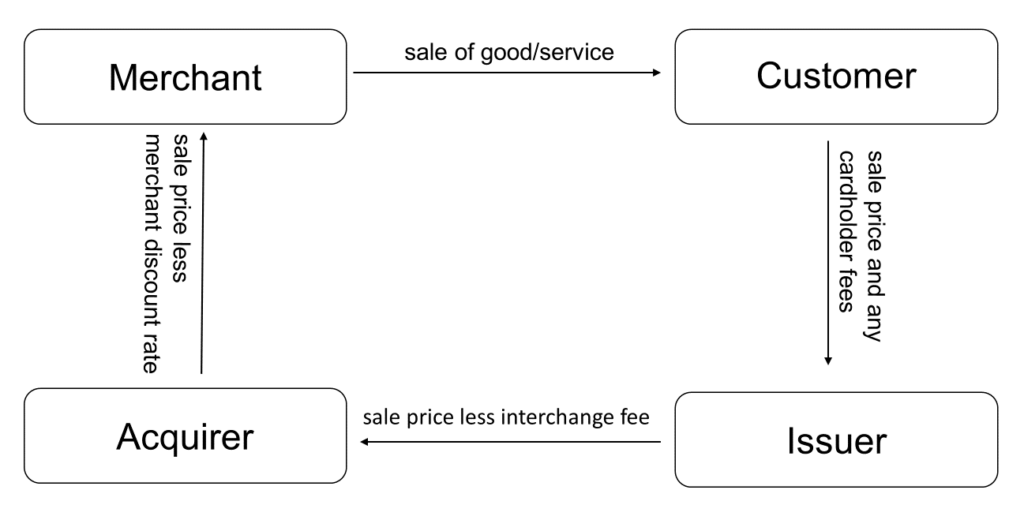
Maximizing value often entails that one side of the market (usually, the merchants) subsidizes the other side (consumers) through an “interchange fee” received by the issuing bank from the acquiring bank. The interchange fee covers a much wider range of costs than the operational costs mentioned above. Specifically, it typically includes issuer costs associated with collection and default, as well as many of the additional benefits that cardholders typically receive, including various kinds of insurance and such rewards as cashback rewards and airline miles. The interchange fee, in turn, is typically covered by fees charged by the merchant’s acquiring bank (see Figure 1), known as the merchant discount rate (MDR) or merchant service charge (MSC).

FIGURE 1: Transactions in a Four-Party Card Model

Caps on interchange fees and/or MDR are price controls, which have the effect of reducing the incentive to supply the product subject to that control. Many countries have introduced price controls on interchange fees, and these have been much-studied. Section II presents a summary of the evidence of the effects of price controls on interchange fees.

By contrast, relatively few countries have imposed price controls on MDR and the effects of such price controls have rarely been scrutinized.[1] Section III thus offers an initial assessment of such effects. Finally, Section IV offers conclusions and policy recommendations.

II. Interchange-Fee Price Controls

This section considers the effects of price controls on interchange fees. While more than 30 jurisdictions have imposed such price controls, we focus on the jurisdictions for which we have the best evidence.[2] While each jurisdiction and each price control is unique, the effects appear  to generalize readily. Therefore, the limited selection of jurisdictions here should be seen as typical examples.

This section begins with a brief description of the specific form price controls took in each jurisdiction. That is followed by a description of the response by (issuing) banks. Finally, the effects on consumers are evaluated.

A. How Jurisdictions Have Capped Interchange Fees

Various jurisdictions have taken a variety of approaches to the imposition of price controls on interchange fees. The following are examples of some of the better-studied interventions.[3] These examples show what happens in the period immediately following the introduction of interchange-fee price controls. While some price controls have been repealed or changed, their effects are most transparent in the immediate aftermath of their implementation, and the inclusion of these examples thus remains instructive.

1. Spain

Spain imposed caps on interchange fees for both credit and debit cards through agreements with merchant associations and card schemes in two distinct phases: the first ran from 1999 to 2003, the second from 2006 to 2010.[4] During the first phase, caps were initially set at 3.5%, falling to 2.75% in July 2002. Caps were much lower during the second phase and were lower for large banks (over €500 million), whose credit-card interchange fees were capped at 0.66% in 2006, falling to 0.45% by 2010, than for small banks (under €100 million), whose credit-card interchange fees were capped at 1.4% in 2006, falling to 0.79% in 2010.

2. Australia

The Reserve Bank of Australia (RBA) introduced caps on interchange fees for credit cards in 2003 under a “cost-based framework,” which adjusted interchange fees based on processing costs. As a result, the RBA aimed in the first instance to reduce interchange fees by 40%, from an average of 0.95% in 2002 to 0.6% in 2003.[5]

3. United States

Under a provision of the Dodd-Frank Wall Street Reform Act of 2010 known commonly as the “Durbin amendment,” the U.S. Federal Reserve imposed caps on debit-card interchange fees for large banks, as well as routing requirements for all debit-card issuers.[6] As a result, debit-card-interchange fees fell by about 50% for large banks almost immediately. Interchange fees on debit cards issued by smaller banks and credit unions initially fell by a smaller amount, and interchange fees on single-message (PIN) debit cards have now fallen to similar levels as PIN debit cards issued by larger banks.[7]

4. European Union

In 2015, the EU capped fees at 0.2% for debit cards and 0.3% for credit cards.[8] These are hard caps with few exceptions, and those rates rapidly became the norm for most transactions (with the exception of some domestic schemes that offer lower rates).[9]

B. Response by Banks

Faced with potentially large losses of revenue, banks adopted numerous strategies to limit their losses, including, most notably:

1. Increasing other fees and interest

Banks commonly increased other fees, including annual-card fees, account-maintenance fees, late fees, and interest on loans and credit cards. For example, in the United States, banks raised monthly account-maintenance fees and increased the minimum balance needed for a fee-free account.[10] In the EU, banks increased other fees and interest rates.[11]

2. Reduced card benefits

Banks reduced the rewards and benefits associated with those cards that were subject to price controls. This included reducing or eliminating cashback rewards, points, and other incentives that were previously funded, in part, by interchange fees. For example, U.S. banks subject to the Durbin amendment generally eliminated debit-card rewards. In Australia, meanwhile, the average value of rewards fell by about 30%.[12]

3. Adjusted product offerings

Some banks shifted their focus to products not affected by the caps. In the United States, where the Durbin amendment applied only to debit cards, banks shifted their promotional efforts toward credit cards. In Australia, banks issued “companion” cards on three-party networks that were initially exempt. In some EU jurisdictions, banks have promoted business credit cards, which are exempt.[13]

C. The Effects on Consumers

Interchange-fee caps make the vast majority of consumers worse off, especially those with lower incomes. This outcome primarily arises from several interconnected factors:

1. Higher costs

As noted, in response to the reduction in interchange fees, banks have increased a range of fees, including higher account-maintenance charges (and higher minimum-balance requirements to qualify for free accounts); larger overdraft fees; increased interest rates on loans and credit cards; and higher annual fees on credit cards. These increased fees have disproportionately affected lower-income consumers, who may struggle more to maintain minimum-balance requirements or avoid overdrafts.[14]

2. Loss of insurance, other services, and the financial benefits of rewards

The reductions in rewards and other benefits on cards subject to interchange-fee caps amount to a direct pecuniary loss for millions of consumers. Often, these losses far exceed the reduction in interchange fees that cause them. A case in point is insurance: credit-card-issuing banks are typically able to negotiate volume-based discounts on insurance, which means they pay less than would an individual seeking his or her own policy. But if there simply is not sufficient revenue to cover the continuation of such benefits, issuers are forced to withdraw it, as many issuers in the EU have done.

3. Lost access to financial services

Larger account fees and increased minimum-balance requirements have resulted in an increase in unbanked and underbanked households in the United States, particularly among lower-income consumers.[15] As a result, more households have become reliant on check-cashing services, payday loans, and other high-cost financial services.

4. Limited savings passed through to consumers

While larger merchants save on transaction fees, due to the lower interchange fees, these savings are not fully passed on to consumers in the form of lower prices. The degree of pass-through can vary greatly, depending on the competitive dynamics of various retail sectors. But in most cases, merchants have passed through the reduced costs associated with lower interchange fees at a lower rate than banks have passed through losses in fee revenue, in the form of higher-priced accounts, cards and services, and reductions in rewards. As such, consumers are, on net, worse off.[16]

While the intended goal of interchange-fee caps may be to reduce merchants’ costs and generate savings for consumers, in practice, consumers see few, if any, retail-price reductions, even as they experience significantly reduced benefits from their payment cards, as well as increased banking costs.

III. MDR Caps

This section explores the effects of caps on merchant discount rates. As noted earlier, it is difficult to draw broad conclusions of the kind we were able to draw in Section II on the effects of interchange-fee caps. This is both because of the relative rarity of MDR caps, as well as the fact that they have—in the two cases examined here—coincided with other policy changes and broader economic and social phenomena that simultaneously have had significant effects on the payments system. The two case studies nonetheless offer salutary lessons about the problems inherent in imposing price controls on payment fees.

A. India

India’s MDR caps, which date back to 2012, were put in place as part of a series of interventions whose broad objective was to increase access to finance and shift transactions from paper to electronic money. These initiatives included (in order of implementation): a digital ID (launched in 2010); a domestic-card scheme and debit card (RuPay) with MDR caps (implemented in 2012); and a domestic faster-payments system (UPI, launched in 2016) with zero MDR for most transactions. This section focuses primarily on the implementation of UPI, its MDR caps, and the implications for consumers, merchants, and payment-service providers.

1.  Mobile payments in India and the role of MDR

Until 2015, the two largest companies offering mobile phone-based payment services in India were Paytm and MobiKwik, which both relied on MDR to facilitate their expansion. MDR enabled these services to offer consumers cashback rewards and other incentives. MobiKwik signed up 1.5 million merchants and 55 million registered users by 2015,[17] while Paytm had 100 million registered accounts in 2015.[18]

Payment services are the core of Paytm’s business, contributing 58% of its revenue in Q3 2023 (although it fell slightly in Q1 2024).[19] These services arise from users making payments from mobile wallets stored on Paytm’s platform, using debit cards and credit cards. The company charges merchants an MDR that ranges from 0.4% to 2.99% of the transaction amount, depending on the payment type (for small-to-medium-size businesses).[20] MobiKwik, meanwhile, generates revenue from commissions and advertisements from its Zaak payment-gateway franchise subsidiary,[21] as well as loans—including short-term credit, buy-now-pay-later, and personal loans—and investment advice.[22] Of note, Zaak is also highly reliant on MDR as a source of revenue.[23]

2. Enter UPI

In 2016, the National Payments Corporation of India (NPCI), a public-private partnership between the Reserve Bank of India (RBI) and the Indian Banks Association (IBA), launched the Unified Payment Interface (UPI), an open-source interoperable API that facilitates real-time transfers between individuals with accounts at participating banks that have integrated the API into their smartphone apps.[24] NPCI also built its own app, BHIM UPI, that is available directly and can also be white-labelled by banks and PSPs.[25]

By any measure, UPI has been enormously successful. In April 2024, more than 80% of all retail payments by volume and about 30% by value were made using UPI.[26]

PhonePe, which launched in 2016, and Google Pay, which launched in India in 2017, have from the outset operated exclusively on UPI. PhonePe launched as a wholly owned subsidiary of Flipkart, India’s largest online marketplace. This enabled it to leverage the marketplace’s then-100 million users, as well as subsequent growth of Flipkart’s user base.[27] Although PhonePe has now separated from Flipkart, it is still owned by Walmart, which bought Flipkart in 2018, and is thus able to leverage the retail giant’s merchant ecosystem.

Google, meanwhile, was able to leverage its brand recognition and to monetize Google Pay through a combination of advertising and its local online marketplace. It is noteworthy that, in a 2023 survey, Google was ranked the top brand in India, followed by Amazon and YouTube (which is owned by Google).[28]

PhonePe is now the largest payment network in India, with approximately 200 million active users; Paytm ranks second, with approximately 100 million active users;[29] Google Pay is third, with about 67 million active users;[30] and MobiKwik is fourth, with 35 million active monthly users in 2023.[31]

In April 2024, PhonePe and Google Pay together represented 87% of UPI transactions by volume and value (Table 1). Paytm was the third-largest payment app on UPI, representing 8% of transactions and 6% of value. The fourth-largest app was CRED, which is a members-only app aimed at individuals with higher credit scores.[32] Together, these top four apps represented 96.5% of transaction volume and 95.5% of transaction value. The remaining apps combined all had less than 5% market share between them, and none had more than 1% individually.[33]

TABLE 1: UPI Transactions by App, April 2024

SOURCE: NPCI

Since UPI transactions represented about 80% of India’s retail volume, this means that the combination of Google Pay and PhonePe represented more than 70% of all non-cash retail transactions in India by volume.

3. How zero MDR distorts competition

The reason such as high proportion of UPI payments come from the top four apps is that their operators have been able to monetize transactions and encourage adoption on both sides of the market without relying on MDR. NPCI prohibits MDR for most applications (exceptions are pre-paid debit and rechargeable mobile wallets, which since April 2023 have been permitted to charge up to 1.1% in MDR).[34]

These MDR caps on UPI have, however, made it less economically viable for payment-services providers (PSPs) to offer such incentives for consumers. Indeed, Paytm has recently switched from offering cashback rewards to consumers to offering cashback rewards to merchants—presumably because it realizes it has to compete with other payments ecosystems that run on UPI and therefore charge zero MDR.[35]

Like the interchange-fee caps explored in Section II, MDR caps change the economics of payment systems by reducing the ability of card issuers and payment-app operators to balance the two sides of the market through cross-subsidies. These effects became most visible after UPI went live in 2016 with zero MDR.

As noted, both PhonePe and Google Pay were able to leverage existing networks to attract both merchants and users (Flipkart, in the case of PhonePe, and Google’s search engine and other products, in the case of Google Pay). Having built a significant base of participants on both sides of the market, the companies have been able to monetize their payment systems through product advertising, upselling of related products, and in-app transactions, thereby reinforcing the network effects.

While MDR is prohibited on UPI, PhonePe usually charges a 2% transaction fee for its online-payment gateway service. Acting as a payment gateway carries little counterparty or credit risk, and is typically offered in other jurisdictions for a small flat fee. The 2% charged by PhonePe therefore effectively goes straight to the bottom line, or can be used to cross-subsidize participation, thereby further enhancing the PSPs’ market share. Indeed, in July 2023, PhonePe began offering its payment gateway for free to new customers (an own-side subsidy: existing users subsidize new users).[36]

Google Pay, meanwhile, has offered cashback incentives for use of the service on apps within its own (Android) ecosystem.[37] This encourages the use of Google Pay in much the same way that traditional rewards offer incentives to use other payment systems. The merchant beneficiaries are, however, limited to participants in its app system, for which Google charges a 30% transaction fee.

While Paytm’s share of UPI is low compared to PhonePe and Google Pay, it can monetize such transactions both by providing add-on financial services, such as insurance and investments, as well as through the MDR it charges on non-UPI transactions.[38] Paytm has also built a rewards program for merchants that encourages participation in its marketplace.[39]

Finally, CRED has partnered with a range of high-end brands to undertake targeted advertising, the revenue from which enables CRED to offer rewards to users of various kinds, including cashback rewards.[40]

While UPI has likely contributed to increased financial inclusion, the prohibition on MDR for most types of transactions has distorted the entire market toward merchants affiliated with the large mobile-payment ecosystems (PhonePe, Google, and Paytm) and a payment network targeted at higher-income customers (CRED). Meanwhile, this has come at a huge price for the majority of banks and other PSPs that facilitate payments on UPI. The Payments Council of India estimates that its members lose 55 billion rupees (US$660 million) annually as a result of the zero MDR on UPI and RuPay transactions.[41] This is effectively a transfer from those banks to the companies whose apps monetize UPI transactions.

India’s government partly offsets this loss through a subsidy to UPI participants of between 15 and 25 billion rupees.[42] But this amounts to a subsidy to PhonePe, Google, Paytm, and CRED, which is odd. Moreover, experience with other systems that impose restrictions on payment-transaction fees suggests that banks will seek to recover these losses via other fees.[43] To the extent that such additional fees fall on lower-income account holders, the effect on financial inclusion is likely to be negative.

India’s government has also announced that it intends to cap the share of UPI transactions for any one service provider to 30% by the end of 2024, with the goal of reducing the dominance of Google Pay and PhonePe.[44] It remains unclear how such caps will be implemented, but it is almost certain that whatever mechanism is adopted would cause other harmful effects. Indeed, there is something slightly absurd about introducing a cap on participation in order to address the perverse consequences of caps on MDR.

Given that the MDR caps are the cause of Google Pay and PhonePe’s combined dominance, a far better solution would be to lift those caps. Indeed, based on the evidence adduced here, removing the MDR caps would likely unleash competition and innovation. Instead of being dominated by a few giant players, UPI would become what its visionaries intended: an inclusive platform that facilitates participation by a wide range of players. The platform could then further expand access to payments, enhance smaller merchants’ ability to compete, and improve financial inclusion.

B. Costa Rica

Costa Rica introduced price controls on payment cards in 2020. Legislative Decree No. 9831 authorized the Central Bank of Costa Rice (BCCR) to regulate fees charged by service providers on “the processing of transactions that use payment devices and the operation of the card system.”[45] The legislation’s stated objective was “to promote its efficiency and security, and guarantee the lowest possible cost for affiliates.” BCCR was tasked with issuing regulations that would ensure the rule is “in the public interest” and guarantee that fees charged to “affiliates” (i.e., merchants) are “the lowest possible … following international best practices.”

Starting Nov. 24, 2020, BCCR set maximum interchange fees for domestic cards at 2.00% and maximum MDR at 2.50%. Over a four-year period, BCCR has gradually ratcheted down both MDR and interchange-fee caps, as shown in Table 2.

TABLE 2: Interchange Fee and MDR Caps in Costa Rica, 2020-2024

An unusual feature of BCCR’s regulation is the simultaneous cap on both MDR and interchange fees, which has the effect of limiting revenue to both acquiring banks and issuing banks. This has likely reduced investments by issuers and acquirers and led to lower levels of system efficiency and speed, and possibly to increased fraud.

It is also worth noting that both interchange fees and MDR vary according to merchant type and location, in large part because the risk of fraud varies among different types of merchants. There is a danger, therefore, that imposing price controls on both MDR and interchange fees could make it unprofitable for acquirers to process payments for some riskier merchants. In other words, in its attempt to reduce merchant costs, BCCR may inadvertently (but predictably) prohibit some merchants from being able to accept payment cards. This is neither efficient, nor is it in the public interest.

Looking at the trajectory of the mean and median MDRs for various merchant categories in Costa Rica before price controls were imposed (as shown in Figures 1 and 2), MDRs were, on average, quite high (a mean of about 4%) but the medians were even higher (ranging from 4% to 10% for all categories except gas stations and passenger transportation). This significant difference between the mean and median MDRs suggests either that a large proportion of merchants represented a particularly high risk (e.g., from fraud and/or chargebacks) or that there was a lack of competition among acquiring banks (and perhaps even collusion)—or perhaps both.

FIGURE 2: Mean MDR for Various Merchants in Costa Rica, 2019-2022 (%)

SOURCE: Author’s calculations based on data from BCCR

If the previously high MDRs were a function of merchant-associated risk, capping MDRs would be expected to cause acquiring banks to drop some merchants. The data, however, show that the number of merchants increased from 2020 to 2022, which suggests that lack of competition among acquirers is a more likely explanation.[46]

FIGURE 2: Median MDR for Various Merchants in Costa Rica, 2019-2022 (%)

SOURCE: Author’s calculations based on data from BCCR

To the extent that these high MDRs reflect a lack of competition among acquiring banks, the appropriate response would have been to seek to understand what was causing this lack of competition and then to remedy that directly. For example, if the lack of competition arose from regulations imposed by BCCR, it would be incumbent on BCCR to modify its regulations to reduce barriers to competition. Capping MDR does not address the underlying problem; indeed, it likely makes it worse, by inhibiting acquirers from being able to differentiate themselves on price or quality.

IV. Conclusions and Policy Implications

In competitive markets without price controls, prices evolve in ways that tend to maximize value for all participants. In payment networks, interchange fees play an important role, enabling issuers to develop appealing and competitive products with features that range from cashback rewards to travel insurance. This encourages customers to use the card or app in question, which, in turn, benefits merchants who see greater sales. The fees also facilitate associated innovations, such as AI-based fraud detection, contactless payments, and online token vaults.

When governments impose price controls on payment fees—whether in the form of caps on interchange fees or on MDR, or both—bank revenue from card transactions falls. Issuers (and acquirers, in the case of MDR caps) respond by increasing other fees, reducing card benefits, and reducing investments in improvements. The ecosystem becomes distorted, unbalanced, and fundamentally less competitive.

The beneficiaries of such interventions tend to be larger merchants and other participants in the system (including larger financial technology, or “fintech,” players). These players can leverage and reinforce their loyal customer base, and often charge fees for services (such as payment gateways) that are as high or higher than interchange fees, and even MDR.

India’s government recognizes the anticompetitive nature of its MDR caps, but appears to think that this is best-addressed by introducing new caps on participation. Costa Rica, meanwhile, appears to have suffered from a lack of competition among merchant acquirers, which drove up the cost of MDR—leading it to introduce caps on MDR.

But, in both cases, regulation is the problem, not the solution. In India’s case, various regulations—especially the caps on MDR for UPI transactions, as well as the government subsidies to UPI—have resulted in heavy concentration and impeded competition from fintech startups. Meanwhile, in Costa Rica, existing regulatory barriers likely impeded competition in the acquisition market, which enabled acquirers to charge excessive rates. This has prompted BCCR to impose MDR and interchange-fee caps that, in turn, have impeded competition in issuance.

The biggest losers from such interventions tend to be lower-income consumers, who end up paying higher bank fees and leaving—or not entering—the banking system. But there are many other losers, including the majority of consumers, and the many potential competitors that are excluded from participation because they are unable to monetize their investments via interchange and/or MDR fees.

Governments should not distort markets in these ways. Quite the opposite: they should be as neutral as possible. Rather than imposing price controls on payment systems, they might look to review and repeal existing government-created barriers to financial inclusion. These could include licensing requirements for banks that limit competition and enable acquirers to charge abnormal MDR rates.

In other words, rather than layer additional distorting regulations atop existing regulations, further harming the operation of complex private-market ecosystems, they should look for ways to reduce government-imposed barriers to competition. And, generally, they should limit themselves to the production of genuine public goods, such as courts and identity registers. Doing so will enable greater participation, competition, and innovation, which will drive financial inclusion.

[1] Other jurisdictions, such as Denmark and China, also have imposed restrictions on MDR/MSC, but this author was unable to adduce sufficient information about the nature and effects of these interventions to develop substantive analyses.

[2] We draw extensively on our earlier review: Julian Morris, Todd J. Zywicki, & Geoffrey A. Manne, The Effects of Price Controls on Payment-Card Interchange Fees: A Review and Update,  (ICLE White Paper 2022-03-04 & George Mason L. & Econ. Research Paper No. 22-07, 2022), https://papers.ssrn.com/sol3/papers.cfm?abstract_id=4063914. See also Fumiko Hayashi & Jesse Leigh Maniff, Public Authority Involvement in Payment Card Markets: Various Countries, August 2020 Update, Fed. Res. Bank of Kan. City (August 2020), available at https://www.kansascityfed.org/documents/6660/PublicAuthorityInvolvementPaymentCardMarkets_VariousCountries_August2020Update.pdf.

[3] Morris et al., supra note 2.

[4] Juan Iranzo, Pascual Fernández, Gustavo Matías, & Manuel Delgado, The Effects of the Mandatory Decrease of Interchange Fees in Spain (Munich Personal RePEc Archive, MPRA Working Paper No. 43097, 2012), available at https://mpra.ub.unimuenchen.de/43097/1/MPRA_%20paper_43097.pdf.

[5] Press Release, Reform of Credit Card Schemes in Australia, Res. Bank of Austl. (Aug. 27, 2002), https://www.rba.gov.au/media-releases/2002/mr-02-15.html.

[6] H.R.4173 – Dodd-Frank Wall Street Reform and Consumer Protection Act, s.1075(a)(3); Debit Card Interchange Fees and Routing; Final Rule, 76 Fed. Reg. 43,393-43,475, (Jul. 20, 2011).

[7] Todd J. Zywicki, Geoffrey A. Manne, & Julian Morris, Unreasonable and Disproportionate: How the Durbin Amendment Harms Poorer Americans and Small Businesses, Int’l Cntr For L. & Econ. (Apr. 25, 2017), available at https://laweconcenter.org/wp-content/uploads/2017/08/icle-durbin_update_2017_final-1.pdf.

[8] Regulation (EU) 2015/751 of the European Parliament and of the Council of 29 April 2015 on Interchange Fees for Card-Based Payment Transactions, 2015, O.J. (L 123) 1, 10-11 (hereinafter “IFR”).

[9] Ferdinand Pavel et al., Study on the Application of the Interchange Fee Regulation: Final Report 89, European Commission Directorate-General for Competition (2020), https://op.europa.eu/s/zKl2.

[10] Mark D. Manuszak & Krzysztof Wozniak, The Impact of Price Controls in Two-Sided Markets: Evidence From US Debit Card Interchange Fee Regulation (Bd. of Governors of the Fed. Res. Sys. Fin. & Econ. Discussion Series, Working Paper No. 2017-074,  2017); Vladimir Mukharlyamov & Natasha Sarin, Price Regulation in Two-Sided Markets: Empirical Evidence From Debit Cards (SSRN Working Paper, 2019), https://papers.ssrn.com/sol3/papers.cfm?abstract_id=3328579.

[11] Interchange Fee Regulation (IFR) Impact Study Report, Edgar Dunn & Co. (Jan. 21, 2020), https://www.edgardunn.com/reports/interchange-fee-regulation-ifr-impact-assessment-study-report.

[12] Iris Chan, Sophia Chong, & Stephen Mitchell, The Personal Credit Card Market in Australia: Pricing Over the Past Decade, Res. Bank Of Austl. Bull. (2012), available at https://www.rba.gov.au/publications/bulletin/2012/mar/pdf/bu-0312-7.pdf.

[13] IFR, supra note 8, Art. 1(3)(a).

[14] Mukharlyamov & Sarin, supra note 10.

[15] Id.

[16] Iranzo et al., supra note 4 at 34-37; Ian Lee, Geoffrey A. Manne, Julian Morris, & Todd J. Zywicki, Credit Where It’s Due: How Payment Cards Benefit Canadian Merchants and Consumers, and How Regulation Can Harm Them, Macdonald-Laurier Institute 1, 27 (2013); Morris, Zywicki, & Manne, supra note 7 at 23-29.

[17] Shabana Hussain, MobiKwik’s Journey and the Path Ahead, Forbes India (Apr. 6, 2015), http://forbesindia.com/article/work-in-progress/mobikwiks-journey-and-the-path-ahead/39905/1 .

[18] Paytm Reaches 100 Million Users, Business World (Aug. 11, 2015), https://businessworld.in/article/paytm-reaches-100-million-users–84698.

[19] Press Release, Paytm’s Earning’s Release for Quarter and Year Ending March 2024, Paytm (May 22, 2024), available at https://paytm.com/document/ir/financial-results/Paytm_Earnings-Release_INR_Q4_FY24.pdf.

[20] Paytm’s Pricing, Paytm, https://business.paytm.com/pricing (last visited Jun. 07, 2024).

[21] MobiKwik Consolidated Financial Statement, MobiKwik (2023), available at https://documents.mobikwik.com/files/investor-relations/statements/mobikwik/Consolidated-Financials-Sept2023.pdf; Report on the Audit of Special Purpose Interim Financial Statements, Tattvam & Co. (Dec. 31, 2023), available at https://documents.mobikwik.com/files/investor-relations/statements/zaakpay/zaakpay-financials-sept2023.pdf; Subsidiary Financials, MobiKwik, https://www.mobikwik.com/ir/subsidiary-financials (last visited Jun. 7, 2024); Status of Applications Received from Online Payment Aggregators (PAs) Under Payment and Settlement Systems Act, 2007, Res. Bank of India, https://www.rbi.org.in/Scripts/bs_viewcontent.aspx?Id=4236 (last updated Jun. 1, 2024).

[22] Id., Res. Bank of India.

[23] Pratik Bhakta, MobiKwik to Add Muscle to Its Payment Gateway Business, The Economic Times (May 13, 2017),  https://economictimes.indiatimes.com/small-biz/startups/mobikwik-shifting-focus-to-payment-gateway-space/articleshow/58655807.cms?from=mdr.

[24] Unified Payments Interface (UPI), National Payments Corporation of India (2024), https://www.npci.org.in/what-we-do/upi/product-overview; UPI Live Members, National Payments Corporation of India (2024),  https://www.npci.org.in/what-we-do/upi/live-members.

[25] BHIM, https://www.bhimupi.org.in (last visited Jun. 7, 2024); Pratik Bhakta, BHIM to Be the Right Platform for Small Banks to Enter Payment Space, The Economic Times (Feb. 3, 2017), https://economictimes.indiatimes.com/small-biz/security-tech/technology/bhim-to-be-the-right-platform-for-small-banks-to-enter-payment-space/articleshow/56945820.cms?from=mdr.

[26] Payment System Indicators, Res. Bank of India (Apr. 2024), https://www.rbi.org.in/Scripts/PSIUserView.aspx?Id=35.

[27] Alnoor Peermohamed, Flipkart Grows User Base to 100 million, Business Standard (Jun. 6, 2024), https://www.business-standard.com/article/companies/flipkart-grows-user-base-to-100-million-116092100216_1.html.

[28] Gaurav Laghate, Google, Amazon, YouTube Top India brands, Livemint (Jun. 27, 2023), https://www.livemint.com/companies/news/google-amazon-youtube-top-india-brands-11687887362055.html.

[29] Paytm Surpasses 100 Million Monthly Transacting Users for the First Time in Q3 FY24, Livemint (Jan. 22, 2024), https://www.livemint.com/companies/news/paytm-surpasses-100-million-monthly-transacting-users-for-the-first-time-in-q3-fy24-11705932856486.html.

[30] Michael G. William, How Many People Use Google Pay in 2023?, Watcher Guru (Sep. 14, 2023), https://watcher.guru/news/how-many-people-use-google-pay-in-2023#google_vignette.

[31] MobiKwik Continues Profitable Streak for Second Quarter in a Row, The Economic Times (Oct. 05, 2023), https://economictimes.indiatimes.com/tech/technology/mobikwik-continues-profitable-streak-for-second-quarter-in-a-row/articleshow/104183594.cms?from=mdr.

[32] CRED, https://cred.club/ipl (last visited Jun. 07, 2024).

[33] Eight other apps had between 0.25% and 0.75% of transaction volume and/or value: Amazon Pay, ICICI Bank Apps, Fampay, Kotak Mahindra Bank Apps, HDFC Bank Apps, WhatsApp, BHIM, and Yes Bank Apps.

[34] Upasana Taku, NPCI’s 1.1% Interchange Fee on UPI Payments Via Wallet – The Watershed Moment for Fintech in India, The Times of India (May 15, 2023), https://timesofindia.indiatimes.com/blogs/voices/npcis-1-1-interchange-fee-on-upi-payments-via-wallet-the-watershed-moment-for-fintech-in-india.

[35] Pratik Bhakta, Inside Paytm’s Cashback Offers for Retailers, The Economic Times (Jul. 7, 2023),   https://economictimes.indiatimes.com/tech/startups/in-through-the-other-door-inside-paytms-cashback-offers-for-retailers/articleshow/101551675.cms?from=mdr.

[36] Mayur Shetty, PhonePe Cuts Fees for Payment Gateway Services, The Times of India (Jun. 14, 2023),  https://timesofindia.indiatimes.com/business/india-business/phonepe-cuts-fees-for-payment-gateway-services/articleshow/100986915.cms.

[37] Manish Singh, Google’s New Plan to Push Google Pay in India: Cashback Incentives in Android Apps, TechCrunch (May 16, 2019), https://techcrunch.com/2019/05/16/google-pay-india-android-cashback.

[38] Paytm, supra note 20.

[39] An Overview of Merchant Discount Rate Charges, AMLegals (Mar. 15, 2024), https://amlegals.com/an-overview-of-merchant-discount-rate-charges.

[40] CRED Pay, https://cred.club/cred-pay/onboarding (last visited Jun. 7, 2024).

[41] Roll Back Zero Merchant Discount Rate on UPI, Rupay Debit Card Payments, Industry Body Payments Council of India Writes to Finance Ministry, The Indian Express (Jan. 23, 2022), https://indianexpress.com/article/business/banking-and-finance/merchant-discount-rate-rollback-on-upi-rupay-debit-cards-7737229.

[42] Pratik Bhakta, Fintechs Await Government Word on MDR Subsidy Allocation, The Economic Times (Feb. 22, 2024), https://economictimes.indiatimes.com/tech/technology/fintechs-await-government-support-for-promoting-digital-payments-for-current-fiscal/articleshow/107891943.cms?from=mdr.

[43] Morris et al., supra note 2.

[44] Ajinkya Kawale,  NPCI to Review by End of Year Decision on 30% UPI Market Share Cap, Business Standard (Apr. 19, 2024), https://www.business-standard.com/markets/news/npci-to-review-30-market-share-cap-decision-by-year-end-124041901059_1.html.

[45] Author’s translations from the Spanish original are approximate.

[46] Fijación Ordinaria de Comisiones Máximas del Sistema de Tarjetas de Pago, Banco Centrale de Costa Rica (Oct. 2023), 12, available at https://www.bccr.fi.cr/en/payments-system/DocCards/Estudio_tecnico_2023_fijacion_ordinaria_comisiones_CP.pdf.

ICLE Issue Brief

Vaccine Hesitancy and the Pandemic: Physician Survey Responses

Executive Summary Vaccines for the SARS-CoV-2 virus saved countless lives and are a modern science miracle. But they had risks, were not as effective as . . .

Executive Summary

Vaccines for the SARS-CoV-2 virus saved countless lives and are a modern science miracle. But they had risks, were not as effective as originally claimed, and were effectively forced onto many people in order for them to work, attend school, or travel. There is early evidence that these and other factors may currently be contributing to heightened vaccine hesitancy, with potentially serious consequences for public health.

To better understand the extent and causes of vaccine hesitancy, we surveyed 124 physicians in Montgomery County, Pennsylvania. They reported that most patients (nearly all adults and most children and infants) took the initial COVID-19 vaccines in the winter of 2021. Take-up among adults declined over the proceeding months and was much lower by the second half of 2023 (and almost non-existent among infants). This shift in vaccine uptake was especially prevalent in the more staunchly Republican-voting areas of Montgomery County. It is noteworthy, however, that at-risk populations continue to receive vaccine boosters.

More worryingly, physicians also report an increase in patient distrust for non-COVID vaccines and a more generalized increase in concern about and distrust of public-health advice among their patients. Even some physicians are concerned about governmental public-health advice.

Future research will need to establish whether vaccine uptake has changed and, if so, how it has changed, and what this may mean for public health. If these data are replicated in larger surveys and a trend becomes identifiable, the implications for public health could be serious, indeed.

I. Background

Vaccines are among the most powerful interventions in the field of public health, plausibly saving and improving more lives than anything other than good sanitation and diet. Historically, however, vaccines have typically taken years to develop. When effective vaccines were developed for COVID within a year of the pandemic’s emergence, many were surprised and awed.[1] Amazingly and, in retrospect, incredibly, the makers of the first mRNA vaccines to be granted emergency use authorization by the U.S. Food and Drug Administration (FDA) claimed more than 90% efficacy in trials. This is much higher than the efficacy of vaccines for many other diseases,[2] including influenza, although this level of efficacy was expected to wane over time.[3] For all of these reasons, COVID vaccines were greeted as truly remarkable public-health interventions.

Uptake of COVID vaccines was initially very high.[4] This was likely primarily because of the protection they afforded against a potentially deadly disease. But it was also partly because, for many, vaccination became a requirement for work, travel, and most other social interactions.

But concerns about the vaccines soon arose. While many of these purported risks were plainly false,[5] some—most notably, the risk of myocarditis and pericarditis among the young—were supported by data.[6] It also emerged that the vaccines were far less effective and shorter lived than originally touted. Moreover, they do not completely prevent disease transmission, although they probably reduce transmission by reducing viral loads.[7] As the virus has mutated over time, it has generally become more virulent, but less dangerous, which also likely has informed the calculus of those considering whether to take further vaccine boosters.

Despite these concerns, state and federal authorities have recommended and, in many cases, demanded vaccination.[8] These mandates were applied even to those who had just had COVID. This appeared illogical, given that the natural immunity provided by a disease is usually greater than the passive immunity from vaccination. This appears to be true of COVID, as well.[9]

U.S. vaccine policy is comprehensive and promotes vaccinations for all ages.[10] It also continues to promote COVID vaccines for everyone over six months old.[11] But skeptics have claimed all sorts of dangers from the vaccines, and most people report their experiences are that the vaccines really only prevented death for the old, obese, or those with other co-morbidities. This has resulted in reactive vaccine hesitancy, especially in more Republican-leaning areas. We hypothesize that this is partly because many elected Republicans vocally opposed vaccine mandates and some even voted to prohibit private requirements.[12] Such actions likely influenced opinion in these Republican-voting areas.

A. Aims

The aim of this research is to examine vaccine uptake and patient opinions about vaccines in Montgomery County, Pennsylvania. If, as expected, COVID-vaccine refusal and more general vaccine hesitancy has increased over the past few years, reasons for this will be discussed.

B. Methods

Primary physicians oversee many vaccinations and also address many questions from patients about vaccines, including about efficacy and safety. We undertook a survey of primary physicians in order to obtain information about changes in vaccine uptake, physicians’ interpretations of patients’ opinions about vaccines, and their own opinions about vaccines.

The survey was undertaken in Montgomery County, Pennsylvania, which ranges from the Northeast suburbs of Philadelphia into more rural areas. It has three members of the U.S. House of Representatives, including two Democrats (Reps. Madeleine Dean and Mary Scanlon) and one Republican (Rep. Brian Fitzpatrick).

Physicians were surveyed in the three constituencies. To assess uptake of, and opinions about, vaccines across the political divide, it made sense to find the few Republican-voting areas and compare them to the rest. The two most strongly Republican-voting of the county’s14 Pennsylvania House of Representatives districts are District 147 and District 131, both of which have 30% more registered Republican voters than Democrats. In many of the other state House districts, there are more than twice as many Democrats as Republicans registered to vote. From within the overall sample, physicians from these two Republican-leaning districts were compared to the other 12 state House districts. The tables in the appendix show all relevant political data.

C. Survey

The survey, titled “Vaccine Questionnaire” and republished in full below, was kept short to ensure full participation by physicians. It was undertaken for two weeks starting in mid-January 2024, with responses collected online, over the phone, or in-person.

D. Vaccine Questionnaire

The aim of this short survey is to find out about opinions and uptake of key vaccines in your practice. And to note whether there have been changes in either opinions or uptake of vaccines over the past few years.

  1. How long have you been at this practice (less than four years will not participate in final results)?
  2. How would you describe the initial uptake (2021) of the COVID vaccine for a) adults b ) children c) infants

Nearly everyone, most, few, almost none

  1. How would you describe the uptake of the most recent COVID booster for a) adults b ) children c) infants

Nearly everyone, most, few, almost none

  1. Over the same time period early 2021- late 2023 has uptake of other (non-COVID vaccines) changed in a) adults b ) children c) infants (increased, stayed the same, decreased)
  2. Have patient opinions changed over this time period?

COVID – positive, the same, negative about the vaccines.

Other vaccines – positive, the same, negative.

  1. Please provide any specific comments you recall made by patients.
  2. How have your opinions changed, if at all, about vaccines over the time period?

Thank you for your time.

E. Response Rate

In all, 124 physicians in Montgomery County who had been in their practice for more than four years replied in full to the survey. Rep. Dean’s constituency is the largest, and this was reflected by having the most physicians surveyed (48), compared with Fitzpatrick (37) and Scanlon (39). 19 physicians came from the two most Republican-leaning Pennsylvania House Districts.

F. Interpretation of Data

The data we obtained are imprecise, because they are primarily based on the recall (of up to four years) of busy physicians, each of whom deal with dozens of patients. Small differences over time or between districts may well be the result of poor recall or biases due to survey design. Nevertheless, significant differences are probably reliable and based on identifiable trends.

II. COVID Vaccine Uptake

As expected, most physicians reported very high initial uptake of the COVID vaccine among all groups, especially adults. Figure 1 represents the number of responses (Y axis) against time (2021 or 2023) and vaccine-recipient type (adult, child, infant). As the chart demonstrates, most physicians reported nearly every adult receiving a vaccine when first offered (a few may have had medical exemptions to vaccinations).

As noted above, when the mRNA COVID vaccines were first rolled out in late 2020 and early 2021, they were touted as more than 90% effective and that they would (or, at least, might) reduce transmission. Vaccines were also required for many jobs and for travel, etc. By late 2023, when the latest booster was made available, fewer adults were taking it, as well as far fewer children and almost no infants.

Perhaps this can be explained by a greater appreciation that the vaccines were less effective than originally touted, did not appreciably reduce transmission, were no longer required for jobs or travel, and that the side effects more widely explained. Additionally, the disease itself changed, becoming more contagious, but less deadly (though the long-term trajectory remains indeterminant).[13] By lowering viral loads, vaccines probably lowered transmission, but many vaccinated individuals still got the disease.[14] Many patients may also regard the side effects of vaccination—such as a sore arm and the possibility of feeling bad for a day or two—as not worthwhile, given that the disease itself appears little worse than a bad cold. Several physicians mentioned this as among the plausible reasons for declining uptake.

FIGURE 1: Montgomery County – COVID Vaccine Uptake

There was very little difference across the three U.S. House districts. While uptake was marginally lower in the Republican Rep. Fitzpatrick’s district, the difference was not statistically significant. In the two most Republican-leaning Pennsylvania House districts, however, there was a notable difference, as can be seen in Figure 2 and Figure 3. Initial uptake was not as great in these two districts, and it is almost non-existent for the most recent booster. This is noteworthy, given that Montgomery County follows Centers for Disease Control and Prevention (CDC) advice that everyone over six months old should receive the latest booster.[15] The vast majority of these districts’ patients are ignoring CDC advice.

FIGURE 2: Montgomery County (12D) Districts – COVID Vaccine Uptake

FIGURE 3: Montgomery County (2R) Districts – COVID Vaccine Uptake

A. Other Vaccines

COVID is one disease among many. Other diseases that require vaccinations obviously have not disappeared. Question 4 sought to gather information about the uptake of these other vaccines over the same period (early 2021 to late 2023). Here, the data are significant, as demonstrated in Figure 4. Not one physician reported an increase in vaccine uptake for these other diseases. While approximately a third reported no change, fully two-thirds (slightly more in the Republican areas) have seen a decrease in vaccination uptake.

This is a very broad measure and far more detailed surveys are required to understand exactly which vaccines are being missed—i.e., whether it is the annual (and not particularly effective) flu vaccines, or the far more important and less-frequent (often a one-off in childhood) vaccines for diseases such as measles, polio, or tuberculosis. The data below also do not show by how much vaccine rates are falling.

FIGURE 4: Non-COVID Vaccine Change in Uptake, 2021-2023

Nevertheless, that rates are falling is potentially worrying and deserving of attention.

III. Vaccine Opinions

The latter questions in the survey refer to opinions about vaccines and, where quantifiable, how they have changed, as well as specific comments made by patients (and the parents of patients) and physicians about vaccines. These responses do not rise much above anecdotes, but they may provide some insight into patient and physician concerns. These comments could also help to design more detailed surveys in the future.

  1. The vast majority of physicians reported a large decline in support for COVID vaccinations (as reflected in uptake) and a much smaller, but still important, decline in support for all vaccines.
  2. Most physicians report patient concerns about the safety of COVID (and, increasingly, other) vaccines. Patients are uncertain of, but worried about, social-media reports of vaccine harm. Given that social media was the only place that supported the notion that the SARS-CoV-2 virus originated in a lab—and permitted discussion of other theories and concerns, many of which turned out to be true—it is perhaps not surprising that many patients were inclined to worry about reports of vaccine harm that also appeared on social media. These patients were less likely to take the vaccine themselves, but more likely to take it than to let their children do so. This was especially true among the many patients who referred to the “lies” told by health authorities (Anthony Fauci was named repeatedly). A few patients appeared to be very angry about being mandated to take a potentially unsafe vaccine, even if they had recently had the disease.
  3. Patients offered more subtle comments—“nuanced” was the word mentioned by more than one physician—about the scientific illiteracy of health authorities who demanded COVID vaccines even for people who had recently had the disease. This led to a “total” distrust of vaccine policy among some patients, which physicians reported has definitely contributed to lowering flu-vaccine uptake, although one physician reported that “it’s too early to tell for other vaccines.” Some physicians agreed with their patients that the advice was unscientific.
  4. Some physicians also said that their trust in vaccination approval, efficacy, and health authorities’ advice had declined.

A. Discussion

A large NIH survey about vaccination opinions among 737 physicians was undertaken in May 2021, when COVID vaccines were taken in vast numbers.[16] The summary findings were that “10.1% of primary care physicians do not agree that, in general, vaccines are safe, 9.3% do not agree they are effective, and 8.3% do not agree they are important.”  Evidently, the vast majority of physicians accepted their safety, efficacy, and importance, but it is both interesting and relevant that a small minority did not.  One reason reported was that the pharmaceutical industry is not widely trusted and that some vaccinations, such as for flu, are often not that effective.

To ensure rapid distribution of COVID vaccines, pharmaceutical producers were given (temporary) immunity from liability related to vaccine-induced harm, which probably fueled some additional skepticism (a point physicians said a few patients made when refusing COVID vaccines).[17] This is obviously a tricky area, as the manufacturers might not have agreed to sell the vaccines in the United States without such protections.

By mid-2023, federal vaccine mandates as a requirement for federal jobs and international travel had been removed.[18] It is therefore not that surprising that the uptake of COVID vaccine boosters collapsed among infants and children, and fell markedly amongst adults. One comment made by a few physicians was that uptake was close to zero, as well, for adults under 40, while being nearly universal among adults over 70, or with co-morbidities. This likely demonstrates that those most at-risk were, indeed, reading the scientific situation correctly and taking the vaccine.

It is important not to overinterpret these results. The data could be the result of faulty recollections by busy physicians. Even if entirely accurate, they may reflect a temporary shift, rather than an actual trend in increased vaccine resistance. But these data are worrying if they are sustained and reflective more broadly than in one county in Pennsylvania.

IV. Conclusion

The development of COVID vaccines was a truly remarkable phenomenon. Within one year of the pandemic’s start, pharmaceutical companies had developed multiple vaccines, while the previous record for the fastest vaccine developed (for mumps) took four and half years.[19] These vaccines saved hundreds of thousands of lives, especially among the old and those with comorbidities who were most at risk from severe COVID.

But the vaccines were oversold, were not as effective as first touted, did not fully prevent transmission and, like most vaccines, posed some risks. By making them mandatory for jobs and travel, people who were disinclined to take them appear to have become more hostile to vaccines in general.  The exact reasons for the downturn in COVID vaccination are myriad. Some are due to vaccine failings, some to inappropriate political demands, but some are related to the disease changing to a more virulent but less harmful form, making vaccination less attractive.

Further research should establish whether the results in this survey are replicated over time and in larger groups. More importantly, there is a need to establish whether vaccine hesitancy applies across all vaccines or whether it is limited to COVID and seasonal vaccines with weak efficacy (such as influenza).

V. Appendix

Data from most recent U.S. Census and election for Montgomery County, Pennsylvania.[20]

Data for the two Republican-leaning Pennsylvania House districts.[21]

[1] COVID-19 Vaccines, U.S. Food & Drug Admin., https://www.fda.gov/emergency-preparedness-and-response/coronavirus-disease-2019-covid-19/covid-19-vaccines (last visited Feb. 15, 2024).

[2] Kathy Katella, Comparing the COVID-19 Vaccines: How Are They Different?, Yale Medicine (Oct. 5, 2023), https://www.yalemedicine.org/news/covid-19-vaccine-comparison.

[3] Huong Q. McLean, et al., Interim Estimates of 2022–23 Seasonal Influenza Vaccine Effectiveness — Wisconsin, October 2022–February 2023, Ctr. Disease Control & Prevention (Feb. 24, 2023), https://www.cdc.gov/mmwr/volumes/72/wr/mm7208a1.htm.

[4] COVID-19 Vaccinations in the United States, Ctr. Disease Control & Prevention, https://covid.cdc.gov/covid-data-tracker/#vaccinations_vacc-people-booster-percent-pop5 (last visited Feb. 16, 2024).

[5] Debunking COVID-19 Myths, Mayo Clinic (Sep. 2, 2021), https://data.cdc.gov/d/rh2h-3yt2/visualization (last visited Feb. 15, 2024).

[6] Colleen Moriarty, The Link Between Myocarditis and COVID-19 mRNA Vaccines, Yale Medicine (Jun. 24, 2021), https://www.yalemedicine.org/news/myocarditis-coronavirus-vaccine.

[7] Anouk Oordt-Speets, et al., Effectiveness of COVID-19 Vaccination on Transmission: A Systematic Review, MDPI (2023), https://www.mdpi.com/2673-8112/3/10/103.

[8] Kevin Liptak & Kaitlan Collins, Biden Announces New Vaccine Mandates That Could Cover 100 Million Americans, CNN (Sep. 9, 2021), https://www.cnn.com/2021/09/09/politics/joe-biden-covid-speech/index.html.

[9] Sara Diani, et al., SARS-CoV-2-The Role of Natural Immunity: A Narrative Review, Nat’l Ctr. Biotechnology Info. (Oct. 25, 2022), https://pubmed.ncbi.nlm.nih.gov/36362500/#:~:text=Conclusions%3A%20this%20extensive%20narrative%20review,SARS%2DCoV%2D2%20vaccination.

[10] Vaccines & Immunizations, U.S. Dept. Health & Human Serv., https://www.hhs.gov/vaccines/vaccines-national-strategic-plan/index.html (last visited Feb. 15, 2024).

[11] COVID-19 Vaccine Effectiveness, Ctr. Disease Control & Prevention, https://www.cdc.gov/respiratory-viruses/whats-new/covid-19-vaccine-effectiveness.html (last visited Feb. 15, 2024).

[12] Jonathan Chait, How Vaccine Skeptics Took Over the Republican Party. A Case Study in the Party’s Dysfunction, Intelligencer (Oct. 21, 2022), https://nymag.com/intelligencer/2022/10/how-vaccine-skeptics-took-over-the-republican-party.html; State Government Policies About Vaccine Requirements (Vaccine Passports), 2021-2022, Ballotpedia, https://ballotpedia.org/State_government_policies_about_vaccine_requirements_(vaccine_passports),_2021-2022 (last visited Feb. 15, 2024).

[13] Ádám Kun, et al., Do Pathogens Always Evolve to Be Less Virulent? The Virulence–Transmission Trade-Off in Light of the COVID-19 Pandemic, 74 Biol. Futura 69–80 (2023), https://link.springer.com/article/10.1007/s42977-023-00159-2.

[14] Anouk Oordt-Speets, et al., Effectiveness of COVID-19 Vaccination on Transmission: A Systematic Review, 3(10) COVID 1516-1527 (2023), https://www.mdpi.com/2673-8112/3/10/103.

[15] CDC Recommends Updated COVID-19 Vaccine for Fall/Winter Virus Season, Ctr. Disease Control & Prevention (Sep. 12, 2023), https://www.cdc.gov/media/releases/2023/p0912-COVID-19-Vaccine.html.

[16] Timothy Callaghan, et al., Imperfect Messengers? An Analysis of Vaccine Confidence Among Primary Care Physicians, 40(18) Vaccine 2588–2603 (Apr. 20, 2022), https://www.ncbi.nlm.nih.gov/pmc/articles/PMC8931689.

[17] Shayna Greene, Fact Check: Are Pharmaceutical Companies Immune From COVID-19 Vaccine Lawsuits?, Newsweek (Jan. 19, 2021), https://www.newsweek.com/fact-check-are-pharmaceutical-companies-immune-covid-19-vaccine-lawsuits-1562793.

[18] The Biden-⁠Harris Administration Will End COVID-⁠19 Vaccination Requirements for Federal Employees, Contractors, International Travelers, Head Start Educators, and CMS-Certified Facilities, White House (May 1, 2023), https://www.whitehouse.gov/briefing-room/statements-releases/2023/05/01/the-biden-administration-will-end-covid-19-vaccination-requirements-for-federal-employees-contractors-international-travelers-head-start-educators-and-cms-certified-facilities.

[19] Dave Roos, How a New Vaccine Was Developed in Record Time in the 1960s, History.com (Oct. 4, 2023), https://www.history.com/news/mumps-vaccine-world-war-ii.

[20] ArcGIS, https://experience.arcgis.com/experience/a560279ebf2844b2ba267d6f50602668/page/US-Congressional/?data_id=dataSource_8-185df68cfdd-layer-4%3A30%2CdataSource_9-185df6f79b7-layer-4%3A62, (last visited Feb. 15, 2024).

[21] ArcGIS, https://experience.arcgis.com/experience/a560279ebf2844b2ba267d6f50602668/page/PA-House/?data_id=dataSource_8-185df68cfdd-layer-4%3A30%2CdataSource_9-185df6f79b7-layer-4%3A62, (last visited Feb. 15, 2024).

ICLE Issue Brief

Gerrymandered Market Definitions in FTC v Amazon

Introduction Market definition is a critical component of any antitrust case. Not only does it narrow consideration to a limited range of relevant products or . . .

Introduction

Market definition is a critical component of any antitrust case. Not only does it narrow consideration to a limited range of relevant products or services but, perhaps more importantly, it specifies a domain of competition at issue in an antitrust case—that is, the nature of the competition between certain firms that might (or might not) be harmed by the conduct of the defendant. As Greg Werden has characterized it:

Alleging the relevant market in an antitrust case does not merely identify the portion of the economy most directly affected by the challenged conduct; it identifies the competitive process alleged to be harmed.[1]

Unsurprisingly, plaintiffs—not least, antitrust agencies—are often tempted to define artificially narrow markets in order to reinforce their cases (sometimes, downright ridiculously so[2]). The consequence is not merely to artificially inflate the market significance of the firm under scrutiny, although it does do that; it is also to misapprehend and misdescribe the true nature of competition relevant to the challenged conduct.

This unfortunate trend—allegations of harm to artificially constrained and gerrymandered markets—is exemplified in the Federal Trade Commission’s (FTC) recent proceedings against Amazon.

The FTC’s complaint against Amazon describes two relevant markets in which anticompetitive harm has allegedly occurred: (1) the “online superstore market” and (2) the “online marketplace services market.”[3]

Unfortunately, both markets are excessively narrow, thereby grossly inflating Amazon’s apparent market share and minimizing the true extent of competition. Moreover, the FTC’s approach to market definition here—lumping together wildly different products and wildly different sellers into single “cluster markets”—grossly misapprehends the nature of competition relating to the challenged conduct.

First, the FTC’s complaint limits the online-superstore market to online stores only, and further limits it to stores that have an “extensive breadth and depth”[4] of products. The latter means online stores that carry virtually all categories of products (“such as sporting goods, kitchen goods, apparel, and consumer electronics”[5]) and that also have an extensive variety of brands within each category (such as Nike, Under Armor, Adidas, etc.).[6] In practice, this definition excludes leading brands’ private channels (such as Nike’s online store),[7] as well as online stores that focus on a particular category of goods (such as Wayfair’s focus on furniture).[8] It also excludes the brick-and-mortar stores that still account for the vast majority of retail transactions.[9] Firms with significant online and brick-and-mortar sales might count, but only their online sales would be considered part of the market.

Second, the online-marketplace-services market is limited to online platforms that provide access to a “significant base of shoppers”;[10] a search function to identify products; a means for the seller to set prices and present product information; and a method to display customer reviews. This implies that current Amazon sellers can’t reach consumers through mechanisms that don’t incorporate all these specific functions, even though consumers regularly use multiple services and third-party sites that accomplish the same thing (e.g., Google Shopping, Shopify, Instagram, etc.)[11] Moreover, it implies that these myriad alternative channels do not constrain Amazon’s pricing of its services.

Documents identified in the complaint do appear to demonstrate that Amazon pays substantial attention to competition from online superstores and online marketplaces. But cherry-picked business documents do not define economically relevant markets.[12] At trial, Amazon will doubtless produce a host of ordinary-course documents that show significant competition from a wide array of competitors on both sides of its retail platform. The scope of competition that the FTC sketches—based on a few documents from among tens of thousands—is a public-relations and litigation tactic, but not remotely the full story.

Third, the FTC’s casual use of “cluster markets,” which lump together distinct types of products and different types of sellers into single markets, may severely undermine the commission’s case. It’s one thing to group, say, all recorded music into a single market (despite the lack of substitutability between, say, death metal and choral Christmas music), but it’s another thing entirely to group batteries and bedroom furniture into a single “market,” just because Amazon happens to facilitate sales of both.

Fourth and finally, it is notable that the relevant markets alleged in the FTC’s complaint draw a distinct line between the seller and buyer sides of Amazon’s platform. Implicit in this characterization is the rejection of cross-market effects as a justification for Amazon’s business conduct. Some of the FTC’s specific concerns—e.g., the alleged obligation imposed on sellers to use Amazon’s fulfillment services to market their products under Amazon’s Prime label—have virtually opposite implications for the seller and buyer sides of the market. Arbitrarily cordoning off such conduct to one market or the other based on where it purportedly causes harm (and thus ignoring where it creates benefit) mangles the two-sided, platform nature of Amazon’s business and would almost certainly lead to its erroneous over-condemnation.[13]

Ultimately, what will determine the scope of the relevant markets will be economic analysis based on empirical data. But based on the FTC’s complaint, public data, and common sense (the best we have to go on, for now), it seems implausible that the FTC’s conception of distinct, and distinctly narrow, relevant markets will comport with reality.

An artificially narrow and gerrymandered market definition is a double-edged sword. If the court accepts it, it’s much easier to show market power. But the odder the construction, the more likely it is to strain the court’s credulity. The FTC has the burden of proving its market definition, as well as competitive harm. By defining these markets so narrowly, the FTC has ensured it will face an uphill battle before the courts.

I.           The Alleged ‘Online Superstore’ Market

A first weakness of the FTC’s suit pertains to the alleged “online superstore market.” This market definition excludes the following: (1) brick-and-mortar retailers, (2) brick-and-mortar sales by firms that do considerable business online and in-person, and (3) online retailers that don’t meet the definition of a “superstore.”[14] The FTC’s market definition also excludes sales of perishable grocery items.[15] The agency argues that consumers don’t consider these other types of retailers to be substitutes for online superstores.[16] This seems dubious, and the FTC’s complaint does little to dispel the doubt.

To see how the market definition tilts the balance, consider the FTC’s allegation that Amazon dominates the online-superstore market with approximately 82% market share.[17] That is, Amazon is reported to have approximately 82% market share (in gross merchandise value, or “GMV”), provided we exclude perishables, and consider the market to comprise solely U.S. online sales by Amazon, Walmart, Target, and eBay, but no other vendors. Note, for example, that Walmart, Target, and Costco all have both online and in-person sales at brick-and-mortar stores, but Costco’s online sales are excluded from the online-superstore category, presumably due to their relatively limited scale and scope. But counting both online and in-person sales, it turns out that twelve-month trailing revenue at Costco is reported to be more than double that of Target, which is included in the FTC’s online-superstore category.[18] Amazon’s share of overall online retail is substantial, but it’s much smaller (37.6%) than its share of a purported market that comprises Amazon, Walmart online, Target online, eBay, and nobody else.[19] Indeed, if one includes total retail sales, then Walmart leads Amazon, not vice versa.[20] And while e-commerce may be substantial and growing, it still represents only about 15% of U.S. retail.[21]

There are countless examples where consumers cross-shop online and offline—televisions and other electronics, clothing, and sporting goods (among many others) spring to mind. Indeed, most consumers would surely be hard-pressed to identify any product they’ve purchased from Amazon that they have not, at some point, also purchased from an offline or non-superstore retailer.

Defining a market with reference to a single retailer’s particular product offering—that is, by a single channel of distribution—is unlikely to “identif[y] the competitive process alleged to be harmed.”[22] In fact, for consumers, it doesn’t identify a product at all, and ends up excluding a host of competing sellers that offer economic substitutes for the products consumers actually buy.[23] By failing to do so, the FTC’s purported market definition is woefully deficient in describing the scope of competition: “Including economic substitutes ensures that the relevant product market encompasses ‘the group or groups of sellers or producers who have actual or potential ability to deprive each other of significant levels of business.’”[24]

A.        Brick-and-Mortar Competes with Amazon Because Shopping Is Not the Same Thing as Consuming

While it may be that some consumers do not consider offline vendors or non-superstores to be substitutes, it does not follow that such rivals don’t impose competitive constraints on online superstores.

If a hypothetical monopolist raises prices, some consumers—perhaps many, perhaps even most—may switch to a brick-and-mortar retailer. That may be enough to constrain the monopolist’s pricing. How many might switch, and the extent to which that constrains pricing, are empirical questions, but there is no question that some consumers might switch: retail multi-homing is common.

And the constraints on switching are far weaker than the FTC claims. The complaint observes that 1) brick-and-mortar retailers are less convenient because it takes time to go to a physical store, 2) stores are not open for shopping at all hours, and 3) consumers may have to visit multiple stores to buy the necessary items.[25]

Online shopping is almost certainly quicker than offline—at least, once one is sitting in front of a computer with Internet access. But the complaint seems to conflate shopping with consuming.

Even with Amazon’s impressive fulfillment and delivery network, if a consumer needs a product that very moment or even that day, a brick-and-mortar retailer may be preferable. The same may be true in circumstances in which a consumer wants to see a product in person, try on clothing, consult an experienced salesperson, etc. And while some consumers may enjoy shopping, they may or may not prefer the experience of online shopping.

More generally and more to the point, consumers purchase goods to use and consume them. Online stores may be “always open,” but shipping and delivery are not instantaneous. That one can shop online at all hours may be convenient, but it may do nothing to hasten the ability to consume the items purchased.

Meanwhile, brick-and-mortar retailers typically have websites that show their inventory and pricing online. Consumers can, accordingly, comparison shop across e-commerce and brick-and-mortar vendors, even when the brick-and-mortar retailers have closed for the evening.

B.         ‘Depth and Breadth’ Isn’t Solely Available from Superstores, and Consumers Buy Products, Not Store Types

Consumers within the “online superstore market” may be able to prevent a hypothetical monopolist from raising prices by switching to other online channels that don’t qualify as a “superstore,” as defined by the FTC.

For example, if a consumer is looking for sporting goods, she can shop at an online superstore, or she can shop at Dick’s online, REI online, or Bass Pro online, all of which have an exceptional “depth and breadth” of items.[26] Alternatively, if the consumer is shopping for a Columbia Sportswear jacket, in addition to the sporting-goods retailers listed, she can also shop on Columbia’s website[27] or at any other online-clothing retailer that carries Columbia jackets (e.g., Macy’s or Nordstrom[28]).

The complaint anticipates and responds to this concern by saying that non-superstore online retailers (as well as brick-and-mortar retailers) lack the depth and breadth of products sold by superstores.[29] But so what? For many consumers, Amazon purchases are made one (or a few) item(s) at a time. When consumers need a bolt cutter, they log in and order it, and when they need a pair of sneakers the next day, they log in and order that. They don’t wait to buy the bolt cutter until they are ready to buy sneakers (i.e., people don’t typically log in to Amazon with a shopping list and purchase multiple items at the same time, except perhaps for perishable groceries, which are excluded from the proposed market). Whether the consumer is buying one item or three or five, a purchase that bundles products across the broad scope of the online-superstore market is not at all the norm.

Indeed, part of the purported advantage of online shopping—when it’s an advantage—is that consumers don’t have to bundle purchases together to minimize the transaction costs of physically visiting a brick-and-mortar retailer. Meanwhile, another part of the advantage of online shopping is the ease of comparison shopping: consumers don’t even have to close an Amazon window on their computers to check alternatives, prices, and availability elsewhere. All of this undermines the claim that one-stop shopping is a defining characteristic of the alleged market.

Data are hard to come by (and the data will ultimately demonstrate whether and to what extent the complaint portrays reality), but public sources indicate that the average number of units per transaction is less than three (admittedly, this is worldwide, and for all online e-commerce, not just Amazon).[30] This does not suggest that shoppers demand extensive “depth and breadth” each time they shop online.

Meanwhile, important lacunae in Amazon’s offerings belie the notion that it offers a true “depth and breadth” that transcends competitive constraints from other retailers. The fact that Nike, on the seller side, doesn’t view Amazon as an essential marketplace[31]—in other words, it believes it has plenty of alternative, competing channels of distribution—has important consequences for the FTC’s market definition on the consumer side. It’s difficult to conceive of a retailer offering anything approaching a comprehensive “depth and breadth” of footwear without offering any Nike shoes. For consumers who buy shoes, Amazon is hardly a unique outlet, and finding even a minimally suitable range of options requires shopping elsewhere, either in combination with Amazon or in its stead.

But the implications are even greater. Because the FTC has grouped sales of all products together—not just footwear or even apparel—and defined the relevant market around that broad clustering of disparate products, can it really be said that Amazon is a “one-stop-shop” at all if it doesn’t offer Nike shoes?

The example may seem trivial, but it aptly illustrates the inherent error in defining the product market essentially by the offerings of a single entity. Necessarily, those offerings will be unique and affected by a host of seller/buyer interactions specific to that company. And in many cases, those specific inclusions and exclusions may be significantly more important than the simple number of SKUs on offer (which is essentially the basis for including Walmart and Target online, but excluding, say, Costco online from the FTC’s “superstores” market).

Further, despite its repeated reliance on “depth and breadth,” the complaint ignores e-commerce aggregators, which allow consumers to search products and pricing across an incredible variety of retailers. Google Shopping is, of course, the most notable example—and, for such a prominent example, curiously absent from the complaint. Through Google Shopping—among other sites—consumers can see extensive results in one place for almost any product, including across all categories and across many brands (the breadth-and-depth factors relied upon by the complaint). Indeed, while many product searches today begin at Amazon, a huge amount of online shopping takes place via Google.[32]

Moreover, online shoppers regularly use third-party sites to research (shop) for products, and these, too, aggregate information from across a huge range of sources. As Search Engine Land reports:

Reviews and ratings can make or break a sale more than any other factor, including product price, free shipping, free returns and exchanges, and more.

Overall, 77% of respondents said they specifically seek out websites with reviews—and this number was even higher for Gen Z (87%) and millennials (81%).[33]

While Amazon is where consumers most often read reviews (94%), other retail websites (91%), search engines (70%), brand websites (68%), and independent review sites (40%) are all significant.[34] And yet, despite their manifest importance in the competitive process of online retail, the FTC’s complaint entirely dismisses the significance of shopping aggregators and non-Amazon, product-review sources.

II.         The Alleged ‘Online Marketplace Services’ Market

The complaint is similarly flawed when it assesses the scope of competition from the point of view of sellers.

The complaint endeavors to distinguish and exclude from the market for online marketplace services all other methods by which a seller can market and sell its products to end consumers. For instance, the complaint distinguishes online marketplaces from online retailers where the seller functions as a vendor (i.e., it transfers title to the retailer) and those where sellers provide their own storefronts or sell directly through social media and other aggregators using “software-as-a-service” (“SaaS”) to market products (e.g., Shopify and BigCommerce).[35]

The complaint alleges that neither operating as a vendor nor utilizing SaaS is “reasonably interchangeable”[36] with online marketplace services—the key language from the Brown Shoe case.[37] But merely saying so does not make it true. Service markets can display differentiated competition, just as product markets do. Superficial—and even significant—differences among services do not, in themselves, establish that they are not competitors.

First, where sellers operate as vendors by transferring title to another party to sell the product (either online or at a brick-and-mortar retailer), they could very well constrain the costs that a hypothetical monopolist imposes on sellers. For example, if a hypothetical monopolist increased prices or decreased quality for selling a product, why would Nike not transfer its products away from the monopolist and toward Foot Locker, Macy’s, or any other number of retailers where Nike operates as a vendor? Or why not rely on Nike’s own website, selling directly to the consumer? In fact, Nike has already done this. In 2019, Nike stopped selling products to Amazon because it was dissatisfied with Amazon’s efforts to limit counterfeit products.[38] Instead, Nike opted to sell directly to its consumers or through its other retailers (both online and offline, of course).

The same can be said for sellers without well-known brands or those who opt to use SaaS to sell their products. Certainly, there are differences between SaaS and online-marketplace services, but that doesn’t mean that a seller can’t or won’t use SaaS in the face of increased prices or decreased quality from an online marketplace. Notably, Shopify claims to be the third-largest online retailer in the United States, with 820,000 merchants selling through the platform.[39] It’s remarkable that it is completely absent from the FTC’s market definition.

Also remarkable is that he FTC’s complaint alleges that SaaS providers are not in the relevant market because:

SaaS providers, unlike online marketplace service providers, do not provide access to an established U.S. customer base. Rather, merchants that use SaaS providers to establish direct-to-consumer online stores must invest in marketing and promotion to attract U.S. shoppers to their online stores.[40]

This is remarkable because a significant claim in the FTC’s complaint is that Amazon has “degraded” its service by introducing sponsored search results, “litter[ing] its storefront with pay-to-play advertisements,” and allegedly requiring (some would say enabling…) sellers to pay for marketing and promotion.[41] It’s unclear why the need to invest in marketing and promotion to attract shoppers to one’s online storefront is qualitatively different than the need to invest in marketing and promotion to attract shoppers to one’s products on Amazon’s platform.

Indeed, the notion that large platforms like Amazon simply “provide access” to consumers glosses over the immense work that such access entails. Amazon and similar platforms (including, of course, SaaS providers) make significant investment in designing and operating user interfaces, matching algorithms, marketing channels, and innumerable other functionalities to convert undifferentiated masses of consumers and sellers into a functional retail experience. Amazon’s value for sellers in providing access to customers must be balanced by the reality that, in doing so, large “superstores” like Amazon also necessarily put a large quantity of disparate sellers in the same unified space.

For obvious reasons, sellers don’t necessarily value selling their products in the same location as other sellers. They do, of course, want access to consumers, but the “marketplace” or “superstore” aspects of Amazon simultaneously impedes that access by congesting it with other sellers and products (and consumers seeking other products). A specialized outlet may, in fact, offer the optimal sales environment: all consumers seeking the seller’s category of goods (but somewhat fewer consumers), and fewer sellers impeding discovery and access (though more selling the same category of goods). A furniture seller may have dozens of online outlets (and, of course, many offline outlets, catalog sales, decorator sales, etc.), and there is little or no reason to think that, by virtue of also offering batteries, clothes, and bolt cutters, Amazon offers anything truly unique to a furniture seller that it can’t get by selling through another distribution channel with a different business model.

The complaint relies heavily on this notion that online-marketplace services deliver a large customer base that cannot be matched by selling as a vendor or using SaaS. (It is entirely unclear if the FTC considers single-category online marketplaces like Wayfair to be in the “online marketplace services” market, a topic to which I return below in the “cluster markets” discussion; it is clear the FTC doesn’t consider Wayfair part of the “online superstores market.”).[42] Again, in this context, the complaint ignores e-commerce aggregators and how they affect sellers’ ability to access customers. Through Google Shopping, consumers can see extensive results for almost any product, including across all categories and across many brands. And Google aggregates product listings without charging the seller.[43] Thus, through Google Shopping, a seller can access a large consumer base that may constrain a hypothetical monopolist in the online-marketplace-services market.

And Google Shopping is not alone. Selling through social media has boomed. According to one source, Instagram is an online-shopping juggernaut.[44] Among other things:

  • 130 million people engage with shoppable Instagram posts monthly;
  • 72% of users say they made a purchase based on something they saw on Instagram;
  • 70% of Instagram users open the app in order to shop; and
  • 81% of Instagram users research new products and services on the platform.[45]

Sellers on Instagram can use Meta’s “Checkout on Instagram”[46] service to process orders directly on Instagram, as well as logistics services like Shopify or ShipBob to manage their supply chains and fulfill sales,[47] replicating the core functionality of a vertically integrated storefront like Amazon.

The bottom line is that Amazon is not remotely the only (or, in many cases, even the best) place for sellers to find, market, and sell to consumers. Its superficial differences from other distribution channels are just that: superficial.

III.       Cluster Markets

One of the most important problems with the FTC’s alleged relevant markets is that they treat all products and all sellers the same. They effectively assume that consumers shop for bolt cutters the same way they shop for furniture, and that Adidas sells shoes the same way that drop-shippers sell toilet paper.

Courts have recognized that such an approach—using “cluster markets” to assess a group of disparate products or services in a single market—can be appropriate for the sake of “administrative[ ]convenience.” As the 6th U.S. Circuit Court of Appeals noted in Promedica Health v. FTC, “[t]his theory holds, in essence, that there is no need to perform separate antitrust analyses for separate product markets when competitive conditions are similar for each.”[48]

A second basis for clustering is the “transactional-complements” theory, relabeled by the 6th Circuit as the “‘package-deal’ theory.”[49] This approach clusters products together for relevant market analysis when “‘most customers would be willing to pay monopoly prices for the convenience’ of receiving certain products as a package.”[50]

For example, it may be appropriate to refer to a “market for recorded music” even though consumers of music by Taylor Swift probably exert little or no competitive pressure on the price or demand for recordings of, say, Cannibal Corpse. Thus, in the EU’s 2012 clearance (with conditions) of the Universal Music Group/EMI Music merger, the Commission determined that, although classical music may present somewhat different competitive dynamics, there was no basis for defining separate markets by artist or even by genre.[51]

Hospital mergers provide another classic example.[52] Labor and delivery services are not a substitute for open-heart surgery, but the FTC nonetheless frequently defines a market as “inpatient general acute care services” or something similar because of the similar relationship of each to a hospital’s organization and administration, as well as the fact that payers typical demand such services (and hospitals typically provide such services) in combination (even though patients, of course, do not consume them together).

The Supreme Court put its imprimatur on the notion of a cluster market in Philadelphia National Bank, accepting the lower court’s determination that “commercial banking” constituted a relevant market because of the distinctiveness, cost advantages, or consumer preferences of the constituent products.[53]

A.        Assessing Cluster Markets

Widespread use (and the occasional fairly serious analysis) of cluster markets notwithstanding, it is worth noting that the economic logic of such markets is, at best, poorly established.

In the UMG/EMI case, for example, the Commission rested on the following factors in concluding that markets should not be separated out by genre (let alone by artist):

The market investigation showed that, by and large, a segmentation of the recorded music market based on genre is not appropriate. First, the borders between genres are often blurred and artists and songs can fit within several genres at the same time. Second, several customers also underline that placing of a song or an album into a specific genre is entirely subjective. Third, a vast majority of customers indicated that they purchase and sell all genres of music.[54]

These facts may all be true, but they do little to permit the inference drawn. Indeed, the first two factors arguably refer only to administrability, not economic reality, and the third is woefully incomplete (e.g., it says little about a potential monopolist’s ability to raise prices if price increases can be passed on to end-consumers in some genres but not others). While the frailties of the market determination may not ultimately have mattered in that case (after all, the parties got their merger, and the Commission presumably brought the strongest case it could), such casual conclusions may well prove problematic elsewhere and do little to advance the logic of the cluster-markets concept.

Similar defects plague the Supreme Court’s endorsement of the theory in PNB. The Court suggests some reasons why, even in its own telling, “some commercial banking products or services”[55] may be insulated from competition, but that still leaves open the possibility that others aren’t, and that the relevant insulating characteristics could be eroded by simple product repositioning, different pricing strategies, or changes in reputation and brand allegiance.

In fact, the defendants in PNB argued before the district court that:

commercial banking in its entirety is not a product line. Rather, they submit it is a business which has two major subdivisions—the acceptance of deposits in which the bank is the debtor, and the making of loans in which the bank is the creditor. Both of these major divisions are further divided by distinct types of deposits and loans. As to many of these functions, there are different types of customers, different market areas, and, most importantly, different types of competitors and competition. With the possible exception of demand deposits, there is an identical or effective substitute for each one of the services which a commercial bank offers.[56]

The court, however, rejected these arguments with little more than a wave of the hand (a conclusion that was then simply accepted by the Supreme Court):

It seems quite apparent that both plaintiff’s and defendants’ positions have some merit. However, it is not the intention of this Court to subdivide a commercial bank into certain selected services and functions. An approach such as this, carried to the logical extreme, would result in many additional so-called lines of commerce. It is the conglomeration of all the various services and functions that sets the commercial bank off from other financial institutions. Each item is an integral part of the whole, almost every one of which is dependent upon and would not exist but for the other. The Court can perceive no useful purpose here in going any further than designating commercial banking a separate and distinct line of commerce within the meaning of the statute. It is undoubtedly true that some services of a commercial bank overlap, to some degree, with those of certain other institutions. Nevertheless, the Court feels quite confident in holding that commercial banking, viewed collectively, has sufficient peculiar characteristics which negate reasonable interchangeability.[57]

None of this response goes to the question of how users of commercial-banking services consume them. Instead, it essentially takes the superficial marketing distinction as economically dispositive, despite the acknowledgment that economic substitutes for the constituent products exist. It is, of course, possible that, in PNB, the error was not outcome determinative; perhaps none of the overlap between commercial banks and other providers of commercial lending is significant enough to change the analysis. But this is not a rigorous defense of the notion.

In a few cases, a more rigorous econometric analysis has been used to establish the viability of cluster markets. Consider, for example, the FTC’s successful challenge of the proposed Penn State Hershey Medical Center/Pinnacle Health System merger.[58] At issue there were the likely effects of a merger for certain services provided by general acute care (GAC) hospitals—that is, a range or “cluster” of services sold to commercial health plans in a defined geographic area covering roughly four counties in central Pennsylvania. Two small community hospitals offered some of the same acute care services, and various clinics and group practices provided some of the primary and secondary care services in the cluster.

At the same time, there was evidence that commercial health plans needed to negotiate for coverage over a range of GAC services that other providers could not offer, and that the merging parties competed on price in such negotiations with commercial health plans. Copious econometric evidence—analysis of price data and patient-draw data—substantiated the FTC’s market definition, bolstered by an amicus brief filed by more than three dozen experts in antitrust, competition, and health-care economics.[59]

All of this supported the FTC’s argument that the provision of GAC services constituted a single “cluster market”—and the 3rd U.S. Circuit Court of Appeals agreed, overturning a flawed geographic-market definition initially adopted by the district court.[60] That is, the agency didn’t merely waive its hands at an impression of ways that certain hospital services were similar to each other; rather, it provided detailed economic analysis of the price competition at issue for a specific range of GAC hospital services.

Notably, in that case, there were specific, identifiable consumers—commercial health plans—that were negotiating prices for a diverse “cluster” of GAC services. An individual patient will not, we hope, need to shop for oncology, cardio-thoracic surgery, a hip replacement, and ob-gyn services at the same time. But a health plan typically considers all of those and more. The same dynamic is not, of course, applicable in the Amazon case.

Perhaps the best example of the rigorous defense of cluster markets came in the first Staples/Office Depot merger matter, where ordinary-course documents played a role in the FTC’s review, but were by no means core to the staff’s analysis.[61] The FTC Bureau of Economics applied considerable econometric analysis of price data to establish that office superstore chains constrained each other’s pricing in a way that other vendors of office supplies did not.[62] That analysis of price effects (as evidence of likely merger effects and as evidence on behalf of the FTC’s market definition) is not apparent in the district court’s opinion enjoining the transaction.[63] But it figured heavily in the FTC’s presentation of the case and, presumably, in the commission’s internal decision to bring the case.

Two things are particularly notable about the cluster markets employed in Staples/Office Depot. First is that the exercise was undertaken at all. That is, it was assumed to be a crucial question whether other types of retailers (those with fewer products or catalog-only sales) constrained the pricing power of office-supply “superstores.” Second, the groupings of products analyzed were based on detailed analyses of pricing and price sensitivity over identified products, not superficial, subjective impressions of the market. The same was likewise the case in the Penn State Hershey hospital case mentioned above, and in other hospital-merger cases.

These types of evidence and analyses are simply not in evidence in the FTC’s case against Amazon—certainly not as they’ve presented it thus far.

B.         The Problem of Cluster Markets in the FTC’s Amazon Complaint

The FTC’s approach to market definition in Amazon appears in sharp contrast with prior cases involving what were, arguably, valid cluster markets and somewhat narrow market definitions.

Although the Amazon case is only at the complaint stage, of course, no factors or analysis similar to those adduced in the hospital and office-superstore cases discussed above are present in the FTC’s complaint against Amazon. Indeed, the complaint offers no evidence that the FTC considered the possibility that different products and different sellers would need to be considered separately (the FTC certainly saw no need to preemptively defend its clustering in the complaint). Instead—and consistent with the apparent assumption that Amazon and its particular characteristics are virtually unique—the complaint appears to assume that if Amazon offers a grouping of products, or if Amazon offers services to different types of sellers, this constitutes an economically rigorous “relevant market.” (Spoiler alert: It does not.)

Such an assumption would seem to need some defense. Certainly, a customer buying a bolt cutter will not consider buying a sneaker to be a reasonable alternative; it is clearly not on the basis of demand substitution that the FTC lumps these products together.[64] Instead, similar competitive conditions across products are implicit in the FTC’s alleged markets. But are competitive conditions sufficiently similar across products sold on Amazon to justify clustering them?

1.           Buyer-side clustering

Conditions vary considerably across the broad swath of products sold on Amazon. For some products sold at online superstores, brick-and-mortar retailers are a much closer substitute. Conceivably, consumers may prefer buying shoes at a brick-and-mortar retailer so that they can try them on, making physical retail a closer substitute for sneakers than for, say, a toilet brush, where very few consumers will demand to try the brush for balance before buying it. And surely consumers may be more willing to buy well-established brands (Nike, Gucci, etc.) directly from the brand’s website than a lesser-known brand sold at an online superstore.

Furniture, for example, is bought and sold in vastly different ways than, say, batteries (by consumers with different preferences for service and timing, by retailers with different relationships with manufacturers, through different channels of distribution, etc.). Whatever the merits to consumers of bundling purchases together from an “online superstore,” it is likely the case that they far less often bundle furniture purchases with other purchases than they do batteries. And surely consumers far more often seek to buy furniture offline or after testing it out in person than they do batteries. Vertically integrated furniture stores like IKEA have certainly done much to “commoditize” the production and sale of furniture in recent decades, but the market remains populated mostly by independent furniture showrooms, traditional manufacturers, and catalog and decorator sales. The same cannot be said for batteries, of course.

It also seems unlikely that consumers purchase Amazon’s proffered products in bundles meaningfully distinct from those they purchase elsewhere. People shopping for kitchen pantry items may well bundle their purchases of these items together. But in the vast majority of cases, they can get that same bundle from a grocery store, even though the grocery store carries many fewer SKUs overall. There is no analog to commercial health plans negotiating prices for a particular “cluster” of hospital services in Amazon’s case—and even if there were, it is certain that any number of other stores can match the actual clusters in which people regularly buy products from Amazon.

2.           Seller-side clustering

The problem of false clustering is even more acute on the seller side in the alleged “online marketplace services” market. Sellers on Amazon comprise at least two distinct types. On the one hand are brands and manufacturers that have a limited range of their own products to offer. These sellers are not resellers of others’ goods, but product creators or brands that use Amazon to sell “direct to consumer” the same sort of products they might otherwise have to sell through a retail intermediary. Within this group there is a further distinction between large, known brands and entrepreneurs selling a unique product (or maybe a few unique products) of their own creation out of their proverbial garage.[65]

On the other hand are retailers—resellers—that offer a wide range of products, none of which they manufacture themselves, but which they may purchase in bulk from manufacturers or offer through drop-shipping. The seller is an intermediary between the actual maker or seller of the product and the customer (in this case, marketing and reaching customers through another intermediary: Amazon). Here, again, there is a further distinction between intermediaries that are virtually invisible or interchangeable pass-throughs of others’ goods and those that attempt to add some value by establishing their own private-label brands or by acting as a trusted intermediary that offers a curated set of products.

Each of these types of sellers has a different demand for the various services bundled by Amazon, and a different set of available alternatives to Amazon. They often compete in different markets, have different relationships with manufacturers, and have differing sets of internal capacities necessitating the purchase of different services (or the purchase of different services in different relative quantities), and entailing a different ability to evaluate their need for different services and differing degrees of reliance on Amazon to complement their capacities. Moreover, the competitive ramifications of constraining each’s ability to sell on Amazon (or increasing the price to do so) is considerably different.

This last point is most obvious when considering the effect on drop-shippers of a possible increase in price on Amazon. What would be the competitive effects if a particular drop-shipper of, say, toilet paper were somehow precluded from Amazon, or harmed by using it? In that case, the seller is largely irrelevant (or worse—simply an additional source of markup). The relevant question is not whether a particular seller can profitably sell the product: “The antitrust laws… were enacted for ‘the protection of competition not competitors.’”[66] Rather, the relevant question is whether the manufacturer of the product can access consumers, and whether consumers can access competing sellers. In the case of toilet paper (or virtually anything else drop-shipped), the answer is manifestly yes. Drop shippers of Charmin could probably disappear completely from Amazon, and consumers would still be able to buy it at competitive prices from Amazon, among a host of competing options, and Proctor & Gamble would have no trouble reaching consumers.

3.           Implications

The implication of all this is that it seems highly dubious that furniture and batteries (to take just one example) face similar enough competitive conditions across online superstores for them to be grouped together in a single “cluster market.” While there may be superficial similarities in the website or technology connecting buyers and sellers, the underlying economics of production, distribution, and consumption seem to vary enormously.

The complaint offers no evidence to support the assertion of similar competitive conditions; no analysis of cross-elasticities of demand or supply across product categories; and no empirical evidence that a price increase for, say, furniture, could be offset by increased sales of batteries. Nor does the complaint consider more granular markets—like furniture, or sporting goods, or books—that would better capture these critical differences.

Indeed, it’s quite possible that narrower markets would demonstrate that Amazon faces real competition in some areas but not others. Grouping disparate products together risks obscuring situations where market power—and thus potentially anticompetitive effects from Amazon’s conduct—might exist in some product spaces but not others. The failure to properly define the relevant market for antitrust analysis doesn’t inherently imply a particular outcome; it just means no outcome can properly be determined.

The FTC offers no defense for clustering beyond the mere fact that Amazon offers these varied products on its platform. Yet selling through a common intermediary hardly establishes that the underlying competition is sufficiently similar to warrant single-market treatment, let alone that common conduct toward sellers affects all products and sellers equally. If the FTC cannot empirically defend treating distinct products as competitively interchangeable, as transactional complements, or as having the same competitive conditions, its case may collapse under the weight of its own market gerrymandering.

IV.      Out-of-Market Effects

This leaves a final question about the two markets defined in the complaint: can and should they really be considered separately, when conduct in each market has significant effects in the other? My colleagues and I intend to address this question more broadly and in more detail in the future (and, indeed, have already begun to do so[67]). For now, I will share a few tantalizing thoughts about this issue.

If Amazon’s practices vis-à-vis sellers cause the sellers to lower their prices, improve the quality of the products available through the marketplace, or otherwise lower costs and whittle down the seller’s profits, then consumers would benefit. Similarly, if Amazon’s practices with sellers improve the quality of consumers’ experience on its marketplace, then consumers would also benefit. The question is whether gain on one side should offset any harms on the other.

The FTC contends that the markets should be considered separately, despite acknowledging (and even trying to bolster its case with) the reality that the two sides of Amazon’s platform have important effects on each other:

Feedback loops between the two relevant markets further demonstrate the critical importance of scale and network effects in these markets. While the markets for online superstores and online marketplace services are distinct, an online superstore may operate an online marketplace and offer associated online marketplace services to sellers. As a result, the relationship and feedback loops between the two relevant markets can create powerful barriers to entry in both markets.[68]

Despite this, the FTC will likely contend that out-of-market efficiencies are not cognizable. That is, benefits to consumers in the online-superstore market that flow from harm in the online-marketplace-services market do not apply (i.e., harm is harm, and it doesn’t matter if it benefits someone else). This approach, however, presents some obvious problems.

If platforms undertake conduct to maximize the overall value of the platform (and not merely the benefits accruing to any one side in particular), it is inevitable that some decisions will impose constraints on some users in order to maximize the value for everyone. Indeed, the FTC attempts to disparage “Amazon’s flywheel” as a mechanism for exploiting its dominance.[69] For Amazon, meanwhile, that “flywheel” encompasses the importance of ensuring value on one side of the platform in order to increase its value to the other side:

A critical mass of customers is key to powering what Amazon calls its “flywheel.” By providing sellers access to significant shopper traffic, Amazon is able to attract more sellers onto its platform. Those sellers’ selection and variety of products, in turn, attract additional shoppers.[70]

But at times, maximizing the value of the platform may entail imposing constraints on sellers or buyers. Unfortunately, some of these practices are the precise ones the FTC complains of here. Limiting access to the “Buy Box” by sellers of products that are available for less elsewhere, for example, ensures that consumers pay less and builds Amazon’s reputation for reliability;[71] bundling Prime services may mean some consumers pay for services they don’t use in order to get fast shipping, but it also attracts more Prime customers, enabling Amazon to raise revenue sufficient to guarantee same-, one-, or two-day shipping and providing a larger customer base for the benefit of its sellers.[72]

The bifurcated market approach also conflicts with the Supreme Court’s holding in Ohio v. American Express.[73] In Amex, the Court held that there must be net harm to both sides of a two-sided market (like Amazon) before a violation of the Sherman Act may be found. And even the decision’s critics recognize the need to look at effects on both sides of the market (whether they are treated as a single market, as in Amex, or not).[74]

The complaint itself seems to provide enough fodder to suggest that Amazon’s marketplace should be treated as a two-sided market, which the Supreme Court defined as a “platform [that] offers different products or services to two different groups who both depend on the platform to intermediate them.”[75] The complaint is replete with allegations of a “feedback loop” between the two markets, and it does appear that the consumers depend on the sellers and vice versa.

The economic literature shows that two-sided markets exhibit interconnectedness between their sides. It would thus be improper to consider effects on only one side in isolation. Yet that is what artificially narrow market definitions facilitate—letting plaintiffs make out a prima facie case of harm in one discrete area. This selective focus then gets upended once defendants demonstrate countervailing efficiencies outside that narrow market.

But why define markets so narrowly if weighing interrelated effects is ultimately essential? Doing so seems certain to heighten false-positive risks. Moreover, cabining market definitions and then trying to “take account” of interdependencies is analytically incoherent. It makes little sense to start with an approach prone to missing the forest for the trees, only to try correcting the distorted lens part way into the analysis. If interconnectedness means single-market treatment is appropriate, the market definition should match from the outset.

But I think the FTC is aiming not for the most accurate approach, but for the one that (it believes) simply permits it to ignore procompetitive effects in other markets, despite its repeated acknowledgment of the “feedback loops” between them.[76] Certainly, FTC Chair Lina Khan is well aware of the possible role that Amex could play, and has even stated previously that she believes Amex does apply to Amazon.[77] Instead, the agency is hoping (incorrectly, I believe) that the Court’s decision in Amex won’t apply, and that its decisions in PNB and Topco will ensure that each market be considered separately and without allowance for “out-of-market” effects occurring between them.[78] Such an approach would make it much easier for the FTC to win its case, but would do nothing to ensure an accurate result.

The district court in Amex, in fact, took a similar approach (finding in favor of the plaintiffs), holding that the case involved “two separate yet complementary product markets.”[79] Citing Topco and PNB, the district court asserted that, “[a]s a general matter . . ., a restraint that causes anticompetitive harm in one market may not be justified by greater competition in a different market.”[80] Similarly, Justice Stephen Breyer, also citing Topco, concluded in his Amex dissent that a burden-shifting analysis wouldn’t incorporate consideration of both sides of the market: “A Sherman Act §1 defendant can rarely, if ever, show that a procompetitive benefit in the market for one product offsets an anticompetitive harm in the market for another.”[81]

Some scholars assert that PNB and Topco apply to preclude offsetting, “out-of-market” efficiencies in monopolization cases, but it is by no means clear that the PNB limitation applies in Sherman Act cases. As a matter of precedent, PNB applies only to mergers evaluated under the Clayton Act. And the claim that the Court in Topco has extended the holding in PNB to the Sherman Act rests (at best) on dicta.[82]

It is true that the Court limited Amex to what it called “transaction” markets.[83] But courts are almost certainly going to have to deal with interrelated effects that occur in less-simultaneous markets, and they will almost certainly have to do so either by extending Amex’s single-market approach, or by accepting out-of-market efficiencies in one market as relevant to the antitrust analysis of an ostensibly distinct market on the other side of the platform. The FTC’s Amazon complaint presents precisely this dynamic.

Legal doctrine aside, ignoring benefits in one interconnected market while focusing on harms in another will lead to costly overdeterrence of procompetitive conduct.

Indeed, the FTC’s complaint identifies not just ambiguous conduct (conduct that may constrain one side but benefit the other side and the platform overall), but it points to the very act of providing benefits to consumers as a means of harming competition.[84]

What if Amazon makes it harder for new entrants on the “marketplace” side to enter profitably, because it offers benefits on the consumer side that most competitors can’t match? The FTC would have you believe that is a harm, full stop, because of the seller-side effect. But that would also effectively mean that simply increasing efficiency and lowering prices would amount to harm, because it would also make it harder for new entrants to match Amazon. How can conduct that provides a clear benefit to consumers constitute an antitrust harm?[85]

In essence, the FTC maintains this illogical position by cordoning off the two sides of Amazon’s platforms into separate markets and then asserting that benefits in one cannot justify “harms” in the other, despite recognizing the close interrelatedness between the two markets:

Sellers who buy marketplace services from Amazon provide much of the product selection that helps Amazon attract and keep its shoppers. As more shoppers turn to Amazon for its product selection, more sellers use its platform to gain access to its ever-expanding consumer base, which attracts more shoppers, and so on. . . . The interplay between Amazon’s shoppers and sellers increases barriers to new entry and expansion in both relevant markets and limits existing rivals’ ability to compete. In this way, scale builds on itself, and is cumulative and self-reinforcing.[86]

This is artificial and nonsensical. What Amazon does is maximize the value of the platform to the benefit of all users, on net. That some of those benefits accrue at certain times to only one set of users cannot be taken to undermine the value of Amazon’s overall, long-term platform-improving conduct.

Finally, it is worth noting that, even where nominal market distinctions across platform users have been argued by plaintiffs and upheld by courts, analysis of anticompetitive effects has generally turned to out-of-market effects.

Consider the famous case of Aspen Skiing Co. v. Aspen Highlands Skiing Corp. In that case, analyzing the competitive effect of the defendant’s conduct regarding access by a competitor to an “all Aspen” ski pass required looking at effects in the output market for downhill skiing, as well as the input market for mountain access needed to provide those tickets.[87] Indeed, as the Court noted, “[t]he question whether Ski Co.’s conduct may properly be characterized as exclusionary cannot be answered by simply considering its effect on Highlands. In addition, it is relevant to consider its impact on consumers and whether it has impaired competition in an unnecessarily restrictive way.”[88] If Aspen Skiing were evaluated as the FTC seeks in this case, there would be two distinct markets at issue, and harm could be proven by assessing the effect on the input market alone, regardless of the effect on consumers.

Indeed, especially where vertically related markets are involved (which is, of course, how the two sides of Amazon’s platform are related), courts have recognized that weighing effects on competition requires a cross-market perspective across both upstream and downstream segments.

Conclusion

The FTC’s proposed market definitions in its case against Amazon exhibit several critical flaws that undermine the complaint. The alleged “online superstore” and “online marketplace services” markets are excessively narrow, excluding manifest competitors and alternatives. The FTC improperly groups together distinctly different products and sellers into questionable “cluster markets” without empirical evidence to support treating them as economically integrated. And the complaint arbitrarily cordons the two markets off from each other, despite acknowledging their interconnectedness, likely in a deliberate effort to avoid weighing out-of-market efficiencies and procompetitive effects flowing between them.

Ultimately, the burden lies with the FTC to defend these narrow market definitions as economically sound. But based on the limited information available thus far, the proposed markets appear to be gerrymandered to suit the FTC’s case, rather than reflective of actual competitive realities.

Whether deliberately tactical or not, the problems with the FTC’s market definition invite skepticism regarding the overall merits of the agency’s case. If the relevant markets prove indefensible upon fuller examination of the facts, the theory of harm in the case may well collapse. At a minimum, the FTC faces an uphill battle if its case indeed rests more on artful pleading than rigorous economics.


[1] Gregory J. Werden, Why (Ever) Define Markets? An Answer to Professor Kaplow, 78 Antitrust L.J. 729, 741 (2013) (emphasis added).

[2] See, e.g., Josh Sisco, The FTC Puts Your Lunch on Its Plate, Politico (Nov. 21, 2023), https://www.politico.com/news/2023/11/21/feds-probe-10b-deal-for-subway-sandwich-chain-00128268.

[3] Complaint, F.T.C., et al. v. Amazon.com, Inc., Case No. 2:23-cv-01495-JHC (W.D. Wa., Nov. 2, 2023) at ¶¶ 119-208, available at https://www.ftc.gov/legal-library/browse/cases-proceedings/1910129-1910130-amazoncom-inc-amazon-ecommerce (“Amazon Complaint”).

[4] Id. at ¶ 124.

[5] Id.

[6] Id.

[7] Nike Store (last visited Dec. 6, 2023), https://www.nike.com.

[8] Wayfair (last visited Dec. 6, 2023), https://www.wayfair.com.

[9] E-Commerce Retail Sales as a Percent of Total Sales (ECOMPCTSA), FRED Economic Data (last updated Nov. 17, 2023), https://fred.stlouisfed.org/series/ECOMPCTSA.

[10] Amazon Complaint, supra note 3, at ¶ 185.

[11] See, e.g., How Google Shopping Works, Google (last visited Dec. 6, 2023), https://support.google.com/faqs/answer/2987537; Shopify Official Website, Shopify (last visited Dec. 6, 2023), https://www.shopify.com/; Instagram Shopping, Instagram (last visited Dec. 6, 2023), https://business.instagram.com/shopping.

[12] See Geoffrey A. Manne & E. Marcellus Williamson, Hot Docs vs. Cold Economics: The Use and Misuse of Business Documents in Antitrust Enforcement and Adjudication, 47 Ariz. L. Rev. 609 (2005).

[13] For a discussion of this problem in the context of mergers (but with relevance to market definition in Section 2 cases), see Daniel J. Gilman, Brian Albrecht and Geoffrey A. Manne, The Conundrum of Out-of-Market Effects in Merger Enforcement, Truth on the Market (Jan. 16, 2024), https://truthonthemarket.com/2024/01/16/the-conundrum-of-out-of-market-effects-in-merger-enforcement.

[14] See Amazon Complaint, supra note 3, at ¶ 117.

[15] See id. at ¶ 163.

[16] See id. at ¶ 123 (“Online superstores offer shoppers a unique set of features”).

[17] See id. at ¶ 171. (“Other commercially available data, including recently reported statistics from eMarketer Insider Intelligence, a widely cited industry market research firm, confirms Amazon’s sustained dominance across this same set of companies, with an estimated market share of more than 82% of GMV in 2022.”).

[18] See Matthew Johnston, 10 Biggest Retail Companies, Investopedia (last updated May 8, 2023), https://www.investopedia.com/articles/markets/122415/worlds-top-10-retailers-wmt-cost.asp.

[19] Stephanie Chevalier, Market Share of Leading Retail E-Commerce Companies in the United States in 2023, Statista (Nov. 6, 2023), https://www.statista.com/statistics/274255/market-share-of-the-leading-retailers-in-us-e-commerce.

[20] See Matthew Johnston, supra note 18.

[21] See E-Commerce Retail Sales as a Percent of Total Sales, supra note 9.

[22] Werden, supra note 1, at 741.

[23] See Geoffrey A. Manne, Premium Natural and Organic Bulls**t, Truth on the Market (Jun. 6, 2007), https://truthonthemarket.com/2007/06/06/premium-natural-and-organic-bullst (“[E]conomically relevant market definition turns on demand elasticity among consumers who are often free to purchase products from multiple distribution channels, [and] a myopic focus on a single channel of distribution to the exclusion of others is dangerous.”).

[24] Hicks v. PGA Tour, Inc., 897 F.3d 1109, 1120-21 (9th Cir. 2018) (citing Newcal Indus., Inc. v. Ikon Office Sol., 513 F.3d 1038, 1045 (9th Cir. 2008)).

[25] See Amazon Complaint, supra note 3, at ¶¶ 128-33.

[26] Dick’s Sporting Goods (last visited Dec. 6, 2023), https://www.dickssportinggoods.com; REI Co-op Shop (last visited Dec. 6, 2023), https://www.rei.com; Bass Pro Shops (last visited Dec. 6, 2023), https://www.basspro.com/shop.

[27] Jackets, Columbia (last visited Dec. 10, 2023), https://www.columbia.com/c/outdoor-jackets-coats.

[28] See Columbia Coats & Jackets, Macy’s (last visited Dec. 10, 2023), https://www.macys.com/shop/womens-clothing/womens-coats/Brand/Columbia?id=269; Women’s Columbia Coats, Nordstrom (last visited Dec. 10, 2023), https://www.nordstrom.com/browse/women/clothing/coats-jackets?filterByBrand=columbia.

[29] See Amazon Complaint, supra note 3, at ¶¶ 148-59.

[30] See Daniela Coppola, Average Number of Products Bought Per Order Worldwide from January 2022 to December 2022, Statista (Feb. 1, 2023), https://www.statista.com/statistics/1363180/monthly-average-units-per-e-commerce-transaction.

[31] See Khadeeja Safdar, supra note 38.

[32] Google Product Discovery Statistics, Think with Google (last visited Dec. 6, 2023), https://www.thinkwithgoogle.com/marketing-strategies/search/google-product-discovery-statistics (“49% of shoppers surveyed say they use Google to discover or find a new item or product”). Also notable, “51% of shoppers surveyed say they use Google to research a purchase they plan to make online.” Product Research Statistics, Think with Google (last visited Dec. 6, 2023), https://www.thinkwithgoogle.com/marketing-strategies/search/product-research-search-statistics.

[33] See Danny Goodwin, 50% Of Product Searches Start on Amazon, Search Engine Land (May 16, 2023), https://searchengineland.com/50-of-product-searches-start-on-amazon-424451.

[34] Id.

[35] See Shopify (last visited Dec. 6, 2023), https://www.shopify.com; BigCommerce (last visited Dec. 6, 2023), https://www.bigcommerce.com.

[36] Amazon Complaint, supra note 3, at ¶ 198 (“SaaS providers’ services are not reasonably interchangeable with online marketplace services.”).

[37] See Brown Shoe Co., Inc. v. United States, 370 U.S. 294, 325 (1962) (“The outer boundaries of a product market are determined by the reasonable interchangeability of use or the cross-elasticity of demand between the product itself and substitutes for it.”).

[38] See, e.g., Khadeeja Safdar, Nike to Stop Selling Directly to Amazon, Wall Street J. (Nov. 13, 2019), https://www.wsj.com/articles/nike-to-stop-selling-directly-to-amazon-11573615633.

[39] See Tomas Kacevicius (@intred), Twitter (Jun. 19, 2019, 7:05 PM), https://x.com/intred/status/1141527349193842688?s=20 (“[M]ore than 820K merchants are currently using #Shopify, making it the 3rd largest online retailer in the US.”).

[40] Amazon Complaint, supra note 3, at ¶ 199 (emphasis added).

[41] Id. at ¶ 5.

[42] See infra Section III.

[43] Juozas Kaziukenas, Google Shopping Is Again an E-Commerce Aggregator, Marketplace Pulse (Apr. 28, 2020), https://www.marketplacepulse.com/articles/google-shopping-is-again-an-e-commerce-aggregator.

[44] See Mohammad. Y, Instagram Commerce Statistics and Shopping Trends in 2023, OnlineDasher (last updated Sep. 19, 2023), https://www.onlinedasher.com/instagram-shopping-statistics.

[45] Id.

[46] Checkout on Instagram, Instagram for Business (last visited Dec. 7, 2023), https://business.instagram.com/shopping/checkout.

[47] See Shopify Fulfillment Network, Shopify (last visited Dec. 6, 2023), https://www.shopify.com/fulfillment; Outsourced Fulfillment, ShipBob (last visited Dec. 7, 2023), https://www.shipbob.com/product/outsourced-fulfillment.

[48] Promedica Health Sys., Inc. v. Fed. Trade Comm’n, 749 F.3d 559, 565 (6th Cir. 2014).

[49] Id. at 567.

[50] Id. (quoting 2B Areeda, Antitrust Law, ¶ 565c at 408).

[51] See EU Commission, Universal Music Group / EMI Music, Case No. COMP/M.6458, Decision, 21 September 2012, ¶¶ 141-58.

[52] See, e.g., In the Matter of HCA Healthcare/Steward Health Care System, FTC Docket No. 9410 (Jun. 2, 2022), available at https://www.ftc.gov/legal-library/browse/cases-proceedings/2210003-hca-healthcaresteward-health-care-system-matter.

[53] U.S. v. Philadelphia Nat. Bank, 374 U.S. 321, 356 (1963) (“PNB”) (“We agree with the District Court that the cluster of products (various kinds of credit) and services (such as checking accounts and trust administration) denoted by the term ‘commercial banking,’ composes a distinct line of commerce.”).

[54] Universal Music Group / EMI Music, supra note 51, at ¶ 141.

[55] PNB, 374 U.S. at 356 (emphasis added).

[56] United States v. Philadelphia National Bank, 201 F. Supp. 348, 361 (E.D. Pa. 1962).

[57] Id. at 363.

[58] In the Matter of Penn State Hershey Medical Center and Pinnacle Health System, FTC Docket No. 9368 (Dec. 7, 2015), available at https://www.ftc.gov/system/files/documents/cases/151214hersheypinnaclecmpt.pdf.

[59] Consent Brief of Amici Curiae Economics Professors in Support of Plaintiffs/Appellants Urging Reversal, FTC v. Penn State Hershey Medical Center, et al., Case No. 16-2365 (3rd Cir., Jun. 8, 2016), available at https://www.hbs.edu/ris/Profile%20Files/Amicus%20Brief%20in%20re%20Hershey-Pinnacle%20Proposed%20Merger%206.2016_e38a4380-c58b-4bb4-aecd-26fc7431ecba.

[60] Fed. Trade Comm’n v. Penn State Hershey Med. Ctr., 838 F.3d 327 (3d Cir. 2016).

[61] Complaint, FTC v. Staples Inc. and Office Depot, Inc., Case No. 1:97CV00701 (D.D.C., Apr. 10, 1997), available at https://www.ftc.gov/legal-library/browse/cases-proceedings/9710008-staples-inc-office-depot-inc.

[62] See Orley Ashenfelter, David Ashmore, Jonathan B. Baker, Suzanne Gleason, & Daniel S. Hosken, Empirical Methods in Merger Analysis: Econometric Analysis of Pricing in FTC v. Staples, 13 Int’l J. Econ. of Bus. 265 (2006).

[63] F.T.C. v. Staples, Inc., 970 F. Supp. 1066 (D.D.C. 1997).

[64] And, for at least one court, this is the only basis on which a cluster market is appropriate. See Green Country Food v. Bottling Group, 371 F.3d 1275, 1284 (10th Cir. 2004) (“A cluster market exists only when the ‘cluster’ is itself an object of consumer demand.”) (citing Westman Comm’n Co. v. Hobart Int’l, Inc., 796 F.2d 1216, 1221 (10th Cir. 1986) (rejecting cluster market approach where cluster was not itself the object of consumer demand)).

[65] For example, successful Chinese food product startup Fly By Jing was started by one woman in 2018. She sells only her own products and does so not only on Amazon, but also on her own website and, among countless other places, Costco. See Fly By Jing Amazon Storefront, Amazon.com (last visited Dec. 8, 2023), https://www.amazon.com/stores/page/F2C02352-02C6-4804-81C4-DEA595C644DE; Fly By Jing (last visited Dec. 8, 2023), https://flybyjing.com/shop; Fly By Jing (@flybyjing), Instagram (Feb. 22, 2022), https://www.instagram.com/reel/CaSnvVzlkUW/ (“Sichuan Chili Crisp Now in Costco”).

[66] Brunswick Corp. v. Pueblo Bowl-O-Mat, Inc., 429 U.S. 477, 488 (1977) (quoting Brown Shoe, 370 U.S. at 320).

[67] See Gilman, Albrecht & Manne, supra note 13.

[68] Amazon Complaint, supra note 3, at ¶ 119.

[69] Id. at ¶ 9.

[70] Id. at ¶ 215.

[71] Id. at ¶ 269.

[72] Id. at ¶ 218.

[73] 138 S. Ct. 2274 (2018) (“Amex”).

[74] See, e.g., Michael Katz and Jonathan Sallet, Multisided Platforms and Antitrust Enforcement,127 Yale L.J. 2142 (2018). Katz and Sallet criticize the concept of treating both sides of a two-sided market in one relevant market: “Because users on different sides of a platform have different economic interests, it is inappropriate to view platform competition as being for a single product offered at a single (i.e., net, two-sided) price.” Id. at 2170. But they also contend that effects on both sides must be considered: “[In order] to reach sound conclusions about market power, competition, and consumer welfare, any significant linkages and feedback mechanisms among the different sides must be taken into account.” Id.

[75] Amex, 138 S. Ct. at 2280.

[76] See Amazon Complaint, supra note 3, at ¶¶ 119, 176, 179, 209, 215, & 217.

[77] Lina Khan, The Supreme Court Just Quietly Gutted Antitrust Law, Vox (Jul. 3, 2018), https://www.vox.com/the-big-idea/2018/7/3/17530320/antitrust-american-express-amazon-uber-tech-monopoly-monopsony (“On the surface, the Court’s language [in Amex] suggests that the special rule would apply to Amazon’s marketplace for third-party merchants.”).

[78] PNB, 374 U.S. 321; United States v. Topco Associates, Inc., 405 U.S. 596 (1972) (“Topco”).

[79] United States, et al. v. Am. Express Co., et al., 88 F. Supp. 3d 153, 171 (E.D.N.Y. 2015).

[80] Id., 88 F. Supp. 3d at 247 (citing Topco, 405 U.S. at 610; PNB, 374 U.S. at 370).

[81] Amex, 138 S. Ct. at 2303 (quoting Topco, 405 U.S. at 611).

[82] See Geoffrey A. Manne, In Defence of the Supreme Court’s ‘Single Market’ Definition in Ohio v American Express, 7 J. Antitrust Enf. 104, 115-17 (2019) (“The Court in Topco cited PNB in dictum, not for a doctrinal proposition relating to the operation of the rule of reason, but for a general, conceptual point about the asserted difficulty of courts adjudicating between conflicting economic rights. . . . Nowhere does the Court in Topco suggest that it is inappropriate within a rule-of-reason analysis to weigh out-of-market efficiencies against in-market effects.”).

[83] Ohio v. Am. Express Co., 138 S. Ct. at 2280 (“Thus, credit-card networks are a special type of two-sided platform known as a ‘transaction’ platform. The key feature of transaction platforms is that they cannot make a sale to one side of the platform without simultaneously making a sale to the other.”) (citations omitted).

[84] See, e.g., Amazon Complaint, supra note 3, at ¶ 222 (“Amazon’s restrictive all-or-nothing Prime strategy artificially heightens entry barriers because rivals and potential rivals cannot compete for shoppers . . . solely on the merits of their online superstores or marketplace services. Instead, they must enter multiple unrelated industries to attract Prime subscribers away from Amazon or incur substantially increased costs to convince Prime subscribers to sign up for a second shipping subscription or otherwise pay for shipping a second time. This substantial expense significantly constrains the number of firms who have any meaningful chance to compete against Amazon and raises the costs of any that even try. . . . Amazon’s restrictive strategy artificially heightens barriers to entry, such that an equally or even a more efficient or innovative rival would be unable to fully compete by offering a better online superstore or better online marketplace services.”).

[85] See Brian Albrecht, Is Amazon’s Scale a Harm?, Truth on the Market (Oct. 13, 2023), https://truthonthemarket.com/2023/10/13/is-amazons-scale-a-harm/.

[86] Amazon Complaint, supra note 3, at ¶¶ 214 & 216.

[87] In Aspen Skiing, the “jury found that the relevant product market was ‘[d]ownhill skiing at destination ski resorts,’” Aspen Skiing Co. v. Aspen Highlands Skiing Corp., 472 U.S. 585, 596 n.20 (1985). The conduct at issue, however, occurred on the input side of the market.

[88] Id. at 605 (emphasis added).

ICLE Issue Brief

FRAND Determinations Under the EU SEP Proposal: Discarding the Huawei Framework

The European Commission’s recently unveiled proposal to overhaul the EU’s licensing system for standard-essential patents (SEPs) would see conciliators issue mandatory, albeit nonbinding, pre-trial . . .

Abstract

The European Commission’s recently unveiled proposal to overhaul the EU’s licensing system for standard-essential patents (SEPs) would see conciliators issue mandatory, albeit nonbinding, pre-trial determinations of fair, reasonable, and non-discriminatory (FRAND) terms. This issue brief investigates the relationship between the proposal’s FRAND-determination process and the test developed by the Court of Justice of the European Union (CJEU) in Huawei v. ZTE, which currently represents the guiding framework for SEP-licensing negotiations in the EU. It aims to demonstrate that, even if the SEP proposal were not intended to displace Huawei, the anti-injunction approach it endorses is inherently inconsistent with the CJEU’s stance, and is essentially a direct response to German case law. Therefore, to the extent that the proposal’s FRAND determinations will coexist with the Huawei bargaining framework, the proposed regulation appears likely to add significant confusion and uncertainty, and to induce licensing disputes, rather than supporting balanced and successful SEP-licensing negotiations.

I.       Introduction

In April 2023, the European Commission unveiled a proposed regulation to overhaul the EU’s licensing system for standard essential patents (SEPs).[1] The initiative aims to address the causes of allegedly inefficient licensing, such as a lack of transparency with regard to SEPs; fair, reasonable, and non-discriminatory (FRAND) terms and conditions; licensing in the value chain; and limited use of dispute-resolution procedures.[2]

A perceived need to enhance transparency, predictability, and efficiency of SEP licensing is not new to the EU policy agenda.[3] The status quo is perceived as particularly unsatisfactory in the context of the Internet of Things (IoT), where newer players with few resources and little licensing experience (i.e., startups and small and medium-sized enterprises) have entered the market for connectivity.[4] As the number of declared SEPs continues to proliferate and a growing number of industrial, business, and consumer applications make use of standards that include SEPs, the European Commission has increasingly seen the need for a smoother and more balanced SEP-licensing system.[5]

Against this background, the Commission’s SEP proposal would alter the current framework by introducing mandatory registration for enforcement purposes; a system for essentiality checks; and a process to determine both aggregate royalties and FRAND terms and conditions. Unsurprisingly, the proposal has drawn criticism for nearly all its provisions, with some questioning its very rationale. Critics charge that such an intrusive and extensive intervention is unnecessary and dangerous, and that there is no economic justification for the initiative.[6] Indeed, proponents of the proposed regulation justify it by citing limited circumstances and situate their case within a market-failure framework. There is, however, no discernible evidence of a market failure to address. Notably, the concerns reported in the Impact Assessment[7] do not match the results of the primary study that informed it.[8]

The Commission’s Impact Assessment raised concerns that SEP-related disputes will increase because of the growing demand for connectivity (particularly for the IoT) and that, because of high transaction costs and licensing uncertainties, both SEP owners and implementers may be discouraged from participating in standards development and the creation of products that use technology standards potentially subject to SEPs, respectively.[9] The empirical evidence that the Impact Assessment used as its primary input, however, does not support these findings and illustrates a significantly different landscape.

In short, the prevalence of SEP litigation is low relative to non-SEP disputes, and it has not increased over time;[10] the caseload of SEP litigation is relatively stable in Europe (while falling in the United States and increasing in China) and, in more recent years, the share of declared SEPs subject to litigation has fallen;[11] and empirically observable data do not indicate that SEP-licensing conditions have led to pervasive opt-outs from standards-related innovation.[12] Therefore, there is no evidence that FRAND-licensing frictions have caused either SEP owners to contribute less to standards development or SEP implementers to opt for alternative (i.e., without FRAND licensing) standards. There is also nothing to indicate that current SEP-licensing conditions systematically suppress or delay standards implementation.[13]

A further criticism directed at the Commission’s SEP proposal regards its decision to delegate the primary duties related to the licensing and litigation of SEPs to the European Union Intellectual Property Office (EUIPO).[14] The EUIPO has no meaningful experience with patents, but would be placed in charge of one of the most complex areas of patent policy.[15] Moreover, the tasks undertaken by EUIPO (more precisely, by the competence center established under the purview of EUIPO) would undermine the authority in SEP enforcement of national courts and the newly established Unified Patent Court (UPC).

This issue brief will focus on provisions of the Commission’s proposal that would introduce mandatory (albeit nonbinding) pre-trial FRAND determinations by conciliators.[16] Under the SEP proposal, such dispute resolution must be initiated by the SEP holder or implementer prior to the initiation either of a patent-infringement claim or a request to determine or assess FRAND terms and conditions before a competent court of an EU member state.

The brief investigates the relationship between the proposed FRAND-determination process and the test developed by the Court of Justice of the European Union (CJEU) in the landmark ruling Huawei v. ZTE, which represents the current guiding framework for good-faith SEP-licensing negotiations.[17] Indeed, mandatory conciliation is expected to benefit SEP holders and implementers in reaching license agreements more quickly and without costly court proceedings, and it is proposed as a complement to—rather than replacement for—the Huawei process,[18] it is equally evident that the proposed regulation underscores the Commission’s dissatisfaction with the Huawei framework and its implementation by national courts.

Furthermore, the proposed approach marks a consequential departure from the one adopted by the CJEU. While the latter elaborated the so-called “willing licensee” test in order to strike a fair balance among the relevant interests, compulsory pre-trial conciliation would reduce the scope of injunctions for SEP holders beyond Huawei, tilting the balance in favor of implementers. Indeed, implementers would be free to challenge SEPs, but patent owners could not initiate infringement proceedings without first going through the mandatory FRAND-determination process. This issue brief aims to demonstrate that, even if the SEP proposal does not displace Huawei, the proposed conciliation process represents an attempt to discard the CJEU’s framework, rather than complement it.

Furthermore, the proposed restraints on the availability of injunctive relief would appear to reinstate the conflict between the Commission and the German courts that apparent prior to the Huawei decision, when opposing approaches emerged in the Motorola and Samsung cases[19] and the Orange Book Standard ruling, respectively.[20] It was the national courts’ differing interpretations of FRAND determination that provided the original impetus for harmonization at the EU level under Article 114 TFEU.[21] The largest number of SEP disputes are, however, litigated in Germany,[22] and the Commission has appeared sensitive to stakeholder complaints that German court practice is overly friendly to patent owners, and that it contradicts Huawei by expanding the availability of injunctions and amounts to a de facto reinstatement of Orange Book Standard.[23] As a result, the SEP proposal’s no-injunction approach, as well as the length of its proposed FRAND-determination procedure, may alter the bargaining process by imposing costs on patent owners and unduly favoring opportunistic behavior and delay tactics by implementers. The effect would be to make hold-out more attractive.

Finally, this brief questions the expected added value of the SEP proposal’s conciliation process. While distrust of the role of courts in FRAND disputes finds no support in the empirical evidence—which instead demonstrates the absence of an SEP-litigation problem in the EU—the new provisions risk generating confusion and uncertainty, which could fuel further litigation. Such risk is further exacerbated by the proposal’s extraterritorial effects. Indeed, while the regulation would apply only to patents in-force in the EU, the FRAND determination may refer to global rates.[24]

The remainder of this issue brief is structured as follows. Sections II and III compare FRAND determinations under the SEP proposal and the Huawei bargaining framework, respectively. Section IV addresses the relationship between the Huawei code of conduct and the solution advanced by the European Commission. Section V investigates the implications and potential side effects of the SEP proposal. Section VI concludes.

II.     FRAND Determinations Under the SEP Proposal

Disagreements regarding the meaning and implementation of FRAND (i.e., about what constitute FRAND terms and conditions, as well as the nature, scope, and implications of FRAND obligations) are among the primary drivers of complexity in SEP licensing.[25] To reduce costs and simplify and speed negotiation of FRAND terms,[26] Title VI of the Commission’s SEP proposal introduces mandatory dispute resolution, which would serve as a precondition to access to the competent court of an EU member state. Indeed, a FRAND determination by a conciliator, selected among candidates proposed by the competence center,[27] would be a mandatory step before an SEP holder could initiate patent-infringement proceedings, or an implementer could request a determination or assessment of FRAND terms and conditions before a competent court.[28] National court enforcement would also be precluded when a determination of FRAND terms and conditions is raised in abuse-of-dominance cases, namely in the national application of the Huawei framework.[29]

The obligation to initiate FRAND determination before the relevant court proceedings is, however, not required for SEPs covering use cases of standards for which the Commission establishes (by means of a delegated act) that there is sufficient evidence that SEP-licensing negotiations on FRAND terms do not give rise to significant difficulties or inefficiencies.[30] Furthermore, the obligation to initiate FRAND determination does not preclude either party’s right to request (pending the FRAND determination) that the competent court of a member state issue a provisional injunction of a financial nature against the alleged infringer.[31] In any case, the provisional injunction would exclude seizure of the alleged infringer’s property, as well as the seizure or delivery of the products suspected of infringing an SEP.

While it would be obligatory to commence the conciliation before initiating a court action, the parties would be free to decide on their level of engagement and would not be prevented from leaving the process at any time.[32] It is even possible to proceed with the FRAND determination with the participation of just one party. Where a party does not reply to the FRAND determination request, or does not commit to comply with the outcome of the FRAND determination, the other party should be able to request either the termination or unilateral continuation of the FRAND determination.[33] The same applies if a party fails to engage in the FRAND determination after the conciliator has been appointed.[34] Where a parallel proceeding is initiated in a third country (i.e., a jurisdiction outside the EU) that results in a legally binding and enforceable decision, the conciliator (or the competence center) shall terminate the FRAND determination upon the request of any other party.[35]

The FRAND determination should be concluded within nine months.[36] At the conclusion of the procedure, the conciliator would make a proposal recommending a FRAND rate.[37] Either party would have the option to accept or reject the proposal. If the parties do not settle and/or do not accept the conciliator’s proposal, the conciliator would be asked to draft a report of the FRAND determination, including both a confidential and a non-confidential version. The latter should contain the proposal for FRAND terms and conditions and the methodology used, and should be provided to the competence center for publication in order to inform any subsequent FRAND determination between the parties and other stakeholders involved in similar negotiations. The Commission’s SEP proposal, however, offers no guidance on how conciliators should set a FRAND royalty or what factors they should consider.

III.   FRAND Determinations Under Huawei

Under existing European law, the evaluation of FRAND commitments in the standard development context is guided by the CJEU’s ruling in Huawei v. ZTE,[38] whose pivotal role was recently confirmed by the Commission’s guidelines on the application of antitrust law to horizontal cooperation agreements.[39]

Huawei represents the most significant attempt to provide a framework for good-faith SEP-licensing negotiations to guide licensors and licensees toward a mutually agreeable FRAND royalty. Toward this aim and in order to strike a fair balance among the relevant interests,[40] the CJEU identified the steps that patent holders and implementers must follow in negotiating a FRAND royalty. Indeed, a balance should be pursued between maintaining free competition and the requirement to safeguard a proprietor’s intellectual-property rights and its right to effective judicial protection.[41]

The exercise of an exclusive right linked to an intellectual-property right may in “exceptional circumstances” involve abusive conduct for the purposes of competition law.[42] In this regard, the CJEU has shown a preference for FRAND determination in the context of negotiations between the parties, using the threat of antitrust liability and patent enforcement as levers to steer both parties toward a mutually agreeable FRAND royalty level. Compliance with the Huawei code of conduct would shield SEP holders from the gaze of competition law and, at the same time, protect implementers from the threat of an injunction and the resulting disruptive effects on sales and production.

More specifically, transposing the essential-facility doctrine’s “exceptional circumstances” test to the standard development scenario,[43] the CJEU finds that the exceptional circumstances in this context are that the patent be essential to standards established by a development organization, and that those patents obtain essentiality status only in return for the holder’s irrevocable commitment to license on FRAND terms.[44]

These premises yield a willing-licensee test. While the alleged infringer must demonstrate more than just a mere willingness to negotiate, the SEP holder is burdened with making the first move and respecting the corresponding behavioral requirements. It is up to the SEP holder to alert the infringer of an alleged violation by naming the patent and specifying how it has been infringed. It is also up to the SEP holder to present a specific and written license offer on FRAND terms, specifying the amount of the royalty and how it is to be calculated.

By contrast, it is up to the alleged infringer to respond diligently to that offer, in accordance with well-established commercial practices, and in good faith, implying that the alleged infringer must not employ delay tactics. If the alleged infringer does not accept the offer, it must make a concrete counteroffer under FRAND conditions within a short period of time. From the point that this counteroffer is rejected by the patent holder, the license seeker already using the patent must provide adequate security, namely by providing a bank guarantee or by depositing the required amounts. In addition, the license seeker must present a precise accounting of past acts of use. If the patent infringer’s conduct does not meet these requirements, or if it employs delay tactics, an allegation of abuse of dominant position against the patent holder would not apply.

As a result, there is no FRAND determination under Huawei. The CJEU did not attempt to specify the content of FRAND, but instead crafted a negotiation framework with mutual obligations for the SEP holder and potential licensees. The goal was to bring parties back to the negotiation table, using the threats of antitrust liability and intellectual-property enforcement as levers to reach a mutually agreeable FRAND royalty level and, ultimately, to avoid a third-party determination. Further, recognizing the existence of different FRAND conditions is implicit in the back-and-forth dialectic of Huawei etiquette. By allowing parties to make diverging FRAND offers and counteroffers, the CJEU acknowledged that there is no unambiguous FRAND point and that several distributional FRAND prices may exist. Therefore, FRAND comprises a range of terms. After all, it is unclear how a rule establishing there could be just one “true” FRAND rate would help parties to negotiate successfully, while identifying a range of legitimate FRAND terms confers on the parties significant and desirable flexibility.[45]

In summary, instead of the methodological approach deployed in the United States, which is concerned with developing tools that allow courts to define royalty rates, the European approach relies on a set of conditions that assess the licensing parties’ FRAND compliance during the negotiations, in order ultimately to leave the actual determination of FRAND rates to the parties themselves.[46] The goal of such an approach is to yield economically efficient royalty rates,[47] and that goal is shared by the European Commission. Indeed, in the 2017 communication on “Setting out the EU approach to Standard Essential Patents,” the Commission stated that the parties are “best placed to arrive at a common understanding of what are fair licensing conditions and fair rates, through good faith negotiations,” and that “there is no one-size-fits-all solution to what FRAND is,” since what can be considered fair and reasonable differs from sector to sector and over time.[48]

  1. The Commission’s Assessment of Huawei

In its SEP proposal, the European Commission appears to agree with the Huawei decision’s premise that the relevant parties are best-positioned to determine the terms most appropriate for their specific situation.[49] According to the Commission, however, Huawei has proven inadequate to handle the complexities of SEP-licensing negotiations. as both licensing and enforcement remain inefficient.[50]

Notably, the Commission observes that national courts have adopted differing approaches to FRAND determinations and the process for negotiating FRAND terms and conditions—in particular, with regard to certain specific aspects of the Huawei test.[51] As affirmed in the study that informed the Commission’s Impact Assessment, despite the Huawei procedural framework’s added value of legal certainty, the Commission believes many uncertainties remain and that the framework fails to resolve several contentious debates regarding the scope and content of FRAND obligations, which has, in turn, led national courts to divergent interpretations of the various steps.[52] The Commission therefore justifies its intervention at the EU level by arguing that approaches taken by member states could diverge “partly depending on whether businesses in those Member States are predominantly SEP holders or implementers.”[53]

Few would dispute that the CJEU left a number of issues unresolved in Huawei (e.g., the existence of dominant position with respect to SEPs, the possibility of applying the framework to non-practicing entities, the definition of FRAND terms) and national courts, especially in Germany, have been busy filling those gaps.[54] Diverging approaches have sometimes been adopted, in particular with regard to implementation of the parties’ duties. Among these are determining the proper order to follow in scrutinizing the FRAND nature of offers and counteroffers; the timing and basis for counteroffers; and the ways in which implementers are expected to behave to demonstrate their willingness to strike a deal. But over the years that Huawei has been implemented, national courts have performed their roles effectively, tackling the risks of both hold-up and hold-out, and untangling various contentious questions about SEPs.[55]

Moreover, empirical evidence does not support the Commission’s findings. Indeed, as already noted, inputs provided to the Impact Assessment found that the volume of SEP-litigation cases has been stable in Europe and represent only a very small proportion of patent disputes overall. There is also no evidence that SEP-licensing conditions systematically suppress or delay standards implementation, thus inducing parties to opt out from standards-related innovation.[56]

Other data further contradict the Commission’s narrative. Discrepancies among national interpretations do not appear particularly significant, as the bulk of SEP disputes are litigated in just one member state (i.e., Germany).[57] The same applies to the suspicion that diverging interpretations may reflect the geographical concentration of SEP holders, since around 80% of all SEPs held by EU companies are owned by just two companies (i.e., Nokia and Ericsson), which are established in Finland and Sweden respectively.[58]

IV.   Co-Living Dangerously

The SEP proposal’s FRAND determinations are supposed to coexist with the Huawei bargaining framework. The Commission has been keen to point out that the initiative will “neither interpret the CJEU case law nor adopt methodologies for FRAND determination per se,”[59] and that the conciliation procedure “will complement and not replace the Huawei v ZTE process.”[60] Moreover, according to the Commission, as the proposal “will establish mechanisms that promote the necessary transparency, increase certainty and reduce the potential for inconsistent rulings,” this will be “a significant improvement in the courts’ abilities to handle SEP disputes.”[61] These statements are hard to believe, however, as the rationale for the conciliation process is to replace national courts in implementing Huawei, and the approach the proposal takes is at odds with Huawei.

The Commission seeks to justify the new procedure on grounds that it is needed to address purported uncertainties stemming from diverging national applications of the Huawei procedural framework that, the Commission contends, make it unfit to ensure an efficient SEP-licensing and enforcement ecosystem. Therefore, to prevent or at least limit divergent interpretations, the conciliator would act as a more informed and presumably wiser judge. Indeed, the SEP proposal’s implicit assumption is that conciliators would have greater expertise than courts and would succeed where they have failed. As a consequence, the conciliator will examine the parties’ offers and counteroffers, and consider the Huawei negotiation steps.[62] Further, its final report will contain a summary of the process and include that information needed to assess whether the SEP holder engaged in the Huawei process with an implementer.[63] Moreover, the conciliator’s suggested FRAND royalty could also be used by both SEP holders and implementers to determine the appropriate amount of security the implementer needs to provide under Huawei.[64]

But ultimately, the SEP proposal endorses an anti-injunction approach inconsistent with the CJEU’s stance. In Huawei, the CJEU attempted to strike a fair balance among the relevant interests. Toward this aim, as the SEP proposal notes, the CJEU recognized SEP holders’ right to seek to enforce its patents in national courts.[65] The CJEU acknowledged that the exercise of remedies to protect intellectual-property rights may be considered unlawful for the purposes of competition law only in exceptional circumstances, and subordinated any limitation of injunctions to the demonstration of the licensee’s willingness to sign a FRAND deal.

In contrast, under the SEP proposal, injunctive relief would become unavailable by default and patent holders would be restricted from filing an infringement suit prior to initiating a FRAND determination, regardless of implementers’ willingness. Implementers, meanwhile, would remain free to request determinations of invalidity, as well as declarations of noninfringement and non-essentiality. Indeed, the FRAND determination would also be carried out even if the implementer failed to provide appropriate security, as required under Huawei.

As a result, in contrast to the CJEU’s approach, the SEP proposal would create an imbalance and an uneven bargaining position between licensors and license seekers. Rather than tackling both hold-up and hold-out opportunistic behavior, the Commission appears concerned only about the former—holding that the ability to negotiate a FRAND rate “without the threat of an injunction is important for any implementer.”[66] The only measure proposed to balance the obligations on both sides would be the issuance of provisional injunctions of a financial nature against the alleged infringer, which would ostensibly provide SEP holders who have agreed to license their SEPs on FRAND terms with the necessary judicial protection.[67] This right to an “injunction” would, however, preclude seizing the alleged infringer’s property, including the seizure or delivery of products suspected of infringing a SEP. Moreover, in determining whether a provisional injunction of a financial nature is adequate, the proposal suggests considering, among other things, the applicant’s economic capacity—in particular for small and medium-sized enterprises (SMEs)—in order to prevent abusive use of such a measure.[68]

While it is highly doubtful that the proposed provisional injunctions would discourage hold-out, the conciliation mechanism does not provide any measure that would offer implementers incentives to reach an agreement and accept the results. In addition to being nonbinding, the SEP proposal establishes that the FRAND determination procedure may take as long as nine months, thus potentially granting implementers the ability to benefit from a delay of patent holders’ requests for injunctive relief against infringement.

As reported by the Impact Assessment, SEP holders who responded during the public consultation identified their main problem as being the various reasons used by implementers to delay taking up a license.[69] In this regard, the conciliation process’ nine-month timeframe should be added to the long negotiations that SEP holders already face, as well as the time spent on potential litigation.[70] While the mandatory conciliation procedure would greater expose SEP holders to opportunistic conduct by implementers, the latter would be able to take advantage of further delays without losing any leverage. Indeed, given that the FRAND determination is nonbinding, implementers that pursue hold-out tactics might simply wait until SEP owners complete the process and, if dissatisfied with the outcome, challenge the results.[71]

  1. New Between the Commission and German Courts

Reconciling the different approaches taken by the SEP proposal and the Huawei framework will prove particularly interesting in Germany. Since the majority of SEP disputes in the EU are litigated there, the Huawei framework has primarily implemented by German courts.[72] Hence, it is evident that any reference to divergent interpretations at the national level mainly points in the direction of Germany. Indeed, the Commission mentions German case law several times with regard to disagreements and controversies over FRAND terms and conditions.[73]

Further, and more importantly, the Commission’s concern regarding the impact of injunctions on implementers (i.e., the risk that the mere threat of an injunction may place undue pressure on negotiations and force the potential licensee to accept non-FRAND rates) is in striking contrast with the German courts’ traditional stance. Indeed, as a result of the public consultation, the Impact Assessment reported the claims of some respondents according to which: “the national court practice increasingly favours SEP holders” and this “particularly applies in Germany after the Sisvel v. Haier decisions of Germany’s Federal Court of Justice”; “some courts have (mis)interpreted Huawei v. ZTE to impose unrealistic requirements on implementers to prove their willingness”; “injunctions for SEPs under FRAND commitment have become more readily available … in particular [because of] the decision of the Germany’s Federal Court of Justice Sisvel v. Haier.”[74] More explicitly, it is argued that the German Federal Court “effectively contradicted the CJEU’s judgement Huawei v. ZTE and brought back the Orange Book Standard … re-shift[ing] the main burden of negotiations on licensees and increase[ing] the availability of injunctions.”[75]

This background conflict between the European Commission and German courts, which predates Huawei, resurfaces in the Commission’s SEP proposal. After all, the Huawei test itself was developed in response to a request for a preliminary ruling advanced by a German court, the District Court (Landgericht) of Dusseldorf.

The CJEU ruling is usually interpreted as being opposed to the framework previously crafted by the German Federal Court of Justice (BGH) in Orange Book Standard.[76] According to the Orange Book framework, a defendant seeking to rely on a competition-law defense against an SEP holder’s claim for injunction would have to advance an unconditional license offer (i.e., the signing of a FRAND license cannot be made conditional on a court’s findings regarding infringement or the validity of the patent in question) and would be required to behave from the point of offer as if the plaintiff had accepted it. Hence, the defendant must have already paid the offered royalties, albeit in escrow.

In contrast to this approach, which allowed the competition-law defense in a very few cases, the Commission took a different stance in Motorola and Samsung. Those rulings established that infringers could avoid an injunction by stating a (rather unspecific) willingness to license and by accepting the binding determination of a third party.[77] Faced with these differing evaluation criteria endorsed by the BGH and the European Commission—which appeared one-sided in favor of patent holders and infringers, respectively—the CJEU set its own framework to pursue a novel and more balanced approach.

In the aftermath of Huawei, the Sisvel v. Haier decisions aligned German case law with the new European framework, setting the general principles according to which implementers are required to show an unequivocal and unconditional willingness to sign a FRAND license and to engage in constructive negotiations to pursue this aim. This does not, however, preclude the infringer from reserving the right to challenge the use of the license.

Because of the difficulties inherent in applying the willingness criteria in concrete example, Huawei’s case-by-case detection remains challenging, as proven by the German lower courts’ jurisprudence.[78] But despite the perception that German case law is overly friendly to patent owners, however, the attention devoted to the conduct of implementers is consistent with the principles set out by the CJEU, as Huawei revolves around the willingness of license seekers.[79]

V.     The SEP Proposal’s Uncertain Added Value

The apparent incongruity between the Commission’s SEP proposal and the existing Huawei framework raises a more general question about whether the initiative could possibly be effective, which is further underscored by the inference that the proposed FRAND-determination process is essentially a response to the German courts’ approach.

Given the differing perspectives embraced by the European Commission and German courts, it is not unreasonable to wonder to what extent the conciliator’s advisory opinion will exert any influence on courts, as the conciliation procedure is mandatory but nonbinding. Indeed, courts may simply disregard the FRAND rate proposed by the conciliator. Further, it is unclear whether courts would consider the degree of the licensee’s engagement in the conciliation procedure as a factor for the willingness assessment under Huawei.

Furthermore, the core of the SEP proposal (including the FRAND determination) would not apply to identified use cases of certain standards, or parts thereof, for which there is “sufficient evidence” that SEP-licensing negotiations on FRAND terms do not give rise to “significant difficulties or inefficiencies.”[80] Therefore, certain standards or implementations can be deemed exempt by means of a delegated act, in particular those for which there are “well established commercial relationships and licensing practices,” “such as the standards for wireless communications.”[81] The Commission offers no guidance or specifications, however, on the meaning of the terms that would justify such an important exemption.

Moreover, the newly envisaged FRAND-determination procedure closely resembles the already established alternative-dispute-resolution methods, such as the mediation of FRAND disputes offered by such organizations as the World Intellectual Property Organization (WIPO). As there is no indication that a mediation process overseen by the EUIPO would hold greater appeal to the relevant parties, a further question is raised regarding how the new process would provide additional benefits compared to the solutions already in place.

Finally, although the new regulation would apply to SEPs in-force in one or more member states, FRAND determinations will nevertheless also concern global SEP licenses, unless otherwise specified by the parties in case both parties agree to the FRAND determination or by the party that requested the continuation of the FRAND determination.[82] The EU has been concerned recently by the forum-shopping strategies some companies have undertaken, which have led to increasing requests of antisuit injunctions (ASIs)—that is, orders restraining a party from pursuing foreign proceedings or enforcing a judgment obtained in foreign proceedings.[83] This surge of ASIs and the risks related to their opportunistic use in the SEP landscape is linked to the role that certain national courts (particularly in the United States, United Kingdom, and China) have come to play in establishing themselves as de facto global licensing tribunals. In such a scenario, ASIs may represent a new and dangerous unfair practice adopted, in particular, by Chinese companies, with the support of Chinese courts and authorities. The presumed goal is to promote domestic economic interests and undervalue foreign patents by setting significantly lower FRAND rates. For these reasons, the EU has filed a case against China at the World Trade Organization (WTO) for preventing EU companies from going to foreign courts to protect their SEPs.[84]

If it is true, however, that national courts’ willingness to establish themselves as global licensing tribunals has spurred a race to the courthouse, thereby offering incentives for forum shopping and the adoption of countermeasures such as ASIs, the extraterritorial effects of the SEP proposal may contribute to such a race to the bottom among jurisdictions. Indeed, from a geopolitical perspective, the provision simply appears to be a retaliation against “certain emerging economies” that are taking a “much more aggressive approach in promoting home-grown standards and providing their industries with a competitive edge in terms of market access and technology roll-out.”[85]

All these elements call into question the added value provided by the European initiative and its effective capacity to pursue the identified objectives—namely, to achieve more transparency, predictability, and efficiency in SEPs licensing. Because of these illustrated uncertainties, the SEP proposal appears likely to add confusion and to induce licensing disputes, rather than supporting balanced and successful SEP-licensing negotiations.

VI.   Conclusion

The Huawei bargaining framework represents the EU’s distinctive approach in SEP-licensing negotiations. It revolves around the principles that the relevant parties are best-positioned to determine the terms most appropriate to their specific situation, and that the exercise of remedies to protect intellectual-property rights may be considered abusive only in exceptional circumstances. Against this background, the willing-licensee test aims to ensure a balance among the differing interests of licensors and license seekers.

Despite some points of criticism and unresolved issues, the economic literature supports the European way. By promoting cooperative solutions and thus moving the parties away from the courtroom and toward the negotiating table, the Huawei framework is more likely to result in economically efficient royalty rates than alternative approaches.

The European Commission apparently does not share this view. By imposing a mandatory conciliation procedure that would impede SEP holders from seeking injunctive reliefs and would allow implementers to further delay the attainment of a license, the SEP proposal seeks to discard Huawei. The intervention seems essentially motivated by dissatisfaction with the German courts’ interpretation and implementation of Huawei, namely with their supposed patent-owner-friendly and pro-injunction approach.

The proposed FRAND-determination procedure, however, represents a solution to a problem that does not exist. The empirical evidence informing the Commission’s initiative shows that there isn’t an SEP-litigation problem in Europe. Moreover, the proposal would just add confusion and uncertainties to the current landscape, both because of its troublesome relationship with Huawei and because some provisions—such as those granting extraterritorial effects to FRAND determinations—would favor litigation and a race to the courthouse.

If the expected added value of the SEP proposal is questionable, at best, it appears far from the Commission’s purported goal of providing “a uniform, open and predictable information and outcome on SEPs for the benefit of SEP holders, implementers and end users, at Union level.”[86]

[1] European Commission, Proposal for a Regulation of the European Parliament and of the Council on Standard Essential Patents and Amending Regulation (EU) 2017/1001, COM(2023)232.

[2] Id., Recital 2.

[3] See Group of Experts on Licensing and Valuation of Standard Essential Patents, Contribution to the Debate on SEPs, (2021) https://ec.europa.eu/docsroom/documents/45217 (all websites last visited 28 Sep. 2023); European Commission, Making the Most of the EU’s Innovative Potential. An Intellectual Property Action Plan to Support the EU’s Recovery and Resilience, COM(2020) 760 final; European Commission, Setting Out the EU approach to Standard Essential Patents, COM(2017) 712 final; European Commission, ICT Standardisation Priorities for the Digital Single Market, COM(2016) 176 final.

[4] European Commission, Intellectual Property – New Framework For Standard-Essential Patents, Call for Evidence for an Impact Assessment (2022). https://ec.europa.eu/info/law/better-regulation/have-your-say/initiatives/13109-Intellectual-property-new-framework-for-standard-essential-patents_en.

[5] Id.

[6] See, e.g., Centre for a Digital Society of the European University Institute, Feedback to EU Commission’s Public Consultation (2023), https://ec.europa.eu/info/law/better-regulation/have-your-say/initiatives/13109-Intellectual-property-new-framework-for-standard-essential-patents/F3432699_en; Christine A. Varney, Makan Delrahim, David J. Kappos, Andrei Iancu, Walter G. Copan, & Noah Joshua Phillips, Comments on European Commission’s Draft “Proposal for Regulation of the European Parliament and of the Council Establishing a Framework for Transparent Licensing of Standard Essential Patents,” (2023), available at https://ipwatchdog.com/wp-content/uploads/2023/04/Comments-on-European-Commission-Draft-SEP-Regulation-by-Former-US-Officials-1.pdf; Robin Jacob & Igor Nikolic, ICLE Feedback to EU Commission’s Public Consultation, International Center for Law & Economics (2023). https://ec.europa.eu/info/law/better-regulation/have-your-say/initiatives/13109-Intellectual-property-new-framework-for-standard-essential-patents/F3433917_en.

[7] European Commission, Impact Assessment Report Accompanying the Document Proposal for a Regulation of the European Parliament and of the Council on Standard Essential Patents and Amending Regulation (EU) 2017/1001, SWD(2023) 124 final.

[8] Justus Baron, Pere Arque-Castells, Amandine Leonard, Tim Pohlmann, & Eric Sergheraert, Empirical Assessment of Potential Challenges in SEP Licensing, Study for the European Commission (2023), available at https://www.iplytics.com/wp-content/uploads/2023/04/Empirical-Assessment-of-Potential-Challenges-in-SEP-Licensing.pdf.

[9] Impact Assessment, supra note 7, 11-17 and 25.

[10] Baron, Arque-Castells, Leonard, Pohlmann, & Sergheraert, supra note 8, 108.

[11] Id., 109-110.

[12] Id., 185.

[13] Id., 164.

[14] SEP Proposal, supra note 1, Article 3.

[15] Varney, Delrahim, Kappos, Iancu, Copan, & Phillips, supra note 6.

[16] SEP Proposal, supra note 1, Title VI.

[17] CJEU, 16 July 2015, Case C-170/13, Huawei Technologies Co Ltd v. ZTE Corp, ECLI:EU:C:2015:477.

[18] Impact Assessment, supra note 7, 43 and 58.

[19] European Commission, 29 April 2014, Cases AT.39985 and AT.39939.

[20] Bundesgerichtshof (BGH), 6 May 2009, Case KZR 39/06.

[21] SEP Proposal, Explanatory Memorandum, supra note 1, 4; European Commission, supra note 4, 3.

[22] Baron, Arque-Castells, Leonard, Pohlmann, & Sergheraert, supra note 8, 71-73.

[23] Impact Assessment, supra note 7, 154 and 158. See also BMW Group, Feedback to EU Commission’s Public Consultation (2023), https://ec.europa.eu/info/law/better-regulation/have-your-say/initiatives/13109-Intellectual-property-new-framework-for-standard-essential-patents/F3434362_en; Mercedes-Benz Group, Feedback to EU Commission’s Public Consultation (2023), https://ec.europa.eu/info/law/better-regulation/have-your-say/initiatives/13109-Intellectual-property-new-framework-for-standard-essential-patents/F3430251_en; and Volkswagen, Feedback to EU Commission’s Public Consultation (2023), https://ec.europa.eu/info/law/better-regulation/have-your-say/initiatives/13109-Intellectual-property-new-framework-for-standard-essential-patents/F3430555_en (welcoming the SEP Proposal for ensuring that, parallel to FRAND determination, any filed proceedings are suspended and that no injunction request may be brought before national courts, “particularly in Germany”); Baron, Arque-Castells, Leonard, Pohlmann, & Sergheraert, supra note 8, 96 (arguing that German courts are relatively strict on the interpretation of the Huawei step regarding the assessment of whether the response has been expressed diligently and without engaging in delaying tactics).

[24] SEP Proposal, supra note 1, Recital 8 and Article 38(6).

[25] Impact Assessment, supra note 7, 15 and 51-52.

[26] SEP Proposal, supra note 1, Recital 32; See Impact Assessment, supra note 7, 43-44 (estimating that the total cost of a conciliation will be eight times lower than the average SEP court cost and that up to 24 court cases could be avoided).

[27] SEP Proposal, supra note 1, Article 39.

[28] Id., Article 34.

[29] Id., Article 56(4).

[30] Id., Article 1(3-4).

[31] Id., Article 34(4).

[32] Id., Recital 34.

[33] Id., Article 38.

[34] Id., Article 46.

[35] Id., Article 47.

[36] Id., Article 37.

[37] Id., Articles 50-58.

[38] Huawei, supra note 17.

[39] European Commission, Guidelines on the Applicability of Article 101 of the Treaty on the Functioning of the European Union to Horizontal Cooperation Agreements, C/2023/4752, (2023) OJ C 259/1, Chapter 7.

[40] Huawei, supra note 17, para. 55

[41] Id., para. 42.

[42] Id., para. 47.

[43] CJEU, 6 April 1995, Joined Cases C-241/91 P and 242/91 P, RTE and ITP v. Commission, ECLI:EU:C:1995:98; CJEU, 26 November 1998, Case C-7/97, Oscar Bronner GmbH & Co. KG v. Mediaprint Zeitungs- und Zeitschriftenverlag GmbH & Co. KG, Mediaprint Zeitungsvertriebsgesellschaft mbH & Co. KG and Mediaprint Anzeigengesellschaft mbH & Co. KG, ECLI:EU:C:1998:569; CJEU, 29 April 2004, Case C-418/01, IMS Health v. NDC Health, ECLI:EU:C:2004:257; General Court, 17 September 2007, Case T-201/04, Microsoft v. Commission ECLI:EU:T:2007:289.

[44] Huawei, supra note 17, paras. 49 and 51.

[45] See, e.g., UK Court of Appeal, Unwired Planet [2018] EWCA Civ 2344 (overturning the single FRAND rate definition endorsed by Justice Colin Birss in Unwired Planet [2017] EWHC 1304 (Pat) and stating that the economic evidence does not support such an inflexible approach and that it is unrealistic to suggest that two parties, acting fairly and reasonably, will necessarily arrive at precisely the same set of license terms as two other parties, also acting fairly and reasonably and faced with the same set of circumstances).

[46] See Chryssoula Pentheroudakis & Justus A. Baron, Licensing Terms of Standard Essential Patents: A Comprehensive Analysis of Cases, JRC Science for Policy Report (2017), 123-124, https://publications.jrc.ec.europa.eu/repository/handle/JRC104068 (arguing that, in order to determine a single royalty rate within a hypothetical negotiation framework, U.S. courts are methodologically sophisticated when they approach FRAND, while European courts are more reluctant to define a single royalty rate and instead focus on the conduct of the parties during the bilateral negotiations to assess whether they complied with the specific FRAND commitments made prior to awarding injunctions).

[47] Id., 13 and 165 (arguing that the theoretical concepts behind FRAND and the empirical data available to determine FRAND rates for specific patents and products merely allow for the determination of a potentially broad FRAND range, rather than a unique FRAND rate, thus suggesting that implementation of the FRAND range should not seek to calculate a single royalty).

[48] European Commission, supra note 3, 6.

[49] See SEP Proposal, supra note 1, Recital 31 (stating that the regulation’s primary objective is to facilitate negotiations and out-of-court dispute resolution).

[50] European Commission, supra note 4, 3.

[51] SEP Proposal, Explanatory Memorandum, supra note 1, 4-5; European Commission, supra note 4, 3.

[52] Baron, Arque-Castells, Leonard, Pohlmann, & Sergheraert, supra note 8, 58-59 and 96.

[53] European Commission, supra note 4, 3.

[54] For analysis of the German case law, see Andrea Aguggia & Giuseppe Colangelo, SEPs Infringement and Competition Law Defence in German Case Law, Queen Mary Journal of Intellectual Property (forthcoming); Giuseppe Colangelo & Valerio Torti, Filling Huawei’s Gaps: The Recent German Case Law on Standard Essential Patents, 38 European Competition Law Review 538 (2017).

[55] See Jacob & Nikolic, supra note 6 (referring, e.g., to the guidance provided regarding what the FRAND rate between the parties ought to be, the scope of a FRAND license, the meaning of a FRAND commitment’s non-discrimination requirements, and whether FRAND commitments require SEP owners to offer licenses at different levels of the production chain); see also Adam Mossoff, Feedback to EU Commission’s Public Consultation (2023), https://ec.europa.eu/info/law/better-regulation/have-your-say/initiatives/13109-Intellectual-property-new-framework-for-standard-essential-patents/F3434471_en.

[56] Baron, Arque-Castells, Leonard, Pohlmann, & Sergheraert, supra note 8, 108 and 164.

[57] Id., 71-73.

[58] Impact Assessment, supra note 7, 8.

[59] SEP Proposal, Explanatory Memorandum, supra note 1, 5.

[60] Impact Assessment, supra note 7, 58.

[61] SEP Proposal, Explanatory Memorandum, supra note 1, 5.

[62] Impact Assessment, supra note 7, 32.

[63] Id., 42.

[64] Id.

[65] SEP Proposal, Explanatory Memorandum, supra note 1, 3.

[66] Impact Assessment, supra note 7, 42; see also Apple, Feedback to EU Commission’s Public Consultation, (2023) 3, https://ec.europa.eu/info/law/better-regulation/have-your-say/initiatives/13109-Proprieta-intellettuale-nuovo-quadro-per-i-brevetti-essenziali/F3434446_it (arguing that, if properly developed and implemented, the conciliation would limit SEP holders’ ability to use injunction threats to hold up licensees and coerce above-FRAND royalties).

[67] SEP Proposal, supra note 1, Recital 35 and Article 34(4).

[68] Id., Recital 35.

[69] Impact Assessment, supra note 7, 12.

[70] Id. (reporting the findings of the study conducted by Baron, Arque-Castells, Leonard, Pohlmann, & Sergheraert, supra note 8, 145, according to which negotiations amount, on average, to three years and that litigation may add another 2.5 years).

[71] Igor Nikolic, Some Practical and Competition Concerns with the Proposed Regulation on Standard Essential Patents, 4iP Council EU AISBL (2023) 5, https://www.4ipcouncil.com/research/some-practical-and-competition-concerns-proposed-regulation-standard-essential-patents.

[72] Impact Assessment, supra note 7, 58.

[73] See, e.g., European Commission, supra note 4, 3; Impact Assessment, supra note 7, 154 and 158; SEP Proposal, Explanatory Memorandum, supra note 1, 4. See also Baron, Arque-Castells, Leonard, Pohlmann, & Sergheraert, supra note 8, 59 (arguing that, in many member states, there currently are only a limited number of decisions under Huawei and that, in light of the controversies and diverging court approaches observed in Germany, it may be difficult for parties to SEP-licensing negotiations to predict how the courts of these EU member states would decide).

[74] Impact Assessment, supra note 7, 154, 155, and 158. The reference is to BGH, 5 May 2020, Case KZR 36/17, Sisvel v. Haier (Einwand I) and BGH, 24 November 2020, Case KZR 35/17, Sisvel v. Haier (Einwand II).

[75] Impact Assessment, supra note 7, 158.

[76] Supra note 20.

[77] Supra note 19.

[78] See Aguggia & Colangelo, supra note 54.

[79] Id.

[80] SEP Proposal, supra note 1, Article 1(4).

[81] Id., Recital 4.

[82] Id., Article 38(6).

[83] For a comparative analysis, see Giuseppe Colangelo & Valerio Torti, Anti-suit Injunctions and Geopolitics in Transnational SEPs Litigation, 14 European Journal of Legal Studies 45 (2022).

[84] European Commission, EU Challenges China at the WTO to Defend its High-Tech Sector, (2022) https://ec.europa.eu/commission/presscorner/detail/en/ip_22_1103.

[85] SEP Proposal, Explanatory Memorandum, supra note 1, 2.

[86] Id., 10.

ICLE Issue Brief

A Coasean Analysis of Online Age-Verification and Parental-Consent Regimes

I.       Introduction Proposals to protect children and teens online are among the few issues in recent years to receive at least rhetorical bipartisan support at . . .

I.       Introduction

Proposals to protect children and teens online are among the few issues in recent years to receive at least rhetorical bipartisan support at both the national and state level. Citing findings of alleged psychological harm to teen users,[1] legislators from around the country have moved to pass bills that would require age verification and verifiable parental consent for teens to use social-media platforms.[2] But the primary question these proposals raise is whether such laws will lead to greater parental supervision and protection for teen users, or whether they will backfire and lead teens to become less likely to use the covered platforms altogether.

The answer, this issue brief proposes, is to focus on transaction costs.[3] Or more precisely, the answer can be found by examining how transaction costs operate under the Coase theorem.

The major U.S. Supreme Court cases that have considered laws to protect children by way of parental consent and age verification all cast significant doubt on the constitutionality of such regimes under the First Amendment. The reasoning such cases have employed appears to apply a Coasean transaction-cost/least-cost-avoider analysis, especially with respect to strict scrutiny’s least-restrictive-means test.

This has important implications for recent attempts to protect teens online by way of an imposed duty of care, mandatory age verification, and/or verifiable parental consent. First, because it means these solutions are likely unconstitutional. Second, because a least-cost-avoider analysis suggests that parents are in best positioned to help teens assess the marginal costs and benefits of social media, by way of the power of the purse and through available technological means. Placing the full burden of externalities on social-media companies would reduce the options available to parents and teens, who could be excluded altogether if transaction costs are sufficiently large as to foreclose negotiation among the parties. This would mean denying teens the overwhelming benefits of social-media usage.

Part II of this brief will define transaction costs and summarize the Coase theorem, with an eye toward how these concepts can help to clarify potential spillover harms and benefits arising from teens’ social-media usage. Part III will examine three major Supreme Court cases that considered earlier parental-consent and age-verification regimes enacted to restrict minors’ access to allegedly harmful content, while arguing that one throughline in the jurisprudence has been the implicit application of least-cost-avoider analysis. Part IV will argue that, even in light of how the internet ecosystem has developed, the Coase theorem’s underlying logic continues to suggest that parents and teens working together are the least-cost avoiders of harmful internet content.

Part V will analyze proposed legislation and recently enacted bills, some of which already face challenges in the federal courts, and argue that the least-cost-avoider analysis embedded in Supreme Court precedent should continue to foreclose age-verification and parental-consent laws. Part VI concludes.

II.     The Coase Theorem and Teenage Use of Social-Media Platforms

A.    The Coase Theorem Briefly Stated and Defined

The Coase theorem has been described as “the bedrock principle of modern law and economics,”[4] and the essay that initially proposed it may be the most-cited law-review article ever published.[5] Drawn from Ronald Coase’s seminal work “The Problem of Social Cost”[6] and subsequent elaborations in the literature,[7] the theorem suggests that:

  1. The problem of externalities is bilateral;
  2. In the absence of transaction costs, resources will be allocated efficiently, as the parties bargain to solve the externality problem;
  3. In the presence of transaction costs, the initial allocation of rights does matter; and
  4. In such cases, the burden of avoiding the externality’s harm should be placed on the lowest-cost avoider, while taking into consideration the total social costs of the institutional framework.

A few definitions are in order. An externality is a side effect of an activity that is not reflected in the cost of that activity—basically, what occurs when we do something whose consequences affect other people. A negative externality occurs when a third party does not like the effects of an action. When we say that such an externality is bilateral, it is to say that it takes two to tango: only when there is a conflict in the use or enjoyment of property is there an externality problem.

Transaction costs are the additional costs borne in the process of buying or selling, separate and apart from the price of the good or service itself—i.e., the costs of all actions involved in an economic transaction. Where transaction costs are present and sufficiently large, they may prevent otherwise beneficial agreements from being concluded. Institutional frameworks determine the rules of the game, including who should bear transaction costs. In order to maximize efficiency, the Coase theorem holds that the burden of avoiding negative externalities should be placed on the party or parties that can avoid them at the lowest cost.

A related and interesting literature focuses on whether the common law is efficient, and the mechanisms by which that may come to be the case.[8] Todd J. Zywicki and Edward P. Stringham argue—contra the arguments of Judge Richard Posner—that the common law’s relative efficiency is a function of the legal process itself, rather than whether judges implicitly or explicitly adopt efficiency or wealth maximization as goals.[9] Zywicki & Stringham find both demand-side and supply-side factors that tend to promote efficiency in the common law, but note that the supply-side factors (e.g., competitive courts for litigants) have changed over time in ways that may result in diminished incentives for efficiency.[10] Their central argument is that the re-litigation of inefficient rules eventually leads to the adoption of more efficient ones.[11] Efficiency itself, they argue, is also best understood as the ability to coordinate plans, rather than as wealth maximization.[12]

In contrast to common law, there is a relative paucity of literature on whether constitutional law follows a pattern of efficiency. For example, one scholar notes that citations to Coase’s work in the corpus of constitutional-law scholarship are actually exceedingly rare.[13] This brief seeks to contribute to the law & economics literature by examining how the Supreme Court appears implicitly to have adopted one version of efficiency—the least-cost-avoider principle—in its First Amendment reviews of parental-consent and age-verification laws under the compelling-government-interest and least-restrictive-means tests.

B.     Applying the Coase Theorem to Teenage Social-Media Usage

The Coase theorem’s basic insights are useful in evaluating not only legal decisions, but also legislation. Here, this means considering issues related to children and teenagers’ online social-media usage. Social-media platforms, teenage users, and their parents are the parties at-issue in this example. While social-media platforms create incredible value for their users,[14] they also arguably impose negative externalities on both teens and their parents.[15] The question here, as it was for Coase, is how to deal with those externalities.

The common-law framework of rights in this scenario is to allow minors to enter into enforceable agreements, except where they are void for public-policy reasons. As Adam Candeub points out:

Contract law is a creature of state law, and states require parental consent for minors entering all sorts of contracts for services or receiving privileges, including getting a tattoo, obtaining a driver’s license, using a tanning facility, purchasing insurance, and signing liability waivers. As a general rule, all contracts with minors are valid, but with certain exceptions they are voidable. And even though a minor can void most contracts he enters into, most jurisdictions have laws that hold a minor accountable for the benefits he received under the contract. Because children can make enforceable contracts for which parents could end up bearing responsibility, it is a reasonable regulation to require parental consent for such contracts. The few courts that have addressed the question of the enforceability of online contracts with minors have held the contracts enforceable on the receipt of the mildest benefit.[16]

Of course, many jurisdictions have passed laws requiring age-verification for various transactions prohibited to minors, such as laws for buying alcohol or tobacco,[17] obtaining driver’s licenses,[18] and buying lottery tickets or pornography.[19] Through the Children’s Online Privacy Protection Act and its regulations, the federal government also requires that online platforms obtain verifiable parental consent before they are permitted to collect certain personal information regarding children under age 13.[20]

The First Amendment, however, has been found to protect minors’ ability to receive speech, including through commercial transactions.[21] The question therefore arises: how should the law regard minors’ ability to access information on social-media platforms? In recent years, multiple jurisdictions have responded to this question by proposing or passing age-verification and parental-consent laws for teens’ social-media usage.[22]

As will be detailed below,[23] while the internet has contributed to significant reductions in transaction costs, they are still present. Thus, in order to maximize social-media platforms’ benefits while minimizing the negative externalities they impose, policymakers should endeavor to place the burden of avoiding the harms associated with teen use on the least-cost avoider. I argue that the least-cost avoider is parents and teens working together to make marginal decisions about social-media use, including by exploiting relatively low-cost practical and technological tools to avoid harmful content. The thesis of this issue brief is that this finding is consistent with the implicit Coasean reasoning in the Supreme Court’s major First Amendment cases on parental consent and age verification.

III.   Major Supreme Court Cases on Parent Consent and Age Verification

Parental-consent and age-verification laws that seek to protect minors from harmful content are not new. The Supreme Court has had occasion to review several of them, while applying First Amendment scrutiny. An interesting aspect of this line of cases is that the Court appears implicitly to have used Coasean analysis in understanding who should bear the burden of avoiding harms associated with speech platforms.

Specifically, in each case, after an initial finding that the restrictions were content-based, the Court applied strict scrutiny. Thus, the burden was placed on the government to prove the relevant laws were narrowly tailored to a compelling government interest using the least-restrictive means. The Court’s transaction-cost analysis is implicit throughout the descriptions of the problem in each case. But the main area of analysis below will be from each case’s least-restrictive-means test section, with a focus on the compelling-state-interest test in Part III.C. Parts III.A, III.B, and III.C will deal with each of these cases in turn.

A.    United States v Playboy Entertainment Group

In United States v. Playboy Entertainment Group,[24] the Supreme Court reviewed § 505 of the Telecommunications Act of 1996, which required “cable television operators who provide channels ‘primarily dedicated to sexually-oriented programming’ either to ‘fully scramble or otherwise fully block’ those channels or to limit their transmission to hours when children are unlikely to be viewing, set by administrative regulation as the time between 10 p.m. and 6 a.m.”[25] Even prior to the regulations promulgated pursuant to the law, cable operators used technological means called “scrambling” to blur sexually explicit content for those viewers who didn’t explicitly subscribe to such content, but there were reported problems with “signal bleed” that allowed some audio and visual content to be obtained by nonsubscribers.[26] Following the regulation, cable operators responded by shifting the hours when such content would be aired—i.e., by making it unavailable for 16 hours a day. This prevented cable subscribers from viewing purchased content of their choosing at times they would prefer.[27]

The basic Coasean framework is present right from the description of the problems that the statute and regulations were trying to solve. As the Court put it:

Two essential points should be understood concerning the speech at issue here. First, we shall assume that many adults themselves would find the material highly offensive; and when we consider the further circumstance that the material comes unwanted into homes where children might see or hear it against parental wishes or consent, there are legitimate reasons for regulating it. Second, all parties bring the case to us on the premise that Playboy’s programming has First Amendment protection. As this case has been litigated, it is not alleged to be obscene; adults have a constitutional right to view it; the Government disclaims any interest in preventing children from seeing or hearing it with the consent of their parents; and Playboy has concomitant rights under the First Amendment to transmit it. These points are undisputed.[28]

In Coasean language, the parties at-issue were the cable operators, content-providers of sexually explicit programming, adult cable subscribers, and their children. Cable television provides tremendous value to its customers, including sexually explicit subscription content that is valued by those subscribers. There is, however, a negative externality to the extent that such programming may become available to children whose parents find it inappropriate. The Court noted that some parents may allow their children to receive such content, and the government disclaimed an interest in preventing such reception with parental consent. Given imperfect scrambling technology, this possible negative externality was clearly present. The question that arose was whether the transaction costs imposed by time-shifting requirements in Section 505 have the effect of restricting adults’ ability to make such viewing decisions for themselves and on behalf of their children.

After concluding that Section 505 was a content-based restriction, due to the targeting of specific adult content and specific programmers, the Court stated that when a content-based restriction is designed “to shield the sensibilities of listeners, the general rule is that the right of expression prevails, even where no less restrictive alternative exists. We are expected to protect our own sensibilities ‘simply by averting [our] eyes.’” [29]

This application of strict scrutiny does not change, the court noted, because we are dealing in this instance with children or the issue of parental consent:

No one suggests the Government must be indifferent to unwanted, indecent speech that comes into the home without parental consent. The speech here, all agree, is protected speech; and the question is what standard the Government must meet in order to restrict it. As we consider a content-based regulation, the answer should be clear: The standard is strict scrutiny. This case involves speech alone; and even where speech is indecent and enters the home, the objective of shielding children does not suffice to support a blanket ban if the protection can be accomplished by a less restrictive alternative.[30]

Again, using our Coasean translator, we can read the opinion as saying the least-cost way to avoid the negative externality of unwanted adult content is by just not looking at it, or for parents to use the means available to them to prevent their children from viewing it.

In fact, that is exactly where the Court goes, by comparing, under the least-restrictive-means test, the targeted blocking mechanism made available in Section 504 of the statute to the requirements imposed by Section 505:

[T]argeted blocking enables the Government to support parental authority without affecting the First Amendment interests of speakers and willing listeners—listeners for whom, if the speech is unpopular or indecent, the privacy of their own homes may be the optimal place of receipt. Simply put, targeted blocking is less restrictive than banning, and the Government cannot ban speech if targeted blocking is a feasible and effective means of furthering its compelling interests. This is not to say that the absence of an effective blocking mechanism will in all cases suffice to support a law restricting the speech in question; but if a less restrictive means is available for the Government to achieve its goals, the Government must use it.[31]

Moreover, the Court found that the fact that parents largely eschewed the available low-cost means to avoid the harm was not necessarily sufficient for the government to prove that it is the least-restrictive alternative:

When a plausible, less restrictive alternative is offered to a content-based speech restriction, it is the Government’s obligation to prove that the alternative will be ineffective to achieve its goals. The Government has not met that burden here. In support of its position, the Government cites empirical evidence showing that § 504, as promulgated and implemented before trial, generated few requests for household-by-household blocking. Between March 1996 and May 1997, while the Government was enjoined from enforcing § 505, § 504 remained in operation. A survey of cable operators determined that fewer than 0.5% of cable subscribers requested full blocking during that time. Id., at 712. The uncomfortable fact is that § 504 was the sole blocking regulation in effect for over a year; and the public greeted it with a collective yawn.[32]

This is because there were, in fact, other market-based means available for parents to use to avoid the harm of unwanted adult programming,[33] and the government had not proved that Section 504 could be effective with more adequate notice.[34] The Court concluded its least-restrictive means analysis by saying:

Even upon the assumption that the Government has an interest in substituting itself for informed and empowered parents, its interest is not sufficiently compelling to justify this widespread restriction on speech. The Government’s argument stems from the idea that parents do not know their children are viewing the material on a scale or frequency to cause concern, or if so, that parents do not want to take affirmative steps to block it and their decisions are to be superseded. The assumptions have not been established; and in any event the assumptions apply only in a regime where the option of blocking has not been explained. The whole point of a publicized § 504 would be to advise parents that indecent material may be shown and to afford them an opportunity to block it at all times, even when they are not at home and even after 10 p.m. Time channeling does not offer this assistance. The regulatory alternative of a publicized § 504, which has the real possibility of promoting more open disclosure and the choice of an effective blocking system, would provide parents the information needed to engage in active supervision. The Government has not shown that this alternative, a regime of added communication and support, would be insufficient to secure its objective, or that any overriding harm justifies its intervention.[35]

In Coasean language, the government’s imposition of transaction costs through time-shifting channels is not the least-cost way to avoid the harm. By publicizing the blocking mechanism of Section 504, as well as promoting market-based alternatives like VCRs to record programming for playback later or blue-screen technology that blocks scrambled video, adults would be able to effectively act as least-cost avoiders of harmful content, including on behalf of their children.

B.     Ashcroft v ACLU

In Ashcroft v. ACLU,[36] the Supreme Court reviewed a U.S. District Court’s preliminary injunction of the age-verification requirements imposed by the Children Online Protection Act (COPA), which was designed to “protect minors from exposure to sexually explicit materials on the Internet.”[37] The law created criminal penalties “of a $50,000 fine and six months in prison for the knowing posting” for ‘commercial purposes’ of World Wide Web content that is ‘harmful to minors.’”[38] The law did, however, provide an escape hatch, through:

…an affirmative defense to those who employ specified means to prevent minors from gaining access to the prohibited materials on their Web site. A person may escape conviction under the statute by demonstrating that he

“has restricted access by minors to material that is harmful to minors—

“(A) by requiring use of a credit card, debit account, adult access code, or adult personal identification number;

“(B) by accepting a digital certificate that verifies age; or

“(C) by any other reasonable measures that are feasible under available technology.” § 231(c)(1).[39]

Here, the Coasean analysis of the problem is not stated as explicitly as in Playboy, but it is still apparent. The internet clearly provides substantial value to users, including those who want to view pornography. But there is a negative externality in internet pornography’s broad availability to minors for whom it would be inappropriate. Thus, to prevent these harms, COPA established a criminal regulatory scheme with an age-verification defense. The threat of criminal penalties, combined with the age-verification regime, imposed high transaction costs on online publishers who post content defined as harmful to minors. This leaves adults (including parents of children) and children themselves as the other relevant parties. Again, the question is: who is the least-cost avoider of the possible negative externality of minor access to pornography? The adult-content publisher or the parents, using technological and practical means?

The Court immediately went to an analysis of the least-restrictive-means test, defining the inquiry as follows:

In considering this question, a court assumes that certain protected speech may be regulated, and then asks what is the least restrictive alternative that can be used to achieve that goal. The purpose of the test is not to consider whether the challenged restriction has some effect in achieving Congress’ goal, regardless of the restriction it imposes. The purpose of the test is to ensure that speech is restricted no further than necessary to achieve the goal, for it is important to ensure that legitimate speech is not chilled or punished. For that reason, the test does not begin with the status quo of existing regulations, then ask whether the challenged restriction has some additional ability to achieve Congress’ legitimate interest. Any restriction on speech could be justified under that analysis. Instead, the court should ask whether the challenged regulation is the least restrictive means among available, effective alternatives.[40]

The Court then considered the available alternative to COPA’s age-verification regime: blocking and filtering software. They found that such tools are clearly less-restrictive means, focusing not only on the software’s granting parents the ability to prevent their children from accessing inappropriate material, but also that adults would retain access to any content blocked by the filter by simply turning it off.[41] In fact, the Court noted that the evidence presented to the District Court suggested that filters, while imperfect, were probably even more effective than the age-verification regime.[42] Finally, the Court noted that, even if Congress couldn’t require filtering software, it could encourage it through parental education, by providing incentives to libraries and schools to use it, and by subsidizing development of the industry itself. Each of these, the Court argued, would be clearly less-restrictive means of promoting COPA’s goals.[43]

In Coasean language, the Court found that parents using technological and practical means are the least-cost avoider of the harm of exposing children to unwanted adult content. Government promotion and support of those means were held up as clearly less-restrictive alternatives than imposing transaction costs on publishers of adult content.

C.    Brown v Entertainment Merchants Association

In Brown v. Entertainment Merchants Association,[44] the Court considered California Assembly Bill 1179, which prohibited the sale or rental of “violent video games” to minors.[45] The Court first disposed of the argument that the government could create a new category of speech that it considered unprotected, just because it is directed at children, stating:

The California Act is something else entirely. It does not adjust the boundaries of an existing category of unprotected speech to ensure that a definition designed for adults is not uncritically applied to children. California does not argue that it is empowered to prohibit selling offensively violent works to adults—and it is wise not to, since that is but a hair’s breadth from the argument rejected in Stevens. Instead, it wishes to create a wholly new category of content-based regulation that is permissible only for speech directed at children.

That is unprecedented and mistaken. “[M]inors are entitled to a significant measure of First Amendment protection, and only in relatively narrow and well-defined circumstances may government bar public dissemination of protected materials to them.” Erznoznik v. Jacksonville, 422 U.S. 205, 212-213, 95 S.Ct. 2736*2736 2268, 45 L.Ed.2d 125 (1975) (citation omitted). No doubt a State possesses legitimate power to protect children from harm, Ginsberg, supra, at 640-641, 88 S.Ct. 1274; Prince v. Massachusetts, 321 U.S. 158, 165, 64 S.Ct. 438, 88 L.Ed. 645 (1944), but that does not include a free-floating power to restrict the ideas to which children may be exposed. “Speech that is neither obscene as to youths nor subject to some other legitimate proscription cannot be suppressed solely to protect the young from ideas or images that a legislative body thinks unsuitable for them.” Erznoznik, supra, at 213-214, 95 S.Ct. 2268.[46]

The Court rejected that there was any “longstanding tradition” of restricting children’s access to depictions of violence, as demonstrated by copious examples of violent content in children’s books, high-school reading lists, motion pictures, radio dramas, comic books, television, music lyrics, etc. Moreover, to the extent there was a time when government enforced such regulations, the courts have eventually overturned them.[47] The fact that video games were interactive did not matter either, the Court found, as all literature is potentially interactive, especially genres like choose-your-own-adventure stories.[48]

Thus, because the law was clearly content-based, the Court applied strict scrutiny. The Court was skeptical even of whether the government had a compelling state interest, finding the law to be both seriously over- and under-inclusive. The same effects of exposure to violent content, the Court noted, could be found from covered video games and cartoons not subject to the law’s provisions. Moreover, the law allowed a parent or guardian (or any adult) to buy violent video games for their children.[49]

The Court then gets to the law’s real justification, which it summarily rejected as inconsistent with the First Amendment:

California claims that the Act is justified in aid of parental authority: By requiring that the purchase of violent video games can be made only by adults, the Act ensures that parents can decide what games are appropriate. At the outset, we note our doubts that punishing third parties for conveying protected speech to children just in case their parents disapprove of that speech is a proper governmental means of aiding parental authority.[50]

In Coasean language, the Court is saying that video games—even violent ones—are subjectively valued by those who play them, including minors. There may be negative externalities from playing such games, in that exposure to violence could be linked to psychological harm, and that they are interactive, but these content and design features are still protected speech. Placing the transaction costs on parents/adults to buy such games on behalf of minors, just in case some parents disapprove of their children playing them, is not a compelling state interest.

While the Court is only truly focused on whether there is a compelling state interest in California’s statutory scheme regulating violent video games, some of the language would equally apply to a least-restrictive means analysis:

But leaving that aside, California cannot show that the Act’s restrictions meet a substantial need of parents who wish to restrict their children’s access to violent video games but cannot do so. The video-game industry has in place a voluntary rating system designed to inform consumers about the content of games. The system, implemented by the Entertainment Software Rating Board (ESRB), assigns age-specific ratings to each video game submitted: EC (Early Childhood); E (Everyone); E10 + (Everyone 10 and older); T (Teens); M (17 and older); and AO (Adults Only—18 and older). App. 86. The Video Software Dealers Association encourages retailers to prominently display information about the ESRB system in their stores; to refrain from renting or selling adults-only games to minors; and to rent or sell “M” rated games to minors only with parental consent. Id., at 47. In 2009, the Federal Trade Commission (FTC) found that, as a result of this system, “the video game industry outpaces the movie and music industries” in “(1) restricting target-marketing of mature-rated products to children; (2) clearly and prominently disclosing rating information; and (3) restricting children’s access to mature-rated products at retail.” FTC, Report to Congress, Marketing Violent Entertainment to Children 30 (Dec.2009), online at http://www. ftc.gov/os/2009/12/P994511violent entertainment.pdf (as visited June 24, 2011, and available in Clerk of Court’s case file) (FTC Report). This system does much to ensure that minors cannot purchase seriously violent games on their own, and that parents who care about the matter can readily evaluate the games their children bring home. Filling the remaining modest gap in concerned parents’ control can hardly be a compelling state interest.

And finally, the Act’s purported aid to parental authority is vastly overinclusive. Not all of the children who are forbidden to purchase violent video games on their own have parents who care whether they purchase violent video games. While some of the legislation’s effect may indeed be in support of what some parents of the restricted children actually want, its entire effect is only in support of what the State thinks parents ought to want. This is not the narrow tailoring to “assisting parents” that restriction of First Amendment rights requires.[51]

In sum, the Court suggests that the law would not be narrowly tailored, because there are already market-based systems in place to help parents and minors make informed decisions about which video games to buy—most importantly from the rating system that judges appropriateness by age and offers warnings about violence. Government paternalism is simply insufficient to justify imposing new transaction costs on parents and minors who wish to buy even violent video games.

Interestingly, the concurrence of Justice Samuel Alito, joined by Chief Justice John Roberts, also contains some language that could be interpreted through a Coasean lens. The concurrence allows, in particular, the possibility that harms from interactive violent video games may differ from other depictions of violence that society has allowed children to view, although it concludes that reasonable minds may differ.[52] In other words, the concurrence basically notes that the negative externalities may be greater than the majority opinion would allow, but nonetheless, that Justices Alito and Roberts agreed the law was not drafted in a constitutional manner that comports with the obscenity exception to the First Amendment.

Nonetheless, it appears the Court applies an implicit Coasean framework when it rejects the imposition of transaction costs on parents and minors to gain access to protected speech—in this case, violent video games. Parents and minors remain the least-cost avoiders of the potential harms of violent video games.

IV.   Coase Theorem Applied to Age-Verification and Verifiable-Consent Laws

As outlined above, the issue is whether social media needs age-verification and parental-consent laws in order to address negative externalities to minor users. This section will analyze this question under the Coasean framework introduced in Part II.

The basic argument proceeds as follows:

  1. Transaction costs for age verification and verifiable consent from parents and/or teens are sufficient large to prevent a bargain from being struck;
  2. The lowest-cost avoiders are parents and teens working together, using practical and technological means, including low-cost monitoring and filtering services, to make marginal decisions about minors’ social-media use; and
  3. Placing the transaction costs on social-media companies to obtain age verification and verifiable consent from parents and/or teens would actually reduce their ability to make marginal decisions about minors’ social-media use, as social-media companies will respond by investing more in excluding minors from access than in creating safe and vibrant spaces for interaction.

Part IV.A will detail the substantial transaction costs associated with obtaining age verification and verifiable parental consent. Part IV.B argues that parents and teens working together using practical and technological means are the lowest-cost avoiders of the harms of social-media use. Part IV.C will consider the counterfactual scenario of placing the transaction costs on social-media companies and argue that the result would be teens’ exclusion from social media, to their detriment, as well as the detriment of parents who would have made different choices.

A.    Transaction Costs, Age Verification, and Verifiable Parental Consent[53]

As Coase taught, in a world without transaction costs (or where such costs are sufficiently low), age-verification laws or mandates to obtain verifiable parental consent would not matter, because the parties would bargain to arrive at an efficient solution. Because there are high transaction costs that prevent such bargains from being easily struck, making the default that teens cannot join social media without verifiable parental consent could have the effect of excluding them from the great benefits of social media usage altogether.[54]

There is considerable evidence that, even despite the internet and digital technology serving to reduce transaction costs considerably across a wide range of fronts,[55] transaction costs remain high when it comes to age verification and verifiable parental consent. A data point that supports this conclusion is the experience of social-media platforms under the Children’s Online Privacy Protection Act (COPPA).[56] In their working paper “COPPAcalypse? The YouTube Settlement’s Impact on Kids Content,”[57] Garrett Johnson, Tesary Lin, James C. Cooper, & Liang Zhong summarized the issue as follows:

The Children’s Online Privacy Protection Act (COPPA), and its implementing regulations, broadly prohibit operators of online services directed at children under 13 from collecting personal information without providing notice of its data collection and use practices and obtaining verifiable parental consent. Because obtaining verifiable parental consent for free online services is difficult and rarely cost justified, COPPA essentially acts as a de facto ban on the collection of personal information by providers of free child-directed content. In 2013, the FTC amended the COPPA rules to include in the definition of personal information “persistent identifier that can be used to recognize a user over time and across different Web sites or online services,” such as a “customer number held in a cookie . . . or unique device identifier.” This regulatory change meant that, as a practical matter, online operators who provide child-directed content could no longer engage in personalized advertising.

On September 4, 2019, the FTC entered into a consent agreement with YouTube to settle charges that it had violated COPPA. The FTC’s allegations focused on YouTube’s practice of serving personalized advertising on child-directed content at children without obtaining verifiable parental consent. Although YouTube maintains it is a general audience website and users must be at least 13 years old to obtain a Google ID (which makes personalized advertising possible), the FTC complaint alleges that YouTube knew that many of its channels were popular with children under 13, citing YouTube’s own claims to advertisers. The settlement required YouTube to identify child-directed channels and videos and to stop collecting personal information from visitors to these channels. In response, YouTube required channel owners producing [“made-for-kids”] MFK content to designate either their entire channels or specific videos as MFK, beginning on January 1, 2020. YouTube supplemented these self-designations with an automated classifier designed to identify content that was likely directed at children younger than 13.9 In so doing, YouTube effectively shifted liability under COPPA to the channel owners, who could face up to $42,530 in fines per video if they fail to self-designate and are not detected by YouTube’s classifier.[58]

The rule change and settlement increased the transaction costs imposed on social-media platforms by requiring verifiable parental consent. YouTube’s economically rational response was to restrict the content creators’ ability to benefit from (considerably more lucrative) personalized advertising. The end result was less content created for children, with competitive effects to boot:

Consistent with a loss in personalized ad revenue, we find that child-directed content creators produce 13% less content and pivot towards producing non-child-directed content. On the demand side, views of child-directed channels fall by 22%. Consistent with the platform’s degraded capacity to match viewers to content, we find that content creation and content views become more concentrated among top child-directed YouTube channels.[59]

This is not the only finding regarding COPPA’s role in reducing the production of content for children. The president of the App Association, a global trade association for small and medium-sized technology companies, presented extensively at the Federal Trade Commission’s (FTC) 2019 COPPA Workshop.[60] The testimony from App Association President Morgan Reed detailed that the transaction costs associated with obtaining verifiable parental consent did little to enhance parental control, but much to reduce the quality and quantity of content directed to children. But it is worth highlighting Reed’s constant use of the words “friction,” “restriction,” and “cost” to describe how the institutional environment of COPPA affects the behavior of the social media platforms, parents, and children. While noting that general audience content is “unfettered, meaning that you don’t feel restricted by what you can get to, how you do it. It’s easy, it’s low friction. Widely available. I can get it on any platform, in any case, in any context and I can get to it rapidly,” COPPA-regulated apps and content are, Reed said, all about:

Friction, restriction, and cost. Every layer of friction you add alters parent behavior significantly. We jokingly refer to it as the over the shoulder factor. If a parent wants access to something and they have to pass it from the back seat to the front seat of the car more than one time, the parent moves on to the next thing. So the more friction you add to an application directed at children the less likely it is that the parent is going to take the steps necessary to get through it because the competition, of course, is as I said, free, unfettered, widely available. Restriction. Kids balk against some of the restrictions. I can’t get to this, I can’t do that. And they say that to the parent. And from the parent’s perspective, fine, I’ll just put in a different age date. They’re participating, they’re parenting but they’re not using the regulatory construction that we all understand. …

The COPPA side, expensive, onerous or friction full. We have to find some way around that. Restrictive, fewer features, fewer capabilities, less known or available, and it’s entertaining-ish. …

Is COPPA the barrier? I thought this quote really summed it up. “Seamlessness is expected. But with COPPA, seamlessness is impossible.” And that has been one of the single largest areas of concern. Our folks are looking to provide a COPPA compliant environment. And they’re finding doing VPC is really hard. We want to make it this way, we just walked away. And why do they want to do it? We wanted to create a hub for kids to promote creativity. So these are not folks who are looking to take data and provide interest based advertising. They’re trying to figure out how to do it so they can build an engaging product. Parental consent makes the whole process very complicated. And this is the depressing part. …

We say that VPC is intentional friction. It’s clear from everything we’ve heard in the last two panels that the authors of COPPA, we don’t really want information collected on kids. So friction is intentional. And this is leading to the destruction of general audience applications basically wiping out COPPA apps off the face of the map.[61]

Reed’s use of the word “friction” is particularly enlightening. Mike Munger has often described transaction costs as frictions, explaining that, to consumers, all costs are transaction costs.[62] When higher transaction costs are imposed on social-media platforms, end users feel the impact. In this case, the result is that children and parents receive less quality children’s apps and content.

A similar example can be seen in the various battles between traditional media and social-media companies in Australia, Canada, and the EU, where laws have been passed that would require platforms to pay for linking to certain news content.[63] Because these laws raise transaction costs, social-media platforms have responded by restricting access to news links,[64] to the detriment of users and the news-media organizations themselves. In other words, much like with verifiable parental consent, the intent of these laws is thwarted by the underlying economics.

More evidence that imposing transaction costs on social-media companies can have the effect of diminishing the user experience can be found in the preliminary injunction issued by the U.S. District Court in Austin, Texas in Free Speech Coalition Inc. v. Colmenero.[65] The court cited evidence from the plaintiff’s complaint that included bills for “several commercial verification services, showing that they cost, at minimum, $40,000.00 per 100,000 verifications.”[66] The court also noted that “[Texas law] H.B. 1181 imposes substantial liability for violations, including $10,000.00 per day for each violation, and up to $250,000.00 if a minor is shown to have viewed the adult content.”[67]

Moreover, the transaction costs in this example also include the subjective costs borne by those who actually go through with verifying their age to access pornography. As the court noted “the law interferes with the Adult Video Companies’ ability to conduct business, and risks deterring adults from visiting the websites.”[68] The court issued a preliminary injunction against the law’s age-verification provision, finding that other means—such as content-filtering software—are clearly more effective than age verification to protect children from unwanted content.[69]

In sum, transaction costs for age verification and verifiable parental consent are sufficiently high as to prevent an easy bargain from being struck. Thus, which party bears the burden of those costs will determine the outcome. The lessons from COPPA, news-media laws, and online-pornography age-verification laws are clear: if the transaction costs are imposed on the online platforms and apps, it will lead to access restrictions on the speech those platforms provide, almost all of which is protected speech. This is the type of collateral censorship that the First Amendment is designed to avoid.[70]

B.     Parents and Teens as the Least-Cost Avoiders of Negative Externalities

If transaction costs due to online age-verification and verifiable-parent-consent laws are substantial, the question becomes which party or parties should be subject to the burden of avoiding the harms arising from social-media usage.

It is possible, in theory, that social-media platforms are the best-positioned to monitor and control content posted to their platforms—for instance, when it comes to harms associated with anonymous or pseudonymous accounts imposing social costs on society.[71] In such cases, a duty of care that would allow for intermediary liability against social-media companies may make sense.[72]

On the other hand, when it comes to online age-verification and parental-consent laws, widely available practical and technological means appear to be lowest-cost way to avoid the negative externalities associated with social-media usage. As NetChoice put it in their complaint against Arkansas’ social-media age-verification law, “[p]arents have myriad ways to restrict their children’s access to online services and to keep their children safe on such services.”[73]

In their complaint, NetChoice recognizes the subjective nature of negative externalities, stating:

Just as people inevitably have different opinions about what books, television shows, and video games are appropriate for minors, people inevitably have different views about whether and to what degree online services are appropriate for minors. While many minors use online services in wholesome and productive ways, online services, like many other technologies, can be abused in ways that may harm minors.[74]

They then expertly list all the ways that parents can take control and help their children avoid online harms, including with respect to the decisions to buy devices for their children and to set terms for how and when they are permitted to use them.[75] Parents can also choose to use tools from cell-phone carriers and broadband providers to block certain apps and sites from their children’s devices, or to control with whom their children can communicate and for how long they can use the devices.[76] They also point to wireless routers that allow for parents to filter and monitor online content;[77] parental controls at the device level;[78] third-party filtering applications;[79] and numerous tools offered by NetChoice members that all allow for relatively low-cost monitoring and control by parents and even teen users acting on their own behalf.[80] Finally, they note that NetChoice members, in response to market demand,[81]expend significant resources curating content to make sure it’s appropriate.[82]

The recent response from the Australian government to the proposed “Roadmap for Age Verification”[83] buttresses this analysis. The government pulled back from plans to “force adult websites to bring in age verification following concerns about privacy and the lack of maturity of the technology.”[84] In particular, the government noted that:

It is clear from the Roadmap that at present, each type of age verification or age assurance technology comes with its own privacy, security, effectiveness and implementation issues. For age assurance to be effective, it must:

  • work reliably without circumvention;
  • be comprehensively implemented, including where pornography is hosted outside of Australia’s jurisdiction; and
  • balance privacy and security, without introducing risks to the personal information of adults who choose to access legal pornography.

Age assurance technologies cannot yet meet all these requirements. While industry is taking steps to further develop these technologies, the Roadmap finds that the age assurance market is, at this time, immature.

The Roadmap makes clear that a decision to mandate age assurance is not ready to be taken.[85]

As a better solution, the government offered “[m]ore support and resources for families,”[86] including promoting tools already available in the marketplace to help prevent children from accessing inappropriate content like pornography,[87] and promoting education for both parents and children on how to avoid online harms.[88]

In sum, this is all about transaction costs. The least-cost avoider from negative externalities imposed by social-media usage are the parents and teens themselves, working together to make marginal decisions about how to use these platforms through the use of widely available practical and technological means.

C.    Teen Exclusion Online and Reduced Parental Involvement in Social-Media Usage Decisions

If the burden of avoiding negative externalities is placed on social-media platforms, the result could be considerable collateral censorship of protected speech. This is because of transaction costs, as explained above in Part IV.A. Thus, while one could argue that the externalities imposed by social-media platforms on teen users and their parents represent a market failure, this is not the end of the analysis. Transaction costs help to explain that the institutional environment we create fosters the rules of the game that platforms, parents, and teens follow. If transaction costs are too high and placed incorrectly on social-media platforms, parents and teens’ ability to control how they use social media will actually suffer.

As can be seen most prominently in the COPPA examples discussed above,[89] the burden of obtaining verifiable parental consent leads to platforms reallocating investments into the exclusion of the protected class—in that case, children under age 13—that could otherwise go toward creating a safe and vibrant community from which children could benefit. Thus, proposals like COPPA 2.0,[90] which would extend the need for verifiable consent to teens, could yield an equivalent result of greater exclusion of teens. State laws that would require age verification and verifiable parental consent for teens are likely to produce the same result, as well. The irony, of course, is that parental consent laws would actually reduce the available choices for those parents who see the use value for their teenagers.

In sum, the economics of transaction costs explains why age-verification and verifiable-parental-consent laws will not satisfy their proponents’ stated objectives. As with minimum-wage laws[91] and rent control,[92] economics helps to explain the counterintuitive finding that well-intentioned laws can actually produce the exact opposite end result. Here, that means age-verification and verifiable-parental-consent laws lead to parents and teens being less able to make meaningful and marginal decisions about the costs and benefits of their own social-media usage.

V.     The Unconstitutionality of Social-Media Verification and Verifiable-Consent Laws

Bringing this all together, Part V will consider the constitutionality of the enacted and proposed laws on age verification and verifiable parental consent under the First Amendment. As several courts have already suggested, these laws will not survive First Amendment scrutiny.

The first question is whether these laws will be subject to strict scrutiny (because they are content-based) or instead to intermediate scrutiny as content-neutral regulations. There is a possibility that it will not matter, because a court could find—as one already has—that such laws burden more speech than necessary anyway. Part V.A will take up these questions.

The second set of questions is whether, assuming strict scrutiny applies, these enacted and proposed laws could survive the least-restrictive-means test. Part V.B will consider this set of questions and argue that, as the lowest-cost avoiders, parents and teens working together using widely available practical and technological means to avoid negative externalities also represents the least-restrictive means to promote the government’s interest in protecting minors from the harms of social media.

A.    Questions of Content Neutrality

The first important question is whether laws that attempt to protect minors from externalities associated with social-media usage are content-neutral. One argument that has been forwarded is that they are simply content-neutral contract laws that shift the consent default to parents before teens can establish an ongoing contractual relationship with a social-media company by creating a profile.[93]

Before delving into whether that argument could work, it is worth considering laws that are clearly content-based to help tell the difference. For instance, the Texas law challenged in Free Speech Coalition v. Colmenero is clearly content-based, because “the regulation is based on whether content contains sexual material.”[94]

Similarly, laws like the Kids Online Safety Act (KOSA)[95] are content-based, in that they require covered platforms to take:

reasonable measures in its design or operation of products and services to prevent or mitigate the following:

  • Consistent with evidence-informed medical information, the following mental health disorders: anxiety, depression, eating disorders, substance use disorders, and suicidal behaviors.

  • Patterns of use that indicate or encourage addiction-like behaviors.

  • Physical violence, online bullying, and harassment of the minor.

  • Sexual exploitation and abuse.

  • Promotion and marketing of narcotic drugs (as defined in section 102 of the Controlled Substances Act (21 U.S.C. 802)), tobacco products, gambling, or alcohol.

  • Predatory, unfair, or deceptive marketing practices, or other financial harms.[96]

While parts 4-6 and actual physical violence all constitute either unprotected speech or conduct, decisions about how to present information from part 2 is arguably protected speech.[97] Even true threats like online bullying and harassment are speech subject to at least some First Amendment scrutiny, in that they would require some type of mens rea to be constitutional.[98] Part 1 may be unconstitutionally vague as written.[99] Moreover, 1-3 are clearly content-based, in that it is necessary to consider the content presented, which will include at least some protected speech. This equally applies to the California Age Appropriate Design Code,[100] which places an obligation on covered companies to identify and mitigate speech that is harmful or potentially harmful to users under 18 years old, and to prioritize speech that promotes such users’ well-being and best interests.[101]

In each of these cases, it would be difficult to argue that strict scrutiny ought not apply. On the other hand, some have argued that the Utah and Arkansas laws requiring age verification and verifiable parental consent are simply content-neutral regulations of contract formation, which can be considered independently of speech.[102] Arkansas has argued that Act 689’s age-verification requirements are “merely a content-neutral regulation on access to speech at particular ‘locations,’ so intermediate scrutiny should apply.”[103]

But even in NetChoice v. Griffin,[104] the U.S. District Court in Arkansas, while skeptical that the law was content-neutral,[105] proceeded as if it was and still found, in granting a preliminary injunction, that the age-verification law “is likely to unduly burden adult and minor access to constitutionally protected speech.”[106] Similarly, the U.S. District Court for the Northern District of California found that all major provisions of California’s AADC were likely unconstitutional under a lax commercial-speech standard.[107]

Nonetheless, there are strong arguments that these laws are content-based. As the court in Griffin put it:

Deciding whether Act 689 is content-based or content-neutral turns on the reasons the State gives for adopting the Act. First, the State argues that the more time a minor spends on social media, the more likely it is that the minor will suffer negative mental health outcomes, including depression and anxiety. Second, the State points out that adult sexual predators on social media seek out minors and victimize them in various ways. Therefore, to the State, a law limiting access to social media platforms based on the user’s age would be content-neutral and require only intermediate scrutiny.

On the other hand, the State points to certain speech-related content on social media that it maintains is harmful for children to view. Some of this content is not constitutionally protected speech, while other content, though potentially damaging or distressing, especially to younger minors, is likely protected nonetheless. Examples of this type of speech include depictions and discussions of violence or self-harming, information about dieting, so-called “bullying” speech, or speech targeting a speaker’s physical appearance, race or ethnicity, sexual orientation, or gender. If the State’s purpose is to restrict access to constitutionally protected speech based on the State’s belief that such speech is harmful to minors, then arguably Act 689 would be subject to strict scrutiny.

During the hearing, the State advocated for intermediate scrutiny and framed Act 689 as “a restriction on where minors can be,” emphasizing it was “not a speech restriction” but “a location restriction.” The State’s briefing analogized Act 689 to a restriction on minors entering a bar or a casino. But this analogy is weak. After all, minors have no constitutional right to consume alcohol, and the primary purpose of a bar is to serve alcohol. By contrast, the primary purpose of a social media platform is to engage in speech, and the State stipulated that social media platforms contain vast amounts of constitutionally protected speech for both adults and minors. Furthermore, Act 689 imposes much broader “location restrictions” than a bar does. The Court inquired of the State why minors should be barred from accessing entire social media platforms, even though only some of the content was potentially harmful to them, and the following colloquy ensued:

THE COURT: Well, to pick up on Mr. Allen’s analogy of the mall, I haven’t been to the Northwest Arkansas mall in a while, but it used to be that there was a restaurant inside the mall that had a bar. And so certainly minors could not go sit at the bar and order up a drink, but they could go to the Barnes & Noble bookstore or the clothing store or the athletic store. Again, borrowing Mr. Allen’s analogy, the gatekeeping that Act 689 imposes is at the front door of the mall, not the bar inside the mall; yes?

THE STATE: The state’s position is that the whole mall is a bar, if you want to continue to use the analogy.

THE COURT: The whole mall is a bar?

THE STATE: Correct.

Clearly, the state’s analogy is not persuasive.

NetChoice argues that Act 689 is not a content-neutral restriction on minors’ ability to access particular spaces online, and the fact that there are so many exemptions to the definitions of “social media company” and “social media platform” proves that the State is targeting certain companies based either on a platform’s content or its viewpoint. Indeed, Act 689’s definitions and exemptions do seem to indicate that the State has selected a few platforms for regulation while ignoring all the rest. The fact that the State fails to acknowledge this causes the Court to suspect that the regulation may not be content neutral. “If there is evidence that an impermissible purpose or justification underpins a facially content-neutral restriction, for instance, that restriction may be content-based.” City of Austin v. Reagan Nat’l Advertising of Austin, LLC, 142 S. Ct. 1464, 1475 (2022).[108]

Utah’s laws HB 311 and 152 would also seem to suffer from a similar defect as KOSA and AADC,[109] though they have not yet been litigated.

B.     Least-Restrictive Means Is to Promote Monitoring and Filtering

Assuming that courts do, in fact, find that these laws are content-based, strict scrutiny would apply, including the least-restrictive-means test.[110] In that case, the caselaw is clear: the least-restrictive means to achieve the government’s interest of protecting minors from social media’s speech and design problems is to promote low-cost monitoring and filtering.

First, however, it is also worth inquiring whether the government would be able to establish a compelling state interest, as the Court discussed in Brown. The Court’s strong skepticism of government paternalism[111] applies equally to the verifiable-parental-consent laws enacted in Arkansas and Utah, as well as COPPA 2.0. Aiding parental consent likely fails to “meet a substantial need of parents who wish to restrict their children’s access”[112] to social media, but can’t do so, to use the late Justice Antonin Scalia’s language. Moreover, the “purported aid to parental authority” is likely to be found to be “vastly overinclusive” because “[n]ot all of the children who are forbidden” to join social media on “their own have parents who care whether” they do so.[113] While such laws “may indeed be in support of what some parents of the restricted children actually want, its entire effect is only in support of what the State thinks parents ought to want. This is not the narrow tailoring to ‘assisting parents’ that restriction of First Amendment rights requires.”[114]

As argued clearly above, Ashcroft is strong precedent that promoting the practical and technological means available in the marketplace, outlined by NetChoice in its brief in Griffin, is less restrictive than age-verification laws to protect minors from harms associated with social-media usage.[115] In fact, there is a strong argument that the market has subsequently produced more and more effective tools than were available even then. This makes it exceedingly unlikely that the Supreme Court will change its mind.

While some have argued that Justice Clarence Thomas’ dissent in Brown offers roadmap to reject these precedents,[116] there is little basis for that conclusion. First, Thomas’ dissent in Brown was not joined by any other members of the Supreme Court.[117] Second, Justice Thomas joined the majority in Ashcroft v. ACLU, suggesting he probably still sees age-verification laws as unconstitutional.[118] Even Associate Justice Samuel Alito issued a concurrence to the majority in that case,[119] expressing skepticism of Justice Thomas’ approach.[120]  Third, it seems unlikely that the newer conservative justices, whose jurisprudence has been more speech-protective by nature,[121] would join Justice Thomas in his opinion on the right of children to receive speech. And far from being vague on the issue of whether a minor has a right to receive speech, [122] Justice Scalia’s majority opinion clearly stated that:

[M]inors are entitled to a significant measure of First Amendment protection, and only in relatively narrow and well-defined circumstances may government bar public dissemination of protected materials to them… but that does not include a free-floating power to restrict the ideas to which children may be exposed.[123]

Precedent is strong against age-verification and parental-consent laws, and there is no reason to think the personnel changes on the Supreme Court would change the analysis.

In sum, straightforward applications of Brown and Ashcroft doom these new social-media laws.

VI.   Conclusion

This issue brief has two main conclusions, one of interest to the scholarship of applying law & economics to constitutional law, and the other to the policy and legal questions surrounding social-media age-verification and parental-consent laws:

  1. The Supreme Court appears to implicitly adopt a Coasean framework in its approach to parental-consent and age-verification laws in the three major precedents of Playboy, Ashcroft, and Brown; and
  2. The application of this least-cost avoider analysis in the least-restrictive-means test, in particular, is likely to doom these laws constitutionally, but also as a matter of economically grounded policy.

In conclusion, these online age-verification laws should be rejected. Why? The answer is transaction costs.

[1] See, e.g., Kirsten Weir, Social Media Brings Benefits and Risks to Teens. Here’s How Psychology Can Help Identify a Path Forward, 54 Monitor on Psychology 46 (Sep. 1, 2023), https://www.apa.org/monitor/2023/09/protecting-teens-on-social-media.

[2] See, e.g., Khara Boender, Jordan Rodell, & Alex Spyropoulos, The State of Affairs: What Happened in Tech Policy During 2023 State Legislative Sessions?, Project Disco (Jul. 25, 2023), https://www.project-disco.org/competition/the-state-of-affairs-state-tech-policy-in-2023 (noting laws passed and proposed addressing children’s online safety at the state level, including California’s Age-Appropriate Design Code and age-verification laws in both Arkansas and Utah, all of which will be considered below).

[3] With apologies to Mike Munger for borrowing the title of his excellent podcast, invoked several times in this issue brief; see The Answer Is Transaction Costs, https://podcasts.apple.com/us/podcast/the-answer-is-transaction-costs/id1687215430 (last accessed Sept. 28, 2023).

[4] Steven G. Medema, “Failure to Appear”: The Use of the Coase Theorem in Judicial Opinions, at 4, Dep’t of Econ. Duke Univ., Working Paper No. 2.1 (2019), available at https://hope.econ.duke.edu/sites/hope.econ.duke.edu/files/Medema%20workshop%20paper.pdf.

[5] Fred R. Shapiro & Michelle Pearse, The Most Cited Law Review Articles of All Time, 110 Mich. L. Rev. 1483, 1489 (2012).

[6] R.H. Coase, The Problem of Social Cost, 3 J. L. & Econ. 1 (1960).

[7] See generally Steven G. Medema, The Coase Theorem at Sixty, 58 J. Econ. Lit. 1045 (2020).

[8] Todd J. Zywicki & Edward Peter Stringham, Common Law and Economic Efficiency, Geo. Mason Univ.. L. & Econ. Rsch., Working Paper No. 10-43 (2010), available at https://www.law.gmu.edu/assets/files/publications/working_papers/1043CommonLawandEconomicEfficiency.pdf.

[9] See id. at 4.

[10] See id. at 3.

[11] See id. at 10.

[12] See id. at 34.

[13] Medema, supra note 4, at 39.

[14] See, e.g., Matti Cuorre & Andrew K. Przybylski, Estimating the Association Between Facebook Adoption and Well-Being in 72 Countries, 10 Royal Soc’y Open Sci. 1 (2023), https://royalsocietypublishing.org/doi/epdf/10.1098/rsos.221451; Sabrina Cipoletta, Clelia Malighetti, Chiara Cenedese, & Andrea Spoto, How Can Adolescents Benefit from the Use of Social Networks? The iGeneration on Instagram, 17 Int. J. Environ. Res. Pub. Health 6952 (2020), https://www.ncbi.nlm.nih.gov/pmc/articles/PMC7579040.

[15] See Jean M. Twenge, Thomas E. Joiner, Megan L Rogers, & Gabrielle N. Martin, Increases in Depressive Symptoms, Suicide-Related Outcomes, and Suicide Rates Among U.S. Adolescents After 2010 and Links to Increased New Media Screen Time, 6 Clinical Psych. Sci. 3 (2018), available at https://courses.engr.illinois.edu/cs565/sp2018/Live1_Depression&ScreenTime.pdf.

[16] Adam Candeub, Age Verification for Social Media: A Constitutional and Reasonable Regulation, FedSoc Blog (Aug. 7, 2023), https://fedsoc.org/commentary/fedsoc-blog/age-verification-for-social-media-a-constitutional-and-reasonable-regulation.

[17] See Wikipedia, List of Alcohol Laws of the United States, https://en.wikipedia.org/wiki/List_of_alcohol_laws_of_the_United_States (last accessed Sep. 28, 2023); Wikipedia, U.S. History of Tobacco Minimum Purchase Age by State, https://en.wikipedia.org/wiki/U.S._history_of_tobacco_minimum_purchase_age_by_state (last accessed Sep. 28, 2023).

[18] See Wikipedia, Driver’s Licenses in the United States, https://en.wikipedia.org/wiki/Driver%27s_licenses_in_the_United_States (last accessed Sep. 28, 2023).

[19] See Wikipedia, Gambling Age, https://en.wikipedia.org/wiki/Gambling_age (last accessed Sep. 28, 2023) (table on minimum age for lottery tickets and casinos by state). As far as this author is aware, every state and territory requires identification demonstrating the buyer is at least 18 years old to make a retail purchase of a pornographic magazine or video.

[20] See 15 U.S.C. § 6501, et seq. (2018); 16 CFR Part 312.

[21] See infra Part III. See Brown v. Ent. Merch. Ass’n, 564 U.S. 786, 794 (2011) (“California does not argue that it is empowered to prohibit selling offensively violent works to adults—and it is wise not to, since that is but a hair’s breadth from the argument rejected in Stevens. Instead, it wishes to create a wholly new category of content-based regulation that is permissible only for speech directed at children. That is unprecedented and mistaken. ‘[M]inors are entitled to a significant measure of First Amendment protection, and only in relatively narrow and well-defined circumstances may government bar public dissemination of protected materials to them…’ No doubt a State possesses legitimate power to protect children from harm… but that does not include a free-floating power to restrict the ideas to which children may be exposed. ‘Speech that is neither obscene as to youths nor subject to some other legitimate proscription cannot be suppressed solely to protect the young from ideas or images that a legislative body thinks unsuitable for them.’”) (internal citations omitted).

[22] See infra Part V.

[23] See infra Part IV.

[24] 529 U.S. 803 (2000).

[25] Id. at 806.

[26] See id.

[27] See id. at 806-807.

[28] Id. at 811.

[29] Id. at 813 (internal citation omitted).

[30] Id. at 814.

[31] Id. at 815.

[32] Id. at 816.

[33] See id. at 821 (“[M]arket-based solutions such as programmable televisions, VCR’s, and mapping systems []which display a blue screen when tuned to a scrambled signal[] may eliminate signal bleed at the consumer end of the cable.”).

[34] See id. at 823 (“The Government also failed to prove § 504 with adequate notice would be an ineffective alternative to § 505.”).

[35] Id. at 825-826.

[36] 542 U.S. 656 (2004).

[37] Id. at 659.

[38] Id. at 661.

[39] Id. at 662.

[40] Id. at 666.

[41] See id. at 667 (“Filters are less restrictive than COPA. They impose selective restrictions on speech at the receiving end, not universal restrictions at the source. Under a filtering regime, adults without children may gain access to speech they have a right to see without having to identify themselves or provide their credit card information. Even adults with children may obtain access to the same speech on the same terms simply by turning off the filter on their home computers. Above all, promoting the use of filters does not condemn as criminal any category of speech, and so the potential chilling effect is eliminated, or at least much diminished. All of these things are true, moreover, regardless of how broadly or narrowly the definitions in COPA are construed.”).

[42] See id. at 667-669.

[43] See id. at 669-670.

[44] 564 U.S. 786 (2011).

[45] See id. at 787.

[46] Id. at 793-795.

[47] See id. at 794-797.

[48] See id. at 796-799.

[49] See id. at 799-802.

[50] Id. at 801.

[51] Id. at 801-804.

[52] See id. at 812 (J. Alito, concurring):

“There is a critical difference, however, between obscenity laws and laws regulating violence in entertainment. By the time of this Court’s landmark obscenity cases in the 1960’s, obscenity had long been prohibited, See Roth v. U.S., 354 U.S. 476, at 484-485, and this experience had helped to shape certain generally accepted norms concerning expression related to sex.

There is no similar history regarding expression related to violence. As the Court notes, classic literature contains descriptions of great violence, and even children’s stories sometimes depict very violent scenes.

Although our society does not generally regard all depictions of violence as suitable for children or adolescents, the prevalence of violent depictions in children’s literature and entertainment creates numerous opportunities for reasonable people to disagree about which depictions may excite “deviant” or “morbid” impulses. See Edwards & Berman, Regulating Violence on Television, 89 Nw. U.L.Rev. 1487, 1523 (1995) (observing that the Miller test would be difficult to apply to violent expression because “there is nothing even approaching a consensus on low-value violence”).

Finally, the difficulty of ascertaining the community standards incorporated into the California law is compounded by the legislature’s decision to lump all minors together. The California law draws no distinction between young children and adolescents who are nearing the age of majority.”

See also id. at 819 (Alito, J., concurring) (“If the technological characteristics of the sophisticated games that are likely to be available in the near future are combined with the characteristics of the most violent games already marketed, the result will be games that allow troubled teens to experience in an extraordinarily personal and vivid way what it would be like to carry out unspeakable acts of violence.”).

[53] The following sections are adapted from Ben Sperry, Right to Anonymous Speech, Part 3: Anonymous Speech and Age-Verification Laws, Truth on the Market (Sep. 11, 2023), https://truthonthemarket.com/2023/09/11/right-to-anonymous-speech-part-3-anonymous-speech-and-age-verification-laws.

[54] See Ben Sperry, Online Safety Bills Will Mean Kids Are No Longer Seen or Heard Online, The Hill (May 12, 2023), https://thehill.com/opinion/congress-blog/4002535-online-safety-bills-will-mean-kids-are-no-longer-seen-or-heard-online;  Ben Sperry, Bills Aimed at ‘Protecting’ Kids Online Throw the Baby out with the Bathwater, The Hill (Jul. 26, 2023), https://thehill.com/opinion/congress-blog/4121324-bills-aimed-at-protecting-kids-online-throw-the-baby-out-with-the-bathwater; Przybylski & Vuorre, supra note 14; Mesfin A. Bekalu, Rachel F. McCloud, & K. Viswanath, Association of Social Media Use With Social Well-Being, Positive Mental Health, and Self-Rated Health: Disentangling Routine Use From Emotional Connection to Use, 42 Sage J. 69S, 69S-80S (2019), https://journals.sagepub.com/doi/full/10.1177/1090198119863768.

[55] See generally Michael Munger, Tomorrow 3.0: Transaction Costs and the Sharing Economy, Cambridge University Press (Mar. 22, 2018).

[56] The Future of the COPPA Rule: An FTC Workshop Part 2, Federal Trade Commission (Oct. 7, 2019), available at https://www.ftc.gov/system/files/documents/public_events/1535372/transcript_of_coppa_workshop_part_2_1.pdf.

[57] Garrett A. Johnson, Tesary Lin, James C. Cooper, & Liang Zhong, COPPAcalypse? The YouTube Settlement’s Impact on Kids Content, SSRN (Apr. 26, 2023), https://papers.ssrn.com/sol3/papers.cfm?abstract_id=4430334.

[58] Id. at 6-7 (emphasis added).

[59] Id. at 1.

[60] FTC, supra note 56.

[61] Id. at 6 (emphasis added).

[62] See Michael Munger, To Consumers, All Costs are Transaction Costs, Am. Inst. Econ. Rsch. (June 13, 2023), https://www.aier.org/article/to-consumers-all-costs-are-transaction-costs.

[63] See Katie Robertson, Meta Begins Blocking News in Canada, N.Y. Times (Aug. 2, 2023), https://www.nytimes.com/2023/08/02/business/media/meta-news-in-canada.html; Mark Collom, Australia Made a Deal to Keep News on Facebook. Why Couldn’t Canada?, CBC News (Aug. 3, 2023), https://www.cbc.ca/news/world/meta-australia-google-news-canada-1.6925726.

[64] See id.

[65] Free Speech Coal. Inc. v. Colmenero, No. 1:23-CV-917-DAE, 2023 U.S. Dist. LEXIS 154065 (W.D. Tex. 2023), available at https://storage.courtlistener.com/recap/gov.uscourts.txwd.1172751222/gov.uscourts.txwd.1172751222.36.0.pdf.

[66] Id. at 10.

[67] Id.

[68] Id.

[69] Id. at 44.

[70] Geoffrey A. Manne, Ben Sperry, & Kristian Stout, Who Moderates the Moderators?: A Law & Economics Approach to Holding Online Platforms Accountable Without Destroying the Internet, 49 Rutgers Comput. & Tech. L.J. 26 (2022), https://laweconcenter.org/resources/who-moderates-the-moderators-a-law-economics-approach-to-holding-online-platforms-accountable-without-destroying-the-internet; Geoffrey A. Manne, Kristian Stout, & Ben Sperry, Twitter v. Taamneh and the Law & Economics of Intermediary Liability, Truth on the Market (Mar. 8, 2023), https://truthonthemarket.com/2023/03/08/twitter-v-taamneh-and-the-law-economics-of-intermediary-liability; Ben Sperry, The Law & Economics of Children’s Online Safety: The First Amendment and Online Intermediary Liability, Truth on the Market (May 12 2023), https://truthonthemarket.com/2023/05/12/the-law-economics-of-childrens-online-safety-the-first-amendment-and-online-intermediary-liability.

[71] See Manne, Stout, & Sperry, Twitter v. Taamneh and the Law & Economics of Intermediary Liability, supra note 70; Ben Sperry, Right to Anonymous Speech, Part 2: A Law & Economics Approach, Truth on the Market. (Sep. 6, 2023), httsps://truthonthemarket.com/2023/09/06/right-to-anonymous-speech-part-2-a-law-economics-approach; Manne, Sperry, & Stout, Who Moderates the Moderators?: A Law & Economics Approach to Holding Online Platforms Accountable Without Destroying the Internet, supra note 70.

[72] See Manne, Stout, & Sperry, Who Moderates the Moderators?: A Law & Economics Approach to Holding Online Platforms Accountable Without Destroying the Internet, supra note 70, at 28 (“To the extent that the current legal regime permits social harms online that exceed concomitant benefits, it should be reformed to deter those harms, provided it can be done so at sufficiently low cost.”); Sperry, Right to Anonymous Speech, Part 2: A Law & Economics Approach, supra note 71.

[73] See NetChoice Complaint, NetChoice LLC v. Griffin, NO. 5:23-CV-05105, available at 2023 U.S. Dist. LEXIS 154571 (W.D. Ark. 2023), https://netchoice.org/wp-content/uploads/2023/06/NetChoice-v-Griffin_-Complaint_2023-06-29.pdf.

[74] Id. at para. 13.

[75] See id. at para. 14

[76] See id.

[77] See id. at para 15.

[78] See id. at para 16.

[79] See id.

[80] See id. at para. 17, 19-21

[81] See Ben Sperry, Congress Should Focus on Protecting Teens from Real Harms, Not Targeted Ads, The Hill (Feb. 12, 2023), https://thehill.com/opinion/congress-blog/3862238-congress-should-focus-on-protecting-teens-from-real-harms-not-targeted-ads.

[82] See NetChoice Complaint, supra note 73 at para. 18.

[83] Government Response to the Roadmap for Age Verification, Australian Gov’t Dep’t of Infrastructure, Transp., Reg’l Dev., Commc’ns and the Arts (Aug. 2023), available at https://www.infrastructure.gov.au/sites/default/files/documents/government-response-to-the-roadmap-for-age-verification-august2023.pdf.

[84] See Josh Taylor, Australia Will Not Force Adult Websites to Bring in Age Verification Due To Privacy And Security Concerns, The Guardian (Aug. 30, 2023), https://www.theguardian.com/australia-news/2023/aug/31/roadmap-for-age-verification-online-pornographic-material-adult-websites-australia-law.

[85] See NetChoice Complaint, supra note 73 at 2.

[86] Id. at 6.

[87] See id.

[88] See id. at 6-8.

[89] Supra Part IV.A.

[90] See Children and Teen’s Online Privacy Protection Act, S. 1418, 118th Cong. (2023), as amended Jul. 27, 2023, available at https://www.congress.gov/bill/118th-congress/senate-bill/1418/text (last accessed Oct. 2, 2023). Other similar bills have been proposed as well. See Protecting Kids on Social Media Act, S. 1291, 118th Cong. (2023); Making Age-Verification Technology Uniform, Robust, and Effective Act, S. 419, 118th Cong. (2023); Social Media Child Protection Act, H.R. 821, 118th Cong. (2023).

[91] See David Neumark & Peter Shirley, Myth or Measurement: What Does the New Minimum Wage Research Say About Minimum Wages and Job Loss in the United States? (Nat’l Bur. Econ. Res. Working Paper 28388, Mar. 2022), available at https://www.nber.org/papers/w28388 (concluding that “(i) there is a clear preponderance of negative estimates in the literature; (ii) this evidence is stronger for teens and young adults as well as the less-educated; (iii) the evidence from studies of directly-affected workers points even more strongly to negative employment effects; and (iv) the evidence from studies of low-wage industries is less one-sided.”).

[92] See Lisa Sturtevant, The Impacts of Rent Control: A Research Review and Synthesis, at 6-7, Nat’l Multifamily Hous. Coun’cl Res. Found. (May 2018), available at https://www.nmhc.org/globalassets/knowledge-library/rent-control-literature-review-final2.pdf (“1. Rent control and rent stabilization policies do a poor job at targeting benefits. While some low-income families do benefit from rent control, so, too, do higher-income households. There are more efficient and effective ways to provide assistance to lower-income individuals and families who have trouble finding housing they can afford. 2. Residents of rent-controlled units move less often than do residents of uncontrolled housing units, which can mean that rent control causes renters to continue to live in units that are too small, too large or not in the right locations to best meet their housing needs. 3. Rent-controlled buildings potentially can suffer from deterioration or lack of investment, but the risk is minimized when there are effective local requirements and/or incentives for building maintenance and improvements. 4. Rent control and rent stabilization laws lead to a reduction in the available supply of rental housing in a community, particularly through the conversion to ownership of controlled buildings. 5. Rent control policies can hold rents of controlled units at lower levels but not under all circumstances. 6. Rent control policies generally lead to higher rents in the uncontrolled market, with rents sometimes substantially higher than would be expected without rent control. 7. There are significant fiscal costs associated with implementing a rent control program.”).

[93] See Candeub, supra note 16.

[94] Colmenero, supra note 65, at 22.

[95] See Kids Online Safety Act, S. 1409, 118th Cong. (2023), as amended and posted by the Senate Committee on Commerce, Science , and Transportation on July 27, 2023, available at https://www.congress.gov/bill/118th-congress/senate-bill/1409/text#toc-id6fefcf1d-a1ae-4949-a826-23c1e1b1ef26 (last accessed Oct. 2, 2023).

[96] See id. at Section 3.

[97] Cf. Manhattan Community Access Corp. v. Halleck, 139 S. Ct. 1921, 1930-31 (2019):

[M]erely hosting speech by others is not a traditional, exclusive public function and does not alone transform private entities into state actors subject to First Amendment constraints…

If the rule were otherwise, all private property owners and private lessees who open their property for speech would be subject to First Amendment constraints and would lose the ability to exercise what they deem to be appropriate editorial discretion within that open forum. Private property owners and private lessees would face the unappetizing choice of allowing all comers or closing the platform altogether.

[98] See Counterman v. Colorado, 600 U.S. 66 (2023); Ben Sperry (@RBenSperry), Twitter (June 28, 2023, 4:46 PM), https://twitter.com/RBenSperry/status/1674157227387547648.

[99] Cf. HØEG v. Newsom, 2023 WL 414258 (E.D. Cal. Jan. 25, 2023); Sperry, The Law & Economics of Children’s Online Safety: The First Amendment and Online Intermediary Liability, supra note 70.

[100] California Age-Appropriate Design Code Act, AB 2273 (2022), https://leginfo.legislature.ca.gov/faces/billNavClient.xhtml?bill_id=202120220AB2273.

[101] See id. at § 1798.99.32(d)(1), (2), (4).

[102] See Candeub, supra note 16.

[103] NetChoice LLC. v. Griffin, Case No. 5:23-CV-05105 at 25 (Aug. 31, 2023), slip op., available at https://netchoice.org/wp-content/uploads/2023/08/GRIFFIN-NETCHOICE-GRANTED.pdf.

[104] Id.

[105] Id. at 38 (“Having considered both sides’ positions on the level of constitutional scrutiny to be applied, the Court tends to agree with NetChoice that the restrictions in Act 689 are subject to strict scrutiny. However, the Court will not reach that conclusion definitively at this early stage in the proceedings and instead will apply intermediate scrutiny, as the State suggests.”).

[106] Id. at 48 (“In sum, NetChoice is likely to succeed on the merits of the First Amendment claim it raises on behalf of Arkansas users of member platforms. The State’s solution to the very real problems associated with minors’ time spent online and access to harmful content on social media is not narrowly tailored. Act 689 is likely to unduly burden adult and minor access to constitutionally protected speech. If the legislature’s goal in passing Act 689 was to protect minors from materials or interactions that could harm them online, there is no compelling evidence that the Act will be effective in achieving those goals.”).

[107] See NetChoice v. Bonta, Case No. 22-cv-08861-BLF (N.D. Cal. Sept. 18, 2023), slip op., available at https://netchoice.org/wp-content/uploads/2023/09/NETCHOICE-v-BONTA-PRELIMINARY-INJUNCTION-GRANTED.pdf; Ben Sperry, What Does NetChoice v. Bonta Mean for KOSA and Other Attempts to Protect Children Online?, Truth on the Market (Sep. 29, 2023), https://truthonthemarket.com/2023/09/29/what-does-netchoice-v-bonta-mean-for-kosa-and-other-attempts-to-protect-children-online.

[108] Id. at 36-38.

[109] See Carl Szabo, NetChoice Sends Veto Request to Utah Gov. Spencer Cox on HB 311 and SB 152, NetChoice (Mar. 3, 2023),  https://netchoice.org/netchoice-sends-veto-request-to-utah-gov-spencer-cox-on-hb-311-and-sb-153.

[110] See, e.g., Sable Commcn’s v. FCC, 492 U.S. 115, 126 (1989) (“The Government may, however, regulate the content of constitutionally protected speech in order to promote a compelling interest if it chooses the least restrictive means to further the articulated interest.”).

[111] Brown, 564 U.S. at 801 (“California claims that the Act is justified in aid of parental authority: By requiring that the purchase of violent video games can be made only by adults, the Act ensures that parents can decide what games are appropriate. At the outset, we note our doubts that punishing third parties for conveying protected speech to children just in case their parents disapprove of that speech is a proper governmental means of aiding parental authority.”).

[112] Brown, 564 U.S. at 801.

[113] Id. at 803

[114] Id.

[115] See supra IV.B.

[116] See Clare Morrell, Adam Candeub, & Michael Toscano, No, Big Tech Doesn’t Have A Right To Speak To Kids Without Their Parent’s Consent, The Federalist (Sept. 21, 2023), https://thefederalist.com/2023/09/21/no-big-tech-doesnt-have-a-right-to-speak-to-kids-without-their-parents-consent (noting “Justice Clarence Thomas wrote in his dissent in the Brown case that “the ‘freedom of speech,’ as originally understood, does not include a right to speak to minors (or a right of minors to access speech) without going through the minors’ parents or guardians.”).

[117] Brown, 564 U.S. at 821.

[118] Id. at 822.

[119] Id. at 805.

[120] Id. at 813.

[121] See, e.g., Ben Sperry, There’s Nothing ‘Conservative’ About Trump’s Views on Free Speech and the Regulation of Social Media, Truth on the Market (Jul. 12, 2019), https://truthonthemarket.com/2019/07/12/theres-nothing-conservative-about-trumps-views-on-free-speech (noting Kavanaugh’s majority opinion in Halleck on compelled speech included all the conservative justices; at the time he and Gorsuch were relatively new Trump appointees); Justice Amy Comey Barrett has also joined the majority opinion in 303 Creative LLC v. Elenis, 600 U.S. 570 (2023), written by Gorsuch and joined by all the conservatives, which found public-accommodations laws are subject to strict scrutiny if they implicate expressive activity.

[122] Clare Morell (@ClareMorellEPPC), Twitter (Sept. 7, 2023, 8:27 PM), https://twitter.com/ClareMorellEPPC/status/1699942446711357731.

[123] Brown, 564 U.S. at 786.

ICLE Issue Brief

Schrems III: Gauging the Validity of the GDPR Adequacy Decision for the United States

Executive Summary The EU Court of Justice’s (CJEU) July 2020 Schrems II decision generated significant uncertainty, as well as enforcement actions in various EU countries, as it questioned the lawfulness...

Executive Summary

The EU Court of Justice’s (CJEU)  July 2020 Schrems II decision generated significant uncertainty, as well as enforcement actions in various EU countries, as it questioned the lawfulness of transferring data to the United States under the General Data Protection Regulation (GDPR)[1] while relying on “standard contractual clauses.”

President Joe Biden signed an executive order in October 2022 establishing a new data-protection framework to address this uncertainty. The European Commission responded in July 2023 by adopting an “Adequacy Decision” under Article 45(3) of the GDPR, formally deeming U.S. data-protection commitments to be adequate.

A member of the French Parliament has already filed the first legal challenge to the Adequacy Decision and another from Austrian privacy activist Max Schrems is expected soon.

This paper discusses key legal issues likely to be litigated:

  1. The legal standard of an “adequate level of protection” for personal data. Although we know that the “adequate level” and “essential equivalence” of protection do not necessarily mean identical protection, the precise degree of flexibility remains an open question that the EU Court may need to clarify to a much greater extent.
  2. The issue of proportionality of “bulk” data collection by the U.S. government. It examines whether the objectives pursued can be considered legitimate under EU law and, if so, whether the existing CJEU precedents preclude such collection from being considered proportionate under the GDPR.
  3. The problem of effective redress—a cornerstone of the Schrems II decision. This paper explores debates around Article 47 of the EU Charter of Fundamental Rights, whether the new U.S. framework offers redress through an impartial tribunal, and whether EU persons can effectively access the redress procedure.
  4. The issue of access to information about U.S. intelligence agencies’ data-processing activities.

I.        Introduction

Since the EU Court of Justice’s (CJEU) Schrems II decision,[2] it has been precarious whether transfers of personal data from the EU to the United States are lawful. It’s true that U.S. intelligence-collection rules and practices have changed since 2016, when the European Commission issued its assessment in the “Privacy Shield Decision” and to which facts the CJEU limited its reasoning. There has, however, also been a vocal movement among NGOs, European politicians, and—recently—national data-protection authorities to treat Schrems II as if it conclusively decided that exports of personal data to the United States could not be justified through standard contractual clauses (“SCC”) in most contexts (i.e., when data can be accessed in the United States). This interpretation has now led to a series of enforcement actions by national authorities in Austria, France, and likely in several other member states (notably in the “Google Analytics” cases, as well as the French “Doctolib/Amazon Web Services” case).[3]

Aiming to address this precarious situation, the White House adopted a new data-protection framework for intelligence-collection activities. On Oct. 7, 2022, President Joe Biden signed an executive order codifying that framework,[4] which had been awaited since U.S. and EU officials reached an agreement in principle on a new data-privacy framework in March 2022.[5] The European Commission responded by preparing a draft “Adequacy Decision” for the United States under Article 45(3) of the General Data Protection Regulation (GDPR), which was released in December 2022.[6] In July 2023, the European Commission formally adopted the Adequacy Decision.[7]

The first legal challenge to the decision has already been filed by Philippe Latombe, a member of the French Parliament and a commissioner of the French Data Protection Authority (CNIL).[8] Latombe is acting in his personal capacity, not as a French MP or a member of CNIL. He chose a direct action for annulment under Article 263 of the Treaty on the Functioning of the European Union (TFEU), which means that his case faces strict admissibility conditions. Based on precedent, it would not be surprising if the EU courts refuse to consider its merits.[9] Regarding the substance of Latombe’s action, he described it in very general terms in his press release (working translation from French):

The text resulting from these negotiations violates the Charter of Fundamental Rights of the Union, due to the insufficient guarantees of respect for private and family life with regard to the bulk collection of personal data, and the General Data Protection Regulation (GDPR), due to the absence of guarantees of a right to an effective remedy and access to an impartial tribunal, the absence of a framework for automated decisions or lack of guarantees relating to the security of the data processed: all violations of our law which I develop in the 33-page brief (+ 283 pages of annexes) filed with the TJUE yesterday.[10]

Latombe also complained about the Adequacy Decision being published only in English.[11] Irrespective of the legal merits of that complaint, however, it is already moot because the Adequacy Decision was subsequently published in the Official Journal of the European Union in all official EU languages.[12]

Reportedly, Max Schrems also plans to bring a legal challenge against the Adequacy Decision,[13] as he has successfully done with the two predecessors of the current EU-US framework.[14] This time, however, Schrems plans to begin the suit in the Austrian courts, hoping for a speedy preliminary reference to the EU Court of Justice (“CJEU”).[15]

This paper aims to present and discuss the key legal issues surrounding the European Commission’s Adequacy Decision, which are likely to be the subject of litigation. In Section II, I begin by problematizing the applicable legal standard of an “adequate level of protection” of personal data in a third country, noting that this issue remains open for the CJEU to address. This makes it more challenging to assess the Adequacy Decision’s chances before the Court and suggests that the conclusive tone adopted by some commentators is premature.

I then turn, in Section III, to the question of proportionality of bulk data collection by the U.S. government. I consider whether the objectives for which U.S. intelligence agencies collect personal data may constitute “legitimate objectives” under EU law. Secondly, I discuss whether bulk collection of personal data may be done in a way that does not jeopardize adequacy under the GDPR.

The second part of Section III is devoted to the problem of effective redress, which was the critical issue on which the CJEU relied in making its Schrems II decision. I note some confusion among the commentators about the precise role of Article 47 of the EU Charter of Fundamental Rights for a third-country adequacy assessment under the GDPR. I then outline the disagreement between the Commission and some commentators on whether the new U.S. data-protection framework provides redress through an independent and impartial tribunal with binding powers.

Finally, I discuss the issue of access to information about U.S. intelligence agencies’ data-processing activities.

II.      The Applicable Legal Standard: What Does ‘Adequacy’ Mean?

The overarching legal question that the CJEU will likely need to answer is whether the United States “ensures an adequate level of protection for personal data essentially equivalent to that guaranteed in the European Union by the GDPR, read in the light of Articles 7 and 8 of the [EU Charter of Fundamental Rights].”[16]

The words “essentially equivalent” are not to be found in the GDPR’s provision on adequacy decisions—i.e., in its Article 45, which merely refers to an “adequate level of protection” of personal data in a third country. Instead, we find them in the GDPR’s recital 104: “[t]he third country should offer guarantees ensuring an adequate level of protection essentially equivalent to that ensured within the Union (…).” This phrasing goes back to the CJEU’s Schrems I decision,[17] where the Court interpreted the old Data Protection Directive (Directive 95/46).[18] In Schrems I, the Court stated:

The word ‘adequate’ in Article 25(6) of Directive 95/46 admittedly signifies that a third country cannot be required to ensure a level of protection identical to that guaranteed in the EU legal order. However, as the Advocate General has observed in point 141 of his Opinion, the term ‘adequate level of protection’ must be understood as requiring the third country in fact to ensure, by reason of its domestic law or its international commitments, a level of protection of fundamental rights and freedoms that is essentially equivalent to that guaranteed within the European Union by virtue of Directive 95/46 read in the light of the Charter.[19]

As Christakis, Propp, & have Swire noted,[20] the critical point that “a third country cannot be required to ensure a level of protection identical to that guaranteed in the EU legal order” was also accepted by the Advocate General Øe in Schrems II.[21]

In 2020, the European Data Protection Board (EDPB) issued recommendations “on the European Essential Guarantees for surveillance measures.”[22] The recommendations aim to “form part of the assessment to conduct in order to determine whether a third country provides a level of protection essentially equivalent to that guaranteed within the EU.”[23] The EDPB’s document is, of course, not a source of law binding the Court of Justice, but it attempts to interpret the law in light of the CJEU’s jurisprudence. The Court is free not to follow the EDPB’s legal interpretation, and thus the importance of the recommendations should not be overstated, either in favor or against the Adequacy Decision.

While we know that the “adequate level” and “essential equivalence” of protection do not necessarily mean identical protection, the precise degree of flexibility remains an open question—and one that the EU Court may need to clarify to a much greater extent.

III.    Arguments Likely to Be Made Against the Adequacy Decision

A.     Proportionality and Bulk Data Collection

Under Article 52(1) of the EU Charter of Fundamental Rights, restrictions on the right to privacy and the protection of personal data must meet several conditions. They must be “provided for by law” and “respect the essence” of the right. Moreover, “subject to the principle of proportionality, limitations may be made only if they are necessary” and meet one of the objectives recognized by EU law or “the need to protect the rights and freedoms of others.”

The October 2022 executive order supplemented the phrasing “as tailored as possible” present in 2014’s Presidential Policy Directive on Signals Intelligence Activities (PPD-28) with language explicitly drawn from EU law: mentions of the “necessity” and “proportionality” of signals-intelligence activities related to “validated intelligence priorities.”[24]

Doubts have been raised, however, as to whether this is sufficient. I consider two potential issues. First, whether the objectives for which U.S. intelligence agencies collect personal data may constitute “legitimate objectives” under EU law. Second, whether the bulk collection of personal data may be done in a way that does not jeopardize adequacy under the GDPR.

1.        Legitimate objectives

In his analysis of the adequacy under EU law of the new U.S. data-protection framework, Douwe Korff argues that:

The purposes for which the Presidential Executive Order allows the use of signal intelligence and bulk data collection capabilities are clearly not limited to what the EU Court of Justice regards as legitimate national security purposes.[25]

Korff’s concern is that the legitimate objectives listed in the executive order are too broad and could be interpreted to include, e.g., criminal or economic threats, which do not rise to the level of “national security” as defined by the CJEU.[26] Korff referred to the EDPB Recommendations, which reference CJEU decisions in La Quadrature du Net and Privacy International. Unlike Korff, however, the EDPB stresses that those CJEU decisions were “in relation to the law of a Member State and not to a third country law.”[27]

In contrast, in Schrems II, the Court did not consider legitimate objectives when assessing whether a third country provides adequate protection. In its recommendations, the EDPB discussed the legal material that was available, i.e., the CJEU decisions on intra-EU matters. Still, this approach can be taken too far without sufficient care. Just because some guidance is available (on intra-EU issues), it does not follow that it applies to data transfers outside the EU. It is instructive to consider, in this context, what Advocate General Øe said in Schrems II:

It also follows from that judgment [Schrems I – MB], in my view, that the law of the third State of destination may reflect its own scale of values according to which the respective weight of the various interests involved may diverge from that attributed to them in the EU legal order. Moreover, the protection of personal data that prevails within the European Union meets a particularly high standard by comparison with the level of protection in force in the rest of the world. The ‘essential equivalence’ test should therefore in my view be applied in such a way as to preserve a certain flexibility in order to take the various legal and cultural traditions into account. That test implies, however, if it is not to be deprived of its substance, that certain minimum safeguards and general requirements for the protection of fundamental rights that follow from the Charter and the ECHR have an equivalent in the legal order of the third country of destination.[28]

Hence, exclusive focus on what the EU law requires within the EU—however convenient this method may be—may be misleading in assessing the adequacy of a third country under Article 45.

Aside from the lack of direct guidance on the question of legitimate objectives under Article 45 GDPR, there is a second reason not to be too quick to conclude that the U.S. framework fails on this point. As the Commission noted in the Adequacy Decision:

(…) the legitimate objectives laid down in EO 14086 cannot by themselves be relied upon by intelligence agencies to justify signals intelligence collection but must be further substantiated, for operational purposes, into more concrete priorities for which signals intelligence may be collected. In other words, actual collection can only take place to advance a more specific priority. Such priorities are established through a dedicated process aimed at ensuring compliance with the applicable legal requirements, including those relating to privacy and civil liberties.[29]

It may be a formalistic mistake to consider the list of “legitimate objectives” in isolation from such additional requirements and process. The assessment of third-country adequacy cannot be constrained by the mere choice of words, even if they seem to correspond to an established concept in EU law. (Note that this also applies to “necessity” and “proportionality” as used in the executive order.)

2.        Can bulk collection be ‘adequate’?

As Max Schrems’ organization NOYB stated in response to the executive order’s publication:

(…) there is no indication that US mass surveillance will change in practice. So-called “bulk surveillance” will continue under the new Executive Order (see Section 2 (c)(ii)) and any data sent to US providers will still end up in programs like PRISM or Upstream, despite of the CJEU declaring US surveillance laws and practices as not “proportionate” (under the European understanding of the word) twice.[30]

Korff echoed this view, noting, e.g.:

(…) – the EO [Executive Order – MB] does not stand in the way of the indiscriminate bulk collection of e-communications content data that the EU Court held does not respect the “essence” of data protection and privacy and that therefore, under EU law, must always be prohibited, even in relation to national security issues (as narrowly defined);

– the EO allows for indiscriminate bulk collection of e-communications metadata outside of the extreme scenarios in which the EU Court only, exceptionally, allows it in Europe; and

– the EO allows for indiscriminate bulk collection of those and other data for broadly defined not national security-related purposes in relation to which such collection is regarded as clearly not “necessary” or “proportionate” under EU law.[31]

The Schrems II Court indeed held that U.S. law and practices do not “[correlate] to the minimum safeguards resulting, under EU law, from the principle of proportionality.”[32] As, however, the EDPB noted in its opinion on a draft of the Adequacy Decision:

… the CJEU did not exclude, by principle, bulk collection, but considered in its Schrems II decision that for such bulk collection to take place lawfully, sufficiently clear and precise limits must be in place to delimit the scope of such bulk collection. (…)

The EDPB also recognizes that while replacing the PPD-28, the EO 14086 provides for new safeguards and limits to the collection and use of data collected outside the U.S., as the limitations of FISA or other more specific U.S. laws do not apply.[33]

As Korff observed, the CJEU has considered the question of bulk collection of electronic communication data, in an intra-EU context, in cases like Digital Rights Ireland[34] and La Quadrature du Net.[35] In Schrems I, the Court referenced Digital Rights Ireland, while stating:

(…) legislation permitting the public authorities to have access on a generalised basis to the content of electronic communications must be regarded as compromising the essence of the fundamental right to respect for private life, as guaranteed by Article 7 of the Charter (…)[36]

This is potentially important, because the Court concluded the discussion included in this paragraph by saying that “a level of protection of fundamental rights essentially equivalent to that guaranteed in the EU legal order” is “apparent in particular from the preceding paragraphs.”[37] This could suggest that, as under the Data Protection Directive in Schrems I, the Court may see the issue of bulk collection of the contents of electronic communications as a serious problem for adequacy under Article 45 GDPR.

The Commission addressed this in the Adequacy Decision as follows:

(…) collection of data within the United States, which is the most relevant for the present adequacy finding as it concerns data that has been transferred to organisations in the U.S., must always be targeted (…) ‘Bulk collection’ may only be carried out outside the United States, on the basis of EO 12333.[38]

The Commission relies on a distinction between data collection that the U.S. government does within the United States and outside of the United States. This likely refers to an argument—discussed by, e.g., Christakis[39] —that adequacy assessment should only concern the processing of personal data that takes place due to a data transfer to the country in question. In other words, it should only concern domestic surveillance, not international surveillance (if personal data transferred from the EU would fall under domestic surveillance in that third country).

The Commission also made a second relevant point:

(…) bulk collection under EO 12333 takes place only when necessary to advance specific validated intelligence priorities and is subject to a number of limitations and safeguards designed to ensure that data is not accessed on an indiscriminate basis. Bulk collection is therefore to be contrasted to collection taking place on a generalised and indiscriminate basis (‘mass surveillance’) without limitations and safeguards.[40]

In the Commission’s view, there is a categorical distinction between “bulk collection” as practiced by the United States and the “generalized and indiscriminate” mass surveillance that the CJEU scrutinized in Digital Rights Ireland and other cases. This may seem like an unnatural reading of “generalized and indiscriminate,” given that it is meant not to apply to “the collection of large quantities of signals intelligence that, due to technical or operational considerations, is acquired without the use of discriminants (for example, without the use of specific identifiers or selection terms).”[41] There may, however, be analogies in EU law that could lead the Court to agree with the Commission on this point.

Consider the Court’s interpretation of the prohibition on “general monitoring” obligations from Article 15(1) of the eCommerce Directive.[42] In Glawischnig-Piesczek, the Court interpreted this rule as not precluding member states from requiring hosting providers to monitor all the content they host in order to identify content identical to “the content of information which was previously declared to be unlawful.”[43] In other words, “general monitoring” was interpreted as not covering indiscriminate processing of all data stored by a hosting provider in order to find content identical to some other content.[44] The Court adopted an analogous approach with respect to Article 17 of the Copyright Directive.[45] This suggests that, in somewhat similar contexts, the Court is willing to see activities that may technically appear to be “general” as “not general,” if some procedural or substantive limitations are present.

B.     Effective Redress

The lack of effective redress available to EU citizens against potential restrictions of their right to privacy from U.S. intelligence activities was central to the Schrems II decision. Among the Court’s key findings were that “PPD-28 does not grant data subjects actionable rights before the courts against the US authorities”[46] and that, under Executive Order 12333, “access to data in transit to the United States [is possible] without that access being subject to any judicial review.”[47]

The new executive order introduced redress mechanisms that include creating a civil-liberties-protection officer in the Office of the Director of National Intelligence (DNI), as well as a new Data Protection Review Court (DPRC). The DPRC is proposed as an independent review body that will make decisions binding on U.S. intelligence agencies. The old framework had sparked concerns about the independence of the DNI’s ombudsperson, and what was seen as insufficient safeguards against external pressures, including the threat of removal. Under the new framework, the independence and binding powers of the DPRC are grounded in regulations issued by the U.S. attorney general.

In a recent public debate, Max Schrems argued that the CJEU would have a difficult time finding that this judicial procedure satisfies Article 47 of the EU Charter, while at the same time holding that some courts in Poland and Hungary do not satisfy it.[48]

1.        Article 47 of the Charter ‘contributes’ to the benchmark level of protection

Schrems’ comment raises two distinct issues. First, Schrems seems to suggest that an adequacy decision can only be granted if the available redress mechanism satisfies the requirements of Article 47 of the Charter of Fundamental Rights.[49] But this is a hasty conclusion. The CJEU’s phrasing in Schrems II is more cautious:

…Article 47 of the Charter, which also contributes to the required level of protection in the European Union, compliance with which must be determined by the Commission before it adopts an adequacy decision pursuant to Article 45(1) of the GDPR.[50]

In arguing that Article 47 “also contributes to the required level of protection,” the Court is not saying that it determines the required level of protection. This is potentially significant, given that the standard of adequacy is “essential equivalence,” not that it be procedurally and substantively identical. Moreover, the Court did not say that the Commission must determine compliance with Article 47 itself, but with the “required level of protection” (which, again, must be “essentially equivalent”). Hence, it is far from clear how the CJEU’s jurisprudence interpreting Article 47 of the Charter is to be applied in the context of an adequacy assessment under Article 45 GDPR.

2.        Is there an independent and impartial tribunal with binding powers?

Second, there is the related but distinct question of whether the redress mechanism is effective under the applicable standard of “required level of protection.” Christakis, Propp, & Swire offer helpful analysis suggesting that it is, considering the proposed DPRC’s independence, effective investigative powers, and authority to issue binding determinations.[51] Gorski & Korff argue that this is not the case, because the DPRC is not “wholly autonomous” and “free from hierarchical constraint.”[52]

The Commission stated in the Adequacy Decision that the available avenues of redress “allow individuals to have access to their personal data, to have the lawfulness of government access to their data reviewed and, if a violation is found, to have such violation remedied, including through the rectification or erasure of their personal data.”[53] Moreover:

(…) the executive branch (the Attorney General and intelligence agencies) are barred from interfering with or improperly influencing the DPRC’s review. The DPRC itself is required to impartially adjudicate cases and operates according to its own rules of procedure (adopted by majority vote) (…)[54]

Likely the most serious objection to this assessment (raised by Gorski) is that:

(…) the court’s decisions can be overruled by the President. Indeed, the President could presumably overrule these decisions in secret, since the court’s opinions are not issued publicly.[55]

Given that Christakis, Propp, & Swire appear to disagree,[56] this question of U.S. law may require further scrutiny. Even if the scenario sketched by Gorski is theoretically possible, however, the CJEU may take the view that it would not be appropriate to rule based on the assumption that the U.S. government would act to mislead the EU. And without that assumption, then the possibility of future changes to U.S. law appear to be adequately addressed by the adequacy-monitoring process (Article 45(4) GDPR).

3.        Do EU persons have effective access to the redress mechanism?

In the already-cited public debate, Max Schrems argued that it may be practically impossible for EU persons to benefit from the new redress mechanism, due to the requirements imposed on “qualifying complaints” under the executive order.[57] Presumably, Schrems implicitly refers to the requirements that a complaint:

(i) “alleges a covered violation has occurred that pertains to personal information of or about the complainant, a natural person, reasonably believed to have been transferred to the United States from a qualifying state after” the official designation of that country by the Attorney General;

(ii) includes “information that forms the basis for alleging that a covered violation has occurred, which need not demonstrate that the complainant’s data has in fact been subject to United States signals intelligence activities; the nature of the relief sought; the specific means by which personal information of or about the complainant was believed to have been transmitted to the United States; the identities of the United States Government entities believed to be involved in the alleged violation (if known); and any other measures the complainant pursued to obtain the relief requested and the response received through those other measures;”

(iii) “is not frivolous, vexatious, or made in bad faith”[58]

Given the qualifications that a complaint need only to “allege” a violation and “need not demonstrate that the complainant’s data has in fact been subject to United States signals intelligence activities,” it is unclear what Schrems’ basis for suggesting that it will not be possible for EU persons to benefit from this redress mechanism is.

C.     Access to Information About Data Processing

Finally, Schrems’ NOYB raised a concern that “judgment by ‘Court’ [is] already spelled out in Executive Order.”[59] This concern seems to be based on the view that a decision of the DPRC (“the judgment”) and what the DPRC communicates to the complainant are the same thing. In other words, the legal effects of a DPRC decision are exhausted by providing the individual with the neither-confirm-nor-deny statement set out in Section 3 of the executive order. This is clearly incorrect. The DPRC has the power to issue binding directions to intelligence agencies. The actual binding determinations of the DPRC are not predetermined by the executive order; only the information to be provided to the complainant is.

Relatedly, Korff argues that:

(…) the meaningless “boilerplate” responses that are spelled out in the rules also violate the principle, enshrined in the ECHR and therefore also applicable under the Charter, that any judgment of a court must be “pronounced publicly”. The “boilerplate” responses, in my opinion, do not constitute the “judgment” reached (…)[60]

Here, as before, Korff appears to elide the question of the legal standard of “adequacy,” directly applying to a third country what he argues is required under the European Convention of Human Rights and thus under the EU Charter.

The issues of access to information and data may, however, call for closer consideration. For example, in La Quadrature du Net, the CJEU looked at the difficult problem of notifying persons whose data has been subject to state surveillance, requiring individual notification “only to the extent that and as soon as it is no longer liable to jeopardise” the law-enforcement tasks in question.[61] Nevertheless, given the “essential equivalence” standard applicable to third-country adequacy assessments, it does not automatically follow that individual notification is at all required in that context.

Moreover, it also does not necessarily follow that adequacy requires that EU citizens have a right to access the data processed by foreign government agencies. The fact that there are significant restrictions on rights to information and access in some EU member states,[62] though not definitive (after all, those countries may be violating EU law), may be instructive for the purposes of assessing the adequacy of data protection in a third country, where EU law requires only “essential equivalence.”

The Commission’s Adequacy Decision accepted that individuals would have access to their personal data processed by U.S. public authorities, but clarifies that this access may be legitimately limited—e.g., by national-security considerations.[63] The Commission did not take the simplistic view that access to personal data must be guaranteed by the same procedure that provides binding redress, including through the Data Protection Review Court. Instead, the Commission accepts that other avenues, such as requests under the Freedom of Information Act, may perform that function.

IV.    Conclusion

With the Adequacy Decision, the European Commission announced that it has favorably assessed the October 2022 executive order’s changes to the U.S. data-protection framework, which apply to foreigners from friendly jurisdictions (presumed to include the EU). The Adequacy Decision is certain to be challenged before the CJEU by privacy advocates. As discussed above, the key legal concerns will likely be the proportionality of data collection and the availability of effective redress.

Opponents of granting an adequacy decision tend to rely on the assumption that a finding of adequacy requires virtually identical substantive and procedural privacy safeguards as required within the EU. As noted by the European Commission in its decision, this position is not well-supported by CJEU case law, which clearly recognizes that only “adequate level” and “essential equivalence” of protection are required from third-party countries under the GDPR. To date, the CJEU has not had to specify in greater detail precisely what, in their view, these provisions mean. Instead, the Court has been able to point to certain features of U.S. law and practice that were significantly below the GDPR standard (e.g., that the official responsible for providing individual redress was not guaranteed to be independent of political pressure). Future legal challenges to a new Adequacy Decision will most likely require the CJEU to provide more guidance on what “adequate” and “essentially equivalent” mean.

In the Adequacy Decision, the Commission carefully considered the features of U.S. law and practice that the Court previously found inadequate under the GDPR. Nearly half of the explanatory part of the decision is devoted to “access and use of personal data transferred from the [EU] by public authorities in the” United States, with the analysis grounded in CJEU’s Schrems II decision.

Overall, the Commission presents a sophisticated, yet uncynical, picture of U.S. law and practice. The lack of cynicism about, e.g., the independence of the DPRC adjudicative process, will undoubtedly be seen by some as naïve and unrealistic, even if the “realism” in this case is based on speculations of what might happen (e.g., secret changes to U.S. policy), rather than evidence. Litigants will likely invite the CJEU to assume that the U.S. government cannot be trusted and that it will attempt to mislead the European Commission and thus undermine the adequacy-monitoring process (Article 45(3) GDPR). It is not clear, however, that the Court will be willing to go that way—not least due to respect for comity in international law.

[1] Regulation (EU) 2016/679 (General Data Protection Regulation).

[2] Case C-311/18, Data Protection Comm’r v. Facebook Ireland Ltd. & Maximillian Schrems, ECLI:EU:C:2019:1145 (CJ, Jul. 16, 2020), available at http://curia.europa.eu/juris/liste.jsf?num=C-311/18 [hereinafter “Schrems II”].

[3] See, e.g., Ariane Mole, Willy Mikalef, & Juliette Terrioux, Why This French Court Decision Has Far-Reaching Consequences for Many Businesses, IAPP.org (Mar. 15, 2021), https://iapp.org/news/a/why-this-french-court-decision-has-far-reaching-consequences-for-many-businesses; Gabriela Zanfir-Fortuna, Understanding Why the First Pieces Fell in the Transatlantic Transfers Domino, The Future of Privacy Forum (2022), https://fpf.org/blog/understanding-why-the-first-pieces-fell-in-the-transatlantic-transfers-domino; Caitlin Fennessy, The Austrian Google Analytics decision: The Race Is On, IAPP Privacy Perspectives (Feb. 7, 2022) https://iapp.org/news/a/the-austrian-google-analytics-decision-the-race-is-on; Italian SA Bans Use of Google Analytics: No Adequate Safeguards for Data Transfers to the USA (Jun. 23, 2022), https://www.gpdp.it/web/guest/home/docweb/-/docweb-display/docweb/9782874.

[4] Executive Order on Enhancing Safeguards for United States Signals Intelligence Activities, The White House (2022), https://www.whitehouse.gov/briefing-room/presidential-actions/2022/10/07/executive-order-on-enhancing-safeguards-for-united-states-signals-intelligence-activities.

[5] European Commission and United States Joint Statement on Trans-Atlantic Data Privacy Framework, European Commission (Mar. 25, 2022), https://ec.europa.eu/commission/presscorner/detail/en/IP_22_2087.

[6] Draft Commission Implementing Decision Pursuant to Regulation (EU) 2016/679 of the European Parliament and of the Council on the Adequate Level of Protection of Personal Data Under the EU-US Data Privacy Framework, European Commission (2022), available at https://commission.europa.eu/system/files/2022-12/Draft%20adequacy%20decision%20on%20EU-US%20Data%20Privacy%20Framework_0.pdf.

[7]  Commission Implementing Decision EU 2023/1795 of 10 July 2023 pursuant to Regulation (EU) 2016/679 of the European Parliament and of the Council on the adequate level of protection of personal data under the EU-US Data Privacy Framework, OJ L 231, 20.9.2023, European Commission (2023), https://eur-lex.europa.eu/legal-content/EN/TXT/?uri=CELEX%3A32023D1795 (hereinafter “Adequacy Decision”).

[8] See Patrice Navarro & Julie Schwartz, Member of French Parliament Lodges First Request for Annulment of EU-US Data Privacy Framework, Hogan Lovells Engage (Sep. 8, 2023), https://www.engage.hoganlovells.com/knowledgeservices/news/member-of-french-parliament-lodges-first-request-for-annulment-of-eu-us-data-privacy-framework; Philippe Latombe, Communiqué de Presse (Sep. 7, 2023), available at https://www.politico.eu/wp-content/uploads/2023/09/07/4_6039685923346583457.pdf.

[9] See, e.g., Joe Jones, EU-US Data Adequacy Litigation Negins, IAPP.org (Sep. 8, 2023), https://iapp.org/news/a/eu-u-s-data-adequacy-litigation-begins.

[10] Latombe, supra note 9.

[11] Id.

[12] See supra note 8.

[13] Mark Scott, We Don’t Talk About Fixing Social Media, Digital Bridge from Politico (Aug. 3, 2023), https://www.politico.eu/newsletter/digital-bridge/we-dont-talk-about-fixing-social-media. See also New Trans-Atlantic Data Privacy Framework Largely a Copy of “Privacy Shield”. NOYB Will Challenge the Decision, noyb.eu (2023), https://noyb.eu/en/european-commission-gives-eu-us-data-transfers-third-round-cjeu.

[14] Case C-362/14, Maximillian Schrems v Data Protection Commissioner, ECLI:EU:C:2015:650, available at https://curia.europa.eu/juris/liste.jsf?num=C-362/14 [hereinafter “Schrems I”].

[15] Scott, supra note 13.

[16] Schrems II [178].

[17] Case C‐362/14, Maximillian Schrems v Data Protection Commissioner, EU:C:2015:650 (CJEU judgment of 6 October 2015) [hereinafter: “Schrems I”].

[18] Directive 95/46/EC of the European Parliament and of the Council of 24 October 1995 on the Protection of Individuals With Regard to the Processing of Personal Data and on the Free Movement of Such Data (“Data Protection Directive”).

[19] Schrems I [73].

[20] Theodore Christakis, Kenneth Propp, & Peter Swire, EU/US Adequacy Negotiations and the Redress Challenge: Whether a New U.S. Statute is Necessary to Produce an “Essentially Equivalent” Solution, European Law Blog (2022), https://europeanlawblog.eu/2022/01/31/eu-us-adequacy-negotiations-and-the-redress-challenge-whether-a-new-u-s-statute-is-necessary-to-produce-an-essentially-equivalent-solution.

[21] Opinion of Advocate General Saugmandsgaard Øe delivered on 19 December 2019, Data Protection Commissioner v Facebook Ireland Limited and Maximillian Schrems, ECLI:EU:C:2019:1145 [248].

[22] European Data Protection Board, Recommendations 02/2020 on the European Essential Guarantees for surveillance measures, available at https://edpb.europa.eu/sites/default/files/files/file1/edpb_recommendations_202002_europeanessentialguaranteessurveillance_en.pdf (hereinafter: “EDPB Recommendations on surveillance measures”).

[23] EDPB Recommendations on surveillance measures [8].

[24] Executive Order, supra note 5, Sec. 2(a)(ii)(B).

[25] Douwe Korff, The Inadequacy of the October 2022 New US Presidential Executive Order on Enhancing Safeguards For United States Signals Intelligence Activities, 13 (2022), https://www.ianbrown.tech/2022/11/11/the-inadequacy-of-the-us-executive-order-on-enhancing-safeguards-for-us-signals-intelligence-activities.

[26] Id. at 10–13.

[27] EDPB Recommendations on surveillance measures [34].

[28] Opinion of Advocate General Saugmandsgaard Øe in Schrems II [249].

[29] European Commission, supra note 8, Recital 135.

[30] New US Executive Order Unlikely to Satisfy EU Law, NOYB (Oct. 7, 2022), https://noyb.eu/en/new-us-executive-order-unlikely-satisfy-eu-law.

[31] Korff, supra note 25 at 19.

[32] Schrems II [184].

[33] European Data Protection Supervisor, Opinion 5/2023 on the European Commission Draft Implementing Decision on the Adequate Protection of Personal Data Under the EU-US Data Privacy Framework, [134]-[135] (2023), https://edpb.europa.eu/our-work-tools/our-documents/opinion-art-70/opinion-52023-european-commission-draft-implementing_en. See also Alex Joel, Necessity, Proportionality, and Executive Order 14086, Joint PIJIP/TLS Research Paper Series (2023), https://digitalcommons.wcl.american.edu/research/99.

[34] Digital Rights Ireland and Others, Cases C‑293/12 and C‑594/12, EU:C:2014:238.

[35] La Quadrature du Net and Others v Premier Ministre and Others, Case C-511/18, ECLI:EU:C:2020:791.

[36] Schrems I [94].

[37] Schrems I [96].

[38] European Commission, supra note 8, Recitals 140-141 (footnotes omitted).

[39] Theodore Christakis, Squaring the Circle? International Surveillance, Underwater Cables and EU-US Adequacy Negotiations (Part 1), European Law Blog (2021), https://europeanlawblog.eu/2021/04/12/squaring-the-circle-international-surveillance-underwater-cables-and-eu-us-adequacy-negotiations-part1; Theodore Christakis, Squaring the Circle? International Surveillance, Underwater Cables and EU-US Adequacy Negotiations (Part 2), European Law Blog (2021), https://europeanlawblog.eu/2021/04/13/squaring-the-circle-international-surveillance-underwater-cables-and-eu-us-adequacy-negotiations-part2.

[40] European Commission, supra note 8, Recital 141, footnote 250 (emphasis added).

[41] Id., Recital 141, footnote 250.

[42] Directive (EU) 2000/31/EC of the European Parliament and of the Council of 8 June 2000 on Certain Legal Aspects of Information Society Services, in Particular Electronic Commerce, in the Internal Market (‘Directive on Electronic Commerce’) [2000] OJ L178/1.

[43] Case C-18/18, Eva Glawischnig-Piesczek v Facebook [2019] ECLI:EU:C:2019:821. See also Daphne Keller, Facebook Filters, Fundamental Rights, and the CJEU’s Glawischnig-Piesczek Ruling, 69 GRUR International 616 (2020).

[44] As Keller puts it: “Instead of defining prohibited ‘general’ monitoring as monitoring that affects every user, the Court effectively defines it as monitoring for content that was not specified in advance by a court.” Id. at 620.

[45] Case C‑401/19, Poland v Parliament and Council [2022] ECLI:EU:C:2022:297; Directive (EU) 2019/790 of the European Parliament and of the Council of 17 April 2019 on Copyright and Related Rights in the Digital Single Market and Amending Directives 96/9/EC and 2001/29/EC (OJ 2019 L 130, p. 92). For background, see Christophe Geiger & Bernd Justin Jütte, Platform Liability Under Art. 17 of the Copyright in the Digital Single Market Directive, Automated Filtering and Fundamental Rights: An Impossible Match, 70 GRUR International 517 (2021).

[46] Schrems II [181].

[47] Schrems II [183].

[48] @MBarczentewicz, Twitter (Aug. 24, 2023, 9:43 AM), https://twitter.com/MBarczentewicz/status/1694707035659813023. See also Max Schrems, Open Letter on the Future of EU-US Data Transfers (May 23, 2022), https://noyb.eu/en/open-letter-future-eu-us-data-transfers.

[49] Similar phrasing can be found in Ashley Gorski, The Biden Administration’s SIGINT Executive Order, Part II: Redress for Unlawful Surveillance, Just Security (2022), https://www.justsecurity.org/83927/the-biden-administrations-sigint-executive-order-part-ii. Gorski’s text shows well how easy it is to elide, even unintentionally, the distinction between the Article 47 being a standard that must be satisfied by a third country, and it merely contributing to the level of protection that constitutes a benchmark for an adequacy assessment. At one point she notes that “the CJEU held that U.S. law failed to provide an avenue of redress ‘essentially equivalent’ to that required by Article 47.” In other places, however, she adopts the phrasing of “satisfying” Article 47.

[50] Schrems II [186].

[51] Theodore Christakis, Kenneth Propp & Peter Swire, The Redress Mechanism in the Privacy Shield Successor: On the Independence and Effective Powers of the DPRC, IAPP.org (2022), https://iapp.org/news/a/the-redress-mechanism-in-the-privacy-shield-successor-on-the-independence-and-effective-powers-of-the-dprc.

[52] Gorski, supra note 49; Korff, supra note 25 at 21.

[53] European Commission, supra note 8, Recital 175.

[54] Id., Recital 187 (footnotes omitted).

[55] Gorski, supra note 49.

[56] According to them: “(…) key U.S. Supreme Court decisions have affirmed the binding force of a DOJ regulation and the legal conclusion that all of the executive branch, including the president and the attorney general, are bound by it.” Christakis, Propp, & Swire, supra note 51.

[57] @MBarczentewicz, Twitter (Aug. 24, 2023, 9:43 AM), https://twitter.com/MBarczentewicz/status/1694707035659813023.

[58] Executive Order, section 5(k)(i)-(iv).

[59] NOYB, New US Executive Order Unlikely to Satisfy EU Law (Oct. 7, 2022), https://noyb.eu/en/new-us-executive-order-unlikely-satisfy-eu-law. See also NOYB, supra note 13.

[60] Korff, supra note 25 at 25.

[61] Joined cases C-511/18, C-512/18 and C-520/18, La Quadrature du Net and others, ECLI:EU:C:2020:791 [191].

[62] European Union Agency for Fundamental Rights, Surveillance by Intelligence Services: Fundamental Rights Safeguards and Remedies in the EU – Volume II: Field Perspectives and Legal Update (2017) https://fra.europa.eu/en/publication/2017/surveillance-intelligence-services-fundamental-rights-safeguards-and-remedies-eu.

[63] European Commission, supra note 8, Recitals 199-200.

Source: SSRN

ICLE Issue Brief

Finding Marginal Improvements for the ‘Good Enough’ Affordable Connectivity Program

Introduction The Affordable Connectivity Program (ACP) is a federal program that provides eligible low-income households with discounts of up to $30 per-month for broadband-internet service . . .

Introduction

The Affordable Connectivity Program (ACP) is a federal program that provides eligible low-income households with discounts of up to $30 per-month for broadband-internet service and up to $100 for a laptop, desktop computer, or tablet from a participating provider. It was created by Congress as part of the COVID-19 relief package and is administered by the Federal Communications Commission (FCC). The ACP is funded by a $14 billion appropriation that is expected to be exhausted within the next year.[1]

In anticipation of legislation to continue ACP funding, some have called for the program to be expanded,[2] while other have urged that it be scaled back or otherwise expressed skepticism of how it is currently administered.[3] Despite its flaws, we argue in this issue brief that the ACP is a “good enough” solution that should be continued with some straightforward adjustments.

Currently, about 95% of households with access to the internet use it at home, and most obtain that access through a subscription with an internet service provider (ISP). Due to what appears to be inelastic demand, ACP has faced difficulties in stimulating sufficient interest among some segments of the 5% of unconnected households that could access the internet, but fail to take up service. These households may not be aware of the program or may lack digital literacy, may be able to access the internet without a subscription, or may have no interest in subscribing to an internet service at any price.

On the other hand, the ACP’s subsidies appear to have successfully enabled already-subscribed households to maintain at-home internet service through the COVID-19 pandemic, thereby proving effective at allowing economically vulnerable inframarginal consumers to remain connected. This becomes a critical fact in light of the interest expressed by some policymakers and advocates in solutions such as municipal broadband and rate regulation in order to guarantee low-income consumers’ continued access to broadband. Moreover, the ability of programs like the ACP to stimulate demand could be deployed to stand up competitive markets in some areas that currently lack them.

This issue brief addresses some of the ACP’s early successes and remaining challenges, while sketching a roadmap for reform. Section I examines the digital divide and the factors that explain why it has proven so difficult to connect the remaining 5% of households that lack an at-home internet connection. Section II summarizes and evaluates the ACP and its predecessors. Section III examines how the ACP compares to an ideal subsidy program and the degree to which it has shown itself to be “good enough.” Section IV identifies some principles for broadband-adoption policy and a roadmap to reform the ACP. Section V offers concluding comments.

Despite the ACP’s shortcomings, the program is a much better policy than many alternatives, such as direct rate regulation or municipal broadband provision. While it is easy to qualify for the ACP, consumers nonetheless report difficulties with the enrollment process. We suggest focusing eligibility criteria on those low-income households that currently lack at-home internet service or that, due to being particularly economically vulnerable, are most likely to drop service. In tandem with tightened eligibility, however, the program’s enrollment process should be streamlined and the burden to enroll reduced. In addition, the program should expand its outreach to eligible households by leveraging data about enrollees in Medicaid, the Supplemental Nutrition Assistance Program (SNAP), and the Section 8 Housing Choice Voucher Program. The FCC should also extend funding to local organizations—such as libraries, schools, community centers, and nonprofits—to inform eligible households about the ACP and to assist them with the application process.

These reforms would improve the ACP’s efficiency and efficacy. They would also likely reduce the program’s costs, thereby allowing a greater proportion of allocated funds to reach the households the program was intended to help.

I.        Broadband Access, Adoption, and Use: Is There a Digital Divide?

According to the Information Technology and Innovation Foundation (ITIF), 97.6% of the U.S. population has access to a fixed connection of at least 25/3 through ADSL, cable, fiber, or fixed wireless.[4] Pew Research reports that 93% of its survey respondents indicated they have a broadband connection at home.[5] Figure 1 summarizes Pew survey results since 2000, which shows at-home broadband use has increased from 1% in 2000 to 77% in 2021.

 Pew’s results are in-line with U.S. Census estimates from the American Community Survey. Table 1 summarizes information from 2021.[6] The table shows that 90.3% of households have a broadband subscription and another 2.3% of households claim they have access to at-home internet “without paying a cell phone company or Internet service provider.” Assuming ITIF’s estimates of broadband availability are accurate, then among households without a broadband subscription, approximately two-thirds, or 6.4 million households, nonetheless have access to broadband.

Evidence about the impact of price on broadband uptake is mixed. In one study, George Zuo of the University of Maryland found that employment increased among low-income populations in areas where Comcast’s subsidized low-cost “Internet Essentials” plans were offered:[7]

The results indicate that … availability of Internet Essentials led to a 0.9 percentage point increase (1.6 percent) in the probability that an eligible low-income individual was employed. … The findings also suggest that Internet Essentials was responsible for narrowing the income-broadband gap by as much as 40 percent. A back-of-the-envelope cost-benefit calculation suggests that the value to consumers (in terms of increased earnings) is four times that of the typical cost to provide the service.

Of course, this is not a direct measure of changes in willingness-to-pay. Employment changes, however, serve as an interesting proxy. Zuo’s work exploits the difference between those eligible and ineligible for Internet Essentials, and found that, after becoming eligible for the plans, the employment gap between the two groups climbs from 3.1% to 5.6%.[8] One very strong possibility, therefore, is that the presence of a low-cost internet option spurred individuals to adopt and use that connection as part of a job search and employment.

Evidence from large surveys suggests that price is not a dominant factor driving adoption for the currently unconnected. For example, among the 7% of households who do not use the internet at home, more than half of Current Population Survey (CPS) respondents indicated that they “don’t need it or [are] not interested.”[9] About one-third of respondents indicated that price is a factor, with responses such as “can’t afford it” or “not worth the cost.”

Smaller surveys and focus groups that allow more opportunities for follow-up questions, however, suggest that price may be more important than suggested by Census Bureau surveys. For example, one study in Detroit, Michigan used surveys and focus groups to examine internet adoption and use in three low-income urban neighborhoods.[10] Participants who reported lacking at-home internet mentioned lack of interest and high costs at roughly equal rates.

Of course, cost and interest are not mutually exclusive factors.[11] A common response to CPS surveys among those who do not subscribe to internet service is that it’s “not worth the cost.” This is an unhelpful response to guide policymakers because it doesn’t answer whether the cost is “too high,” the value is “too low,” or a combination of both. Another common response is “not interested.” This, too, is unhelpful, as it does not identify the price at which a potential consumer might become interested, if such a price exists. For example, as discussed below, studies suggest that some nonadopters may become interested in subscribing to internet services or find it worth the cost at a price of zero.

A.      How Responsive Are Households to Broadband Pricing?

One way of evaluating the importance of cost is through empirical estimates of demand elasticity. The price elasticity of demand is the percent change in the quantity demanded for a good, divided by the percent change in price. A demand curve with an elasticity between 0 and –1 is said to be inelastic, meaning that the change in the quantity demanded is relatively less responsive to changes in price. An elasticity of less than –1 is said to be elastic, meaning the change in the quantity demanded is relatively more responsive to changes in price.

Michael Williams & Wei Zao’s survey of the research on the price elasticity of demand for internet services concludes that “demand for Internet services was price-inelastic and has become increasingly so over time.”[12] In 2015, Octavian Carare, et al. estimated an elasticity of –0.62.[13] George Ford’s 2021 study estimates an elasticity ranging from –0.58 to –0.33.[14] Williams & Zao’s 2020 report concluded with elasticity ranges from –0.08 to –0.05. [15] These results indicate a subsidy program that reduced the price of internet services by 10% would increase adoption by anywhere from 0.5% to 6.2%.

While these recent studies indicate an inelastic demand for internet services, the wide range of estimates makes it difficult to guide subsidy policies. If the elasticity is –0.62, then a subsidy program may be effective in meaningfully moving adoption closer to 100% of households with access. If the elasticity is closer to –0.05, however, then even a generous subsidy program would do very little to increase access.

The larger lesson is that policymakers need to be careful in determining how subsidies are used. As in Zuo’s findings about improvements in employment outcomes, much could be gained from targeted subsidies in some contexts. In situations where demand is less elastic, however, subsidies will be less effective.

One reason that demand for internet services may be so inelastic is the nature of demand curves. Generally speaking, as quantity demanded increases (i.e., moving downward along the demand curve), the demand curve becomes less elastic, as shown in Figure 2.[16] With adoption currently at more than 90% of households, a significant portion of the remaining nonadopters are much less likely to adopt at any price.

This is demonstrated by a National Telecommunications and Information Administration (NTIA) survey of internet use that reported the average monthly price that offline households wanted to pay for internet access was approximately $10 per month; roughly 75% of households gave $0 or “none” as their answer.[17] In addition, as shown in Table 1, about a quarter of households without a broadband or smartphone subscription claim that they can access the internet at home without paying for a subscription. Thus, one potential reason for the substantial share of nonadopters who would not adopt internet service even if it were free may be because, in effect, some are already able to use it without paying for it. It is also likely, of course, that the status of those who are able to access broadband without paying for it could change quickly.

B.      Does Digital Literacy Matter?

Despite near-ubiquitous internet access and use across society, there is a widespread belief that digital literacy presents a significant barrier to broadband adoption. Digital literacy can be divided into two broad categories: (1) familiarity with computers and the internet, and (2) an understanding of the potential value of a fixed broadband connection. J. A. Hauge & J. E. Prieger report that 22% of nonadopters cited digital illiteracy as a factor for nonadoption.[18] Erezi Ogbo, et al. conclude from the literature that low-income households are unlikely to adopt broadband without understanding how being connected can save them time and money.[19] Jacob Manlove & Brian Whitacre note that one of the goals of the Connected Nation Broadband Adoption Program is to improve digital literacy and educate users about the relevance of broadband.[20]

Lack of access to—or a lack of understanding of how to use—a computer, tablet, or other internet-connected device certainly presents some barrier to broadband adoption. But as reported by Scott Wallsten, the evidence indicates little consumer interest in—if not outright antipathy toward—digital-literacy training classes:[21]

Finally, subscribers generally expressed a preference to avoid digital literacy training classes. In one project, many participants were willing to forego an additional $10 per month savings or a free computer in order to avoid taking those classes.

Perhaps, rather than a lack of digital literacy, some nonadopters may have a surfeit of literacy, and conclude that smartphone internet service provides a superior “bang for the buck” relative to fixed broadband. Jamie Greig & Hannah Nelson note that low-income households are more likely to use smartphones than computers for internet access.[22] According to Pew Research, 19% of adults who do not lack at-home broadband report that their smartphone does everything they need to do online.[23] Colin Rhinesmith, et al. recount the response of a Detroit focus group participant:[24]

As one male, African-American job seeker in one of the focus groups mentioned, he was not interested in having home access, as he was able to do almost anything he wanted to on his smartphone: “I have my four wheels, why would I pay for eight?” He explained—and this sentiment was echoed by many others across the three groups—that if he had to choose between home access and mobile access, the latter is more desirable as it allows him to be reachable and flexible for job interviews and the like. However, later in the conversation, he changed his mind when the possibility of cheap home access was mentioned by another participant, explaining he would sign up for home access, if he could afford to do so in addition to his data plan. This is another indication that low-income communities appreciate and understand the value of fixed access, but if financially forced to choose between home access and mobile access, it is not the first choice.

So, again, the findings on digital literacy are mixed. There is, however, another potential hurdle for adoption. As discussed in Section III, simple unawareness of programs such as the ACP could be the steepest hurdle. Increasing awareness of an existing program is a much lower-cost endeavor to implement than embarking on a nationwide digital-literacy effort.

II.      The Affordable Connectivity Program and Its Predecessors: Successes and Failures

Since the Great Financial Crisis of 2008 and the ensuing recession, Congress and federal agencies have enacted several programs to increase broadband adoption among low-income households. These include the Broadband Technology Opportunities Program, the FCC’s Lifeline Broadband Program, the COVID-19 pandemic-era Emergency Broadband Benefit Program, and the current Affordable Connectivity Program. While the first program had little demonstrated success, both Congress and the FCC appear to have built on the lessons of earlier programs to develop today’s relatively straightforward ACP.

A.      Broadband Technology Opportunities Program

The Broadband Technology Opportunities Program (BTOP) was a federal grant program that aimed to expand broadband access and adoption across the United States. It was funded by the American Recovery and Reinvestment Act of 2009, and administered by the NTIA. BTOP awarded about $4 billion to 233 projects across the country, covering three categories: infrastructure, public computer centers, and adoption.[25] BTOP funded 44 grants totaling $251 million on projects to sustain adoption of broadband service.[26] Unlike other program discussed in this section, however, BTOP did not include direct subsidies to consumers.[27] The program formally ended in 2015, but some projects continued to operate beyond that date.

NTIA reported that, based on the evaluation study sample of BTOP communities, more than 4.3 million people across the United States gained broadband availability from June 30, 2011 through June 30, 2013.[28] Jacob Manlove & Brian Whitacre note, however, that “the program’s effect on increasing adoption were not rigorously studied” in the evaluation.[29] A later empirical study concluded that BTOP had no measurable effect on broadband adoption:[30]

We did not find clear evidence supporting the position that BTOP led to beneficial out-comes of increased adoption. In fact, with such a high degree of uncertainty in the results, no sweeping claims can be made for the success of BTOP as regards the goal of sustainable adoption. In fact, in at least some ranges of spending, additional BTOP spending is associated with lower levels of adoption.

More recent research concludes: “no effect of the BTOP programs on home broadband adoption, a result consistent with prior empirical analysis on BTOP programs.”[31]

B.      Lifeline Broadband

The FCC’s 2012 Lifeline Order specified three goals for the Lifeline program: (1) ensure the availability of voice service for low-income Americans; (2) ensure the availability of broadband for low-income Americans; and (3) minimize the Universal Service Fund contribution burden on consumers and businesses.[32] The order established a broadband pilot program to gather data about how Lifeline could be used to support broadband adoption.[33] The pilot program aimed to test how the Lifeline program could be best structured to provide support for broadband services. In December 2012, the FCC announced the broadband pilot program and authorized approximately $13.8 million for 14 projects, spanning 21 states and Puerto Rico.[34] The selected projects would study the effects of varying subsidy amounts, end-user charges, access to digital-literacy training, data-usage limits, choices for broadband speed, access to equipment, and other variables affecting broadband adoption. The pilot program ran from February 2013 to November 2014.

From the pilot program, FCC staff concluded that consumers were willing to pay for speeds in the mid-range of options and preferred “more modest and affordable” speeds and data allowances.[35] Similarly, consumers had “little interest” in paying for the highest-speed tiers.[36] In addition, consumers had “little interest” in receiving digital-literacy training.[37] Based on these findings, the FCC’s 2016 Lifeline Order included broadband as a supported service in the Lifeline program, with the following provisions:

  • Allow Lifeline subscribers to apply the $9.25 monthly Lifeline discount to broadband and broadband voice-bundled service;
  • Set minimum service standards for Lifeline-supported service;[38]
  • Establish the National Verifier as a neutral third party to make program-eligibility decisions; and
  • Phase out support for voice-only service over time.[39]

A 2017 Government Accountability Office report notes:[40]

[W]hile some academic studies have raised questions whether Lifeline is a costly and inefficient means of achieving universal service, FCC has not evaluated the program to determine whether it is efficiently and effectively meeting its goals …

The 2016 Lifeline Order mandated that the Universal Service Administrative Company (USAC) obtain an independent program evaluation of the Lifeline program’s design, function, and administration. In response, USAC contracted Grant Thornton Public Sector LLC to conduct an independent program evaluation. Grant Thornton’s 2020 report concluded that “the Lifeline program has been successful in providing a free/low-cost option for voice and broadband service for consumers,” but that “[t]here is no evidence to support whether or not the Lifeline program has improved access to voice and broadband services for low-income consumers.”[41] In addition, the report notes “administrative costs relative to program enrollment and the number of eligible low-income households have been steadily increasing since 2011 and should be monitored.”[42]

The Lifeline broadband program has faced allegations of waste, fraud, or abuse, such as the Assurance Wireless scandal.[43] Assurance was a Sprint brand that, as of 2019, had more than three million Lifeline customers in 41 states and the District of Columbia. That year, the FCC investigated allegations that the company may have enrolled ineligible or duplicate subscribers in three states. As part of the investigation, Sprint disclosed that more than one million Lifeline subscribers were not using their Lifeline services. In other words, approximately one-third of Sprint’s Lifeline subscribers—and one in eight of all Lifeline subscribers—were not using the Lifeline services in which they were enrolled.

C.      Emergency Broadband Benefit and the Affordable Connectivity Program

Congress enacted the Consolidated Appropriations Act of 2021 in response to the COVID-19 pandemic. One provision of the act created a temporary $3.2 billion Emergency Broadband Benefit (EBB) within the Lifeline program. The EBB program provides eligible households with a $50 monthly discount on qualifying broadband service or bundled voice-broadband packages purchased from participating providers, as well as a one-time discount of up to $100 for the purchase of a device (computer or tablet). The EBB program was originally set to expire when the funds were depleted or six months after the U.S. Department of Health and Human Services (HHS) declared an end to the pandemic.

With passage of the Infrastructure Investment and Jobs Act (IIJA) in November 2021, the EBB’s temporary subsidy was extended indefinitely and renamed the Affordable Connectivity Program (ACP). The IIJA allocated an additional $14 billion to provide subsidies of $30 a month to eligible households. Without additional appropriations, the ACP is expected to run out of funding by early 2024.[44]

III.    Lessons Learned From ACP and Its Predecessors

The mixed results found in various studies of subsidized broadband access warrant caution and context. Caution is needed, insofar as, without some fiscal guardrails, merely throwing money at the problem—particularly at the tail of nonadopters—is unlikely to help very much. Context is needed because, in fact, subsidization can help along a number of dimensions, but the programs need to meet consumers where they are, rather than seeking to effect some ideal situation.

As noted above, some portion of current nonadopters have fairly inelastic demand and are unlikely to adopt at any price. That may not be the case, however, for many or most households that have not yet adopted broadband. Myopic focus on the hardest-to-connect group may distort the optimal design of a broader subsidy program. Apart from the significant portion of nonadopters who would adopt at the “right” price, there is some large share of users who have already adopted, but would unadopt if they faced economic hardship.

In the face of recession, job loss, or other economic volatility, many low-income households would likely unadopt from broadband access. When economic hardship strikes, families are often faced with tough choices about how to allocate their limited resources. Essential needs such as food, shelter, and utilities naturally take precedence over other expenses. Broadband access, despite its crucial role in modern society, would likely be one of the first things to be eliminated from the budget for many households.

The Broadband Equity, Access, and Deployment (BEAD) program, initiated by Congress this past year, underlines a recognition of this issue and reflects a commitment to ensuring and maintaining digital inclusivity. The BEAD program is structured to regard internet access as more than just as a luxury, but as a vital tool for education, employment, communication, and countless other facets of daily life.  Thus, it is highly improbable that the FCC and Congress would merely look on as large numbers of people disconnect from the internet due to financial hardships. Instead, they will likely face recurring cycles of efforts to reconnect the disconnected, leading to substantial economic waste as programs are cyclically decommissioned and then reinstated.

This inefficiency can be likened to the function of a household thermostat. Keeping a home’s temperature constant is more energy- and cost-efficient than constantly turning off and restarting the heating or cooling systems as external temperatures fluctuate. The same concept applies to broadband adoption. It is likely to be much more economically efficient, and less disruptive to households, to maintain a constant state of connection, rather than navigating the start-stop cycle of disconnection and reconnection.

In light of this reality, broadband-policy design needs to evolve to sustain continuous connectivity, even in the face of economic hardship. Thus, policymakers should look at subsidy design as getting a “good enough” result in the face of the various difficulties these programs face, and to forego aiming for the perfect.

More narrowly, even on its own terms, there is more to be done to make ACP a broader success. Approximately 40% of U.S. households are eligible for the ACP program.[45] At least two-thirds of eligible households, however, do not participate in the ACP. The GAO reports the program has an uptake rate of about one-third of eligible households,[46] while the Annenberg Research Network on International Communication estimates a 28% uptake rate.[47] Moreover, despite repeated requests from the GAO to collect the data needed to evaluate the programs, the FCC has not undertaken any serious efforts to do so. Thus, more needs to be done to explore why eligible households are not taking advantage of ACP.

Unawareness of the ACP is a significant factor driving the low uptake rate. A survey of ACP-eligible households reports that 53% of respondents had either never heard of the program or had heard of it, but didn’t know anything about it.[48] This suggests that increasing awareness of the program may be one of the most cost-effective ways to increase enrollment among unconnected households.

Even so, cost likely remains a key factor, too. The same survey reports that 42% of households pay $50 or more a month after receiving the ACP discount.[49] In addition, 7% of nonadopters indicate the cost of a computer as a reason for not having broadband at home.[50] The ACP’s equipment subsidy may be one way to address this factor.

On the flip side of the concern that Lifeline and ACP are ineffective at fostering broadband adoption is the concern that the programs provide subsidies to those who do not need them (at least, for adoption purposes). In congressional testimony, GAO Director Andrew Von Ah reported:[51]

One of the things we noted in a report we recently did on that [Affordable Connectivity] Program was that we’re not sure—based the way that they measure their performance of that program—whether they’re serving people who are new subscribers or they’re serving people who already have a subscription but now they’re getting a subsidy for that subscription.

George Ford estimates that less than 10% of EBB participants were not connected prior to enrolling in EBB.[52] This suggests that more than 90% of participants did not need a subsidy to subscribe to internet service. On the one hand, Daniel Lyons notes that Lifeline and ACP “risk squandering large amounts of subsidy dollars on households that would have bought internet access even without the subsidy.”[53] On the other hand, regarding the EBB, Hernan Galperin argues:

[T]he primary impact of the EBB program was to alleviate the cost burden for households that were already connected pre-pandemic, with only modest impact in bringing new households online. Alleviating the cost burden of broadband for vulnerable households is an important policy goal, as evidence from other studies suggests that low-income households often cut on essentials expenses (such as food and clothing) to pay for Internet service.[54]

It is necessary here to walk the line walking carefully. We do not want all of the households that would otherwise connect to receive the benefit, but we want enough of the lower-income households to stay online until the point that competition is sufficiently healthy enough in their market to support organic low-cost options. Thus, creating a bright-line rule that cuts off ACP for anyone who was not connected prior to the program probably does not make sense.

In addition to concerns about subsidizing infra-marginal households, there are also concerns about potential waste, fraud, and abuse in the program as it is currently structured. Based on experiences with the Lifeline Broadband program, the GAO identified two overarching areas of potential concern with the ACP:[55]

  • Non-use of broadband service. Instances in which providers receive ACP reimbursement for subscribers who do not use their broadband service; and
  • False reimbursement claims, such as the submission of incorrect information regarding subscriber eligibility for ACP, failure to de-enroll ineligible subscribers or de-enroll them in a timely manner, or submission of incorrect imbursement amounts.

For example, in September 2022, the FCC inspector general reported that potentially thousands of households were fraudulently enrolled in the ACP.[56] Typically, households are eligible for ACP support based on the subscriber’s own participation in a qualifying federal program, like SNAP or Medicaid. Many other households, however, are eligible due to the presence of a “benefit-qualifying person” (BQP). A BQP is a household member—such as a child or dependent—who meets one of the ACP eligibility requirements. For example, if a child is enrolled in Medicaid or qualifies for free or reduced lunch at school, then the household would be eligible for ACP.[57] The inspector general found 12 BQPs who were used by service providers and their agents to enroll an average of 504 ACP households each. One BQP, a four-year old child who receives Medicaid benefits, was used to enroll 1,042 households.

One avenue for this sort of fraud is that the ACP subsidies go to ISPs, rather than directly to consumers. This creates an incentive for providers to enroll as many subscribers as possible in order to capture the revenues from the subsidies. The incentives appear to be sufficient to encourage some degree of chicanery (or at least negligence) to obtain the additional revenues. In January 2023, for example, the FCC proposed a $62 million penalty for wireless provider Q Link Wireless, which was accused of seeking and receiving EBB reimbursements for internet-connected tablets in excess of the market value of the devices.[58]

D.     Defining ACP Success in a Competitive Market

In a perfect world, direct subsidies would have a linear (or better) relationship with adoption and use of broadband. As noted above, this is an idealistic aim, but our goal for a subsidy program should be more rooted in the reality that individuals face. The goal of ACP (and any other similar program) should be focused on adoption where possible, and also on making sure that the economically vulnerable do not unadopt. This is, of course, a fine line to walk. We could over-index in the direction of preventing unadoption, and effectively subsidize the middle class, an endeavor that would be self-obviously economically inefficient.

In light of the interest shown by the FCC and Congress in keeping households online, subsidy programs like the ACP should be designed to minimize market disruption. That is, we know that Congress and the FCC are comfortable intervening in the market, and we want to make sure that intervention is done in the least-destructive manner possible that also yields the greatest possible benefits.

As we have previously noted, the existence of even potential competition across speed tiers has a substantial disciplining effect on broadband prices.[59] Thus, where a subsidy program is used to bring and keep people online, its success can be measured in terms of how many providers are now able to enter a new area. Once two or more providers have established themselves in an area, for example, households in that area can be weaned off of the subsidy program and market regulation can take over. As a competitive marketplace matures for hard-to-connect households, the need for the subsidy shrinks over time.

This is also where digital literacy and similar programs can have some positive effect. For those in the tail of the willingness-to-pay, learning how to use the internet for activities such as job searches, education, and health care will serve to stimulate some demand. Combined with the invigorated competition that flows from vulnerable inframarginal individuals becoming stable customers, such subsidies can provide the needed demand stimulus to grow a functional, self-supporting market.

IV.    A Roadmap for Reform

As Congress considers additional funding for ACP, lawmakers should consider the following reforms to make the program more effective in helping consumers and reducing the cost to taxpayers. The reforms should have three goals: (1) expand internet adoption among unconnected households and retain connections for vulnerable infra-marginal households; (2) reduce wasteful spending on erroneous or fraudulent enrollments, and (3) empower consumers to choose the devices and services that best fit their demands.

Some of these goals can operate at cross purposes. For example, efforts to increase enrollment in ACP increase the risk of false reimbursement claims. Similarly, efforts to reduce fraudulent claims will likely increase the burden on eligible consumers seeking to successfully enroll in the program, thereby stifling enrollment and adoption. With an eye toward reducing these cross purposes, we propose the following reforms to the ACP.

Design eligibility criteria to target low-income nonadopters and vulnerable infra-marginal households. The current eligibility criteria may be overly broad and include households that are neither unconnected nor economically vulnerable. For example, households that live in a school district that offers free and reduced-price school lunch through the U.S. Department of Agriculture’s Community Eligibility Provision are eligible for ACP, regardless of their own income or broadband status. Some of this spending is likely wasteful and diminishes the program’s effectiveness. Instead, the eligibility criteria should be based on income and broadband adoption, such as households that have no broadband service or only use mobile data plans, or are within a certain percentage of the federal poverty level.

Provide targeted outreach to increase awareness among eligible households. Many eligible households are unaware of the ACP or how to apply for it. According to a survey by Pew Research Center, only about half of low-income adults have heard of the ACP or a similar program. This limits the program’s reach and effectiveness. The FCC should partner with local organizations—such as libraries, schools, community centers, and nonprofits—to inform and assist eligible households with applying for the ACP. The FCC should also leverage its existing Lifeline program—which provides discounts on phone service for low-income households—to promote the ACP and enroll eligible customers.

Reduce enrollment complexities. The ACP’s current enrollment process is cumbersome and confusing for both consumers and providers. Consumers have to apply for the program through a website or a mail-in application, verify their eligibility through various documents or databases, and contact a participating provider to select a service plan. Some providers may have an alternative application that they will ask consumers to complete. Providers have to verify customers’ eligibility through a national verifier system, report data on their enrollments and reimbursements, and comply with various rules and requirements. These complexities create barriers and inefficiencies for both parties.

The FCC should streamline the enrollment process by creating a user-friendly online portal that allows consumers to apply for and manage their ACP benefits, verify their eligibility through a single source of data, and compare and choose among different broadband options. The FCC should also simplify the reporting and reimbursement process for providers by creating a standardized system that minimizes paperwork and delays.

Indeed, there has long been criticism of the National Verifier program that the FCC uses to administer these programs.[60] The process is error prone and, according to Pew, more than two-thirds of Lifeline applicants using the process abandon their application.[61] In lieu of making their own process work better, the FCC should continue to allow private providers to engage in more efficient, alternative-verification processes.[62]

V.      Conclusion

The ACP is expected to run out of federal funding within the next year. In anticipation of legislation to continue funding, some have called for the program’s expansion, while others urge that the ACP be scaled back. Despite its flaws, the ACP is a “good enough” solution and should be continued with some straightforward adjustments.

Approximately 95% of households with access to the internet use it at home, and most obtain that access through a subscription with an ISP. In addition to the 5% of fully unconnected homes, we need to be practically and politically concerned with some portion of the economically vulnerable at the tail of the 95% of current adopters.

Among nonadopting households, some are not aware of the program, some lack digital literacy, some currently access the internet without a subscription, and some have no interest in subscribing to an internet service at any price. On the other hand, the ACP and its predecessors appear to have been successful in subsidizing low-income households that already subscribe to an internet service, allowing these households to maintain at-home internet service through the COVID-19 pandemic and afterward.

The ACP has provisions to prevent and detect waste and fraud, and the FCC has implemented many of them. These provisions include requiring verification of eligibility, identity, and address, and auditing providers’ compliance. Nevertheless, the program has experienced instances of fraud and abuse, such as providers enrolling ineligible customers or providers overcharging for equipment.

Even so, lawmakers and regulators must accept that any policies to make enrollment easier will necessarily increase the risk of erroneous or fraudulent subsidy payments. Similarly, any policies to reduce these risks will necessarily add additional burdens on providers and consumers and suppress enrollment.

Despite its shortcomings, the ACP is a much better policy than other alternatives, such as direct rate regulation or municipal broadband. Rate regulation would discourage investment and innovation in the broadband market.[63] Municipal broadband would create unfair competition and waste local taxpayer money.[64] Both of these are realistic policy alternatives that are frequently offered by advocates as ways to ease the burden of paying for broadband access by low-income households.

In contrast, the ACP likely fosters investment by encouraging household internet adoption and retention. Unlike municipal broadband, the ACP does not favor one provider over another and does not require any state or local funding.

The ACP is easy to qualify for, but difficult to enroll in. Eligibility criteria should be focused on low-income households that do not already use an internet service at home or are particularly economically vulnerable. Hand-in-hand with tightened eligibility, the ACP should streamline the process and reduce the burden to enroll. At the same time, the program should increase its outreach to eligible households through existing programs to support low-income households, such as SNAP, Medicaid, and Section 8. The FCC should provide funding to local organizations—such as libraries, schools, community centers, and nonprofits—to inform eligible households and assist them with applying for the ACP.

These reforms would make the ACP more efficient and effective. They would likely reduce the program’s costs, thereby allowing more of the appropriated funds to be directed toward the households the program is intended to help.

[1] Affordable Connectivity Program, Federal Communications Commission, https://www.fcc.gov/acp (last accessed Sep. 14, 2023).

[2] Nicole Ferraro, Rosenworcel Warns Congress That Not Funding ACP Will ‘Cut Families Off’, Light Reading (Jun. 21, 2023), https://www.lightreading.com/broadband/rosenworcel-warns-congress-that-not-funding-acp-will-cut-families-off/d/d-id/785380.

[3] Press Release, Thune, Cruz Statement on the FCC’s Mismanagement of a Taxpayer-Funded Broadband Subsidy Program, Sen. John Thune (Jan. 25, 2023), https://www.thune.senate.gov/public/index.cfm/2023/1/thune-cruz-statement-on-the-fcc-s-mismanagement-of-a-taxpayer-funded-broadband-subsidy-program.

[4] Jessica Dine & Joe Kane, The State of US Broadband in 2022: Reassessing the Whole Picture, Information Technology & Innovation Foundation (Dec. 5, 2022), https://itif.org/publications/2022/12/05/state-of-us-broadband-in-2022-reassessing-the-whole-picture.

[5] Internet/Broadband Fact Sheet, Pew Research Center (Apr. 7, 2021), https://www.pewresearch.org/internet/fact-sheet/internet-broadband.

[6] 2021 American Community Survey 1-Year Estimates, U.S. Census Bureau (2021), Table Id. S2801; ACS 1-Year Estimates Public Use Microdata Sample 2021, Access to the Internet (ACCESSINET), U.S. Census Bureau (2021).

[7] George W. Zuo, Wired and Hired: Employment Effects of Subsidized Broadband Internet for Low-Income Americans, 13 Am. Econ. J.: Econ. Pol’y 447 (2021).

[8] Id. at 463.

[9] George S. Ford, Confusing Relevance and Price: Interpreting and Improving Surveys on Internet Non-adoption, 45 Telecomm. Pol’y 102084 (2021).

[10] Colin Rhinesmith, Bianca Reisdorf, & Madison Bishop, The Ability to Pay For Broadband, 5 Comm. Res. Pract. 121 (2019).

[11] Ford, supra note 9.

[12] Michael A. Williams & Wei Zao, (Expert Report of Michael A. Williams and Wei Zhao, NTCA–The Rural Broadband Association (May 7, 2020), available at https://www.ntca.org/sites/default/files/documents/2020-05/2020-05-07%20-%20Williams-Zhao%20report%20Final.pdf.

[13] Octavian Carare, Chris McGovern, Raquel Noriega, & Jay Schwarz, The Willingness to Pay For Broadband of Non-Adopters in the U.S.: Estimates From a Multi-State Survey, 30 Inf. Econ. Pol’y. 19 (2015).

[14] George S. Ford, Assessing Broadband Policy Options: Empirical Evidence on Two Relationships of Primary Interest, Phoenix Ctr. For Advanced Legal & Econ. Pub. Pol’y Stud., Perspectives 21-04 (Jul. 28, 2021) available at https://www.phoenix-center.org/perspectives/Perspective21-04Final.pdf.

[15] Williams & Zao, supra note 12.

[16] See also, N. Gregory Mankiw, Principles of Economics (4th ed, Thomson South-Western 2007) (“At points with a low price and high quantity, the [linear] demand curve is inelastic. At points with a high price and low quantity, the [linear] demand curve is elastic.”)

[17] Michelle Cao & Rafi Goldberg, New Analysis Shows Offline Households Are Willing to Pay $10-a-Month on Average for Home Internet Service, Though Three in Four Say Any Cost is Too Much, National Telecommunications and Information Administration (Oct. 6, 2022), https://ntia.gov/blog/2022/new-analysis-shows-offline-households-are-willing-pay-10-month-average-home-internet.

[18] J. A. Hauge & J. E. Prieger, Evaluating the Impact of the American Recovery and Reinvestment Act’s BTOP on Broadband Adoption, 47 App. Econ. 6553 (2015).

[19] Erezi Ruth Ogbo, Heonuk Ha, Hernan Galperin, & François Bar, Measuring the Effectiveness of Digital Inclusion Approaches, iConference 2022 (Feb. 2, 2022) available at https://www.ideals.illinois.edu/items/123109.

[20] Jacob Manlove & Brian Whitacre, An Evaluation of the Connected Nation Broadband Adoption Program, 43 Telecomm. Pol’y 101809 (2019).

[21] Scott Wallsten, Learning from the FCC’s Lifeline Broadband Pilot Projects, TPRC 44: The 44th Research Conference on Communication, Information and Internet Policy 2016 (March 23, 2016), available at http://dx.doi.org/10.2139/ssrn.2757149.

[22] Jamie Greig & Hannah Nelson, Federal Funding Challenges Inhibit a Twenty-First Century “New Deal” for Rural Broadband, 37 Choices 1 (2022).

[23] Andrew Perrin, Mobile Technology and Home Broadband 2021, Pew Research Center (Jun. 3, 2021), https://www.pewresearch.org/internet/2021/06/03/mobile-technology-and-home-broadband-2021.

[24] Rhinesmith, et al., supra note 10.

[25] Broadband Technology Opportunities Program 46th Quarterly Report to Congress, National Telecommunications and Information Administration (Nov. 2020), available at https://ntia.gov/sites/default/files/publications/ntia_btop_46th_quarterly_congressional_report_0.pdf.

[26] Hauge & Prieger, supra note 18.

[27] T. Randolph Beard, George S. Ford, & Michael Stern, Bridging the Digital Divide: An Empirical Analysis of Public Programs to Increase Broadband Adoption, 67 Telematics & Informatics 10754 (2022).

[28] NTIA, BTOP/SBI Archived Grant Program (n.d.), https://www2.ntia.doc.gov/Broadband-Resources#evaluation. See also, Final Report: Social and Economic Impacts of the Broadband Technology Opportunities Program, ASR Analytics (Sep. 15, 2014), available at https://www2.ntia.doc.gov/files/asr_final_report.pdf.

[29] Manlove & Whitacre, supra note 20.

[30] Hauge & Prieger, supra note 18.

[31] Beard, et al., supra note 27.

[32] FCC Lifeline Reform Order, 47 CFR 54 (2012), available at https://docs.fcc.gov/public/attachments/FCC-12-11A1.pdf (“2012 Lifeline Order”).

[33] FCC Should Evaluate the Efficiency and Effectiveness of the Lifeline Program, U.S. Government Accountability Office (Mar. 2015), available at https://www.gao.gov/assets/gao-15-335.pdf.

[34] Id.

[35] Wireline Competition Bureau Low-Income Broadband Pilot Program Staff Report, 30 FCC Rcd 4960 (6) (May 22, 2015), available at https://docs.fcc.gov/public/attachments/DA-15-624A1.pdf.

[36] Id.

[37] Id.

[38] Initially, the minimum service standards for fixed broadband were 10/1 Mbps speeds and 150 GB per-month of usage. Currently, the standards are 25/3 Mbps speeds and 1,280 GB of usage. FCC Lifeline Reform Order, 81 FR 7999 (2016), available at https://docs.fcc.gov/public/attachments/FCC-16-38A1.pdf (“2016 Lifeline Order”). See also, Minimum Service Standards, Universal Service Administrative Company (n.d.), https://www.usac.org/lifeline/rules-and-requirements/minimum-service-standards.

[39] Under the 2016 Lifeline Order, support for voice-only Lifeline services would decline to $7.25 per-month beginning December 2019, and decline further to $5.25 per-month by December 2020. Voice-only service for Lifeline would be eliminated by December 2021. However, voice-only service would continue to be supported so long as it was offered with a broadband service meeting the minimum service standards, or if the subscribers’ Lifeline service was only available from one Lifeline provider within a U.S. Census block. See also, Additional Action Needed to Address Significant Risks in FCC’s Lifeline Program, U.S. Government Accountability Office (May 2015), available at https://www.gao.gov/assets/gao-17-538.pdf.

[40] Id.

[41] Universal Service Administrative Co. Lifeline Program 2020 Evaluation, Grant Thornton Public Sector LLC (Feb. 5, 2021), available at https://www.neca.org/docs/default-source/wwpdf/public/7121usac.pdf.

[42] Id.

[43] Daniel Lyons, Assessing Broadband Affordability Initiatives, Boston College Law Sch. Legal Stud. Res. Paper No. 593, (Jan. 16, 2023), available at https://ssrn.com/abstract=4363595.

[44] Jessica Dine, Allowing the Affordable Connectivity Program to Lapse Helps Nobody, Innovation Files (Mar. 29, 2023), https://itif.org/publications/2023/03/29/allowing-the-acp-to-lapse-helps-nobody.

[45] Hernan Galperin, Estimating Participation in the Affordable Connectivity Program (ACP), Annenberg Res. Network on Int’l Comm. (Oct. 2022) available at https://arnicusc.org/wp-content/uploads/2022/10/Policy-Brief-2-ACP-eligibility-final-1.pdf (“Expressed in terms of percentage of eligible households, the income-only criteria estimates that about 28% of U.S. households are eligible for ACP, when the true number is closer to 40%.”).

[46] FCC Could Improve Performance Goals and Measures, Consumer Outreach, and Fraud Risk Management, U.S. Government Accountability Office (Jan. 2023), available at https://www.gao.gov/assets/gao-23-105399.pdf.

[47] François Bar & Hernan Galperin, A Look at the Affordable Connectivity Program’s Inaugural Year through Interactive Dashboards, USC Annenberg Research Network on International Communication (Feb. 22, 2023), https://arnicusc.org/a-look-at-the-affordable-connectivity-programs-inaugural-year-through-interactive-dashboards.

[48] Half of ACP-Eligible Households Still Unaware of the Program, Benton Institute for Broadband & Society (Mar. 17, 2023), https://www.benton.org/blog/half-acp-eligible-households-still-unaware-program.

[49] Id.

[50] Lyons, supra note 43.

[51] Closing the Digital Divide: Overseeing Federal Funds for Broadband Deployment, Before House Oversight and Investigations Subcommittee, 118th Cong. (May 10, 2023) (statement of Andrew Von Ah, Director, Physical Infrastructure, Government Accountability Office), https://energycommerce.house.gov/events/oversight-and-investigations-subcommittee-hearing-closing-the-digital-divide-overseeing-federal-funds-for-broadband-deployment.

[52] George S. Ford, EBB, Lifeline, and ACP: Some Guidance, Phoenix Ctr. For Advanced Legal & Econ. Pub. Pol’y Stud. (Jan. 13, 2022) available at http://dx.doi.org/10.2139/ssrn.4159859.

[53] Lyons, supra note 43.

[54] Galperin, supra note 45.

[55] GAO, supra note 46.

[56] Advisory Regarding Provider Enrollments of Multiple ACP Households Based on the Same Child/Dependent, Federal Communications Commission (Sep. 8, 2022), available at https://docs.fcc.gov/public/attachments/DOC-387009A1.pdf.

[57] GAO, supra note 46.

[58] Diana Goovaerts, FCC Proposes to Fine Q Link Wireless $62M Related to ACP, Fierce Wireless (Jan. 18, 2023), https://www.fiercewireless.com/wireless/fcc-fines-q-link-wireless-62m-alleged-acp-fraud.

[59] Geoffrey A. Manne, Kristian Stout, & Ben Sperry, A Dynamic Analysis of Broadband Competition: What Concentration Numbers Fail to Capture, Int’l Ctr. for L. & Econ. (Jun. 3, 2021), https://laweconcenter.org/resources/a-dynamic-analysis-of-broadband-competition-what-concentration-numbers-fail-to-capture.

[60] Anna Read & Kelly Wert, Enrollment Hurdles Limit Uptake for FCC’s Affordable Connectivity Program, Pew Charitable Trusts (Feb. 28, 2023), https://www.pewtrusts.org/nb/research-and-analysis/articles/2023/02/28/enrollment-hurdles-limit-uptake-for-fccs-affordable-connectivity-program.

[61] Id.

[62] Unfortunately, the FCC has signaled some reluctance to allow providers to do so. See Masha Abarinova, FCC Urges Cox, Charter, Starry to Double Down on ACP Verification, Fierce Telecom (May 18, 2023), https://www.fiercetelecom.com/broadband/fcc-urges-charter-cox-starry-double-down-acp-verification.

[63] Eric Fruits & Geoffrey Manne, Quack Attack: De Facto Rate Regulation in Telecommunications, Int’l Ctr. for L. & Econ. (March 30, 2023), https://ssrn.com/abstract=4412076 or http://dx.doi.org/10.2139/ssrn.4412076.

[64] Manne, et al., supra note 59.

ICLE Issue Brief

Peer-to-Peer and Real-Time Payments: A Primer

Executive Summary Electronic peer-to-peer (P2P) payments can serve as an effective alternative to other payment methods, such as cash and checks. Real-time payments (RTPs)—originally developed . . .

Executive Summary

Electronic peer-to-peer (P2P) payments can serve as an effective alternative to other payment methods, such as cash and checks. Real-time payments (RTPs)—originally developed to reduce settlement times and thereby lower float costs—have come into their own as means to facilitate interoperability between otherwise-closed P2P payments systems. That likely explains why 62 new RTP systems were created in the past decade, compared with a total of 22 in the prior four decades.

P2P payments and associated RTP rails are well-suited for payments where immediacy and finality are required, where the goods or services have already been delivered or are being supplied by a trusted provider, and where the payor is satisfied that the warranties provided by the payee are adequate and easily enforced. For such transactions, P2P payments are in many ways superior to cash, checks, or older EFT-based online debit transactions.

By contrast, P2P payments in general—including those made over RTP rails—are poorly suited to transactions where immediacy and/or finality are not required and where there are significant risks of nonperformance by the payee. This is because the speed and finality of P2P payments made over RTP rails makes it more difficult to detect, prevent, and rectify fraud, theft, and mistake. P2P-RTPs are thus particularly poorly suited to transactions where goods and services are delivered after payment has been sent and the payor does not have an established trust relationship with the merchant. In such circumstances, closed-loop or dual-message open-loop payment cards will typically be superior.

Organizations designing and implementing P2Ps and RTPs would do well to bear these lessons in mind and not pursue overly ambitious and impractical goals. Where those organizations are governmental entities—such as central banks—that have a remit to regulate payments, it is essential that they implement measures to mitigate potential conflicts of interest.

I.        Introduction

This is the first in a series of ICLE issue briefs that will investigate innovations in and the regulation of payments technologies, with a particular focus on their effects on financial inclusion. The aim of this paper is to offer an overview of two important and related payment systems: peer-to-peer (P2P) and real-time payments (RTPs).[1] Subsequent papers in the series will look at specific aspects of these systems in greater detail.

In traditional payment systems, funds sent from one account to another can take from hours to days to clear and settle. These delays have an opportunity cost: once funds have been debited from a sender’s account, they are not available for use until they are credited at the recipient’s account. In addition, delays in clearing and settlement can contribute to counterparty risk for recipients. At the same time, there are tradeoffs between the speed and finality of payments and counterparty risk for senders.

In principle, P2P and RTPs hold significant potential to increase financial inclusion and enhance economic efficiency. But to do so successfully, such tradeoffs must be acknowledged and factored into system designs. Relatedly, it is important for system designers and regulators to understand both the likely use cases for P2P and RTP systems and the uses to which they are poorly suited. For example, some P2P and RTP evangelists have argued that they will replace credit cards.[2] As explored below, this seems unlikely for two reasons: first, credit cards have more effective mechanisms to address counterparty risk for consumers and, second, in many cases, credit cards better enable consumers to address timing mismatches between income and consumption.

P2Ps and RTPs come in various guises. Some are purely private systems, including P2Ps offered by Venmo, Zelle, and PayPal, and RTPs operated by The Clearing House, Visa, Mastercard, and PayUK. Some RTPs (such as India’s Unified Payments Interface, or UPI) are public-private partnerships. Other RTPs—such as Brazil’s Pix and the forthcoming FedNow system in the United States—are run by central banks. These various systems have adopted different approaches to implementation. By considering the particular system designs and the consequences of those differences, this paper offers tentative best practices for P2P and RTP design. Future papers will explore these issues in greater detail.

In order to put P2Ps and RTPs into the broader context of payment systems as they have evolved, Section II describes the means by which payments are cleared and settled, starting with an account of the basic process, followed by descriptions of some of the primary payment-settlement systems, including automated clearing houses, faster-payment systems, P2Ps, and RTPs. Section III considers the benefits and drawbacks to P2Ps and RTPs. Finally, Section IV offers concluding remarks.

II.      Clearing and Settlement Systems

Bank accounts are essentially ledgers that record credits and debits. When funds move from account A to account B, a debit is recorded on account A and a credit recorded in account B. This is typically a four-stage process: authorization, verification, clearing, and settlement:

  • Authorization is the process by which the sender authorizes a payment from A to B.
  • Verification is the process by which the sender’s payment authorization is verified.
  • Clearing is the process by which the banks reconcile the ledgers of accounts A and B. If there are insufficient funds in A to facilitate the payment, the transaction will not clear. (In some definitions, clearing is taken to comprise, in addition, the two steps above.)[3]
  • Settlement is the process by which funds are transferred, either individually or in batches (often netted—see below), and the ledgers are updated.

Historically, this was primarily done through the use of checks and deposit slips. The signed check authorizes the transfer from the sender (debitor) account (A) and the deposit slip authorizes the receipt of funds by the creditor account (B). The bank—or banks, if the accounts are with different depository institutions—then verify the authenticity of the checks and deposit slips and clear the funds to be transferred. Finally, the bank(s) adjust the ledgers in each account, recording a debit in account A and a credit in account B.

Consider the simple case of a two-bank system with only one account holder in each bank. The owner of account A in bank X writes and signs a check to the owner of account B in bank Y authorizing the transfer of funds from A to B. In this case, X confirms the authenticity of the check signed by the owner of A and clears funds to be transferred to B. Meanwhile, settlement requires funds to be moved from X to Y, which entails the recording of a debit in X’s master ledger and a credit in Y’s master ledger. To avoid counterparty risk, while a debit will be recorded in A after clearing, a credit will only appear in B after settlement.

Now, consider the slightly more complicated case of multiple accountholders in each of the two banks. In this case, numerous accountholders in each bank write checks to account holders in the other bank. These checks are first cleared. Then, at the end of the day, the total amount of funds cleared between all accounts in X and Y would be calculated and any difference in the net amount would be settled by adjusting the ledgers of the two banks. As before, funds debited from senders’ accounts only appear as credits in recipients’ accounts following settlement.

In practice, there are many banks and many accountholders within each bank. On any day, some number of accountholders in each bank write checks to accountholders in other banks. It is therefore more efficient for clearing and settlement to occur on a multiparty basis. This led to the establishment of clearing houses, which are independent intermediaries that facilitate clearing and settlement. In 1863, the largest U.S. banks formed The Clearing House (TCH) for this purpose. The process is still essentially the same, however, with settlement occurring following the netting of amounts owed between each bank in the system.

A.      Automated Clearing and Settlement

Electronic payments enable more rapid funds transfer. The earliest such payments were “wires,” which began in the 19th century, with information about the sender and recipient being sent between individual banks over telegraph wires. In 1970, TCH established the Clearing House Interbank Payment Services (CHIPS) to clear and settle wire payments for eight of its largest members. Membership was subsequently expanded to banks across the United States and internationally.

During the 1950s and 1960s, banks introduced computers and gradually shifted from paper-based ledgers to electronic ledgers. As the cost of computers and telecommunications fell, it became increasingly efficient to send information relating to smaller-value payments electronically, which in turn facilitated automation of the entire payments system. In 1968, UK banks introduced the first automated electronic clearing house, called Bankers’ Automated Clearing System (BACS).[4] In 1972, a group of California banks established the first automated clearing-house (ACH) network in the United States to clear and settle accounts electronically.[5] Other regional networks and the Federal Reserve (FedACH) followed and, in 1974, these networks established the National Automated Clearing House Association (NACHA). Similar networks were developed in many other countries, typically supported by—and, in many cases, run by—central banks.

B.      Settlement Times

In the United States, settlement over NACHA and CHIPS originally took two to three days.[6] Settlement on payment systems in other jurisdictions, such as BACS in the United Kingdom, typically occurred on similar timeframes.[7] Over time, settlement times for payment systems have gradually been reduced. Most U.S. settlements now take only a day or less. Since 2010, FedACH has offered a same-day clearing/settlement service,[8] while NACHA has offered a similar same-day clearing/settlement service since 2016.[9] CHIPS settles at the end of the day over Fedwire.[10]

Separate from the ACH systems, real-time gross-settlement (RTGS) systems, such as Fedwire, are used for settling large-value payments between banks without netting. These typically settle immediately upon receipt, during hours of operation.[11] Because there is no netting, banks must either ensure they have sufficient reserves to send funds, or borrow funds to cover outgoing payments. Potential mismatches between outgoing and expected incoming funds can lead to cash hoarding, driving up demands for intraday borrowing, as occurred during the 2008 financial crisis.[12]

C.      Fast Payments, Faster Payments, and Real-Time Payments

So-called “fast payments” or “faster payments” systems are RTGS systems designed to clear and settle smaller sums quickly between accounts. In general, such systems have the following features: (1) payment messages transmit and clear sufficiently quickly that payor and payee can see changes in their respective account balances more-or-less instantly (practically speaking, that means under a minute); (2) payment is final and irrevocable.[13]

In 1973, Japan introduced Zengin, the first nationwide fast-payments system, and many others have followed suit in the ensuing half-century.[14] An early driver of fast payments’ introduction of was the desire to reduce float (see Section III Part B below). More recently, interoperability among P2P payment networks has become a major driver, leading to the introduction of systems that operate continuously. Such round-the-clock fast-payment systems are typically referred to as real-time payments (RTPs). (Various other labels, including “instant payments,” are also used.)

With improvements in the speed and capacity of data processing and transfer, settlement times have gradually fallen. Indeed, some RTPs, such as TCH’s RTP, settle instantly. This requires payment service providers (PSPs) to maintain a balance with the settlement provider sufficient to “pre-fund” any payment (similar to RTGS). Indeed, some proponents of RTPs argue that instantaneous settlement is a defining feature of such systems.[15] Other fast-payment systems, such as the UK’s Faster Payments Service (FPS), continue to operate on a deferred-settlement basis but are nevertheless referred to as RTPs because the other criteria are met. For the purposes of this primer, a payment system is considered an RTP if transactions using the system:

  • enable the payor and payee to see changes in their respective account balances instantly;
  • result in final and irrevocable transfers of funds from payor to payee; and
  • may be made 24 hours a day, seven days a week.

D.     Peer-to-Peer Payments

As noted, one of the drivers leading to the introduction of RTPs has been peer-to-peer (P2P) payments. Most P2P payments systems began as closed systems. While transfers within these P2P systems would often occur in real time, transfers into and out of the system—including to other P2P systems—could take days. RTPs offer a solution to this problem, enabling interoperability among different P2P systems, as well as interoperability between traditional bank accounts and P2P systems.

The first electronic peer-to-peer (P2P) payment system was M-Pesa,[16] a pilot of which was established in Kenya in 2005 by Safaricom, a cellphone-service provider, and subsequently rolled out nationwide in 2007. M-Pesa was inspired by the sharing of air-time credits by cellphone users in various sub-Saharan African countries.[17] Realizing that such air-time credit sharing was effectively acting as a form of money transmission and had the potential to enhance financial inclusion and associated economic development, the UK Department for International Development provided a challenge grant to Vodafone to support the development of more formal systems.[18] Initially, Vodafone worked with its Kenyan affiliate, Safaricom, to offer subscribers the ability to purchase M-Pesa funds at registered retailers in exchange for cash, thereby effectively turning their cell phones into mobile wallets. Users could send funds to others via SMS. Over time, M-Pesa expanded into other markets[19] and built numerous service offerings, including online payments[20] and savings and loans.[21] It now enables funding of accounts via online bank debits.[22]

Numerous companies subsequently built wallet applications for smartphones that enable users to link their bank accounts. This allows them to add funds by debiting those accounts and to deposit funds by sending credit to their accounts. Users of these wallets can send funds directly to other users of the same wallet. Examples include Venmo, Zelle, PayPal, Google Pay, Apple Pay Cash, Cash App, Paytm (India), WhatsAppPay (currently in India and Brazil), ViberPay (currently in Greece and Germany), and China’s AliPay and WeChatPay.

More recently, several bank associations and clearing houses have established RTP systems that facilitate interbank payments in real time, thereby in principle enabling interoperability between P2P systems. In some cases, interoperability has been baked in by design. For example, in 2016, the National Payments Corporation of India (NPCI) created the Unified Payments Interface (UPI), which is an RTP with an associated API that facilitates “push” credit payments and requests for payment for NPCI member banks.[23] As Figure I shows, around 400 banks are now part of UPI, which sees 8 billion monthly transactions with a total value of 14 trillion Rupees (about $170 billion).

SOURCE: NPCI[24]

TCH introduced an RTP system for member banks in 2017.[25] As Figure II shows, the RTP has experienced explosive growth over the past three years and many U.S. P2P services now operate over it, effectively turning those P2Ps into RTPs.

In the first quarter of 2023 alone, TCH’s RTP facilitated 50 million transactions with a total value of about $25 billion. While P2Ps operating over TCH’s RTP are not necessarily interoperable, Zelle users can send funds directly to a counterparty’s bank account over RTP, even if that counterparty does not have Zelle installed at the time the payment is sent (they will have to install Zelle to be able to receive the funds).

SOURCE: TCH[26]

Central banks have also established and are establishing RTPs. Notable examples include Brazil’s Pix,[27] which was launched in 2020; the U.S. Federal Reserve’s FedNow, which launched in July 2023;[28] and Bank of Canada’s Real Time Rail.[29]

At the time of writing, fast payments systems have been introduced in 72 countries,[30] with several of those jurisdictions having more than one such system. As can be seen in Figure III, the vast majority of fast payment systems were introduced in the past decade; most of those are RTPs.

SOURCE: Based on information from ACI Worldwide[31]

E.      Payment Cards

Payment-card networks emerged in the 1950s and have grown rapidly since, becoming the dominant means of retail payment in the United States and other OECD jurisdictions. Figure IV shows the dramatic increase in the  proportion of U.S. transactions made using payment cards over the past two decades, which rose from 32% in 2000 to 77% in 2021.

The earliest payment cards—Diners Club and American Express—were and are still largely closed-loop systems, operating separately from bank networks. In the late 1950s, banks began operating their own payment-card networks. Over time, these bank-card networks gradually became more expansive and independent, with Visa and Mastercard becoming the largest such networks in the world, although there remain many competitors, including JCB, China Union Pay, and numerous national schemes.

Today, payment card systems can be divided into three main types:

  • Closed-loop (three-party) credit cards
  • Open-loop (four-party) dual-message (“signature”) systems
  • Open-loop (four-party) single-message (“PIN”) systems

SOURCE: Federal Reserve Payment Study[32]

As the name suggests, closed-loop cards, such as American Express and Discover, operate largely outside the banking system. When a payor uses a closed-loop card to make a purchase, the card issuer decides whether the payment is legitimate (for example, by authenticating the payor and undertaking fraud checks) and whether the payor has sufficient credit; if it passes those checks, the issuer guarantees to pay the payee.

When a payor uses a card operating over an open-loop dual-message (“signature”) payment network, two messages are sent. The first is a request for authorization sent to the issuing bank, which confirms the authenticity of the card and checks whether the cardholder has sufficient credit remaining (for a credit transaction) or funds in their account (for a debit transaction). But the message is also parsed by the network, which is able to monitor for fraud. If authorized, the second message contains information confirming the actual amount of the transaction, which is then either added to the cardholders’ credit-card bill or debited from the cardholder’s account during clearing and settlement, as appropriate.

In this sense, the dual-message settlement process is analogous to a check, in that there is some delay in the posting and clearing of the transaction. The ability to put a “hold” on a dual-message card payment enables merchants to delay payment (sometimes by as much as several days), thereby reducing the likelihood of fraud and associated chargebacks.[33]

Single-message debit networks generally rely on the personal identification number (PIN) programmed on the card to authenticate a transaction. As a result, the only message that is required is a notification to the issuing bank to debit the account of the cardholder in the amount they have authorized, and to credit that amount to the account of the merchant—less the discount fee, which is paid to the acquiring bank. Because of the nature of the transaction, settlement can be effected over banks’ electronic-funds-transfer (EFT) networks, which were initially built to settle transactions at shared ATMs, and subsequently over networks of ATMs.[34] As with an ATM transaction, single-message debit transactions settle and funds are transferred more or less immediately from the consumer’s account.

One of the major advantages of card payments has always been that merchants are guaranteed payment (on the condition that they comply with the payment-card rules). The closed-loop systems and dual-message open-loop systems are not RTPs, however, because they do not settle instantly. As discussed below, this has certain advantages. Open-loop single-message systems, by contrast, can and increasingly do operate over RTPs for debit payments. For example, Visa Now and Mastercard Send enable debit-card holders to make real-time payments.[35]

III.    Benefits and Drawbacks of P2Ps and RTPs

P2Ps and RTPs have some significant advantages over other payment systems. In particular, they can reduce counterparty risk for recipients, decrease opportunity costs of funds, and facilitate more advanced bilateral messaging between payor and payee. But they also have some drawbacks. Most notably, they entail high counterparty risk for payors; have engendered new types of fraud and theft risk; and lack any built-in credit facility. This section discusses these benefits (parts A, B, and C) and drawbacks (parts D, E, and F).

A.      Reduced Counterparty Risk for Payees

Transfers sent using a system that nets payments, such as ACH or BACS, take some time to settle. As such, use of these payment systems creates a risk for recipients that payments will not arrive. This is particularly problematic for large-value transactions, such as home purchases, and for retail payments where the purchaser takes possession of the goods before the payment settles.

One way to reduce such payee counterparty risk is to use escrow (whereby funds are held on trust by a third party until the transaction is completed), banker’s drafts (also known as teller’s checks), or same-day wires. But these are all relatively costly solutions and hence only viable for larger-value transactions, such as the purchase of a car or a house. Wire transfers are clearly not suitable for transactions where the goods or services are of relatively low value, especially in cases where the purchaser will have left the premises before the wire has arrived, which would typically be the case for retail sales.

In comparison to wires, banker’s drafts, and escrow, credit and debit cards offer a lower-cost solution to counterparty risk. In both cases, payment is effectively guaranteed by the issuer (if the merchant complies with the card-network rules). In order to be able to accept credit or debit cards, however, the payee must establish a merchant account with an acquiring bank. While the costs and difficulty of establishing such an account has fallen with the introduction of modern payment-processing technologies, it can still be a barrier for merchants selling relatively small amounts of lower-valued items and is unlikely to make sense for individuals who make only occasional sales.

In contrast to these other payment methods, RTPs essentially eliminate counterparty risk for payees through the simple expedient of finality. This means that payees can see that funds have arrived nearly the moment that they are sent and know that the payment cannot be reversed. Meanwhile, when associated with a P2P system, RTPs can have very low setup costs, making them attractive for individuals and low-volume merchants.

B.      Reduced Opportunity Costs

RTPs also eliminate the opportunity cost associated with funds that take time to settle. Compared with some other forms of payment—such as checks or credit cards, which can take a day or more to settle—the instantaneous settlement available with RTPs can create significant benefits for payees.

The Federal Reserve estimates that approximately 12 billion checks were written in 2021, with a total value of $27.47 trillion.[36] Of those, approximately 800 million, with a value of $240 billion, were converted to ACH. This means that the remainder—i.e., 11.2 billion checks, with a combined value of $27.23 trillion—were processed through conventional clearing. It typically takes about two business days for a check to clear and settle, which means that U.S. businesses require an additional gross daily “collection float” of about $210 billion to cover this lag between payment and settlement.[37] In practice, the net collection float required is far lower, because most checks are paid from one business to another; at any point in time, many businesses will be both debtors and creditors. Nonetheless, the need for even a few billion dollars of collection float is a significant cost, either reducing the amount of cash available for other uses or requiring lines of credit and associated interest payments. Using RTPs in place of checks can eliminate this float and associated costs.

C.      Improved Bilateral Messaging

Another advantage of RTPs is improved documentation and bilateral communications. Some RTPs have introduced enhanced bilateral messaging between payer and payee.[38] Among other things, this enables senders to verify the identity of the account to which they are sending funds, which can reduce the incidence of mistakes. In addition, payees can send requests for payment to payors, which can simplify the payment process (but as noted below, can lead to fraud). In addition, messages can include human-readable documents such as invoices and receipts that can improve reconciliation by both parties.

D.     Increased Counterparty Risk for Payors

While counterparty risk for payees is low when using a RTP, the opposite is true for those who use RTPs to pay for goods and services—and for largely the same reason: the finality of payments made using an RTP means that, once a payment has been initiated, it cannot be stopped or reversed. This reduces counterparty risk for payees and increases it for payors. If the goods or services purchased using an RTP system are not supplied or do not meet the payor’s expectations, the payor cannot initiate a reversal or chargeback. (The payor could send a request-for-payment to the recipient, but the recipient is under no obligation to comply.)

E.      Fraud and Theft

Fraud and theft are perennial problems with payment systems of all kinds. Cash sales are particularly susceptible to “skimming,” whereby the till operator takes some of the cash tended (for example, by overcharging or by failing to ring up the correct amount in the register).[39] Cash is also susceptible to theft while in transit. To reduce such problems, merchants invest in such technologies as product bar codes, which prevent till operators from inputting incorrect prices (as well as improving inventory management) and security firms that use armored vehicles to transport cash.[40]

Non-cash payment methods are not subject to physical theft per se, but criminals have deployed all manner of schemes to use them to steal and defraud. Among other things, checks have been used to steal funds by impersonation of account holders; to defraud merchants by pretending to spend funds that are not available (“bouncing”); and to embezzle funds from companies. To address these problems, merchants introduced requirements like identity confirmation and caps on check amounts, while banks introduced card-based guarantees, and payor companies and banks introduced multi-signature requirements.[41]

Payment cards have suffered some similar problems. In response, issuing banks, merchants, card-payment networks, and other participants in the card-payments ecosystem have introduced rules and technologies designed to prevent fraud and theft. Early solutions included payment-authorization requirements; floor limits (above which authorization is required); and chargebacks (the ability to charge a transaction back to the merchant when an illegitimate transaction has not been authorized).[42] More recent innovations include machine-learning-based systems that monitor individual-payment patterns, with suspicious transactions subject to rejection or additional authorization requirements, as well as tokenized payments, which prevent the collection and transmission of personal account numbers (PANs).[43]

These rules and technologies have dramatically reduced fraud at the point of sale. But new technologies have created new opportunities for criminals to adapt old scams and develop new ones. The shift toward online transactions, for example, led to an explosion of card-not-present fraud.[44] As before, companies in the payment-network ecosystem have responded by developing systems that limit such fraud, such as the use of cookies, address verification, one-time passwords, velocity checks, multi-factor authentication, notification alerts, fraud scoring, and tokenization using token vaults.[45]

RTP systems are able to reduce some kinds of fraud and mistake. For example, the ability to check the identity of the recipient of the payee should, in principle, reduce the likelihood that a payment is sent to the wrong recipient. Raising the confidence of the payor, however, can also contribute to push-payment fraud. The lack of ability to reverse payments made over an RTP makes such systems particularly prone not only to push-payment fraud, but also to other kinds of frauds, as discussed in the subsections below.

1.        Authorized Push-Payment Fraud

One of the most common types of payment fraud is also one of the oldest. A fraudster pretends to offer goods or services (often apparently in the name of a real business) and asks for upfront payment, but never delivers the goods or services. Such cons can take many forms, but increasingly they use online communications (websites, emails, app-based systems) and take advantage of irrevocable electronic transfers of funds.

This is the essence of “authorized push payment” (APP) fraud, which involves a con artist sending a request for payment (RFP) from a fake business (usually with a name that is very similar to that of a real business). The victim, assuming the request is from a legitimate business, then authorizes payment. APP fraud has become particularly prevalent in the United Kingdom since the introduction of the country’s Faster Payment System (FPS) RTP.[46]

2.        Lightning Kidnappings, Data Breaches, and Malware Attacks

In some jurisdictions, the immediacy and finality of RTPs has been associated with an increase in other more disturbing crimes. Shortly after the introduction of Pix, Brazil saw a 40% rise in the phenomenon of “lightning kidnappings.” [47] Traditionally, such kidnappings involved victims being taken to an ATM and forced to take out money to secure their release. In the more recent iteration of the scheme, kidnappers simply demand that victims make a transfer to the kidnapper’s Pix account.

In response, Brazil’s central bank (BCB) capped the value of P2P Pix transactions made between the hours of 8 p.m. and 6 a.m. to R1,000 ($182, at the time).[48] Meanwhile, some Brazilians have taken matters into their own hands, responding to the threat of Pix kidnappings by purchasing secondary “Pix phones.”[49] Users load these mid-range Android phones with banking and Pix apps and leave them at home. Meanwhile, they delete all banking apps from their primary phone. While such an approach allows those who can afford a second phone to prevent criminals from stealing potentially large amounts of money, it is quite a costly solution.

Brazil’s Pix also appears to be particularly susceptible to cybersecurity risks. Over the past 18 months, there have been three significant cybersecurity violations relating to Pix accounts. The first three were data breaches that appear to have arisen as a result of inadequate cybersecurity protections at banks and fintech companies whose account holders had the Pix app installed.[50] One concern is that criminals may be seeking to use data gathered from these account breaches to create fake accounts in the names of real people, which they could then use to receive funds from the hostages they kidnap and/or engage in other criminal activities. They could then launder the money by using Pix to buy goods and, after depleting the account, destroy the phone used to create it.

The fourth breach, identified in late 2022, is by far the largest and potentially most serious, as it involved the use of a piece of malware nicknamed PixPirate, which targets Android versions of the Pix app itself and potentially affects all Pix customers using Android phones.[51] It would appear that PixPirate enables the theft of passwords used to access bank accounts, as well as the interception of SMS messages. In combination, these data could be used to defeat some types of two-factor authentication.

F.       Governance

In some respects, the problems of fraud and theft discussed above may be considered part of a wider problem of “governance” of P2P and RTP systems. While space precludes a detailed discussion of this issue here (it will be the subject of a forthcoming paper in this series), from an economic perspective, it is important for payment-network operators’ incentives to be aligned with those of users. Among other things, this means that the operator of a payment network should not also have monopoly powers to regulate all other payment networks and PSPs, since this creates a potential conflict of interest whereby the payment network that the regulator operates is privileged relative to other networks and PSPs, thereby undermining competition and harming users.

In practice, central banks often operate at least part of the payment-network infrastructure and have broad regulatory powers with respect to payment-network operations. In such circumstances, conflicts of interest cannot be entirely avoided, but can at least be mitigated by ensuring that there is separation between the division responsible for operating payments infrastructure and the division charged with regulation. As the BIS Committee on Payment and Settlement Systems has noted:

A central bank needs to be clear when it is acting as regulator and when as owner and/or operator. This can be facilitated by separating the functions into different organisational units, managed by different personnel.[52]

Such best practices are followed by central banks such as the U.S. Federal Reserve and the Reserve Bank of Australia.[53] By contrast, at the Central Bank of Brazil (BCB), the same unit that operates Pix also regulates other private PSPs.[54]

G.     No Automatic Credit

One of the key advantages of credit cards is that cardholders can pay for goods and services when they face temporary liquidity constraints—i.e., when they have insufficient funds immediately available to make a purchase. Most credit-cards issuers provide cardholders with interest-free credit from the time of a purchase until the bill is due, which typically ranges from 15 to 45 days, depending on when the purchase was made during the billing cycle. If the bill is settled in full by the due date, then no interest is payable. If the bill is not settled in full by the due date, then interest is payable on the outstanding amount.

Unlike payments made using credit cards, those made using a P2P-RTP do not inherently offer the payor the ability to spend more than they have in their account at the time of a purchase. Some P2P payments platforms have, however, developed credit facilities via buy-now-pay-later (BNPL) providers such as Afterpay (owned by Square), Affirm, Flexpay, Klarna, Sezzle, Splitit, and Zip.[55] BNPLs offer various ways to defer payment. For example, payors may be offered an option to defer the payment for a short period (such as four to eight weeks) at 0% interest, in which case the BNPL typically charges the retailer a transaction fee of between 2% and 8% (depending on the consumer’s credit score and the type of merchant).[56] Square charges the purchaser a standard rate of 6% plus a transaction fee of $0.30.[57] Alternatively, payors may be offered longer-term payment solutions, in which case, the merchant pays a transaction fee and the consumer pays the interest.[58]

Nonetheless, unlike credit cards, which automatically provide credit, BNPLs require the user to make an additional step when making a purchase, slowing the process down. And as noted, BNPLs can end up being more costly to the merchant and/or consumer than using a credit card.

IV.    Conclusions

P2Ps and RTPs clearly have both advantages and drawbacks compared to other payment systems. They are well-suited for payments where immediacy and finality are required, where the goods or services have already been delivered or are being supplied by a trusted provider, and where the payor is satisfied that the warranties provided by the payee are adequate and easily enforced. For such transactions, payments made using P2Ps and RTPs are in many ways superior to cash, checks, or older EFT-based online debit transactions.

By offering a means of sending credit in real time between banks operating on the same system, RTP rails have facilitated more widespread use of P2P payments. Indeed, it is likely this characteristic, as much as improved bandwidth and processing speeds for online transactions, that explains the dramatic increase in the number of RTP systems over the course of the past decade.

By contrast, P2Ps and RTPs are poorly suited to transactions where immediacy and/or finality are not required, either because the goods or services have not yet been delivered or because of concerns regarding the quality of those goods or services. This is because the finality of P2P and RTPs makes it more difficult for the systems to detect, prevent, and rectify fraud, theft, and mistake. P2Ps and RTPs are thus poorly suited to transactions where goods and services are delivered after payment has been sent and the payor does not have an established trust relationship with the merchant. That includes many online purchases.

In such circumstances, closed-loop or dual-message open-loop payment cards will typically be superior to P2Ps and RTPs. For example, cardholders may dispute charges and make chargebacks if products have not been received or are defective. Acquirers and/or issuers also may delay payment until fraud checks have been completed, reducing the likelihood of a fraudulent transaction and thereby protecting merchants from chargebacks and protecting cardholders from fraud.

P2Ps and RTPs are also less well-suited to paying for goods or services when the payor does not have adequate funds in their bank account. While BNPLs may offer a solution in such cases, in most cases, it will be quicker and in many cases, it will be less costly to use a credit card. Subsequent papers in this series will look in more detail at issues relating to adoption of P2Ps and RTPs, the problem of APP fraud, and governance of RTPs.

[1] P2P is sometimes used in a more restrictive sense to mean “person-to-person”; the broader meaning used here includes person-to-person, person-to-business, and business-to-business.

[2] Marcela Ayres, Brazil’s Central Bank Chief Predicts End of Credit Cards, Reuters (Aug. 12, 2022), https://www.reuters.com/world/americas/brazils-central-bank-chief-says-credit-card-will-cease-exist-soon-2022-08-12.

[3] For example, the European Central Bank defines clearing as “the process of transmitting, reconciling and, in some cases, confirming transfer orders prior to settlement, potentially including the netting of orders and the establishment of final positions for settlement.” See, All Glossary Entries, European Central Bank, https://www.ecb.europa.eu/services/glossary/html/glossa.en.html (last accessed Aug. 19, 2023).

[4] History of Bacs, Bacs Payment Schemes Ltd. (Feb. 23, 2015), available at https://www.bacs.co.uk/DocumentLibrary/History_of_Bacs.pdf.

[5] History of Nacha and the ACH Network, Nacha (Apr. 20, 2019), https://www.nacha.org/content/history-nacha-and-ach-network.

[6] Id.

[7] As recently as 2012, standard settlement over BACS was 3 days. See, Payment, Clearing and Settlement Systems in the United Kingdom (CPSS Red Book), Bank for International Settlement Committee on Payment and Market Infrastructure (2012), at 455, available at https://www.bis.org/cpmi/publ/d105_uk.pdf.

[8] Press Release, Federal Reserve Announces Posting Rules for New Same-Day Automated Clearing House Service, Federal Reserve (Jun. 21, 2010), https://www.federalreserve.gov/newsevents/pressreleases/other20100621a.htm.

[9] Same Day ACH, NACHA, https://www.nacha.org/content/same-day-ach (last accessed Aug. 19, 2023).

[10] CHIPS, Modern Treasury, https://www.moderntreasury.com/learn/chips (last accessed Aug. 19, 2023).

[11] Fedwire Funds Services, Federal Reserve (May 7, 2021), https://www.federalreserve.gov/paymentsystems/fedfunds_about.htm.

[12] Gara Alfonso et al., Interbank Payment Timing is Still Closely Coupled, Working Paper (Jun. 2022), available at https://www.dnb.nl/media/raafily1/presentation-session-vii.pdf.

[13] The Bank for International Settlements offers the following definition: “Fast payments can be defined by two key features: speed and continuous service availability. Based on these features, fast payments can be defined as payments in which the transmission of the payment message and the availability of final funds to the payee occur in real time or near-real time and on as near to a 24-hour and 7-day (24/7) basis as possible.” See, Fast Payments – Enhancing the Speed and Availability of Retail Payments, Bank for International Settlements (Nov. 2016), at 1, available at https://www.bis.org/cpmi/publ/d154.pdf; Meanwhile, the Federal Reserve notes that: “To be classified as a faster payment, the payment option must 1) enable both payer and payee to see the transaction reflected in their respective account balances immediately and 2) provide funds that the payee can use right after the payer initiates the payment. And because of this, the payment is, by its nature, also irrevocable, meaning it cannot be reversed by the payer or the payer’s financial institution (FI) after it is sent.” See, Fast, Faster, Instant Payments: What’s in a Name?, Federal Reserve, https://www.frbservices.org/financial-services/fednow/instant-payments-education/whats-in-a-name.html (last accessed Aug. 19, 2023).

[14] Alfonso, supra note 12, at 5.

[15] The Distinctions Between Faster Payments and Real-Time Payments, Payments Journal (Aug. 18, 2020), https://www.paymentsjournal.com/the-distinctions-between-faster-payments-and-real-time-payments.

[16] The name is an abbreviation of “Mobile Pesa”; Pesa means money in Swahili.

[17] Mobile Money: From Transferring Cash by SMS to a Digital Payments Ecosystem (2000–20) in Russell Southwood, Africa 2.0, Manchester University Press (2022).

[18] Nick Hughes & Susie Lonie, M-PESA: Mobile Money for the “Unbanked”, Innovations (Winter and Spring 2007), 63-81, available at https://www.gsma.com/mobilefordevelopment/wp-content/uploads/2012/06/innovationsarticleonmpesa_0_d_14.pdf.

[19] What is M-PESA?, Vodaphone, https://www.vodafone.com/about-vodafone/what-we-do/consumer-products-and-services/m-pesa (last accessed Aug. 19, 2023).

[20] M-Pesa for Business, https://m-pesaforbusiness.co.ke (last accessed Aug. 19, 2023).

[21] M-Pesa: Credit and Savings, Safaricom, https://www.safaricom.co.ke/personal/m-pesa/credit-and-savings (last accessed Aug. 19, 2023).

[22] M-Pesa, Safaricom, https://www.safaricom.co.ke/personal/m-pesa (last accessed Aug. 19, 2023).

[23] Unified Payments Interface (UPI) Overview, NPCI, https://www.npci.org.in/what-we-do/upi/product-overview (last accessed Aug. 19, 2023).

[24] Statistics of NPCI, NPCI, https://www.npci.org.in/statistics (last accessed Aug. 19, 2023).

[25] Frequently Asked Questions, The Clearing House, https://www.theclearinghouse.org/payment-systems/rtp/institution (last accessed Aug. 19, 2023).

[26] RTP Quarterly Payment Activity (1Q23), The Clearing House, https://www.theclearinghouse.org/payment-systems/rtp.

[27] Julian Morris, Is Pix Really the End of Credit Cards? Truth on the Market (Sep. 28, 2022), https://truthonthemarket.com/2022/09/28/is-pix-really-the-end-of-credit-cards.

[28] About the FedNow Service, Federal Reserve Board, https://www.frbservices.org/financial-services/fednow/about.html (last accessed Aug. 19, 2023).

[29] The Real-Time Rail: Canada’s Fastest Payment System, Payments Canada, https://payments.ca/systems-services/payment-systems/real-time-rail-payment-system (last accessed Aug. 19, 2023).

[30] Prime Time for Real-Time Global Payments Report, ACI Worldwide (2023), https://www.aciworldwide.com/real-time-payments-report.

[31] RTP Quarterly Payment Activity (1Q23), The Clearing House, https://www.theclearinghouse.org/payment-systems/rtp (last accessed Aug. 19, 2023).

[32] Federal Reserve Payments Study (FRPS), Federal Reserve Board (2023), https://www.federalreserve.gov/paymentsystems/fr-payments-study.htm.

[33] Tyler DeLarm, Credit Card Authorization Hold- How and When to Use, Chargeback Gurus (Dec. 26, 2021), https://www.chargebackgurus.com/blog/credit-card-authorization-holds.

[34] Stan Sienkiewicz, The Evolution of EFT Networks from ATMs to New On-Line Debit Payment Products, Fed. Rsrv. Bank of Phila (Apr. 2002), https://papers.ssrn.com/sol3/papers.cfm?abstract_id=927473.

[35] Enable Individuals and Businesses to Move Money Globally, Visa, https://usa.visa.com/run-your-business/visa-direct/use-cases.html (last accessed Aug. 19, 2023); Send Money Quickly, Securely and Simply, Mastercard, https://www.mastercard.us/en-us/business/large-enterprise/grow-your-business/mastercard-send/mc-send-domestic-payments.html (last accessed Aug. 19, 2023).

[36] Federal Reserve Board, supra note 32.

[37] It should be noted that on the other side of the equation is “disbursement float,”—i.e., funds that have not yet left the payor’s account and are thus still available to the payor. The float is thus effectively a short-term loan made by the payee to the payor.

[38] For example, these features will be enabled for FedNow payments. See, The Real Value of Real-Time Payments, J.P. Morgan, https://www.jpmorgan.com/solutions/treasury-payments/insights/real-value-real-time-payments (last accessed Aug. 19, 2023).

[39] Skimming Fraud, Corporate Finance Institute (Jun. 8, 2020), https://corporatefinanceinstitute.com/resources/esg/skimming-fraud.

[40] Cash Larceny, Corporate Finance Institute (Jun. 7, 2020), https://corporatefinanceinstitute.com/resources/risk-management/cash-larceny.

[41] Check Fraud: A Guide to Avoiding Losses, U.S. Office of the Comptroller of the Currency (Feb. 1999), available at https://www.occ.gov/publications-and-resources/publications/banker-education/files/pub-check-fraud.pdf.

[42] David L Stearns, “Think of it as Money”: A History of the VISA Payment System, 1970–1984, PhD Thesis, University of Edinburgh (Aug. 2007), at 46 and 57-59, available at https://era.ed.ac.uk/bitstream/handle/1842/2672/Stearns%20DL%20thesis%2007.pdf.

[43] Julian Morris & Todd J. Zywicki, Regulating Routing in Payment Networks, International Center for Law & Economics (Aug. 17, 2022), available at https://laweconcenter.org/wp-content/uploads/2022/08/Regulating-Routing-in-Payment-Networks-final.pdf.

[44] Card Fraud Losses Dip to $28.58 Billion, Nilson Report (Dec. 2021), 5-7, available at https://nilsonreport.com/upload/content_promo/NilsonReport_Issue1209.pdf.

[45] Id.; see also, Card-Not-Present (CNP) Fraud Mitigation Techniques, U.S. Payments Forum (2020), available at https://www.uspaymentsforum.org/wp-content/uploads/2020/07/CNP-Fraud-Mitigation-Techniques-WP-FINAL-July-2020.pdf.

[46] Over £1.2 Billion Stolen Through Fraud In 2022, With Nearly 80 Per Cent of APP Fraud Cases Starting Online, UK Finance (May 11, 2023), https://www.ukfinance.org.uk/news-and-insight/press-release/over-ps12-billion-stolen-through-fraud-in-2022-nearly-80-cent-app.

[47] Bryan Harris, Brazil’s Criminals Turn to Flash Kidnapping as They Take Advantage of New Tech, Financial Times (Sep. 3, 2021), https://www.ft.com/content/225fd97c-ef82-4dfa-b09b-97b1671e1e00.

[48] Id.

[49] Alana Fernandes, Brasileiros Estão Apostando no Celular do PIX, Edital Concursos Brasil (May 21, 2022), https://editalconcursosbrasil.com.br/noticias/2022/05/brasileiros-estao-apostando-no-celular-do-pix-entenda-o-que-e-e-como-usar.

[50] The first, in late September 2021, resulted in the theft of information from nearly 400,000 Pix users due to a systems failure at state-owned Bank of the State of Sergipe (Banese). See Angelica Mari, Brazilian Data Protection Authority Investigates First PIX Data Leak, ZDNet (Oct. 6, 2021), https://www.zdnet.com/article/brazilian-data-protection-authority-investigates-first-pix-data-leak. See also Larissa Garcia & Alvaro Campos, New Leak Threatens Pix’s Credibility Central Bank Reports a Third Hacker Attack in Six Months, Now With 2,112 Keys Exposed, Valor International (Feb. 3, 2022). The second breach occurred in late January 2022 and involved the theft of data relating to approximately 160,000 Pix users from Acesso Pagamentos. See Gabriel Shinohara, Banco Central Comunica Vazamento de Dados de 160,1 Mil Chaves Pix da Acesso Pagamentos Segundo o BC, Não Houve Vazamento de Dados Sensíveis Como Senhas e Saldos, O Globo (Jan. 21, 2022), https://oglobo.globo.com/economia/banco-central-comunica-vazamento-de-dados-de-1601-mil-chaves-pix-da-acesso-pagamentos-25362574. The third breach, reported in February 2022 but relating to an incident in early December 2021, involved the theft of data from around 2,100 Pix users from LogBank. See Fernanda Capelli, Central Bank Confirms Another Leak of Pix Keys from Logbank, Programadores Brasil (Feb. 4, 2022), https://programadoresbrasil.com.br/en/2022/02/see-central-bank-confirms-yet-another-logbank-pix-key-leak.

[51] New Banking Trojan Targeting 100M Pix Payment Platform Accounts, Dark Reading (Feb 7, 2023), https://www.darkreading.com/risk/new-bank-trojan-targeting-100m-pix-payment-platform-accounts; PixPirate: A New Brazilian Banking Trojan, Cleafy (Feb. 3, 2023), https://www.cleafy.com/cleafy-labs/pixpirate-a-new-brazilian-banking-trojan.

[52] Central Bank Oversight of Payment and Settlement Systems, Bank for International Settlements Committee on Payment and Settlement Systems (May 2005), available at https://www.bis.org/cpmi/publ/d68.pdf.

[53] Policies: The Federal Reserve in the Payments System, Board of Governors of the Federal Reserve System (Jan. 2001), https://www.federalreserve.gov/paymentsystems/pfs_frpaysys.htm; Managing Potential Conflicts of Interest Arising from the Bank’s Commercial Activities, Reserve Bank of Australia (Feb. 2022), https://www.rba.gov.au/payments-andinfrastructure/payments-system-regulation/conflict-of-interest.html.

[54] Julian Morris, Central Banks and Real-Time Payments: Lessons from Brazil’s Pix, IInternational Center for Law & Economics (Jun. 1, 2022), at 13, available at https://laweconcenter.org/wp-content/uploads/2022/06/Lessons-from-Brazils-Pix.pdf.

[55] Erin Gregory, How Does Buy Now Pay Later (BNPL) Work for Businesses?, Tech Radar (Mar. 4, 2022), https://www.techradar.com/features/how-does-buy-now-pay-later-bnpl-work-for-businesses; Jarosław Ściślak, Top 10 Buy Now Pay Later Companies to Watch in 2022, Code & Pepper (Aug. 5, 2022), https://codeandpepper.com/buy-now-pay-later-2022.

[56] Id.

[57] Bring in More Business With Buy Now, Pay Later, Square, https://squareup.com/us/en/buy-now-pay-later (last accessed Aug. 19, 2023).

[58] Id.

ICLE Issue Brief