



Competition in the Market for Groceries

Competition in the Market for Groceries

Background: In October 2022, supermarkets Kroger and Albertsons announced their intent to merge in a $24.6 billion deal. The combined company would be the third-largest . . .

Background: In October 2022, supermarkets Kroger and Albertsons announced their intent to merge in a $24.6 billion deal. The combined company would be the third-largest food and grocery retailer, behind Walmart and Amazon, and would account for roughly 9% of nationwide sales. Based on the Federal Trade Commission’s (FTC) recently released draft merger guidelines and comments by FTC Chair Lina Khan, it appears likely that the agency will move to block the merger, even if the companies offer to divest stores to competing chains.

But… If the FTC does seek to block the deal, it will face an uphill battle. The retail industry has changed dramatically over the past few decades. Partly due to the tremendous growth of supercenters, club stores, and online retail, U.S. consumers are no longer “one-stop shoppers.” These market changes have placed tremendous competitive pressure on traditional retail.

Some of the deal’s critics have also raised concerns about the prospect of monopsony power in labor markets, but these claims are speculative at best and unlikely to hold up in court.

AMERICANS AREN’T ONE-STOP SHOPPERS

The FTC has for decades clung to a narrow definition of supermarkets that includes only those stores that allow consumers to buy nearly all of their weekly food and grocery needs in a single trip. This definition encompasses traditional food and grocery retailers, such as Kroger and Albertsons, as well as supercenters with grocery sections, such as some Walmart and Target stores. But critically, the FTC’s definition excludes warehouse clubs like Costco and e-commerce services like Amazon.

The FTC’s hypothetical customer is no longer typical. Grocery shopping has shifted toward more frequent shopping trips across various formats, including not only warehouse clubs and e-commerce services, but online-delivery platforms like Instacart; limited-assortment stores like Trader Joe’s and Aldi; natural and organic markets like Whole Foods; and ethnic-specialty stores like H Mart. 

Due to these enormous changes, the market definition used in earlier FTC consent orders likely will be, and should be, challenged. This means there are fewer geographic areas where the deal would lead to problematic post-merger market positions.

COMPETITION FROM SUPERCENTERS, CLUB STORES, & ONLINE RETAIL

Over the past 25 years or so, warehouse clubs and supercenters like Walmart have doubled their share of retail sales, while supermarkets’ share has dropped by more than 25%. Indeed, according to data from the industry magazine Progressive Grocer, if the merger goes through, Kroger/Albertsons will still be about 50% smaller than Walmart.
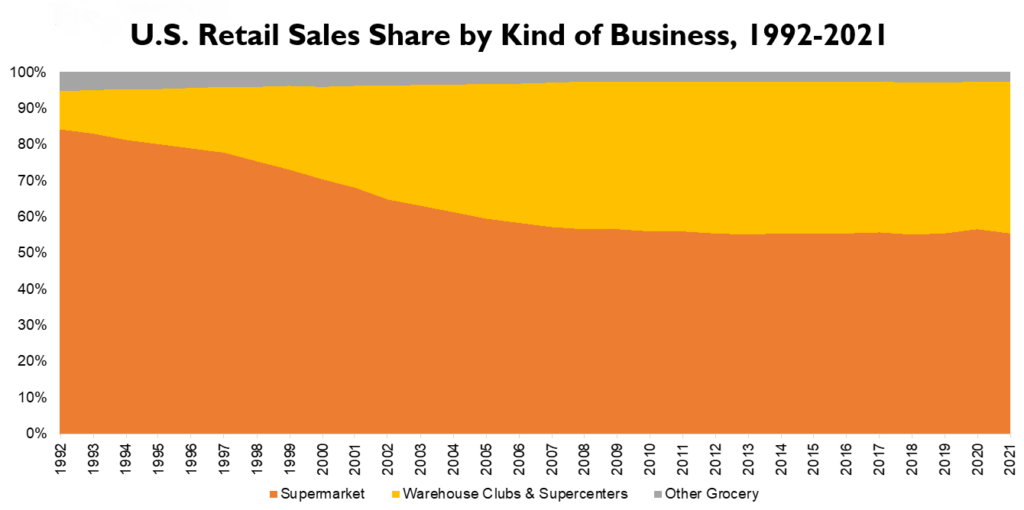
Along similar lines, online shopping and home delivery have grown from niche services that served only 10,000 households nationwide a quarter century ago to a scenario in which 12.5% of U.S. consumers now purchase groceries mostly or exclusively online.

Amazon is now the second-largest food and grocery retailer in the United States. Meanwhile, millions of consumers use delivery services like Instacart to purchase food and groceries from supermarkets, supercenters, club stores, wholesalers, and ethnic markets.

These new businesses place significant competitive pressure on traditional retailers, making the prospect of post-merger market power even more unlikely.

MISPLACED LABOR-MARKET CONCERNS

Some opponents of the merger argue that it would lead to monopsony power in labor markets and depress supermarket employee wages. But these concerns are overblown and will be nearly impossible to demonstrate if the merger were to be litigated. 

The market for labor in the retail sector is highly competitive, with workers having a wide range of alternative employment options. More importantly, both Kroger and Albertsons are highly unionized firms. Through their collective-bargaining agreements, these unions exert their own market power.

THE HAGGEN FIASCO: LESSONS LEARNED

Finally, some point to Haggen’s disastrous acquisition of stores spun-off from the Albertsons/Safeway merger as evidence that divestitures don’t work. But several factors idiosyncratic to Haggen and its acquisition strategy led to that failure, rather than the divestiture itself. 

Before it acquired the stores, Haggen was a small regional chain with only 18 stores, mostly in Washington State. In addition, buying the stores left Haggen’s owners heavily in debt.

These issues could—and should—have been addressed when the FTC and the merging parties were negotiating their consent order. Today’s enforcers should thus learn from the Haggen experience—by devising workable remedies—rather than view it as a justification to reject reasonable divestiture options.

For more on this issue, see the International Center for Law & Economics (ICLE) issue brief “Five Problems with a Potential FTC Challenge to the Kroger/Albertsons Merger.”

TL;DR

AI Regulation Needs a Light Touch

Background: Artificial intelligence—or “AI”—is everywhere these days. It powers our smartphones, cars, homes, and entertainment. It helps us diagnose diseases, teach children, and create art. . . .

Background: Artificial intelligence—or “AI”—is everywhere these days. It powers our smartphones, cars, homes, and entertainment. It helps us diagnose diseases, teach children, and create art. It promises to revolutionize every aspect of our lives, for better or worse. 

But … How should public policy respond to this powerful and rapidly evolving force? How should we ensure that AI serves our interests and values, rather than undermining or subverting them?

Some observers and policymakers fear that AI could pose existential threats to humanity, such as unleashing rogue superintelligences, triggering mass job losses, or sparking global wars. They argue that governments should take a prescriptive approach to AI regulation to preempt speculated threats.

Some argue that we need to impose strict and specific rules on AI development and deployment, before it is too late. In a recent U.S. Senate Judiciary Committee hearing, OpenAI CEO Sam Altman suggested that the United States needs a central regulator for AI. 

However … This approach is likely to be both misguided and counterproductive. Overregulation could stifle innovation and competition, depriving us of the benefits and opportunities that AI offers. It could put some countries at a disadvantage relative to those that pursue AI openly and aggressively. It could also stifle learning from AI and developing better AI.

ADOPT AN ADAPTIVE APPROACH

A more sensible and effective approach to oversight is to pursue an adaptive framework that relies on existing laws and institutions, rather than creating new regulations, agencies, and enforcement mechanisms.

There are already laws, policies, agencies, and courts in place to address actual harms and risks, rather than hypothetical or speculative ones. This is what we’ve done with earlier transformative technologies like biotech, nanotech, and the internet. Each has been regulated by applying existing laws and principles, such as antitrust, torts, contracts, and consumer protection. 

In addition, an adaptive approach would foster international dialogue and cooperation, which have been essential for establishing norms and standards for emerging technologies.

AN ADAPTIVE APPROACH DOES NOT MEAN COMPLACENCY

Pursuing an adaptive approach does not mean that we should be complacent or naive about AI. Where the technology is misused or causes harm, there should be actionable legal consequences. For example, if a real-estate developer intentionally used AI tools to screen out individuals from purchasing homes on the basis of protected characteristics, that should be actionable. If a criminal found a novel way to use ChatGPT to commit fraud, that should be actionable. If generative AI is used to create “deep fakes” that amounts to libel, that should be actionable. But in each of these cases, it is not the AI itself that is the relevant unit of legal analysis, but the actions of criminals and the harms they cause.

Ultimately, it would be fruitless to try to build a regulatory framework that would make it impossible for bad actors to misuse AI. Bad actors will always find ways to misuse tools, and heavy-handed regulatory requirements would chill the development of the very AI tools that could combat misuse.

DON’T NEGLECT THE BENEFITS

If history is any guide, it is likely that AI tools will allow firms and individuals to do more with less, expanding their productivity and improving their incomes.

By freeing capital from easily automated tasks, existing firms and new entrepreneurs could better focus on their core business missions. For example, investments in marketing or HR could be redeployed to R&D. At this point, we have little idea how AI will be used by people and firms. And more importantly, neither do politicians, policymakers, or regulators.

OVER-REGULATION WOULD INCREASE MARKET POWER

Overly burdensome AI regulation would likely hinder the entry and growth of new AI firms. For example, as an established player in the AI market, it should be no surprise that OpenAI’s CEO would favor a strong central regulator that can impose entry barriers on newcomers.  It is well-known in both law and economics that incumbent firms can profit from raising their rivals’ regulatory costs.

This dynamic can create strong strategic incentives for industry incumbents to promote regulation and can lead to a cozy relationship between agencies and incumbent firms in a process known as “regulatory capture.”

CONCLUSION

The key challenge confronting policymakers lies in navigating the dichotomy of mitigating actual risks posed by AI, while simultaneously fostering the substantial benefits it offers. 

To be sure, AI will bring about disruption and may provide a conduit for bad actors, just as technologies like the printing press and the internet have done in the past. This does not, however, merit taking an overly cautious stance that would suppress many of the potential benefits of AI.

Policymakers must eschew dystopian science-fiction narratives and instead base policy on realistic scenarios. Moreover, they should recognize the laws, policies, and agencies that already have enormous authority and power to find and punish those who misuse AI.

For more on this issue, see the International Center for Law & Economics’ (ICLE) response to the National Telecommunications and Information Administration’s AI Accountability Policy, as well as ICLE’s response to the similar inquiry from the White House Office of Science and Technology Policy.

TL;DR

Network Effects and Interoperability

Background: The European Union’s Digital Markets Act (DMA), which went into effect in November 2022,  requires online platforms deemed to be “gatekeepers” to make their . . .

Background: The European Union’s Digital Markets Act (DMA), which went into effect in November 2022,  requires online platforms deemed to be “gatekeepers” to make their services interoperable. Interoperability refers to the ability of different systems, devices, or applications to communicate and exchange information. Importantly, the DMA envisions horizontal interoperability for messaging services, as well as vertical interoperability obligations. These include the ability to install third-party app stores and to install applications through sideloading, along with ensuring access to operating systems’ critical functionalities and specific devices’ hardware capabilities.

However… While interoperability requirements can reduce switching costs between platforms and possibly  help consumers avoid being “locked-in” to inferior products, the net effects on new technology and greater competition are mostly speculative. Claims that mandatory interoperability is a “super tool” for platform competition rely on excessive switching costs between platforms effectively serving as a barrier to entry. The rise of new social networks like TikTok and messaging services like Discord suggests that network effects may be less pervasive than previously thought. Many consumers are perfectly comfortable with “multi-homing” and using multiple platforms. 

Network Effects Are Everywhere; Network Harms Are More Specific

Consumers in any market—not exclusively or even predominantly digital markets—strike a balance between using multiple providers (multi-homing) and remaining loyal to just one. Network effects can give incumbents an advantage over challengers, but identifying that a given market has network effects does not, in itself, justify mandating interoperability. For any potential interoperability mandate, we must ask how costly it is for consumers to multi-home. 

For example, a consumer may find it low-cost to download multiple apps—such as Zelle, PayPal, or Venmo—that each allow one to send money to a friend. By contrast, it may be quite costly to gain followers on a new social-media platform. Interoperability mandates have tended to focus on markets that already have low switching costs, hence limiting potential gains.

Lock-In Can Increase Competition

We say a consumer is “locked-in” when high switching costs make it difficult for them to switch suppliers even when quality changes. But markets subject to lock-in may still see fierce competition for users. Companies compete upfront to attract such consumers through tactics like penetration pricing, introductory offers, and price wars. This “competition for the market” can effectively substitute for standard compatible competition and might even be more intense, as it reduces differentiation. It is not a simple linear relationship, where lower switching costs are always better for consumers.

Interoperability Isn’t Always Good

Interoperability proponents argue that it levels the playing field between tech giants and smaller competitors. The debate often imagines a low-quality incumbent using lock-in to keep a high-quality challenger at bay. But we don’t necessarily want everything to be interoperable. It would be a problem if, e.g., everyone’s door keys were interoperable. The analogous problem in tech is cybersecurity. More interconnected systems are more vulnerable to cyberattacks and data breaches. Mandating interoperability, such as between messaging services, can inadvertently expose users to greater security risks by creating additional points of access for bad actors.

Static Standards and Dynamic Markets

There are many examples of interoperability resulting from the voluntary adoption of standards. Credit-card companies manage vast, interoperable payment networks; screwdrivers work with screws made by various manufacturers; and U.S. colleges accept credits from other institutions. 

Interoperability also tends to evolve over time and regulators should not imagine the current system will last forever. Bluetooth was initially developed for wireless communication between devices like headsets and phones, but has evolved to also enable seamless connectivity among various speakers, keyboards, smartwatches, and so forth—all from different manufacturers. This standardization has greatly simplified wireless connections and improved user experience.

Calculate Costs in Addition to Benefits

While a literature review on switching costs and network effects by esteemed scholars Joseph Farrell and Paul Klemperer concluded that “firms probably seek incompatibility too often. We therefore favor thoughtfully pro-compatibility public policy,” they also recognize that competition to be the dominant platform “can adequately replace ordinary compatible competition, and can even be fiercer than compatible competition by weakening differentiation.”

Moreover, the theoretical papers they considered mostly ask whether increasing or decreasing switching costs increases consumer welfare. Mandates implemented through public policy tend to be more blunt and, after accounting for factors like increased security risks, are less likely to pass a cost-benefit test. Consumers often come across situations where interoperability might provide some benefits, but where the costs outweigh the gains. Policymakers should take the same approach.

For more on this issue, see “Antitrust Unchained: The EU’s Case Against Self-Preferencing” by Giuseppe Colangelo; “Privacy and Security Implications of Regulation of Digital Services in the EU and in the US” by Mikolaj Barczentewicz; and “Mandatory Interoperability Is Not a ‘Super Tool’ for Platform Competition” by Samuel Bowman.

TL;DR

Ads Aren’t Stocks: The AMERICA Act’s Dangerous False Analogies

Background: The Advertising Middlemen Endangering Rigorous Internet Competition Accountability (AMERICA) Act, recently introduced by Sen. Mike Lee (R-Utah), would bar companies that own a digital-advertising . . .

Background: The Advertising Middlemen Endangering Rigorous Internet Competition Accountability (AMERICA) Act, recently introduced by Sen. Mike Lee (R-Utah), would bar companies that own a digital-advertising exchange with more than $20 billion in annual ad revenue from also providing services to buyers and sellers of ads, or from selling advertising space themselves. The bill also would impose fiduciary-like duties on those who buy and sell online ads for others

However… While advocates of the legislation claim the changes they seek are based on analogous rules used in the regulation of securities markets, such analogies are based on fundamental misunderstandings of how securities regulation works and why it exists. The requirement for “physical separation,” which could force the breakup of vertically integrated digital-advertising platforms like Google, does not exist in securities law; many stockbrokers also own exchanges where stocks are traded. Moreover, rules that stock trades be executed at the best-available price are imposed precisely because vertical integration is common. Ultimately, stocks are regulated in the way that they are because of the central role they play in the savings and investments of everyday Americans. Advertising, while important, does not serve that role.

No ‘Physical Separation’ Rule in Stocks

In a press release announcing the introduction of the AMERICA Act, Matt Stoller of the American Economic Liberties Project expressed a sentiment common among proponents of the legislation, that just as “no one would accept Goldman Sachs running the New York Stock Exchange,” Congress should not “let corporations run all sides of a transaction in online ad markets.”

Sen. Lee likewise has said of his bill that its “restrictions and requirements mirror those imposed on electronic trading in the financial sector.”

The problem with these analogies is that there actually is no requirement in securities law that prohibits brokers from owning exchanges on which stocks are traded. Goldman Sachs does not own the NYSE, but it does own a different stock exchange (called SigmaX2) where the same stocks are bought and sold. In fact, about half of all stock trades are made on trading venues (i.e., exchanges by a different name) owned by brokers.

Thus, while the AMERICA Act would ban Google from acting as a broker on its own ad exchange, securities law—on which the law is purportedly founded—permits exactly this same conduct.

The Best-Interests Standard May Be Impossible to Enforce in Ad Tech

The AMERICA Act would also create a legal duty to act in a client’s best interest when helping them buy or sell ads. This is similar to rules in securities law, but one of the reasons such duties exist in stock markets is precisely because brokers may own exchanges and otherwise act on behalf of clients when there are real or potential conflicts of interest. 

While stockbrokers do have a duty to execute trades at the best price, there is some discretion baked into the system, especially since price is not the only factor customers care about. A recent empirical study found that only about 43% of trades were made at the “best” price, because of the impact of various discounts and other factors paid by exchanges.

As difficult as it is to enforce a best-interests rule in stock markets, establishing something akin to it in online display advertising would be a monumental task. While a stock has one price for every potential investor at any time, and it has some intrinsic value, online advertisements have many more degrees of interest. In online display-ad auctions, the price is set for a particular viewer at a particular location at a particular time. These multiple factors, and the lack of any objective valuation, makes determining the “best” price, or even a reasonable price, far more complex.

The AMERICA ACT proposes that the best-interests rule would be enforced by the U.S. Justice Department and state attorneys general, but this is a massive underestimate of the bureaucracy needed to establish and enforce such rules.

Ads Aren’t Stocks

Plenty of markets involve vertical integration with conflicts of interest, but do not require physical separation or impose fiduciary duties. For instance, auction houses provide a venue where buyers and sellers come together to bid on art and antiquities, while also providing services and advice to buyers and sellers, as well as sometimes bidding on items themselves.

The AMERICA Act takes a belt-and-suspenders approach that offers more supposed protection for advertisers and ad buyers than stock traders, even though the potential mischief and consequences are greater in the securities world. Ordinary Americans have their savings and their futures bet in the stock markets, not in ad markets, which are merely places where business-to-business services are bought and sold. There is no investment or speculation in ad markets.

Ultimately, the stock market is regulated as it is because of the profound social importance of accurate stock prices, not because of overriding concerns about conflicts of interests in general. Stocks are regulated as they are because they are stocks. Ads are not stocks, and thus, regulating them like stocks makes no sense.

For a more extensive treatment of this issue, see the ICLE white paper “Ads Aren’t Stocks, or How Bad Analogies Make Bad Law,” as well as other ICLE research on the law & economics of digital advertising here and here.

TL;DR

Europe’s New SEP Regulation: All Quiet on the Patent Front?

Background: The European Commission is about to unveil draft regulation that will more tightly regulate how patents are incorporated into technology standards. The Commission’s expert . . .

Background: The European Commission is about to unveil draft regulation that will more tightly regulate how patents are incorporated into technology standards. The Commission’s expert report and call for comments suggest that it wants to create a regime of third-party checks that would verify whether inventors’ patents are truly essential to a technology standard (i.e., “essentiality checks”). The goal ultimately is to ensure that standard-essential patents (SEPs) are adequately disclosed to would-be licensees. There are thousands of SEPs that underpin the technologies powering the digital economy, thus making it essential that firms coordinate to develop and implement these technologies.

However… It is unclear that such regulation would improve upon the status quo. While it might not be perfect, the existing approach to essentially checks has seen SEP-reliant industries provide countless technological breakthroughs. This has led industries where SEPs are particularly relevant to occupy key geostrategic positions. By contrast, imposing heavy-handed regulation risks not only that there will be harm to consumers, but the potential that the West’s strategic position relative to adversarial foreign powers like China or Russia may be weakened.

THE ROLE OF ESSENTIALITY CHECKS

Technical standards (e.g., 5G, WiFi, USB-C, etc.) often rely on hundreds—sometimes thousands—of distinct inventions that can each be covered by multiple patents. 

Firms that commercialize goods incorporating these technologies need to know which patents are essential to those standards—thus avoiding situations where license fees are paid for technologies that are not necessary to practice a given standard.

Essentiality checks can potentially streamline this process, thereby limiting the over- and/or under-disclosure of SEPs. But this is a complex and costly endeavor. The benefits of achieving perfect disclosure of SEPs—be it via market forces or regulation—are thus unlikely to outweigh the costs.

WHO SHOULD ASSESS ESSENTIALITY?

As things stand, a patent’s essentiality is determined in various ways. These include the use of patent pools, self-assessments by inventors, and evaluations outsourced to third-party experts. 

Whatever one thinks of that heterogeneous approach, it is clear that the SEP industry has thrived under this laissez-faire paradigm, and that competition among the various inventors, implementers, and standards-development organizations (who bring inventors and implementers together) has played a useful role in optimizing these processes. Regulators should thus be wary not to upset the apple cart.

In contrast, the Commission’s expert report and its call for comments both suggest that it favors a more centralized system in which government institutions, such as patent offices, would act as backstops for essentiality checks. 

Such a system would not be without risks. Indeed, there is little evidence that SEP-heavy industries are underperforming. Any reform thus risks creating more friction than it removes.

WHAT ABOUT SANCTIONS?

There are fears that excessive sanctions for failing to adequately disclose essential patents could tilt the bargaining power in SEP-reliant industries toward implementers. In turn, this could undermine inventors’ incentive to produce new technologies.

In recent years, courts around the world have sought to strike an appropriate balance between the interests of inventors and implementers. In doing so, they have foiled attempts by several regulators to limit the royalties that inventors can extract; to prevent them from obtaining injunctions against infringers of their patents; and to determine the level of the value chain at which royalties are to be calculated. 

One concern is that the draft regulation may seek to forward those goals by assessing penalties for failing to comply with its provisions. For instance, inventors may lose the ability to bring injunctions against infringers if a third party deems their patent to be non-essential. Given the vital role that these injunctions play, such a policy would be misguided.

GEOSTRATEGIC IMPACT 

Finally, overburdening firms that are active in the SEP space could erode the West’s technological leadership relative to states with manufacturing-reliant economies whose political leaders routinely undermine the intellectual property rights of foreign firms.

Many SEPs, particularly those relevant to the telecommunications sector, are held by companies in the West and specifically in the United States. The lion’s share of implementers, by contrast, are based in China. Policies that impose significant costs on inventors and benefit implementers may thus amount to a subsidy to Chinese firms and a tax on Western innovation.

These harmful consequences are magnified in light of China’s strategic effort to shape international technology standards. With European firms systematically deterred from participating in the development of open technology standards, Chinese firms—directed by their government authorities—will gain significant control of the technologies that underpin tomorrow’s digital goods and services. The consequences are potentially catastrophic.

For more on this issue, see ICLE’s academic output on standard essential patents here and here, and our response to the Commission’s recent consultation here. 

TL;DR

FTC UMC Authority: Enforcement Issues

Background: In 2015, the Federal Trade Commission (FTC) issued a policy statement on its “unfair methods of competition” (UMC) authority—the antitrust part of Section 5 . . .

Background: In 2015, the Federal Trade Commission (FTC) issued a policy statement on its “unfair methods of competition” (UMC) authority—the antitrust part of Section 5 of the FTC Act. According to the statement, while Section 5 wouldn’t be strictly limited to conduct illegal under the letter of the Sherman Antitrust Act, it would stick to the “spirit” of the Sherman Act, use roughly the same economic tools and general approach, and maintain the same focus on consumer welfare. 

But… Some argue for a more expansive interpretation of the FTC’s UMC authority, seeing Section 5 as allowing government enforcers to evade the judicial limits the Sherman Act places on private plaintiffs. This view, of course, still leaves open the question of what Section 5 should cover: If antitrust is supposed to protect competition without impeding markets and innovation, enforcement without any of the procedural and substantive guardrails developed over the course of 130 years of Sherman Act litigation is surely inappropriate.

A NEW POLICY STATEMENT 

Although a few saw the 2015 statement as too expansive, many condemned it as too constraining on enforcement. Those views found support in the new FTC majority appointed by President Joe Biden, which in 2021 moved by a strictly partisan vote  to withdraw the 2015 statement. The FTC issued a completely new Section 5 UMC policy statement in November 2022.

OLD STANDARDS & METHODS ARE OUT

The 2022 UMC policy statement omits both the consumer welfare standard and the rule of reason, which have been used to weigh how alleged violations harm and benefit competition and consumers. Under the new statement, conduct deemed problematic by the FTC can no longer be justified by efficiency or by a numerical cost-benefit analysis. It’s not clear that it can be justified at all. The actual and likely effects of conduct are no longer critical either.

The Commission says it will look at the “tendency” of a type of action to have an effect on not just consumers but also workers or “other market participants.” The new statement expresses concern with market conduct that is “exploitative” or “coercive.” Those terms sound bad, to be sure, but they don’t have any established meaning in antitrust law. The new statement reflects the Commission’s belief that it’s simply up to them to decide what constitutes a UMC violation.

REGULATIONS RATHER THAN CASE BY CASE

The 2022 UMC policy statement also signaled that the FTC would issue rules in accordance with its new interpretation of Section 5, potentially removing certain conduct from traditional rule-of-reason judicial review. Indeed, in January 2023, the FTC issued a notice of proposed rulemaking on noncompete clauses. The proposed rule claims the FTC’s UMC authority as its basis, and eschews a case-by-case approach to assessing the competitive effects of noncompete clauses for, instead, a blanket, per se ban on all such clauses in workplace contracts.

SEVERAL PROBLEMS REMAIN

When the FTC was established in 1914, some in Congress wanted the prohibition on “unfair” competition to reach further than the Sherman Act did at the time. But Congress didn’t specify the details, and today’s Sherman Act reflects a century of antitrust developments since then. 

Whatever “unfair competition” was intended to mean, it’s unlikely it was intended to operate in a realm entirely divorced from the economic understandings and law developed under the Sherman Act. 

In its selective reading of the legislative history, the Commission ignores the checks imposed by Congress and the courts when the FTC last tried a highly expansive “reading” of Section 5. In the 1970s, Congress thought the FTC was running amok, and it imposed new legal restrictions on the agency’s ability to issue regulations. For a brief time, Congress shut the FTC down. In a number of decisions, courts said that the FTC had failed to make a standalone case. 

CONSTITUTIONAL LIMITS ON AGENCIES

Under the U.S. Constitution, Congress makes the laws. Executive agencies interpret them and carry them out. The “major questions doctrine,” which has gained renewed import with the Court’s 2022 West Virginia v. EPA decision,  says there are limits on an agency’s ability to make law under the guise of interpretation. An agency can issue sweeping regulations with major economic import only if Congress has been specific in telling it what to regulate and how to do it. 

But “unfair” is not at all specific. And, in fact, the current FTC majority has made clear that it is interested in regulating all sorts of significant things for which it has no specific remit under Section 5, including employment agreements and data privacy. 

What’s more, the “nondelegation doctrine” says that Congress cannot be too sweeping in telling an agency what to do, because it cannot delegate its constitutional lawmaking duty to unelected agencies. The wording of the FTC’s new policy statement suggests that it remains very interested in promulgating such “legislative” rules, as the noncompete rule bears out. 

We don’t know for certain how the courts will view the FTC’s innovations, but there’s ample reason to expect considerable judicial skepticism.

For more on the limits of the FTC’s UMC authority, see the ICLE explainer FTC UMC Authority: Uncertain Scope.

TL;DR

FTC UMC Authority: Uncertain Scope

Background: U.S. law grants both the Federal Trade Commission (FTC) and the U.S. Justice Department (DOJ) authority to enforce both the Sherman Antitrust Act and . . .

Background: U.S. law grants both the Federal Trade Commission (FTC) and the U.S. Justice Department (DOJ) authority to enforce both the Sherman Antitrust Act and the Clayton Antitrust Act. The FTC also enforces the Federal Trade Commission Act. Indeed, the agency’s antitrust authority is grounded in Section 5 of that act, which prohibits “unfair methods of competition” (UMC).

But… There’s been ongoing controversy about the meaning of these laws and particularly about Section 5. Both the Sherman Act and the FTC Act are written in very broad terms. Section 1 of the Sherman Act prohibits “Every contract, combination… or conspiracy, in restraint of trade.” But which contracts or combinations are illegal restraints of trade? Similarly, which methods of competition are “unfair,” as prohibited under Section 5? Most importantly, what, if anything, does UMC cover that isn’t covered by the Sherman Act?

A PURPOSEFUL LACK OF SPECIFICS 

In writing these antitrust statutes, Congress set down general goals, an institutional structure, and enforcement powers, but left it to the agencies and the courts to develop the details. That provided for flexibility as the economy and our understanding of market competition evolved.

For more than 100 years, that’s roughly how things proceeded. Both agencies brought cases; the FTC also generated research and reports; and the courts weighed in, too. Congress exercised its voice through both amendments and appropriations. The FTC monitored and contributed to economic learning in ways ultimately reflected in legal standards.

An understanding emerged that the FTC’s UMC authority reached somewhat beyond the Sherman Act, but was still tethered to the central antitrust concepts of the consumer welfare standard and the “rule of reason,” both of which offer courts a means to evaluate the legality of market behavior in terms of its likely harms and benefits.

WHAT ELSE, IF ANYTHING, DOES UMC COVER?

While the various antitrust laws use somewhat different language, there is considerable overlap among them. In 1941, the Supreme Court ruled (and has affirmed many times since) that UMC includes conduct prohibited under the Sherman and Clayton Acts. But UMC also includes some amount of “extra” coverage beyond the other antitrust laws—known as “standalone Section 5 authority.” While there’s been considerable agreement that Section 5 goes beyond the letter of the Sherman Act, there’s much less agreement about what lies beyond.

For one thing, the FTC Act doesn’t say. Also, relatively few decisions are based on standalone Section 5. The FTC has tended to bring cases alleging simultaneous violations of both Section 5 and the Sherman Act, and the DOJ doesn’t enforce the FTC Act. The relevant court decisions are old and likely out of date. Complicating the issue is that many of the cases recognizing standalone authority are ones the government lost, so the decisions suggest that Section 5 reaches something beyond the Sherman Act, but fail to indicate what that might be.

KEY CONSTRAINTS IMPOSED BY CONGRESS AND THE COURTS

In 1972’s FTC v. Sperry & Hutchinson, the U.S. Supreme Court famously found that there may be Section 5 violations that have “anticompetitive impact” but do not violate the other antitrust laws. But the FTC lost that case because the agency did not appeal the lower court’s decision that there was no Sherman Act violation and because it failed to establish a Section 5 violation on any other grounds. The Court’s ruling didn’t tell us what would constitute a standalone violation of Section 5, except that consideration of “public values beyond… those enshrined… in the… antitrust laws” was permitted.

Yet in the wake of Sperry & Hutchinson, as well as a dust-up between the FTC and Congress over Section 5’s prohibition of “unfair or deceptive acts or practices” (UDAP), Congress amended Section 5 to make clear that “public policy considerations may not serve as a primary basis” for liability (at least for UDAP).

More recent decisions have reinforced the importance of an integrated approach to the antitrust laws, as well as of both the rule of reason and the consumer welfare standard. This prompted former FTC Chairman Bill Kovacic to write that the FTC “should not… rely on the assertion… that the Commission could use its UMC authority to reach practices outside both the letter and spirit of the antitrust laws. We think the early history is now problematic, and we view the relevant language… with skepticism.”

A GENERAL CONSENSUS

Most experts recognize that Section 5 operates as a measured extension of the Sherman Act, with the two laws serving a common goal. Thus there is agreement that Section 5 applies to “invitations to collude.” If two or more competing firms agree to fix prices, that’s an illegal agreement that violates the Sherman Act. But if one firm attempts unsuccessfully to collude—inviting a competitor to join in a price fixing scheme only to be rebuffed—there’s no agreement at all, much less an actual restraint. But because it’s an attempt to violate the Sherman Act that presents a risk of harm to competition and consumers but serves no legitimate business purpose, most everyone agrees it would properly be within the scope of Section 5.

For more on ongoing controversies regarding Section 5 UMC, see the ICLE explainer FTC UMC Authority: Enforcement Issues.

TL;DR

Implementing the DMA: Great Power Requires Great Procedural Safeguards

Background… In December 2022, the European Commission launched a public consultation on the regulation to implement the Digital Markets Act, including how the DMA will . . .

Background…

In December 2022, the European Commission launched a public consultation on the regulation to implement the Digital Markets Act, including how the DMA will be enforced procedurally. Among the issues the regulation covers are parties’ rights to be heard, firms’ deadlines to submit documents to the Commission, access to those documents and to the Commission’s case file, and how confidentiality will be protected.

However…

While reasonable people may disagree about the merits of digital-markets regulation, appropriate procedural rules that safeguard parties’ rights and create legal certainty are essential. The timing, background, and content of the Implementing Regulation, however, all raise legitimate concerns and underscore broader issues in the DMA.

Read the full explainer here.

TL;DR

Journalism Competition and Preservation Act: Not What It Says on the Box

Background… As leaders of the U.S. Senate work to pass the National Defense Authorization Act (NDAA) in the ongoing lame-duck session, some reports suggest that S. 673, the Journalism Competition...

Background…

As leaders of the U.S. Senate work to pass the National Defense Authorization Act (NDAA) in the ongoing lame-duck session, some reports suggest that S. 673, the Journalism Competition and Preservation Act (JCPA), could be added to the legislative package. Approved in September 2022 by the Senate Judiciary Committee, the JCPA aims to boost the fortunes of traditional media companies by forcing “covered” online platforms to pay for digital journalism accessed via their services. The bill would require that platforms continue to display digital journalism, while setting out an intricate process whereby digital-journalism providers would collectively negotiate the price of content with platforms.

But…

This quixotic attempt to prop up flailing media firms will create legally sanctioned cartels that harm consumers, while forcing online platforms to carry and pay for content in ways that violate long-established principles of intellectual property, economic efficiency, and the U.S. Constitution.

Read the full explainer here.

TL;DR