




Carveouts at Checkout: Small Savings, Large Costs, and the Payment-Card Settlement

Executive Summary
The proposed settlement of the longstanding multidistrict Visa and Mastercard antitrust litigation would reduce interchange fees and expand merchants’ options for card acceptance, surcharging, and steering. Meanwhile, various state legislative carveouts, led by Illinois’ Interchange Fee Prohibition Act, seek to eliminate interchange fees on taxes and/or gratuities. Both approaches aim to lower merchants’ acceptance costs, but the multidistrict litigation settlement would deliver broader relief with far lower merchant compliance costs—in addition to weakening the case for legislative carveouts.
The settlement’s average interchange reduction would equal roughly 0.1% of covered credit card sales, comparable to Illinois’ projected gross carveout savings. Merchants on interchange-plus pricing would receive the reduction directly, while savings under blended pricing would depend on processors’ adjustments. Carveouts would also require costly system upgrades or reimbursement claims, potentially consuming smaller merchants’ savings. Lower settlement rates would further shrink carveout benefits, concentrating gains among large retailers. Merchants recovering their acceptance costs through surcharges would have little additional benefit to gain.
The two interventions would also interact in costly ways. The settlement’s caps would constrain efforts to offset carveout losses through interchange adjustments, shifting costs toward cardholders through reduced rewards or higher fees. Federal preemption also appears likely to concentrate the remaining institutional losses on local banks and credit unions. Carveouts could count toward the settlement’s nationwide reduction, reducing relief elsewhere, while implementation would compete for engineering capacity. Both interventions might also shift transactions toward more expensive three-party cards, including American Express and Discover.
The settlement itself would likely impose net economic costs through reduced cardholder benefits and higher fees. State carveouts would add compliance burdens and distortions for increasingly narrow gains. Whether or not the settlement is ultimately approved, Illinois should repeal its carveout, and other states should abandon similar proposals. Capped compensation for electronic tax remittance offers a more direct way to address merchants’ tax-collection costs.
I. Introduction
Judge Brian Cogan of the U.S. District Court for the Eastern District of New York granted preliminary approval June 9, 2026, to the proposed settlement of In re Payment Card Interchange Fee and Merchant Discount Antitrust Litigation, a multidistrict litigation proceeding. The 21-year-old antitrust action involves a mandatory class of more than 12 million U.S. merchants—who cannot opt out—suing Visa, Mastercard, and their member banks.[1]
Court-appointed experts value the settlement at roughly $38 billion through 2031. It would reduce average credit interchange rates—the fees merchants’ banks pay card-issuing institutions—by 10 basis points, or 0.1% of transaction value, for five years. It would also freeze posted rates at March 2025 levels, cap standard consumer credit card rates at 1.25% for at least eight years, repeal the honor-all-cards rule requiring merchants to accept all cards within a network, and expand merchants’ rights to surcharge, discount, and negotiate collectively.[2]
While negotiating the settlement, merchant groups pursued a parallel campaign in state legislatures to exclude specific portions of card transactions from interchange fees. Only Illinois has thus far enacted legislation, which remains in legal limbo, with implementation deferred until July 1, 2027.[3] If implemented, the Illinois Interchange Fee Prohibition Act (IFPA) would prohibit retaining interchange fees on the portions of a card transaction attributable to state and local taxes and gratuities.[4]
Similar bills were defeated 46 times in more than two dozen states in 2025 and 2026. None became law. Colorado’s version passed the legislature in May 2026 before Gov. Jared Polis vetoed it.[5] Delaware has considered a bill directed at gratuities, Rhode Island has held hearings, Pennsylvania continues to advance carve-out measures, and Massachusetts has convened a special commission whose remit includes interchange regulation.[6] These proposals rest on the premise that merchants pay too much to accept payment cards, particularly on amounts they collect for the state or pass on as gratuities.
This issue brief builds on my recent commentary on the settlement, earlier papers on state interchange-fee carveouts, and evidence on the effects of interchange regulation across jurisdictions.[7] It examines the settlement’s likely effects in greater detail, summarizes the likely effects of the carveouts, and compares the two interventions and their interactions.
The settlement’s net economic effect is almost certainly negative, but its social cost would likely be significantly lower than that of the state carveouts. It also achieves much of what the carveouts purport to achieve, while making them less effective on their own terms and more expensive to implement.
The settlement would directly reduce the fees many merchants pay by 0.1% of transaction value, with few, if any, compliance requirements. It would also reduce interchange revenue for card-issuing banks and credit unions, which would likely respond by raising other fees, reducing card benefits such as rewards, or both. Some merchants would likely introduce surcharges and steer customers toward cards with lower fees. Evidence suggests that most merchants would retain the savings from lower fees, while those that pass savings on to consumers would share only a small fraction.[8] Cardholders would thus face higher fees and fewer benefits, with largely unchanged prices.
The carveouts would allow merchants to reduce their fees, but most, if not all, would need to make substantial investments in payment-processing systems. For smaller merchants, the cost of systems that automatically exclude taxes and tips from interchange calculations may exceed the savings. Some might instead seek reimbursement by saving receipts and submitting them manually—a costly, error-prone process that would likely require additional auditing. Both approaches would add significant costs to payment processing, leading to higher fees, reduced investment elsewhere, or both.
The carveouts also assume that card issuers will process the exempt portion of each transaction for free. If issuers refuse, customers will have to pay taxes and tips by cash or check. As with the settlement, consumers would see little, if any, reduction in costs, while facing greater inconvenience. Smaller banks would also bear a disproportionate burden because of the high fixed costs of compliance.
The settlement would therefore deliver larger, guaranteed, and more evenly distributed fee reductions to merchants, with practically none of the merchant compliance costs associated with the carveouts. It would also allow merchants to surcharge up to 3% of transaction value, or their processing cost, whichever is lower. Merchants that surcharge could recover all their processing fees, including those attributable to sales taxes and tips.
Section II of this brief examines interchange fees’ role in the broader card-payments system. Section III describes the settlement’s core elements and implications for issuers and merchants. Section IV summarizes the state carveout laws’ aims, mechanics, and current legal status. Section v compares the settlement and carveouts, examines their interactions, and assesses their effects on three-party card systems, in which one company issues cards, serves merchants, and operates the network. Section VI concludes.
II. Interchange Fees and Merchant Payment Costs
Interchange fees help coordinate payment networks and balance participation by merchants and cardholders. This section explains how three- and four-party card systems perform those functions and how merchant pricing arrangements affect the pass-through of interchange reductions. These distinctions help explain why the settlement and state carveouts affect merchants differently and may shift transactions toward three-party systems, which fall outside both interventions
A. How Payment Card Systems Work
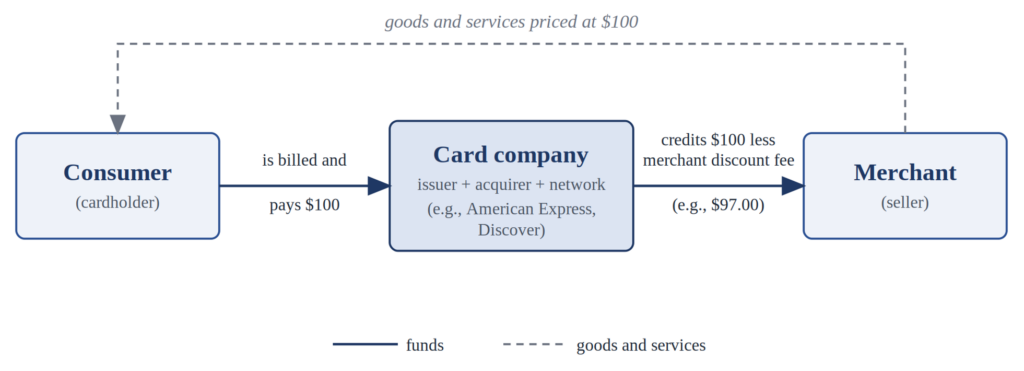
Payment cards in the United States operate under one of two architectures. In a three-party system, such as American Express or Discover, a single company performs all intermediary functions. It issues cards to consumers, acquires payments on merchants’ behalf, and operates the network that authorizes, clears, and settles transactions—approving payments, reconciling transaction details, and transferring funds.
FIGURE 1: Transactions in a Three-Party Card System
SOURCE: Author’s illustration.
When a cardholder spends $100 at a merchant, the card company bills the cardholder, credits the merchant with $100 less a merchant discount fee, and retains that fee as compensation for its services (Figure 1). Because one firm serves both cardholders and merchants, it balances what cardholders receive against what merchants pay through its pricing on each side.[9]
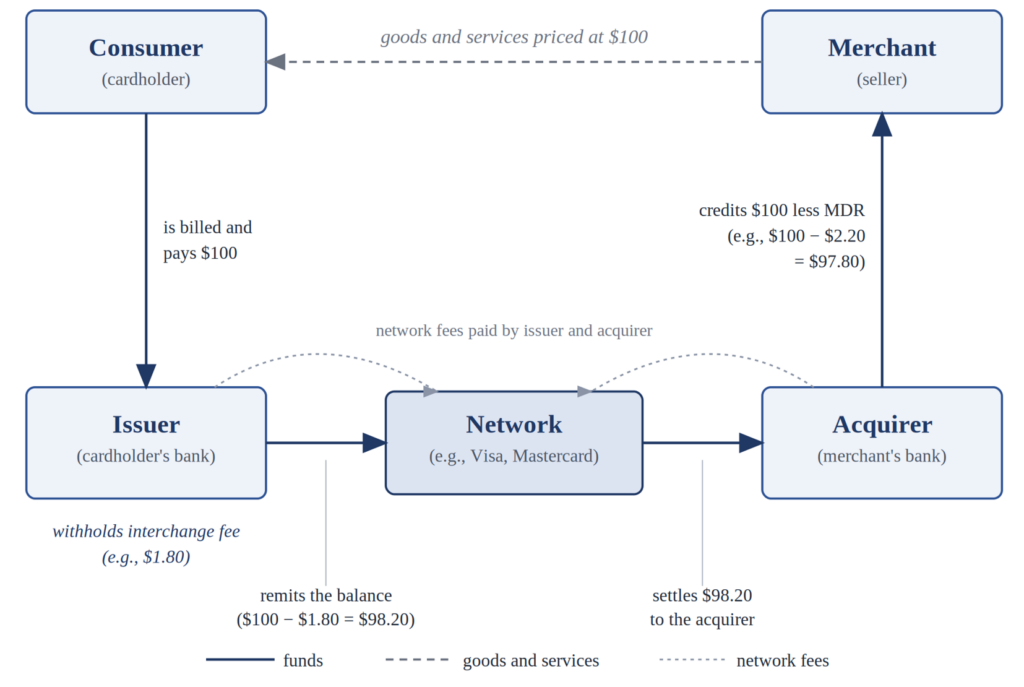
In a four-party system, separate financial institutions issue cards and acquire payments, connected by a network such as Visa or Mastercard (Figure 2). The cardholder’s bank (the issuer) bills the cardholder. The merchant’s bank (the acquirer) credits the merchant. The network carries the messages needed to authorize or decline, clear, and settle each transaction, charging fees to both banks.
FIGURE 2: Transactions in a Four-Party Card System
SOURCE: Author’s illustration.
When the issuer transfers funds to the acquirer, it withholds an interchange fee. With roughly 8,500 card-issuing institutions in the United States, bilateral negotiation of these fees would require millions of separate agreements. The networks instead set schedules of default interchange rates that apply unless the parties negotiate their own terms.[10]
The interchange fee typically amounts to between 1% and 2% of a transaction’s value. Treating it simply as compensation for processing a payment dramatically understates its role. It originated as a way to reduce coordination costs and align independent issuers’ and acquirers’ incentives within an open four-party payment network, as I explained in my Truth on the Market post:
A common misconception treats interchange as little more than compensation for processing a transaction. Its role is much broader. Interchange arose as a practical solution to a coordination problem in the original BankAmericard system and later became a way to balance the interests of merchants and consumers.
When BankAmericard, the forerunner of Visa, launched in 1958, it operated as a three-party network. Bank of America issued the cards, signed up merchants, and processed the transactions.
That changed when Bank of America began licensing other banks to issue BankAmericard cards in 1966. At first, the amount an acquiring bank paid to the issuing bank depended on the merchant discount the acquirer charged, or claimed to charge, sometimes adjusted for processing costs. The arrangement proved difficult to administer and audit.
Merchant discounts varied across banks and merchants, which gave acquirers an incentive to understate them. The formula also left acquirers with little or no margin on transactions involving cards issued by other banks. Issuers could receive too little, acquirers had weaker incentives to recruit and serve merchants, and the system encouraged strategic misreporting.
In 1970, Bank of America and its licensees created National BankAmericard Inc., an independent company owned by participating banks. The new organization replaced the uncertain formula with a uniform interchange reimbursement fee.
Set at 1.95% in 1971, the standardized fee separated the issuer’s payment from the merchant discount negotiated by the acquirer. The acquirer could retain the difference between the merchant discount and the interchange fee to cover its own costs.
Interchange therefore began as a way to align the incentives of independent issuers and acquirers in an open payment network. The Interbank Card Association, which operated MasterCharge, the precursor to Mastercard, adopted a similar approach about a year later. Economists later developed a fuller account of why the mechanism worked.[11]
Interchange continues to serve those functions. But arguably, its larger role today is to support subsidies between merchants and cardholders that encourage participation on both sides.
A card network creates value only if enough merchants and cardholders participate. As William F. Baxter showed in a seminal 1983 article, this often requires one side to subsidize the other.[12] Jean-Charles Rochet and Jean Tirole subsequently showed that when the two sides differ in their responsiveness to price, the fee structure that maximizes value typically involves the less price-sensitive side (usually merchants) subsidizing the more price-sensitive side (usually consumers).[13]
These analyses help explain why issuing banks use interchange revenue to fund cardholder benefits, including rewards, interest-free credit during the billing cycle, zero-liability fraud protection, and chargeback rights (the ability to dispute and reverse certain payments). That revenue also supports continuing investment in authorization, tokenization (the replacement of sensitive card details with secure identifiers), and fraud-detection infrastructure, all of which help secure card payments.
Three-party systems instead balance the two sides internally. They have no separate interchange fee because one institution performs all the functions. Instead, the merchant discount fee funds the subsidy. That fee is typically higher than the merchant discount rate acquirers charge in four-party networks.[14]
B. What Merchants Pay
Merchants receive the transaction amount from their acquirer, less a merchant discount fee calculated using the merchant discount rate (MDR). That fee typically covers interchange, the acquirer’s network fees, and its margin for processing, underwriting, and servicing the transaction. Interchange is by far the largest component, particularly for larger merchants, whose scale reduces the acquirer’s per-transaction margin.
How merchants pay these fees depends on their acquiring arrangement. Larger merchants typically use “interchange-plus” pricing, which transparently passes through the interchange component. Changes in interchange rates therefore flow directly into what the merchant pays.[15]
Smaller merchants often purchase card acceptance on a blended or flat-rate basis. The acquirer or payment processor charges the same all-in rate across multiple card types, despite differences in the interchange fees on individual transactions. Square, for example, lists a standard rate of 2.6% plus $0.15 for in-person card transactions across the major card brands. Square and Stripe also offer online payment products, for transactions in which the card is not physically present, at 2.9% plus $0.30.[16]
Under these arrangements, a change in interchange does not necessarily reach the merchant immediately or proportionately. It initially changes the processor’s margin and affects the merchant’s MDR only if and when the processor revises its blended price.
Both interventions this brief examines target four-party interchange fees exclusively. The settlement binds only Visa, Mastercard, and their issuers. The state carveout statutes address “interchange fees,” which exist as distinct fees only in four-party systems. American Express and Discover’s merchant discount fees therefore fall outside both the settlement and the carveouts.
Section v examines the implications of this asymmetry. In essence, policies that make four-party cards less attractive tend to shift transaction volume toward three-party cards, which have historically cost merchants more to accept.
III. The Settlement and Its Likely Effects
The proposed settlement would reduce interchange fees and give merchants more flexibility over card acceptance, surcharging, and steering. This section examines those changes, issuers’ likely responses to lost revenue, and the resulting effects on cardholder benefits, payment choices, and merchant costs. The rate relief would require no merchant action, but its broader effects would depend on how issuers, merchants, and consumers respond.
A. Fee Reductions and Merchant Flexibility
The settlement would make the following changes to interchange fees and card-network rules:[17]
- Visa and Mastercard would each reduce their combined volume-weighted average effective interchange rate on domestic credit transactions by at least 10 basis points—equivalent to 0.1% of transaction value—from the average for the year ending March 31, 2025. This measure weights rates by transaction volume. The reduction would last five years, with annual verification by an independent auditor. Merchants paying individually negotiated rates would receive a proportional reduction.
- The networks would cap all posted credit card interchange fees at their March 31, 2025 levels for five years.
- The networks would cap posted interchange fees on standard consumer credit cards at 1.25% for at least eight years, a reduction of 62 basis points from those products’ current average posted rate.
- The networks would replace the honor-all-cards rule with a rule allowing merchants to decline entire card categories—debit, standard consumer credit, premium consumer credit, and commercial.
- Merchants could surcharge at the brand or product level, up to their cost of acceptance or 3% of transaction value, whichever is lower.
- Merchants could expressly offer discounts and otherwise steer customers toward cards from particular issuers, supplementing existing brand- and product-level steering.
- Merchants could form buying groups to negotiate rates collectively.[18]
These provisions would take effect quickly. The surcharging changes would begin within 90 days of the Settlement Approval Date, and the rate reductions and caps within roughly four months, timed to the networks’ semiannual rule-release cycle.[19] The Settlement Approval Date turns on the district court’s entry of final judgment. Relief would therefore begin while appeals remain pending unless a court grants a stay.
B. Issuer Revenue and Responses
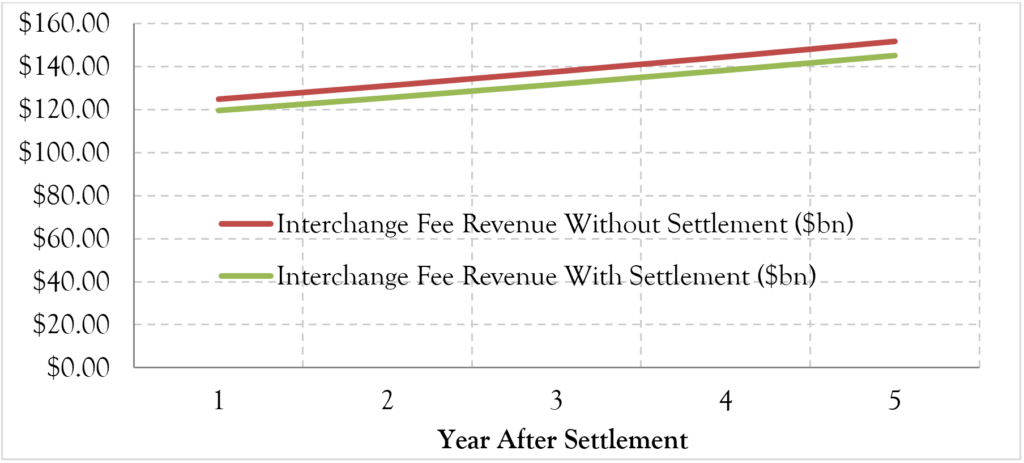
The proposed changes could significantly reduce issuer revenue. Current card-purchase volume, projections based on recent growth rates, and the settlement’s 10-basis-point reduction provide a starting estimate. Assuming card-purchase volume grows 5% annually, issuers would lose roughly $29 billion over five years, as Figure 3 shows.
The actual revenue loss would depend on how four-party issuers respond to lower interchange fees, how three-party issuers react, and how consumers respond to both. These adjustments would, in turn, prompt further changes in pricing and card use.
Interchange revenue helps fund rewards, introductory offers, fraud protection, and the fixed costs of maintaining card accounts. Four-party issuers would therefore likely recoup at least some lost revenue by reducing rewards, tightening eligibility for richer benefits, raising annual or other account fees, or combining these approaches.
Where regulation has reduced interchange revenue, issuers have responded by cutting costs or recovering income elsewhere. When Regulation II roughly halved the debit interchange retained by covered U.S. banks in 2011, debit rewards programs largely disappeared, free checking at those banks contracted sharply, and monthly maintenance fees and minimum-balance requirements rose. Lower-income customers bore a disproportionate share of that burden. Australian issuers responded to the Reserve Bank of Australia’s interchange standards by cutting rewards and raising annual fees by around 50%. The European Union’s (EU) Interchange Fee Regulation prompted similar adjustments.[20]
FIGURE 3: Effects of the Ten-Basis-Point Reduction on Interchange-Fee Revenue
If four-party issuers reduce benefits or raise annual fees, cardholders would likely use those cards somewhat less. That could alter competition with three-party networks such as American Express and Discover. Because the caps do not constrain three-party systems, they could preserve rewards and other benefits, or launch products with higher rewards. Cardholder demand could shift from Visa and Mastercard products toward three-party cards, even as merchants generally pay less to accept four-party cards.
Four-party issuers would anticipate these competitive effects. They might therefore absorb some losses or recover revenue through other charges, such as higher interest rates.
Their choices would ultimately depend on how sensitive different cardholders are to price. If cardholders who carry balances from month to month (revolvers) are less price-sensitive than those who pay in full (transactors), issuers would likely recover more of the loss from revolvers through higher interest charges. Similarly, less price-sensitive holders of ultrapremium cards might face disproportionately higher annual fees. The response would likely vary by card. Holders of airline co-branded cards, for example, might be less price-sensitive than holders of cashback cards, many of whom could switch to three-party cards offering higher rewards.
Merchants’ responses to the new acceptance, surcharging, and discounting rules would also affect issuer revenue, prompting further adjustments by networks and issuers. Merchants would likely surcharge where consumers would accept the added charge or switch to a payment method with lower processing costs. Surcharging would be less attractive where consumers would abandon the transaction or switch to a method that costs the merchant more to accept.
Australia’s experience broadly supports this expectation. After networks removed their no-surcharge rules, surcharging remained far from universal and concentrated among certain merchants and industries. The Reserve Bank of Australia identified airlines and taxis as sectors where unusually high surcharges persisted, and noted that higher surcharges were more common online, where customers generally could not pay cash.[21] In these settings, switching payment methods or abandoning a transaction may impose substantial costs on consumers, giving merchants more room to surcharge.
C. Merchant Steering and Acceptance Costs
By allowing surcharges that vary by card category and substantially reducing interchange fees on standard consumer cards, the settlement could help merchants steer consumers toward cards with lower interchange fees. That, at least, is the intention.[22]
But steering carries risks. Some consumers may switch to more expensive payment methods when merchants surcharge certain four-party cards. Uncertainty about surcharges may also prompt cardholders to use an alternative payment method preemptively.
If consumers choose lower-cost cards or other cheaper payment methods, merchants’ acceptance costs could fall. But consumers might instead choose more expensive three-party cards or cash, which also costs merchants more to accept.[23] Declining particular card categories therefore has an uncertain effect on acceptance costs. Some customers would also likely abandon the transaction altogether, potentially reducing merchant income.
Two other features of the settlement deserve attention before turning to the state laws. First, as Judge Cogan observed when granting preliminary approval, no court could have ordered the rate relief after trial because courts lack the power to set rates or regulate prices.[24] Merchants thus secured through settlement relief they could not have obtained at trial.
Second, merchants need take no action to receive the rate relief. The networks would implement the reductions and caps within their existing rate schedules, with an independent auditor verifying compliance at the defendants’ expense. Merchants would not need to buy equipment, alter checkout processes, or submit documentation.
IV. State Carveouts: Compliance Costs and Legal Limits
The IFPA prohibits issuers, networks, acquirers, and processors from receiving or charging interchange fees on the tax or gratuity portion of a transaction, provided the merchant transmits that information during authorization or settlement. Merchants that do not transmit the data in real time may instead submit tax documentation within 180 days and receive a credit from the issuer within 30 days. Financial institutions face a $1,000 civil penalty per transaction for violations. Merchants face no liability or penalty for inaccurate or fraudulent reimbursement requests.[25]
As I have described in earlier work, neither point-of-sale terminals nor network messaging standards currently distinguish the tax or tip component of a consumer transaction, largely because they have had no reason to do so. Systems operating identically in every state have always calculated interchange on the total transaction amount.[26] Implementing a carveout would therefore require one of three costly mechanisms:
- Dual authorizations. Merchants could split each sale into exempt and nonexempt transactions, dramatically slowing checkout.
- Additional transaction data. Merchants could transmit tax and tip data through Level 2 and Level 3 message fields, which carry more detailed transaction information. This would require terminal upgrades and reprogramming throughout the payment system. Single-message debit networks, which authorize and settle payments through one message, generally cannot process these fields.
- Retrospective rebates. Merchants, acquirers, and issuers could maintain linked records of encrypted transaction data for seven months or more to support reimbursement requests. This approach would invite error and fraud.[27]
A significant share of these costs is fixed, placing a disproportionate burden on small and medium-sized merchants and small issuers. Evidence from comparable compliance regimes suggests that these costs can consume much or all of smaller firms’ gross savings. After South Dakota v. Wayfair, Inc. allowed states to require remote sellers to collect sales tax, the U.S. Government Accountability Office found that large businesses absorbed the change with minimal new setup costs, while smaller sellers faced a significant compliance burden. One small online seller spent about $2.25 on compliance for every $1 of tax collected.[28]
Other recent state proposals follow the IFPA’s basic design but differ in ways that compound the problem. For example, while the IFPA covers taxes and gratuities and applies to all issuers, Colorado’s vetoed S.B. 26-134 covered only taxes and exempted issuers with $60 billion or less in assets. That exemption would have excluded more than a third of debit cards and perhaps a quarter of credit cards issued nationwide, along with every card issued by a Colorado-domiciled institution. Merchants would have had to determine, card by card, whether the exemption applied.[29]
Delaware’s bill, meanwhile, addresses gratuities alone. If several such laws took effect, the payment system would face mutually inconsistent carveout standards, each requiring separate screening rules for every transaction processed nationwide.[30]
The IFPA’s legality—and, by extension, that of similar state carveouts—remains contested and precarious. In February 2026, the federal district court hearing the banking industry’s challenge declined to enjoin the IFPA’s interchange-fee provision, reasoning that networks, rather than banks, set the fees.[31]
In April, the Office of the Comptroller of the Currency issued an interim final order finding that federal law preempts the IFPA for national banks and federal savings associations. It also issued an interim final rule confirming that banks’ authority to charge fees extends to fees set by third parties. Following those actions, the 7th U.S. Circuit Court of Appeals vacated the district court’s judgment. On remand, the district court permanently enjoined the interchange-fee provision as applied to national banks, federal savings associations, out-of-state state banks, and payment-card networks.[32]
The National Credit Union Administration then issued a similar rule for federal credit unions, and the district court recently expanded its injunction to cover them as well.[33] Illinois subsequently deferred the IFPA’s effective date a second time, to July 1, 2027.[34]
Unless courts overturn the federal regulators’ actions, the IFPA and similar laws will bind only institutions chartered by the enacting state, which issue a small fraction of cards in circulation. The analysis that follows assumes, for the sake of argument, that the carveouts could take effect at full scope, although that outcome appears unlikely.
V. Comparing the Settlement and State Carveouts
Both the settlement and state carveouts aim to lower merchants’ card-acceptance costs. This section compares their likely savings and compliance burdens, then examines how the settlement could further reduce carveout benefits, shift costs toward consumers and local issuers, and complicate implementation. It also considers how surcharging could make carveouts redundant for some merchants and how both interventions could shift transactions toward more expensive three-party cards.
A. Merchant Savings and Compliance Costs
The settlement would reduce merchant acceptance costs directly. The 10-basis-point reduction in average effective interchange equals 0.1% of covered credit card sales and applies automatically across merchants in every state, on the entire transaction amount. For merchants on interchange-plus pricing, the reduction would pass through to the MDR immediately. The settlement expressly provides a proportional reduction for merchants paying negotiated rates. Even many merchants on blended pricing could expect a share over time, as acquirers compete for their business and pass through a durable, independently verified reduction in their largest input cost.[35]
The carveouts promise savings of a similar magnitude. In earlier work, I estimated the IFPA’s gross savings to merchants at roughly 0.1% of the sale amount, reflecting an average combined Illinois sales tax of about 8.86%, gratuities on some transactions, and prevailing interchange rates.[36] The settlement’s average rate reduction is comparable, but merchants need no particular acquiring arrangement to qualify. They need not transmit tax data, buy new terminals or software, or submit rebate claims within a 180-day documentation window. The settlement also covers transactions on cards issued by institutions beyond the state statute’s reach.
The IFPA and similar carveouts would therefore deliver considerably smaller net fee reductions than the settlement. Moreover, once the settlement takes effect, lower interchange rates would further reduce the amounts available through carveouts.
Even at pre-settlement rates, most smaller merchants would see little, if any, net savings from a carveout. Fixed costs for upgraded terminals, software integration, and recordkeeping—or the administrative burden of rebate claims—would absorb much or all of the gross benefit. Merchants on blended pricing might receive no gross benefit at all.[37]
Reducing the gross benefit by a third or more would further narrow the group of merchants for whom a carveout’s benefits exceed its costs. The remaining beneficiaries would principally be the largest retailers, which already spread compliance costs across a large volume of transactions and stood to gain the most from carveouts. Before the settlement, just 10 national chains would receive more than one-fifth of the IFPA’s projected savings.[38] The settlement would intensify that concentration, making the carveout an even more pronounced subsidy to big-box retailers financed by consumers, smaller merchants, and local financial institutions.
The settlement would also give merchants concerned about high-fee cards more options. Under its terms, they could decline premium and commercial cards outright, surcharge them, or offer discounts to steer customers toward cheaper products. Indeed, merchants could surcharge their full processing cost, up to 3% of transaction value.
Merchants using that tool could recover far more than the IFPA or similar carveouts would offer, making the carveouts redundant for them. As discussed below, when a surcharge equals or exceeds the amount a merchant could recover under a state carveout, the merchant’s recovery weakens the rationale for that carveout.
B. Shifting Costs to Consumers and Local Issuers
National issuers could respond to a state carveout by seeking adjustments to interchange schedules that spread the loss across merchants nationwide. The settlement, however, largely forecloses that response. It freezes posted rates, caps standard consumer rates, and requires the average effective rate to remain 10 basis points below the benchmark, subject to annual audit.[39] For at least five years, issuers or networks would therefore find it difficult, if not impossible, to lawfully offset carveout losses by adjusting interchange schedules.
Consumers would bear the carveout’s costs more directly through reduced rewards and higher fees. Those costs would reach consumers both inside and outside the enacting state because national issuers adjust terms nationally rather than maintain state-specific rewards schedules.[40] Indeed, most affected consumers would live outside the state, making the effects predominantly extraterritorial.
Local banks and credit unions that remain within the statutes’ reach after the preemption rulings would face a different constraint. They could neither offset the lost revenue through the frozen interchange schedules nor spread it across a national portfolio. The loss would come on top of settlement-driven reductions in their card-program revenue.
The settlement therefore changes who bears a carveout’s costs, making the distribution of those costs worse. A state considering a carveout would still impose diffuse harms on consumers, while concentrating institutional losses on the banks and credit unions its charter system exists to serve.
C. How Carveouts Could Reduce Settlement Relief Elsewhere
The settlement measures the average effective interchange rate by dividing the network-set default interchange fees actually assessed on domestic credit transactions by the corresponding sales volume.[41] A state carveout that eliminates interchange on taxes and tips reduces the fees assessed without reducing sales volume, lowering the measured national average.
Mechanically, that reduction would count toward the 10-basis-point reduction the networks owe the merchant class. The networks could then provide correspondingly less rate relief to merchants in the other 49 states. A state enacting a carveout would thus finance part of its local experiment through settlement relief owed to merchants elsewhere.
Whether the independent auditor would treat statutory exclusions this way remains an open question. The agreement addresses individually negotiated reductions but says nothing about state-mandated ones. Either approach creates problems. If statutory exclusions count, carveout states would draw on the class’s recovery to fund their own mandates. If they do not, the networks and auditor would need another layer of state-specific accounting to exclude them from the calculation.
D. Surcharging and the Case for Carveouts
The settlement permits merchants to surcharge at the brand or product level up to their cost of acceptance or 3% of transaction value, whichever is lower.[42] A merchant that recovers its full acceptance cost through a surcharge also recovers interchange on the entire transaction, including taxes and gratuities. For that merchant, a carveout offers no further recovery. Full-cost surcharging therefore removes the basis for that merchant’s argument for a state carveout.
The same reasoning applies, to a lesser extent, to merchants that decline premium and commercial cards or offer discounts to steer customers toward standard cards. Those choices eliminate or reduce the fees from which a carveout would provide a partial exemption.
The remaining benefit of carveouts would therefore accrue principally to merchants that forgo the settlement’s self-help options. The principal reason to do so would be to preserve fast, efficient checkout with minimal risk that customers abandon transactions. That preference would appear to conflict with seeking a carveout that would make payment processing more cumbersome.
E. Competing Implementation Demands
After the settlement’s final approval, networks, acquirers, processors, and issuers will have to undertake substantial changes to their systems on a court-supervised schedule. These include identifying premium and commercial cards at checkout, implementing three-tier acceptance, building surcharge notification and reporting systems, and supplying the data the independent auditor requires.[43]
This work would use the same messaging standards, processing systems, and semiannual release cycles needed to implement carveouts. The IFPA’s scheduled July 1, 2027, effective date falls squarely within the settlement’s rollout.[44] Implementing a carveout during that period would compete for engineering capacity with obligations the industry must meet under a federal court order, potentially increasing costs, delays, and errors for both.
The industry would also need to check every acceptance category, surcharge configuration, and rate schedule introduced by the settlement against each state’s carveout rules, and vice versa. These interaction costs did not exist when lawmakers drafted the carveout bills, and none of the states’ fiscal notes—their estimates of legislation’s budgetary effects—accounts for them.
F. Shifting Transactions to Three-Party Systems
Neither the settlement nor the carveouts apply to three-party systems. American Express and Discover remain free to fund rewards and benefits at whatever level their internal pricing supports. As Visa and Mastercard issuers respond to lower interchange revenue by trimming rewards and raising fees, three-party companies could attract premium cardholders by offering benefits no longer available on four-party cards.
Australia’s experience is instructive. After the Reserve Bank of Australia’s price controls reduced four-party interchange in 2003, banks shifted premium customers toward American Express companion cards—that is, cards offered alongside their Visa or Mastercard products. American Express’s market share rose by about 25% before the regulator extended its standards to cover the arrangement.[45]
Carveouts share this asymmetry and add further friction. The compliance mechanisms described in Section IV, including dual authorizations and expanded transaction messages, would apply only to four-party transactions, making them slower and more prone to checkout failures than unchanged three-party transactions. Merchants using dual authorizations, in particular, should expect greater use of American Express and Discover cards, alongside some shift back to cash.
These consequences undermine both interventions’ aims, especially those of the carveouts. First, migration toward three-party cards would erode merchant savings because those cards cost more to accept. Second, each transaction that shifts to a three-party card would fall outside the carveout, further reducing the law’s already-diminished benefits while leaving its fixed costs unchanged. Third, local banks and credit unions still subject to a carveout after the preemption rulings would lose card volume to three-party competitors, on top of the revenue the statute removes directly.
Consumers who qualify for three-party products could retain rewards, partially offsetting their losses. But that benefit would come with the costs and inconvenience of maintaining additional cards, and would reach only eligible customers. A law that steers transactions toward the most expensive card-acceptance channel would be a strange way to lower merchants’ acceptance costs.
VI. Conclusion
State interchange carveouts arose from merchants’ objection to paying fees on amounts they collect for the state or pass on as gratuities, with no relief in prospect from Congress or the courts. The proposed settlement substantially weakens that rationale. It would reduce interchange across covered transactions nationwide by roughly the same share of sales that carveouts promised in their best case, without imposing merchant compliance costs. Pass-through would depend on merchants’ pricing arrangements, but the settlement would also give them more ways to recover acceptance costs through surcharging and steering.
A carveout would add only a diminished exemption from an already-reduced fee. Merchants would need to incur fixed costs that the settlement makes harder to recover, and relief would reach only cards issued by the shrinking set of institutions left within the statutes’ scope after federal preemption.
The carveouts’ costs would remain and, in several respects, grow. If courts ultimately reject federal preemption, national issuers would spread much of the burden to out-of-state consumers through reduced rewards and changed account terms. Out-of-state merchants could also face lower demand and potentially less settlement relief. If preemption holds, losses would concentrate on local banks and credit unions and their customers.
In either case, small and medium-sized merchants in the enacting state would face compliance costs that could exceed their savings. Many would likely forgo the carveout, further weakening their position relative to larger competitors. Implementation would also compete with the settlement’s court-supervised rollout, while slower four-party transactions and reduced cardholder benefits could shift spending toward more expensive three-party cards.
The settlement itself would likely impose net economic costs, particularly through reduced cardholder benefits and higher fees. Its comparatively lower compliance burden nonetheless makes the case for additional state carveouts weaker.
States seeking to reduce merchants’ tax-collection costs have a more direct tool in the form of capped compensation for electronic remittance, of the kind most states already provide.[46] Requiring a national payment system to administer a local subsidy would add costs and distortions while delivering increasingly narrow benefits. Illinois should repeal its carveout, and other states should abandon similar proposals, regardless of whether the settlement receives final approval.
[1] Memorandum Decision and Order, In re Payment Card Interchange Fee & Merch. Disc. Antitrust Litig., No. 05-md-1720 (BMC) (E.D.N.Y. June 9, 2026) [hereinafter Preliminary Approval Order].
[2] Id. at 6–10; Visa Inc., Current Report (Form 8-K) (Nov. 10, 2025) (attaching Superseding and Amended Definitive Class Settlement Agreement of the Rule 23(b)(2) Class Plaintiffs [hereinafter Settlement Agreement]); Nandita Krishnaswamy, In re Payment Card Interchange Fee and Merchant Discount Antitrust Litigation: Summary of the November 2025 Proposed Settlement, ABA Antitrust L. Sec. (Apr. 1, 2026), https://www.americanbar.org/groups/antitrust_law/resources/newsletters/in-re-payment-card-interchange-fee-merchant-discount-antitrust-litigation.
[3] See Ill. Bankers Ass’n v. Raoul, No. 1:24-cv-07307, slip op. at 2–4, 27–28 (N.D. Ill. June 1, 2026); see also 815 Ill. Comp. Stat. 151/150-1, 151/999-99 (2026) (effective July 1, 2027).
[4] Interchange Fee Prohibition Act, 815 Ill. Comp. Stat. 151/150-1 et seq. (2024).
[5] Colorado Bill To Cut Sales Tax from Interchange Calculation Vetoed, Digital Transactions (June 2026), https://www.digitaltransactions.net/colorado-bill-to-cut-sales-tax-from-interchange-calculation-vetoed; S.B. 26-134, 2026 Reg. Sess. (Colo. 2026).
[6] Patrick Cooley, State Interchange Fee Laws Progress, Payments Dive (Mar. 18, 2026), https://www.paymentsdive.com/news/state-interchange-fee-laws-progress/815072; Gail Cole, Can States Ban Swipe Fees on Taxes and Fees?, Avalara (May 2026), https://www.avalara.com/blog/en/north-america/2026/05/states-ban-swipe-fees-on-taxes-and-fees.html.
[7] Julian Morris, The Price of Peace in the Swipe-Fee Wars, Truth on the Mkt. (July 23, 2026), https://truthonthemarket.com/2026/07/23/the-price-of-peace-in-the-swipe-fee-wars [hereinafter Morris, Price of Peace]; Julian Morris, State Regulation of Interchange Fees (Int’l Ctr. L. & Econ., Nov. 15, 2024), https://laweconcenter.org/resources/state-regulation-of-interchange-fees [hereinafter Morris, State Regulation]; Julian Morris & Ben Sperry, Regulating State Interchange Fees: Evaluating the Likely Effects of the IFPA 8 (Int’l Ctr. L. & Econ., July 7, 2025), https://laweconcenter.org/wp-content/uploads/2025/07/IFPA-Paper-2025.pdf [hereinafter Morris & Sperry, IFPA].
[8] See Julian Morris, Todd J. Zywicki & Geoffrey A. Manne, The Effects of Price Controls on Payment-Card Interchange Fees: A Review and Update 24–27 (Int’l Ctr. L. & Econ., White Paper, Mar. 4, 2022), https://laweconcenter.org/wp-content/uploads/2022/03/Payments-2021-Lit-Review.pdf; Todd J. Zywicki, Ben Sperry & Julian Morris, Credit Cards and the Reverse Robin Hood Fallacy: Do Credit Card Rewards Really Steal from the Poor and Give to the Rich? 14–16 (Int’l Ctr. L. & Econ., Issue Brief, Nov. 4, 2021); Zhu Wang, Scarlett Schwartz & Neil Mitchell, The Impact of the Durbin Amendment on Merchants: A Survey Study, 100 Econ. Q. 183, 189, 198–200 (2014); Vladimir Mukharlyamov & Natasha Sarin, Price Regulation in Two-Sided Markets: Empirical Evidence from Debit Cards, 172 J. Fin. Econ. 104094, 10–11, 15–16 (2025), https://doi.org/10.1016/j.jfineco.2025.104094.
[9] Morris, State Regulation, supra note 7, at 6 (describing three-party networks, in which the card company acts as issuer, acquirer, and network operator, subsidizing cardholders directly through fees charged to merchants).
[10] Id. at 7–9. The number of bilateral agreements required among n institutions is n(n − 1)/2.
[11] Morris, Price of Peace, supra note 7.
[12] See William F. Baxter, Bank Interchange of Transactional Paper: Legal and Economic Perspectives, 26 J.L. & Econ. 541 (1983).
[13] Jean-Charles Rochet & Jean Tirole, Cooperation Among Competitors: Some Economics of Payment Card Associations, 33 RAND J. Econ. 549 (2002); Jean-Charles Rochet & Jean Tirole, Platform Competition in Two-Sided Markets, 1 J. Eur. Econ. Ass’n 990 (2003); Todd J. Zywicki, The Economics of Payment Card Interchange Fees and the Limits of Regulation (Int’l Ctr. L. & Econ., June 2, 2010), https://laweconcenter.org/images/articles/zywicki_interchange.pdf; Ohio v. Am. Express Co., 585 U.S. 529, 545 (2018).
[14] Jack Caporal, Average Credit Card Processing Fees and Costs in America, Motley Fool Money (updated June 23, 2026), https://www.fool.com/money/research/average-credit-card-processing-fees-costs-america (reporting Helcim’s 2026 weighted effective rates).
[15] Morris, State Regulation, supra note 7, at 9–10 (describing interchange-plus and blended acquirer pricing); Morris & Sperry, IFPA, supra note 7, at 14–18.
[16] Understanding Our Fees, Square, https://squareup.com/us/en/payments/our-fees (last visited Aug. 9, 2026) (listing standard processing fees of 2.6% plus $0.15 for card-present transactions and 2.9% plus $0.30 for online transactions using Square’s API); Pricing, Stripe, https://stripe.com/pricing (last visited Aug. 9, 2026) (listing standard U.S. pricing of 2.9% plus $0.30 per successful transaction for domestic cards).
[17] Settlement Agreement, supra note 2, ¶¶ 48–53; Preliminary Approval Order, supra note 1, at 9–10.
[18] Settlement Agreement, supra note 2, ¶¶ 39–47; Preliminary Approval Order, supra note 1, at 6–9. A group must include at least two merchants, incorporate as a U.S. nonprofit, and comply with applicable antitrust standards. Groups may submit proposals concerning interchange rates and rate categories, merchant rules and fees, acceptance, surcharging, and other network practices. Visa and Mastercard must consider qualifying proposals in good faith and engage in reasonable, bona fide negotiations when a proposal offers commercially reasonable benefits. They need not agree to the rates the group seeks.
[19] Settlement Agreement, supra note 2, ¶¶ 39, 48(a).
[20] Morris, Zywicki & Manne, supra note 8; Todd J. Zywicki, Geoffrey A. Manne & Julian Morris, Unreasonable and Disproportionate: How the Durbin Amendment Harms Poorer Americans and Small Businesses (Int’l Ctr. L. & Econ., Apr. 2017), https://laweconcenter.org/wp-content/uploads/2017/08/icle-durbin_update_2017_final-1.pdf.
[21] Reserve Bank of Austl., Regulatory Developments in Retail Payments, in Payments System Board Annual Report 2012 (2012) (reporting that approximately 36% of surveyed merchants imposed a surcharge on at least one accepted credit card and that very large merchants surcharged more often); Reserve Bank of Austl., The Payments System (Supplementary Submission to the Financial System Inquiry, Aug. 2014) (observing that market forces ordinarily constrain excessive surcharging because merchants consider its effect on the customer experience, while identifying the taxi and air-travel industries as exceptions); Cameron Dark, Chay Fisher, Kim McBey & Ed Tellez, Payment Surcharges: Economics, Regulation and Enforcement, Reserve Bank of Austl. Bull., Dec. 2018 (identifying airlines as a prominent source of excessive surcharging and noting reports of higher surcharges more often for online transactions, where customers generally could not pay cash); Reserve Bank of Austl., Excessive Surcharging, in Review of Card Payments Regulation: Conclusions Paper (May 2016) (discussing $7–$8 fixed-dollar airline surcharges and explaining why they could substantially exceed acceptance costs on low-value airfares).
[22] Preliminary Approval Order, supra note 1, at 9–10.
[23] Julian Morris & Ben Sperry, The Cost of Payments: A Review (Int’l Ctr. L. & Econ., Aug. 2024), https://laweconcenter.org/resources/the-cost-of-payments-a-review.
[24] Preliminary Approval Order, supra note 1, at 22 (citing Prentis v. Atl. Coast Line Co., 211 U.S. 210, 226 (1908)); Settlement Agreement, supra note 2, ¶¶ 48, 52–53 (Independent Auditor provisions).
[25] 815 Ill. Comp. Stat. 151/150-10, 151/150-15 (2024).
[26] Morris, State Regulation, supra note 7, at 16–21; Morris & Sperry, IFPA, supra note 7, at 14–18.
[27] Morris, State Regulation, supra note 7, at 17–21.
[28] Morris & Sperry, IFPA, supra note 7, at 16 (citing U.S. Gov’t Accountability Off., GAO-23-105359, Remote Sales Tax: Federal Legislation Could Resolve Some Uncertainties and Improve Overall System (2022)); South Dakota v. Wayfair, Inc., 585 U.S. 162 (2018).
[29] S.B. 26-134, 2026 Reg. Sess. (Colo. 2026); Bd. of Governors of the Fed. Rsrv. Sys., 2023 Interchange Fee Revenue, Covered Issuer Costs, and Covered Issuer and Merchant Fraud Losses Related to Debit Card Transactions (2023).
[30] See Morris & Sperry, IFPA, supra note 7, at 20–21 (discussing how differing state mandates could fragment the multilateral interchange-fee system).
[31] Ill. Bankers Ass’n v. Raoul, No. 1:24-cv-07307 (N.D. Ill. Feb. 10, 2026).
[32] Ill. Bankers Ass’n v. Raoul, Nos. 26-1354, 26-1371, 26-1440 & 26-1441 (7th Cir. May 8, 2026) (order vacating and remanding); Illinois Interchange Fee Law Maxes Out After Permanent Injunction and Legislative Postponement, Glob. Fintech & Digit. Assets Blog (June 2026), https://www.fintechanddigitalassets.com/2026/06/illinois-interchange-fee-law-maxes-out-after-permanent-injunction-and-legislative-postponement [hereinafter Illinois Interchange Fee Law Maxes Out].
[33] Order Preempting the Illinois Interchange Fee Prohibition Act, 91 Fed. Reg. 23,150 (Apr. 29, 2026); Preemption—Federal Credit Union Non-Interest Charges and Fees, 91 Fed. Reg. 34,725 (June 9, 2026).
[34] 815 Ill. Comp. Stat. 151/999-99 (2026) (deferring the effective date to July 1, 2027); see also Illinois Interchange Fee Law Maxes Out, supra note 32.
[35] On acquirers’ pass-through of interchange reductions, see Morris, Zywicki & Manne, supra note 8, at 31–38.
[36] Morris & Sperry, IFPA, supra note 7, at 18 & n.65.
[37] Morris, State Regulation, supra note 7, at 9–10, 22–23; Morris & Sperry, IFPA, supra note 7, at 14–18.
[38] Elec. Payments Coal., New Illinois Law Creates Windfall for Largest Corporate Mega-Stores (2024), https://guardyourcard.com/wp-content/uploads/2024/10/Illinois-State-Sales-Tax-Interchange-Report-9.24.24.pdf.
[39] Settlement Agreement, supra note 2, ¶¶ 48, 51–52.
[40] Morris & Sperry, IFPA, supra note 7, at 19–21.
[41] Settlement Agreement, supra note 2 (defining “Effective Interchange Rate” as network-set default interchange fees assessed to acquirers, divided by the sales volume of the corresponding transactions).
[42] Id. ¶¶ 39–41.
[43] Id. ¶¶ 39–42, 48, 51–53; Preliminary Approval Order, supra note 1, at 7 & n.7.
[44] Illinois Interchange Fee Law Maxes Out, supra note 32.
[45] Morris, Zywicki & Manne, supra note 8 (reviewing the Australian evidence, including the companion-card episode).
[46] Morris, State Regulation, supra note 7, at 26–27.