





ICLE Comments on the FTC’s Personalized Pricing Proposed Enforcement Policy Statement
I. Introduction and Summary of Recommendations The International Center for Law & Economics (ICLE) is a nonprofit, nonpartisan research center based in Portland, Oregon. In . . .
I. Introduction and Summary of Recommendations
The International Center for Law & Economics (ICLE) is a nonprofit, nonpartisan research center based in Portland, Oregon. In comments to the Federal Trade Commission (FTC) in 2014,[1] 2018–19,[2] and 2022,[3] and to the Canadian Competition Bureau in 2025[4] and 2026,[5] we have explained why price differences that expand output and lower prices for price-sensitive consumers should not be deemed presumptively harmful. We have made the same point in work on the Kroger/Albertsons merger,[6] state grocery-pricing laws,[7] food-delivery fees,[8] and the FTC’s proposed enforcement policy statement on personalized pricing (Proposed Statement).[9]
The Proposed Statement says that, where consumers reasonably expect prices not to vary with their personal data, a seller that personalizes prices should disclose that fact, the basis for the personalization, and the types of data used.[10] Omitting any of the three is “likely to constitute an unfair or deceptive act or practice in violation of Section 5.”[11] Yet the same document reports that “the effects of personalized pricing on consumers are unclear.”[12]
The Commission thus proposes to presume unlawful a practice whose prevalence it does not know and whose effects, by its own account, could benefit or harm consumers. Section 5(n) requires the Commission to weigh the costs of enforcement mistakes in unfairness matters,[13] and a presumption can substitute for evidence only where theory predicts a high probability of harm.[14] Where theory predicts mixed effects, a presumption turns the agency’s uncertainty into the regulated firm’s liability.
The two possible errors also impose different costs. A seller that drops targeted discounts to avoid a disclosure dispute takes those discounts from the consumers who would have received them, and market forces may not restore them.[15] A seller that personalizes prices without disclosure, in a market where consumers can compare offers, faces rivals that can discount to win its customers. Disclosure mandates produce the first kind of loss nearly as readily as prohibitions do: A mandate raises the cost of the conduct it covers relative to conduct it does not, and firms may respond by changing what they do rather than by becoming transparent about it.[16] The Proposed Statement moves from “unclear” effects to “likely” illegality without weighing these errors.
The FTC’s deception policy recognizes that omissions can mislead consumers. But a consumer’s belief alone cannot establish that a seller conveyed a misleading message. The Proposed Statement’s second deception theory finds deception when a consumer “reasonably believes” a price is static or widely offered and the seller “fails to disclose” that it is personalized.[17] This assumption is unsubstantiated. A displayed price tells a buyer what she may pay; standing alone, it does not say what everyone else pays. The Commission’s International Harvester decision declines to treat such “pure omissions” as deceptive.[18]
Unfairness requires substantial injury that consumers cannot reasonably avoid and that countervailing benefits do not outweigh. The 11th U.S. Circuit Court of Appeals called those conditions “mandatory” in FTC v. Corpay Inc.[19] The Proposed Statement applies none of them to its seven hypothetical examples. Having called the practice’s effects “unclear,” the Commission cannot simply conclude that it is nevertheless “injurious in its net effects.”[20]
The Proposed Statement cites six economic works for the claim that “the more sophisticated personalized pricing practices become, the less likely consumers are to benefit.”[21] None tests disclosure, and none supports the claim as stated. Where the papers find consumer losses, they trace them to market structure, a seller’s pricing power, or unequal access to data among rivals. In each of the three empirical studies, most consumers pay less; in two, the market grows.[22]
The Proposed Statement also assumes that the benefits of personalization may “be realized without concealing” it.[23] But a notice that lets buyers avoid a higher price changes the prices a seller can profitably offer. A seller forced to discount either for everyone or for no one will discount less. The Commission has not examined how its proposed notice would change prices.
The notice’s second and third elements compound the problem. They require a seller to explain how it set a price—more information than consumers generally care about or use, and more than International Harvester contemplates for mandatory disclosure.[24]
The Proposed Statement improves on the 2022 advance notice of proposed rulemaking that preceded it.[25] It acknowledges that Congress has not authorized the Commission to prohibit personalized pricing,[26] drops the term “surveillance pricing,”[27] and proceeds through guidance, as we urged.[28] But useful guidance would explain how the Commission will assess materiality, injury, countervailing benefits, and reasonable avoidability in the cases it describes. The Proposed Statement announces a conclusion instead.
A document that tells every seller what to disclose also operates as a disclosure rule, whatever its disclaimer of legal effect.[29] Firms will plan as though it binds them, without the protections of Section 18 rulemaking.[30]
The Commission should withdraw the Proposed Statement and proceed case by case, as Corpay shows it can. If the Commission nonetheless issues a statement, it should preserve the concessions the proposal already makes and adopt the six revisions laid out in Part VII:
- Withdraw or qualify the third economic claim and expand the evidence. Withdraw the claim that more sophisticated personalization is less likely to benefit consumers, or identify the conditions under which more detailed consumer information can cause harm.
- Clarify what a price display represents. A displayed price, standing alone, does not represent that every consumer sees the same price. Whether a particular presentation conveys that claim depends on evidence about the market in which it appears.
- Confine the deception theory to representations. Strike the “reasonably believes” theory, retain the first theory, and use extrinsic evidence to establish what consumers understood an alleged implied claim to mean.
- Replace the three-element prescription with a safe harbor. A clear and conspicuous statement that prices may vary with customer data should defeat a claim of implied uniformity.
- Identify practices the Commission is not targeting. Name individualized discounts, coupons, loyalty pricing, retention offers, and negotiated prices as practices the Commission does not regard as presumptively unlawful.
- Analyze the examples or relabel them. For each of the seven hypothetical examples, identify the price that would have prevailed without personalization, the substantial injury and whether consumers could reasonably avoid it, and the gains and losses for consumers and competition.
Only after resolving these legal and evidentiary questions should the Commission test which of the avoidance steps it describes that a notice would enable consumers to take, just as it tested its mortgage disclosures.[31] It should separately assess how sellers would change their prices in response.
Finally, any prescription of a disclosure’s wording, placement, or format constitutes a rule, which requires Section 18 rulemaking procedures.
II. The Effects of Personalized Pricing Depend on Market Conditions
The Proposed Statement makes four concessions that any final statement should retain. First, Congress has not authorized the Commission to prohibit personalized pricing outright. Second, personalized pricing “is a long-established norm in some markets,” including car sales, residential real estate, and markets where buyers and sellers negotiate.[32] Third, prices vary for reasons unrelated to personalization, including local supply and demand, regional taxes, and the individualized risk assessments used in insurance and credit. Fourth, real-world personalization is imperfect. An analysis that takes these concessions seriously must account for competition and the limits of consumer data and pricing tools.
Ample evidence that personalized pricing generally harms consumers might make those circumstances less consequential. The studies the Commission cites provide no such evidence. They report mixed effects on consumer welfare and show that the circumstances often determine the outcome.
The Commission begins its economic account with a monopoly benchmark, then concedes that the benchmark does not describe most markets. Perfect personalized pricing “without business competition would allow a monopolist to capture the entire consumer surplus.”[33] But the Commission immediately acknowledges that “real-world personalized pricing would be less than perfect in its ability to identify consumers and determine their willingness to pay and, in the vast majority of circumstances, would have to contend with competitive pressures that limit pricing power.”[34] That is the Statement’s most significant concession: In actual markets, imperfect information and competition may limit or eliminate the harm predicted by the monopoly benchmark. Without empirical findings about particular markets, the Commission’s case rests heavily on what six economic studies say about consumer harm under realistic conditions. As discussed below, those studies do not support many of the Statement’s claims or proposals.
A. Targeted Pricing Can Intensify Competition
Personalized prices can intensify competition by letting a seller compete for a rival’s customers without cutting prices for all its existing buyers. Under uniform pricing, a seller must extend a price cut meant to attract new customers to buyers who would have paid the old price. That makes price cuts more costly and less likely. Targeted offers avoid that cost, and rivals can respond with targeted offers of their own, multiplying the potential benefits.
The literature on price discrimination—charging different buyers different prices—supports this dynamic, although its effects depend on the market. Thisse and Vives show that it can lower prices and profits in a duopoly market with two differentiated sellers.[35] Corts shows why the result depends on how firms rank customer groups and the groups’ relative importance.[36] In his model, price discrimination can lower prices in every segment or raise them in every segment. A calculation based on a monopolist cannot, however, predict what happens when competing sellers can respond. As the antitrust literature puts it, price discrimination “implies neither that a market is not performing ‘competitively’ nor that it would perform more ‘competitively’ without price discrimination.”[37]
B. Imperfect Data and Competition Limit Personalized Pricing
Imperfect data and competing offers limit a seller’s ability to personalize prices and the effects it can plausibly achieve. Data are noisy and often dated, and sellers estimate pricing models from samples rather than individual buyers. A consumer who can buy elsewhere—or decline to buy—will not pay more than a purchase is worth compared with her best alternative. Better data can improve a seller’s estimate and change the prices it can profitably charge, but the result remains an estimate.
In some markets, prices must depend on personal information. As then-Commissioner Ferguson observed:
This practice is ancient and commonplace for many products and services. The prices of insurance policies or of credit, for example, necessarily turn on a consumer’s personal details because the price must reflect the risk of providing the good or service to the consumer.[38]
The Commission also concedes that it does not know how widely sellers use personalized pricing.[39] The available evidence suggests limited use in the markets studied. A 2018 European Commission mystery-shopping study of 160 e-commerce sites in eight member states found personalized price differences in only 6% of tests. The median difference was less than 1.6%.[40]
Alberto Cavallo found no evidence that large U.S. multichannel retailers varied online prices with a shopper’s location or browsing history. He attributed that restraint to retailers’ fear of “antagonizing their customers.”[41] Stefano DellaVigna and Matthew Gentzkow found that most large U.S. food, drug, and mass-merchandise chains charged nearly uniform prices across stores despite substantial differences in local demographics and competition. The median chain forwent about $16 million a year in profit by doing so.[42]
Customers’ reactions already constrain a practice that firms forgo despite its potential returns. That restraint does not make enforcement unnecessary in every case, but it raises questions about what a general presumption would accomplish and what it would cost to apply one to the discounts that make up much of the practice.
C. The Cited Studies Do Not Support a General Presumption of Harm
The Proposed Statement cites six works in support of its three economic claims: Personalized pricing is likely to increase business profits; it benefits some customers while harming others; and more “sophisticated” practices are less likely to benefit consumers.[43] The Commission does not claim that personalized pricing has no benefits, causes net harm, or is prevalent. Its first two claims are accurate as far as they go, but leave out consequential findings. The cited literature does not support the third.
The six studies differ in what they can establish. Three are empirical studies but compare the observed setting with modeled pricing alternatives. Jean-Pierre Dubé and Sanjog Misra conduct field experiments on a business-to-business hiring platform and model the seller as a monopolist. Benjamin Reed Shiller estimates what personalization might have done for Netflix’s DVD-by-mail service in 2006, when the company had some pricing power but did not personalize prices. Nicholas Buchholz and coauthors model a Prague-based taxi-hailing platform whose drivers bid in an auction that does not rely on personalized data.
Two other papers are theoretical models without empirical data: Andrew Rhodes and Jidong Zhou’s model of competing firms in an oligopoly setting, and Rosa-Branca Esteves and Francisco Carballo-Cruz’s unpublished model of entry over two periods. The sixth work, by Ginger Zhe Jin, Liad Wagman, and Mengyi Zhong, summarizes the literature without adding a model or data of its own.
None empirically studies personalized pricing in a consumer retail market like those in the Proposed Statement’s examples. None tests the proposed disclosures, and none of the three empirical studies measures what happens when competitors respond.[44]
The Appendix to these comments includes a table that summarizes each paper’s setting and findings, how the Commission uses it, and how well it supports the Commission’s claims. Briefly, with respect to the claims, the studies show the following:
- Profits: The three empirical studies find profit gains in the settings they examine. But in Dubé and Misra and in Buchholz et al., most of the gains come from correcting or centralizing a uniform price rather than personalizing it. One theoretical paper shows that personalization under competition can reduce industry profits.
- Winners and Losers: The conclusion that some consumers gain while others lose is true, but also trivial. Because consumers are heterogeneous along indefinitely many dimensions—both observable and unobservable—every pricing practice, including uniform pricing, benefits some consumers while harming others. That differential alone says nothing about the size or direction of the net effect. Nor does it show whether the distribution of gains and losses is undesirable along dimensions policymakers may care about, such as income.
- Sophistication: The cited studies do not establish the third claim that more “sophisticated” practices are less likely to benefit consumers. The Proposed Statement does not define the term. Some forms of personalization can reduce consumer surplus, depending on competition, access to data, and how sellers use the data. But several cited works find that broader access to more data can benefit consumers. Where those works identify harm, they often trace it to market power or unequal access to data, rather than to the use of more data itself.
Assessing welfare also requires separating new sales from the redistribution of gains on sales that would have occurred anyway. A higher price on a purchase that still occurs transfers surplus from buyer to seller. A discount that induces an additional purchase that would not otherwise have occurred can create gains from trade. At the same time, price discrimination can also reduce welfare if it allocates a fixed supply to buyers who value it less. The traditional monopoly analysis developed by Robinson, Schmalensee, and Varian and surveyed by Stole weighs the effect on output against this allocation effect. Under its assumptions, output must increase for total welfare to rise. But neither higher output nor higher total welfare establishes that consumers collectively benefit.[45]
1. Seller Effects: Profit Estimates Omit Rivals’ Responses
The three empirical studies the Commission cites estimate profit gains from personalization, but none evaluates how rival sellers would respond. Rivals could offer deeper discounts, retain customers who would otherwise switch, or both, reducing the estimated gains.
- Netflix. Shiller estimates that Netflix could have increased profits by 12.99% in 2006 by setting markups based on subscribers’ web-browsing histories, compared with 0.27% using demographics alone.[46] Of course, a tiered menu that used no consumer data would have increased profits by 22.48%.[47] Shiller also finds that the top 0.5% of consumers account for 42% of the estimated gain.[48] Notably, Netflix did not personalize its prices in 2006; these results come from a simulation.
- ZipRecruiter. Dubé and Misra estimate that personalized pricing would raise ZipRecruiter’s profit by 19% relative to its optimal uniform price and by 86% relative to the price it actually charged.[49] But correcting the uniform price accounts for 55 of the 86 percentage points. That gain does not come from personalization.[50]
- Liftago. Buchholz and coauthors model Liftago, a Prague app on which licensed taxi drivers bid for each ride. They simulate pricing counterfactuals for one route during evening hours.[51] Compared with actual pricing through driver competition, a single platform-set price for all riders would cut driver profit by 76% and increase the share of riders who walk away from 37% to 53%. Adding personalization would raise platform profit by a further 7.82% and driver profit by 13.44% relative to platform-set uniform pricing. Drivers would recover only a small fraction of what they lost when the platform took control of pricing. Most of the estimated effect comes from that change in control, rather than the use of consumer data.[52]
The studies model some customer responses, but none measures how competing sellers would respond. Dubé and Misra expressly exclude a competitive response from other platforms.[53] In the abstract, that dynamic should uniformly reduce the estimated effects. The distinction matters for Liftago. Buchholz and coauthors note that Prague’s regulatory setting is “different from most U.S. cities in which there is nearly free driver entry into the ride-hail market with firms such as Uber and Lyft.”[54] Where drivers can switch easily between competing platforms, a rival’s better offer would limit how much profit a platform could shift from drivers to itself.
The size of that competitive effect is uncertain, but its direction is clear: It would reduce the platform’s estimated profit gain. The papers therefore show that personalization can increase profits in the settings they model, while leaving the effect of competitive responses unanswered. In the limit case, competition could reduce any expected profit increase to zero. Indeed, although the Commission does not cite it for this point, Andrew Rhodes and Jidong Zhou model a market in which, when the market is fully covered, personalized pricing by all firms reduces industry profit.[55]
2. Consumer Effects: Outcomes Depend on the Market and the Benchmark
As the Commission acknowledges, the cited papers find that some consumers gain from personalized pricing while others lose. None of the three empirical studies, however, examines an ordinary retail buyer looking at a posted price in a U.S. store—the kind of buyer the Proposed Statement would affect.
The Commission also omits a finding common to all three studies: Most consumers gain surplus—the value they receive beyond what they pay—or receive lower price offers. In Buchholz et al., 62.5% of consumers gain surplus, while losses fall chiefly on riders least sensitive to price and waiting time.[56] Dubé and Misra estimate that roughly three-fifths of potential customers would receive a lower offer under personalization than under the profit-maximizing uniform price.[57] Shiller finds that “most consumers receive lower prices when prices are personalized, and hence the majority are slightly better off.”[58]
Rhodes and Zhou’s theoretical model shows why the broader result depends on the market and on which competitors have access to data.[59] When the market is fully covered— all potential consumers buy at the prevailing uniform price—and all firms personalize, industry profits fall and consumers collectively gain relative to uniform pricing. That result cuts against the Proposed Statement’s implicit presumption of consumer harm.
The result can reverse when the uniform price excludes some consumers. Personalization then brings more buyers into the market, but firms may collect enough from existing buyers to raise industry profits and reduce aggregate consumer surplus. In the authors’ numerical examples, industry profits begin to rise when uniform pricing excludes roughly 10%–20% of consumers. Aggregate consumer surplus begins to fall when it excludes roughly 20%–30%. Those thresholds depend on costs and the number of firms, while the model holds firms’ information fixed at a perfect level.[60] The remedies the authors consider—data sharing or restrictions on firms with more data—address situations in which only some firms can personalize. Neither is a consumer-disclosure remedy.
The benchmark also matters when interpreting the empirical studies. In Buchholz et al., replacing Liftago’s actual driver auctions with a single price set by the platform would cut consumer surplus by 33% and increase the share of riders who walk away from 37% to 53%.[61] But loss comes from replacing driver competition with centralized pricing. Moving from centralized uniform pricing to centralized personalized pricing reduces consumer surplus by a further 2.25%. Thus, the vast majority of the consumer-surplus loss comes from the platform taking control of pricing, rather than using consumer data.[62]
Dubé and Misra find a find a similar distinction. Moving ZipRecruiter from its actual uniform price of $99 to a profit-maximizing uniform price of $327 would raise profits by 55% and halve the share of prospective customers who buy, from 25% to 12%. Again, this entails no personalization. The paper measures the consumer-surplus effects of personalization against that $327 price rather than against $99, because they expect a maturing firm to charge the optimal uniform price even without personalization. Against that benchmark, theoretically optimal personalized pricing reduces total consumer surplus by 25%. The $499-capped personalization ZipRecruiter implemented reduces it by 2.04% while increasing profits by more than 8%.[63]
Personalization matters in both studies, but their headline changes cannot all be attributed to it. In Buchholz et al., personalization accounts for a small fraction of the consumer-surplus loss. In Dubé and Misra, the implemented policy reduces consumer surplus by about 2% against a uniform-price benchmark that itself halves the share of prospective customers who buy.
3. Distributional Effects: Consumer Gains, Losses, and Market Expansion
The studies’ most important finding is that personalized pricing affects consumers differently. In Rhodes and Zhou’s model, when the prevailing uniform price excludes some buyers, personalization both lowers aggregate consumer surplus and brings previously priced-out consumers into the market.[64] The studies find that the net effect of personalized pricing can sometimes be a reduction in aggregate consumer surplus.[65] They also find that personalization can expand access, that most consumers in the settings studied gain or receive lower offers, and that the beneficiaries tend to be more sensitive to price.[66] The Commission acknowledges that personalized pricing produces winners and losers, but it does not explain what follows from that dichotomy.
The FTC’s Unfairness Policy Statement treats a practice as unfair only if it is “injurious in its net effects.”[67] But the Proposed Statement does not claim that personalized pricing lowers aggregate consumer welfare. Instead, it points to particular consumers who pay more. That raises a question about distribution—who gains and who loses—that the cited studies help answer.
In Buchholz et al., losses fall chiefly on riders least sensitive to both price and waiting time, a profile unlike that of a passenger in an emergency. In Dubé and Misra’s study, larger employers hiring full-time workers with benefits tend to pay more, while smaller firms hiring part-time staff are most likely to gain. In Shiller’s study, subscribers whose browsing histories predict the highest willingness to pay face higher prices.[68] These findings do not support the impression left by the Statement’s examples that those paying more are the consumers least able to choose otherwise.
Section 5(n) also requires the Commission to weigh any “substantial injury to consumers” against “countervailing benefits to consumers or to competition.”[69] In the studies cited, however, the measured losses are small. Against a uniform-price benchmark, the estimated consumer-surplus losses are 0.5% in Shiller and 2.25% in Buchholz et al. For the capped personalization ZipRecruiter implemented, Dubé and Misra estimate a 2.04% loss against the optimal uniform price, although their estimate for uncapped personalization is much larger: 25% against that benchmark.[70]
Whether those numbers suggest substantial injury or not, they are static, partial-equilibrium sums with equal dollar weights. They do not show who gains or loses, and they value new participation only by the estimated surplus of each additional buyer. A measure that also considers distribution may reach a different result and the sign can even reverse. Dubé and Misra find that under inequality-averse welfare measures, personalization is preferred to uniform pricing “because the allocative benefits outweigh the decline in total surplus,” and that those benefits accrue mainly to smaller firms.[71]
Similarly, the assessment of benefits “to competition” permitted by Section 5(n) contemplates a separate calculation from the static consumer-effect balancing, one that includes the dynamic consequences of a larger market (e.g., entry, scale, investment, spillovers), not just consumer surplus.[72] Market size and access may, in fact, be more important than the consumer-surplus sign. Output expansion is antitrust law’s own measure of competitive benefit,[73] and traditional monopoly analysis treats output growth as necessary, though not sufficient, for price discrimination to increase total welfare.[74] Two of the three empirical studies find that personalization expands participation: About 7% more requests result in a ride in Buchholz et al., and about 3% more households subscribe in Shiller.[75]
The Proposed Statement instead treats a measured aggregate loss as presumptive injury without accounting for the majority who gain, the consumers newly able to buy, or the benefits of market expansion. That applies a welfare criterion the Statement has not explained or defended and does not complete the balancing Section 5(n) requires.
4. The Studies Do Not Support the Sophistication Claim
The Proposed Statement’s cited authorities do not establish that “the more sophisticated personalized pricing practices become, the less likely consumers are to benefit.”[76]
The Commission cites Dubé and Misra to suggest that the effects on consumers depend on the data available to a seller—and, implicitly, that more data means less consumer welfare.[77] The study finds a more complicated relationship. The pages the Commission cites give an example in which more detailed data raise consumer surplus and conclude that “increasing the granularity of the consumer data available to a firm can increase consumer surplus and even reduce deadweight loss.”[78] The authors report “a nonmonotonic relationship between the granularity of data and consumer surplus under personalization.”[79] In other words, more detailed data do not consistently help or harm consumers.
Across 62 potential personalization schemes, the authors find that “allowing the firm to target on more granular data can be good for consumer surplus,” that “granularity per se does not harm consumers,” and that “granting the firm access to more information is not per se worse for the consumer, as it can lead to segmentation schemes that allocate more surplus to the consumer.”[80] They warn that “overregulation of the types of data that firms can use for personalized pricing purposes could exacerbate rather than offset some of the harm to consumers.”[81] All 62 schemes do lower total consumer surplus relative to the optimal uniform price, but the size of that loss does not move consistently with the granularity of the data.[82] That finding undercuts the Statement’s general claim about sophistication.
The Commission cites Rhodes and Zhou for the finding that “when only some companies in a market can personalize prices, consumers can be worse off than when either all or no companies do so.”[83] That summary is accurate, but it does not support the sophistication claim. The harm in the model comes from unequal access to personalized data across firms, not from increasingly detailed data.[84] Indeed, the finding cannot depend on the amount or sophistication of the data, because the model gives every personalizing firm perfect information about each consumer. The authors leave the effects of differing amounts of information for future work.[85]
Buchholz and coauthors provide the Commission’s best evidence for its sophistication claim, and it is thin. The paper finds that, relative to a uniform price set by the platform, personalizing prices based only on riders’ sensitivity to waiting time leaves aggregate consumer surplus unchanged. Adding their sensitivity to price lowers it by 2.25%.[86] Yet nearly all of the consumer loss comes from the platform taking control of pricing. Replacing driver auctions with a uniform platform price costs riders a third of their surplus. The platform’s other pricing policies, from a menu using no rider data to full personalization, differ by less than four percentage points.[87] As the authors put it, “the losses in consumer surplus from personalized pricing are mostly due to the platform’s ability to centralize pricing and not its knowledge of consumer preferences.”[88]
Adding information thus has either no effect or a small negative effect on aggregate consumer surplus in the settings Buchholz and coauthors model. It also brings important benefits: 62.5% of riders are better off, the average fare falls, and about 7% more requests result in a ride. Indeed, the authors reach the opposite conclusion from the Commission’s about total welfare: “Conditional on the platform exercising this pricing power, the more information the platform incorporates into its pricing policy, the larger the overall welfare gains.”[89] Meanwhile, higher fares fall on the riders least sensitive to price.[90] The paper primarily demonstrates that a dominant platform with unconstrained pricing power can take surplus from its least elastic customers. That is much stronger support for the Commission’s market-power admission than for its sophistication claim.
Jin, Wagman, and Zhong’s literature review likewise does not establish the Commission’s general claim.[91] First, it is a literature review with no original model or data; it summarizes and assesses other economists’ work and is not independent evidence. Second, the authors warn that “as a firm with market power collects extremely fine-grained personal data, it can approach this limit case and potentially hurt all consumers.”[92] The claim is confined to the market-power setting, and the paper’s next sentence adds that “the concern about first-degree price discrimination can be mitigated by market competition.”[93]
Even where the paper claims that “access to finer-grained consumer information” allows a firm to “selectively undercut its rivals’ customer base,”[94] its support for the Statement’s sophistication claim is limited. As the paper notes, the result is a function of “raising switching costs for targeted consumers and creating data asymmetry among firms and consumers.”[95] Asymmetry can arise at any level of sophistication (although presumably more sophisticated data in some firms’ hands makes asymmetry more likely).
The review’s conclusion emphasizes the conditions the Proposed Statement overlooks. It says that “in competitive markets where multiple firms have access to consumer data, personalized pricing can intensify competition and benefit consumers,” and that greater pricing sophistication holds “the potential for both significant consumer benefits and serious market failures.”[96] Even where a firm has market power, “the consumer benefits can exceed the costs in net, depending on the market and product specifics.”[97] The authors’ first policy recommendation addresses the Statement’s central defect: “Regulatory frameworks should focus on market structure and competitive dynamics rather than treating all forms of personalized pricing equally.”[98]
The remaining paper the Commission cites for its sophistication claim, Esteves and Carballo-Cruz’s theoretical duopoly model, attributes harm to the asymmetry of access to data, not the sophistication of the data used. Consumer harm arises when an incumbent’s exclusive data prevent a rival from entering, leaving the incumbent as a monopolist.[99] When entry does occur, aggregate consumer surplus is highest if both firms personalize, lower if only the incumbent does, and lowest if neither does.[100] In other words, consumers collectively benefit as more firms personalize.[101] The authors conclude that, when entry costs are low, “price discrimination intensifies competition and overall consumer surplus is above its non-discrimination counterpart.”[102] In those markets, they find “there are no reasons to block price discrimination.”[103]
Other research confirms that more information can raise or lower consumer surplus, under both competition and monopoly. Mark Armstrong and John Vickers show that data identifying captive buyers, who consider only one seller, let firms charge those buyers more while competing harder for buyers who compare offers. Under the paper’s demand conditions, discrimination harms consumers collectively when the firms are sufficiently similar and can benefit them when the firms are sufficiently asymmetric.[104] In Brian C. Albrecht’s model, complete information available to all firms can maximize aggregate consumer surplus even though sellers charge loyal buyers the full value of the product: Competition drives prices for contested buyers down to the cost of serving them.[105] Dirk Bergemann and coauthors show that perfect price discrimination leaves consumers with zero surplus, their worst feasible outcome. But they also identify partial market segmentations that leave consumers better off than uniform monopoly pricing would.[106]
Different information and different market conditions determine whether greater sophistication harms or helps consumers. Better estimates of willingness to pay, the ability to identify a rival’s customers, and wider access to the same data can affect prices and welfare differently. Buchholz and coauthors find one refinement that slightly lowers consumer surplus and another that leaves it unchanged. The competitive models identify conditions under which more informative or more widely available data benefit consumers.
Evidence that personalization can sometimes benefit consumers is not, by itself, an objection to disclosure; nor is disclosure obviously an answer to firms’ variable ability to harm consumers with personalized pricing. The studies compare pricing policies and access to information; the Proposed Statement concerns what sellers tell buyers. The Commission has yet to ask how its proposed notices would affect consumer choices, firms’ access to data, their incentives to change prices, and the resulting gains and losses.
There is, however, no basis for the Proposed Statement’s broad, unqualified claim about sophistication. A final statement should withdraw the claim or identify when more detailed information can harm consumers. The relevant conditions would include the extent of competition, the amount and distribution of data, differences among firms’ ability to personalize, and the ease of entry.[107] The Commission must also specify the pricing benchmark against which it measures harm and separately assess how disclosure would change consumer choices and seller prices.
III. Consumer Expectations Alone Cannot Establish Deception
The Proposed Statement advances two theories of deception. Under the first, retailers “may deceive consumers in violation of Section 5 when they represent, expressly or by implication, that a price is static or widely offered when in fact it is personalized.”[108] That theory follows settled deception law by asking what the seller’s express or implied representations conveyed.
Under the second, retailers “may similarly deceive consumers when a consumer reasonably believes that a price for a good or service is static or widely offered, and the merchant fails to disclose that the price is in fact personalized.”[109] This theory rests on a consumer’s expectation without identifying what, if anything, in the seller’s presentation conveyed that prices were uniform.
A. A Displayed Price Does Not Promise Uniformity
A price tag makes a narrow, useful offer: A buyer may purchase an item at the displayed price. Standing alone, it does not say that every other buyer sees the same price at the same moment. Whether a seller’s broader presentation conveys that message depends on how consumers understand it, and that understanding can differ across markets.
U.S. shoppers already encounter many forms of price variation: clipped, downloaded, and register-generated coupons; loyalty-card prices posted beside shelf prices; student, senior, and military discounts; airline fares that change between search and booking; retention offers available only when a subscriber tries to cancel; and negotiated prices for cars, homes, and professional services. Prices for insurance and credit products, as the Commission itself says, “necessarily vary from purchaser to purchaser.”[110]
The Commission acknowledges that personalized pricing is established in some markets. In others, it infers that consumers reasonably expect “that the price they see for a product or service is the same price that any other consumer at the same place and time would see.”[111] But the absence of established personalization does not show that consumers read a displayed price as a promise of uniform treatment. In a store with a loyalty program, that expectation is already false, and loyalty-card holders know it. The Commission might call a loyalty price “widely offered,” but that answer concedes the point: Consumers may expect to see the terms of a price without expecting everyone to pay the same amount.
The Proposed Statement also leaves the expectation undefined. How many consumers must hold it, and how consistently?[112] A new customer may expect something different from a customer placing his 100th order. Expectations can change as pricing practices change. In a 2015 report on differential pricing, the Council of Economic Advisers said disclosure rules “should be based on a comparison of the compliance costs and the expected benefits from increased transparency.” It predicted that buyers “may come to expect personalized pricing in specific online settings, just as they do offline.”[113] A trigger based on current expectations risks freezing a norm that, as the Commission notes, varies by market. It also gives sellers little guidance when they set prices.
The Commission can still bring a deception case when a seller’s presentation conveys a uniform-price claim and the evidence establishes that claim. The Deception Policy Statement says the Commission “will often be able to determine meaning through an examination of the representation itself.” In other situations, it “will require extrinsic evidence that reasonable consumers reach the implied claims,” such as copy tests, surveys, or consumer testimony.[114] An alleged implied promise of uniform pricing calls for that evidence. The policy’s presumptions of materiality—for express claims, intended implied claims, and information about central product characteristics such as cost—apply only after the Commission identifies a claim or omission likely to mislead. They do not establish that a price display conveys a promise of uniformity.[115]
B. Deception Requires More Than an Assumed Expectation
The FTC’s deception test has three elements: A representation, omission, or practice must be likely to mislead; the Commission assesses it from the perspective of a consumer acting reasonably in the circumstances; and it must be material, meaning likely to affect the consumer’s conduct or decision.[116]
1. A Pure Omission Does Not Convey a Claim
An omission can satisfy the first element only when the context gives the silence a misleading meaning. In International Harvester, the Commission distinguished a half-truth—“where a seller fails to disclose qualifying information necessary to prevent one of his affirmative statements from creating a misleading impression”—from a “pure omission,” or “a subject upon which the seller has simply said nothing, in circumstances that do not give any particular meaning to his silence.”[117]
The Commission explained that it “does not treat pure omissions as deceptive.” Otherwise, deception would expand “virtually beyond limits” because “[i]ndividual consumers may have erroneous preconceptions about issues as diverse as the entire range of human error.” Moreover, deception law provides no cost-benefit analysis of the disclosure that a finding would compel.[118] The Commission therefore held that a manufacturer’s failure to disclose a fuel-system hazard was unfair, but not deceptive, allowing “a cost-benefit analysis” before ordering disclosure.[119] The Proposed Statement’s second theory treats exactly such a preconception as a representation.
International Harvester recognized an exception when silence occurs “under circumstances that constitute an implied but false representation.” That can include “ordinary consumer expectations as to the irreducible minimum performance standards of a particular class of good,” such as the expectation that a car can reach highway speed.[120] The Proposed Statement’s second theory appears to invoke that category. But the category is defined by an expectation that virtually every buyer of the class of goods holds and that the seller knows its product does not fulfill. The Commission has acknowledged that personalized pricing is well established in some markets. Expectations of uniform pricing therefore vary by market and consumer. The Statement turns an expectation it has not identified into a representation it need not prove.
If a consumer’s mistaken preconception is enough to create a duty to speak, a duty to speak, sellers must anticipate every consequential misunderstanding a buyer might hold. Sellers cannot survey that set of assumptions, and enforcers cannot define it in advance.[121]
The Proposed Statement’s citation to P. Lorillard Co. v. FTC, introduced with a “cf.” signal, does not establish a general duty to disclose the fact, basis, or data sources behind personalized pricing.[122] Lorillard promoted Old Gold cigarettes as lowest in nicotine, tar, and resin while selectively invoking a Reader’s Digest test. Read as a whole, the test found the differences among brands practically insignificant and did not support a claim that any brand was less harmful. The court therefore found that Lorillard’s own partial affirmative statements created a misleading net impression. The problem “was not that it did not print all that the Reader’s Digest article said, but that it printed a small part thereof in such a way as to create an entirely false and misleading impression.”[123]
Lorillard did not hold that silence alone is deceptive or that firms must disclose everything consumers might consider relevant. The other case cited in the same footnote, FTC v. Standard Education Society, concerned salespeople who falsely told prospects that a set of books was free and that its regular price exceeded the offered price—affirmative statements the Commission found false.[124]
2. The Materiality Rationale Remains Untested
The Proposed Statement grounds materiality in steps an informed consumer might take to avoid a personalized price. Consumers unaware of personalization “cannot take steps to avoid the higher prices that may result from it, such as using a virtual private network or private browsing functionality, choosing a different retailer whose prices are static or widely offered, rather than personalized, or simply declining to complete the transaction.”[125]
A virtual private network masks the address a server uses to infer location, but does nothing about personalization keyed to a logged-in account, a loyalty number, or a stored payment card—the personalization the Commission’s model disclosure describes as a price derived “from data about that consumer’s previous purchases from the same retailer through the same login account.”[126] Private browsing can clear cookies after a session, but it leaves purchase history held by the seller intact. A consumer would need to know which other retailers use uniform prices before switching to one; a notice from the current seller does not supply that information. And a consumer can decline any purchase at a price she considers too high, personalized or otherwise.
Materiality then depends on something narrower than the Commission claims: Would learning that a price was personalized cause consumers to shop elsewhere or delay buying? The Commission can test that proposition but has not done so. Nor does a presumption that information about cost is material resolve the issue. Materiality is the third element of deception; a presumption about it cannot establish the first—an act or practice likely to mislead.
C. Colgate-Palmolive Concerns False Claims, Not Silent Prices
FTC v. Colgate-Palmolive Co. does not establish a general duty to disclose personalized pricing.[127] The passage the Commission cites says a seller deceives consumers by falsely claiming that a product usually sells at an inflated price and is now available at a special discount.[128] The Court offered that example by analogy. The case itself concerned a television commercial that presented an undisclosed mock-up as an actual product demonstration.
Even so, the discount example turns on an affirmative false claim. The seller represents that the higher reference price is genuine and the lower price is a bargain. The Court used it to show that a false claim can be material even when buyers receive a product worth what they paid. It did not hold that a seller must disclose every fact that influenced its price.
A retailer that advertises “$40, marked down from $80” makes a false claim if the item did not ordinarily sell for $80. A retailer that simply lists an item for $40 makes no comparable claim about a discount, price uniformity, or its pricing method. The Proposed Statement initially respects that distinction by tying possible liability to an express or implied representation that a personalized price is static or widely offered. Its second theory drops the requirement by treating a consumer’s belief as sufficient without a seller-created representation. Colgate-Palmolive does not support turning a rule against false price claims into a general duty to disclose personalized pricing.
IV. The Proposed Statement Does Not Establish Unfairness
Section 5(n) limits the Commission’s authority rather than listing factors for it to balance. It provides that the Commission “shall have no authority” to declare a practice unfair “unless the act or practice causes or is likely to cause substantial injury to consumers which is not reasonably avoidable by consumers themselves and not outweighed by countervailing benefits to consumers or to competition.”[129] As the 11th U.S. Circuit Court of Appeals explained in Corpay, “[a]s ‘unless’ conveys, the three factors that follow it are mandatory for a finding that a practice is ‘unfair.’”[130]
The Proposed Statement, however, casts each requirement as a possibility: Injury “may be” substantial, consumers “may not” be able to avoid it, and benefits “may also” be realized another way. It then presents seven hypothetical examples without applying the statutory requirements to any of them.
A. The Examples Do Not Apply the Unfairness Test
The Proposed Statement closes with seven hypothetical examples of personalized pricing that, “without adequate disclosure,” would raise Section 5 concerns. A food-delivery service quotes a higher price to a customer it believes cannot leave home. A grocery chain charges more for milk to a household with several children. A hotel charges more to a traveler it believes is attending a funeral. A rideshare service charges more to a rider with no competing apps installed, and more again to one headed to a medical facility during an apparent emergency. A retailer charges a recent crime victim more for a security camera and raises its website price for a shopper standing in its parking lot.[131]
The examples differ sharply on whether a consumer can avoid the higher price. The shopper in the parking lot can check the shelf price at little cost. A rider without a competing app may be able to download one, though that takes time and effort. Indeed, the example’s surcharge depends on the seller’s belief that the rider is less likely to switch. By contrast, a passenger headed to an emergency room may have no practical chance to compare fares. The Proposed Statement groups these situations together despite their differences on the very question Section 5(n)’s avoidability requirement asks.
A finding of substantial injury also needs a comparison price—the price the seller would have charged but for personalization. The Proposed Statement supplies neither that price nor a method for finding it. The comparison is not necessarily the lowest price offered to anyone, but the price the seller would have set had it not personalized. It might be a uniform price or a price based on different customer information. Data that could support a surcharge for a household could, for example, also support a family discount. The grocery example does not say which outcome would occur.
A defined comparison price would also distinguish a loss in total consumer surplus from a redistribution of gains among consumers. Higher prices injure the buyers who pay them. If personalization also lowers prices for others, those buyers gain. Section 5(n) then requires the Commission to weigh the injury against benefits to consumers or competition. It cannot do so without estimating who gains, who loses, and by how much.
The statute requires a finding that injury is “not outweighed by countervailing benefits to consumers or to competition.”[132] Yet the Commission says the effects of personalized pricing on consumers are unclear.[133] Instead of estimating those effects, the Proposed Statement assumes that “[a]ny benefits to consumers or competition from personalized pricing may also be realized without concealing the fact and nature of the personalized pricing.”[134] Whether sellers would keep personalizing under a disclosure requirement, and which benefits would survive, is a question about how firms respond to compliance costs. The Commission should test those responses using its Section 6(b) record.
The FTC’s Unfairness Policy Statement adds two constraints absent from the proposal. The Commission “is not concerned with trivial or merely speculative harms,” and “[e]motional impact and other more subjective types of harm . . . will not ordinarily make a practice unfair.”[135] It also “will not find that a practice unfairly injures consumers unless it is injurious in its net effects.”[136] The Proposed Statement cannot establish net injury while describing the practice’s effects as “unclear.” To the extent it relies on consumers’ reported sense that personalized pricing is unfair, it relies on the kind of subjective harm that the Unfairness Policy Statement and the legislative history of Section 5(n) exclude.[137]
The Commission also identifies three ways consumers might avoid a higher price. It says they may lack the tools to “modify their behavior to avoid triggering higher prices, dispute or correct inaccurate information collected about them that is leading to higher prices, or avoid the collection of that data in the first place.”[138] A notice might help consumers compare offers or limit data collection without explaining every feature of a seller’s pricing model. Disputing an error, though, requires knowing which information the seller used. Limiting collection requires knowing where the information came from. Categories such as “purchase history” or “location” answer neither question.
This does not mean the Commission should demand a more detailed notice. It means the avoidability analysis cannot depend on steps the prescribed notice would not enable. A final statement should identify which steps the notice would make possible and confine its analysis to them.
The proposal’s unfairness theory turns on concealment: Consumers may be unable to avoid a higher price “if the fact or nature of personalization of the price has been concealed by the retailer.”[139] Consider the rider headed to a medical facility during an apparent emergency. Telling him that the fare reflects data suggesting an emergency removes the concealment but leaves both his circumstances and the surcharge intact. The same problem applies to a hotel guest believed to be attending a funeral. Both examples depend on the possibility that some personalized prices are unfair even when fully disclosed—a question the Commission expressly sets aside.[140]
FTC v. Corpay Inc. shows what an unfairness case supported by evidence can look like. The 11th U.S. Circuit Court of Appeals upheld summary judgment for the Commission on a claim that Corpay charged fleet-card customers fees it had not disclosed.[141] The record showed what customers were told and what the company knew about their confusion. A telephone survey by the Commission’s expert found that Corpay told only 7.02% of affected customers about all the fees before charging them. The survey also measured advance notice for each fee.
Internal emails and complaints showed that sales staff omitted the fees. Corpay kept its terms and conditions offline for three years and instructed employees not to send electronic copies. Eight internal surveys from 2016 through 2020 showed that its fees confused and surprised customers. Corpay’s expert testified that customers bought no less fuel after a fee was disclosed. The court found that testimony did not answer the evidence that Corpay had failed to disclose the fees in the first place.
None of the Proposed Statement’s seven examples supplies comparable evidence about what consumers were told, what sellers knew, or how many consumers could have avoided the charge.
B. Credit and Insurance Laws Do Not Create a General Pricing-Disclosure Duty
The Commission invokes the Fair Credit Reporting Act (FCRA) to support a duty under Section 5 to disclose the reasons for a personalized price. It says the FCRA requires notice “not only when an adverse action is based on a consumer report (for example, the charging of a higher price), but also of the specific basis for that adverse action.”[142] Section 1681m(a) does not require that explanation. The Proposed Statement’s own footnote describes the provision more accurately: It requires an adverse-action notice and tells consumers how to obtain a free copy of their report “so they can identify and dispute any inaccuracies.”[143]
The notice must identify the adverse action; provide any credit score used, along with the key factors that adversely affected the score; identify the consumer reporting agency; and explain the right to a free report and to dispute its contents. The key factors explain the score, not the creditor’s decision. FCRA also requires “a statement that the consumer reporting agency did not make the decision to take the adverse action and is unable to provide the consumer the specific reasons why the adverse action was taken.”[144]
The reason-giving duty the Commission describes comes from the Equal Credit Opportunity Act (ECOA), which it does not cite. ECOA entitles an applicant subject to adverse action to a statement of reasons, which suffices “only if it contains the specific reasons for the adverse action taken.”[145] Even there, a creditor may discharge the obligation by notifying the applicant of the right to request those reasons, rather than volunteering them.[146] The duty applies to specified credit decisions, including a denial or revocation, a change to the terms of an existing arrangement, or a refusal to grant credit on substantially the terms requested.[147]
FCRA’s other notice provisions are equally specific. If a lender uses a consumer report to offer credit “on material terms that are materially less favorable than the most favorable terms available to a substantial proportion of consumers,” Section 1681m(h) requires a risk-based pricing notice. That notice identifies the report’s role in setting the terms, the reporting agency, and the right to a free copy and contact information for obtaining it. If the lender used a credit score, the notice must also provide the score and specified accompanying information, including the factors that adversely affected it.[148]
FCRA does require disclosure of “the nature of the information” behind certain decisions based on information from someone other than a consumer reporting agency, including a denial of credit or an increase in its charge. But the duty arises only after a consumer makes a written request within 60 days.[149] Disclosure to a consumer who asks differs from a notice on every displayed price.
Congress enacted these targeted requirements. That suggests Section 5 did not already compel them across markets. The same point applies to the state insurance provisions the Commission cites: Each reflects a legislative or regulatory decision to require notice in a particular market.[150]
Section 5(n) allows the Commission to consider established public policies as evidence, but says “[s]uch public policy considerations may not serve as a primary basis for such determination.”[151] The Proposed Statement quotes that limit in footnote 21, then relies on FCRA and state insurance law as its only statutory support for a disclosure duty.[152] The FTC’s Unfairness Policy Statement says public policy most often supplies “additional evidence on the degree of consumer injury.” When the Commission relies on it heavily, the policy should be “widely shared, and not the isolated decision of a single state or a single court.”[153] Two state insurance statutes, one state insurance regulation, and a credit statute with narrower requirements do not establish the general duty the Proposed Statement proposes.
V. Disclosure Requirements Need Clear Limits and Consumer Testing
The Proposed Statement leaves unclear how much detail a personalized-pricing notice must provide. It calls for disclosure of personalization, its basis, and the types of data used.[154] Its example of an adequate notice describes a price “based on a consumer’s estimated willingness to pay derived from data about that consumer’s previous purchases from the same retailer through the same login account.”[155] That explanation identifies the purpose and source of the data without revealing the full pricing model.
If the Commission retains these three elements instead of adopting a safe harbor, it should clarify what satisfies them when prices depend on several data sources. That clarification should, however, stop at what a notice must convey. If the Commission goes on to mandate the format of the disclosure—its wording, placement, or presentation—the document ceases to be a statement of enforcement policy and becomes a disclosure rule, one that would require the procedures of Section 18 rulemaking.
Disclosing what a consumer will pay differs from explaining how the seller arrived at the price. Clear final prices, honest reference prices, and understandable loyalty terms help consumers compare offers.[156] The Proposed Statement’s second and third elements instead ask sellers to describe their pricing methods and the data they use.
In International Harvester, the Commission advised that “[i]n most cases it is appropriate to limit mandatory disclosure to those core aspects of a transaction that virtually all consumers would consider essential to an informed decision.”[157] Price clearly meets that threshold. Whether the model behind the price does is far less clear. Even a 2014 White House report drew this line, calling it “implausible for consumers to be presented with the full parameters of the data and algorithms shaping their online and offline experience.”[158] The Council of Economic Advisers’ 2015 follow-up described a narrower option: a rule “requiring disclosure that prices or search results may vary across users.” It said such a rule “should be based on a comparison of the compliance costs and the expected benefits from increased transparency.”[159]
A. More Disclosure Can Mean Less Useful Information
Petra Persson models how a firm can satisfy a disclosure mandate while defeating its purpose. The firm complies, then sends “an increasing swarm of irrelevant cues” that obscures the required information and leaves readers worse off.[160] Her model formalizes a prediction Frank H. Easterbrook and Daniel R. Fischel made in 1984: Firms “may cease disclosing some category of useful information and switch to some obfuscatory (but complying) information.”[161] Persson also shows how a firm told to disclose information in an easy-to-understand format can complicate its product until that requirement no longer helps.[162] She concludes that “simple disclosure rules can be completely impotent and have no impact on social welfare.”[163]
At the same time, the consumer who must read what the firm produces bears a cost of her own. Mandated disclosures “provide diminishing returns and increasing costs,” while “[o]ptimal disclosure is not maximal disclosure.” Yet commentators often “take for granted that increased disclosure is beneficial—and cheap.”[164] Additional information can “corrode[] the decision-making value of information” by forcing consumers to separate what matters from what does not.[165] The consumers least equipped to do that may be the very people a mandate aims to help.[166]
The Proposed Statement’s second and third disclosure elements ask a shopper at checkout to do exactly that. A notice saying a price reflects “estimated willingness to pay derived from data about that consumer’s previous purchases” describes a process.[167] It does not tell the shopper what she would pay elsewhere or what action to take. Nor would a better-drafted paragraph solve the broader problem. A single disclosure prescribed for every seller and market replaces judgments tailored to particular transactions with “a blunt ex ante standard of disclosure.” As Geoffrey A. Manne observes, “[t]here is no reason to believe that the costs imposed by the blanket standard, although different in nature, are any smaller in magnitude” than the costs it displaces.[168] The Commission should instead ask whether each added element improves consumers’ decisions sufficiently to justify its costs in attention and changes to sellers’ behavior. The Proposed Statement does not ask that question.[169]
The Organization for Economic Co-operation and Development (OECD) accordingly advises governments to “limit the prescriptiveness and extensiveness” of mandated disclosures to what is necessary. It also warns of an accumulation problem: Disclosures that seem defensible one by one can overwhelm consumers in combination. Quoting Omri Ben-Shahar and Carl Schneider—“[o]ne disclosure by itself may seem trivial, but en masse disclosures are overwhelming”—the OECD warns that “even a well-designed personalised pricing disclosure may be easily overlooked in the presence of a relatively more salient health warning.”[170]
Accumulation is a problem even at this Commission. The Rule on Unfair or Deceptive Fees governs how sellers display total prices for live-event ticketing and short-term lodging.[171] In March and April 2026, the Commission sought comment on rules for rental-housing fees[172] and for fees in online food and grocery delivery.[173] While each of those disclosures is confined to its market, a personalization notice would not be. It would apply to every seller that personalizes, joining the fee disclosure the Commission already requires, along with the privacy notices, cookie banners, and terms that already compete for the same checkout screen. The consumer’s attention to that screen does not grow with the number of notices on it.
Research by Lisa Robinson, Kip Viscusi, and Richard Zeckhauser suggests that generic warnings can weaken the force of warnings about serious risks. They found that 69% of surveyed consumers thought a generic Proposition 65 cancer warning on breakfast cereal conveyed a risk as great as a cigarette warning from 1966. “Taking cigarettes as the benchmark for wolves,” they write, “the Proposition 65 warnings are largely about puppies.”[174] A notice on every personalized price would likewise attach the same signal to a loyalty discount and to the emergency rideshare surcharge in the Commission’s example. The OECD’s review of online disclosures adds that consumers “might mistake, for example, neutral information for a warning, focus their attention unduly on disclosed information, rather than other product characteristics,” or react to it emotionally.[175]
Howard Beales and Todd J. Zywicki similarly warn that “disclosures may misdirect attention, if they imply that consumers should pay attention to information that has no real significance for them.”[176] A personalization notice could do just that for a shopper receiving a discount.
Anna Priester and coauthors, whom the Commission cites in support of disclosure, asked participants to imagine buying a digital movie and rate the fairness of the price they were told they received. Individually personalized prices drew lower fairness ratings than prices set for customer groups, though the difference was marginal in both studies.[177] Every participant was told the pricing rule, so the researchers did not test the effect of disclosing it. Their study therefore measures reactions to a described practice, not whether a notice helps consumers understand a price or act on it.
Finally, the academic case for algorithmic-pricing transparency is narrower than the Proposed Statement suggests. Oren Bar-Gill, Cass R. Sunstein, and Inbal Talgam-Cohen tie harm to algorithms that exploit consumers’ misperceptions. They describe pricing based on preferences and wealth as causing “limited harm,” and a disclosure that a seller charges wealthier consumers more as revealing a “(not particularly alarming) fact.”[178]
B. Consumer Testing Does Not Support the Proposed Notice
The OECD two personalized-pricing notices. Working for its Committee on Consumer Policy, Ireland’s Economic and Social Research Institute recruited 210 participants in Dublin and 210 in Santiago, Chile. Each completed eight purchase tasks on simulated retail sites. Some saw no notice. Others saw a statement that “[w]e used your personal data in calculating this/these price(s) for you.” A stronger version added that the price “may be higher or lower than for other customers.” The stronger notice increased stated awareness among Irish participants after they received a definition of personalized pricing, but awareness remained low. The study “failed to provide evidence of a significant impact of the disclosures on participants’ purchasing behaviour.”[179] Between 62% and 94% of Irish participants and between 85% and 96% of Chilean participants did not recall seeing a notice.[180] The authors concluded: “Neither disclosure was effective in protecting participants from paying more than they needed to.”[181]
While interesting, the experiment has two important limits. First, prices varied randomly rather than according to personal data, a limitation the authors identify themselves.[182] At the same time, 66% of Dublin participants and 51% of Santiago participants said personalized pricing should not be allowed.[183] The absence of a significant effect on purchases therefore does not show that participants approved of the practice. Second, results from simulated sites in two cities need testing before they can support a U.S. retail policy. The notices were prominent and repeated—likely more so than a notice at checkout[184]—yet most participants did not recall seeing them.[185]
Willem H. van Boom and coauthors tested how notice wording affected stated purchase intentions. They first studied 426 Dutch university students choosing among hotel rooms, then repeated the experiment with 186 U.S. participants recruited online.[186] Notices suggesting that personalization served the buyer’s interests—because the price might be lower than others paid or was “appropriate”—raised stated purchase intentions. In the U.S. study, the effect operated entirely through participants’ belief that the practice served their self-interest.[187] Notices also tended to raise stated purchase intentions compared with no notice.[188] It should be noted in this regard that, under the Proposed Statement, sellers would draft their own notices and choose the wording. The van Boom study suggests that wording, rather than disclosure alone, can shape consumers’ responses.
Allison Nicoletti and Christina Zhu studied roughly 22 million loan applications after the Truth in Lending Act–Real Estate Settlement Procedures Act (TILA-RESPA) Integrated Disclosure rule took effect. They compared covered mortgages with exempt open-end loans, which let borrowers draw credit repeatedly. Borrowers became more likely to withdraw covered applications or leave them incomplete, a result the authors interpret as consistent with lower information-processing costs. Approval rates also fell by about 5 percentage points. Compliance costs and frictions in selling loans to investors reduced credit availability.[189] The authors draw no conclusion about net welfare and call their findings “primarily descriptive.”[190]
Calorie labels can change purchasing behavior, although their average effect is small. A 2025 Cochrane review by Natasha Clarke and coauthors finds strong evidence of a small reduction in calories selected or purchased. The evidence on calories actually consumed is less certain.[191] Pasquale E. Rummo and coauthors found 24.7 fewer calories purchased per transaction across 2,329 Taco Bell restaurants. Most restaurants subject to labeling were in California. For restaurants outside California, the pooled estimate showed no statistically significant change over the three- to 24-month follow-up.[192]
These studies offer a narrower lesson than the Proposed Statement draws. Calorie labels are brief. Mortgage forms span several pages, but they use standardized fields and quantities that borrowers can compare when choosing a loan. A notice that prices may vary with personal data could be brief and standardized. An explanation of how a seller set a price may be longer and harder to standardize. It also gives consumers no alternative price to compare at the moment of purchase.
None of these studies establishes how consumers would use the Commission’s proposed notice at a U.S. retail checkout. The Commission should first resolve the legal and evidentiary questions discussed above and define the scope of any disclosure duty. If it proceeds, it should conduct or commission consumer testing comparable to its mortgage-disclosure research.[193] The tests should ask whether consumers understand the notice, can use it to compare offers, and make different purchasing decisions. Testing could inform a safe harbor or an eventual Section 18 rule. The Commission must separately assess how disclosure would change sellers’ prices and consumer welfare.
VI. Disclosure Would Change Sellers’ Pricing Decisions
The Commission cannot assume that personalized pricing’s benefits would survive its proposed disclosure requirement.[194] If a notice helps consumers avoid higher prices, sellers may lower those prices, raise discounted prices, change how they make offers, or narrow eligibility for discounts. The Commission must assess the resulting gains and losses across consumers before concluding that disclosure would preserve the benefits.
The Proposed Statement assumes that “[a]ny benefits to consumers or competition from personalized pricing may also be realized without concealing the fact and nature of the personalized pricing.”[195] That assumption treats sellers’ conduct as fixed and the notice as a costless addition. But it is a mistake to “treat regulated behavior as static” when regulation makes some conduct more expensive.[196] As Geoffrey A. Manne explains, “[d]isclosure regulation makes some forms of behavior more expensive relative to others. Rational actors will respond by shifting some conduct into the comparatively cheaper outlets. And these alternative behaviors may actually be less beneficial than the regulated, deterred behavior.”[197]
The size of that shift depends on how closely other practices can substitute for personalized pricing.[198] Sellers have many alternatives to an individualized discount that requires a three-part notice and may still invite enforcement scrutiny.[199] They can charge everyone one higher price, vary prices by location or time of day, offer coupons through intermediaries, or use bundles and loyalty tiers. They can also let consumers choose among offers. Buchholz and his coauthors describe one example: pricing based on a rider’s expected wait time rather than purchase history.[200] These alternatives may preserve some gains from personalization, but they may miss consumers who would have received a targeted discount. The losses will be hard to observe. The Commission may see fewer personalized prices without seeing the discounts that sellers stopped offering.[201] And the benefits cannot be assumed: “It is insufficient either to ignore unanticipated consequences or to presume that the only relevant effects will be the salutary, intended ones.”[202]
Price discrimination also depends on limits to buyers’ ability to obtain another buyer’s lower price. If a notice lets a buyer qualify for a discount at a cost below the price difference, the seller must account for that possibility when setting both prices. It may lower the higher price or raise the discounted price until seeking the discount is no longer worthwhile. Consumers need not actually change their behavior for this constraint to affect prices. An assessment that holds prices fixed would miss these effects.[203]
Where disclosure helps consumers in these models, it does so because sellers change their behavior. Xi Li and Krista J. Li find that making it cheaper for consumers to manipulate the data used in pricing can reduce consumer surplus.[204] In their model, sellers raise prices for buyers with low willingness to pay, while other buyers incur costs to obtain discounts. Disclosing the scope of data collection, by contrast, weakly increases consumer surplus in the same model. Sellers collect less data, consumers spend less effort manipulating it, and prices fall for buyers with low willingness to pay.
Consumers’ information choices can also change the offers competing firms make. S. Nageeb Ali, Greg Lewis, and Shoshana Vasserman study buyers who choose which verifiable information to reveal to each seller.[205] A buyer can obtain a lower offer from a rival by revealing information to that rival while withholding it from a preferred seller. Under the model’s demand assumptions, the authors construct an equilibrium in which every consumer type benefits relative to a market without personalization. Competition for the buyer drives those gains. A notice alone may give consumers no comparable control over their information. To apply this result, the Commission must identify what its notice would enable consumers to do and how competing sellers would respond.
Consumers who currently receive lower personalized prices could lose out if disclosure prompts sellers to withdraw those offers. Dubé and Misra estimate that roughly three-fifths of potential business customers would receive lower offers under personalization than under a profit-maximizing uniform price.[206] Those customers’ potential losses belong in the analysis. Whether the discounts would disappear depends on whether they would remain profitable after consumers respond to the notice.
Evidence on geographic pricing shows that a move toward common prices can affect consumers unequally. DellaVigna and Gentzkow find that food-store prices near the 10th percentile of demand elasticity within a chain are only 0.4% higher than prices near the 90th percentile. A model with common marginal costs predicts a difference of about 17%.[207] Their calibration also suggests that uniform pricing raises prices at stores serving the lowest-income decile by roughly 10% relative to stores serving the highest-income decile, compared with flexible pricing. The authors caution that competitive responses, including entry and exit, could change those results.[208] That caution reinforces the need to account for consumers who benefit from existing price differences.
Rules that push sellers toward uniform prices offer another warning. When sellers must extend a discount to everyone or no one, they may discount less. The Antitrust Modernization Commission reached that conclusion about the Robinson-Patman Act, which has exposed sellers to litigation over price differences and pushed them toward rigid uniform pricing.[209] The FTC has likewise alleged that Amazon’s “anti-discounting” tactics, “[b]y taming price cutters into price followers,” suppress price competition and deprive shoppers of lower prices.[210] Competition can produce individualized discounts, and a disclosure regime that raises the cost or legal risk of offering them weakens sellers’ incentives to do so. Research on pay transparency points to a similar risk: when individualized terms become visible, firms may narrow the differences and offer fewer favorable terms.[211]
The effect of personalization on consumers depends on how firms compete for different buyers. If a notice changes which customers a seller can attract with a discount, rivals may change their offers in response. The welfare comparison must therefore account for prices across competing sellers, rather than treating the avoidance of one seller’s higher price as the entire consumer benefit.
The Commission needs evidence on these pricing responses before concluding that disclosure would preserve the benefits of personalization. Its January 2025 interim staff perspective reports initial findings from the Section 6(b) study and acknowledges limits on their representativeness and on conclusions about effects.[212] Further aggregated evidence should show which consumers receive higher and lower prices, what the proposed notice would enable them to do, and how sellers would adjust their offers. The Commission should compare gains and losses across consumers under the resulting prices.
VII. Recommendations: Withdraw or Substantially Revise the Proposed Statement
The Proposed Statement concedes that personalized pricing’s effects on consumers are unclear. The literature and evidence do not support its broader inferences, and the Commission has not done the analysis needed to justify the proposed policy. The Commission should withdraw it. If it proceeds, we urge it to adopt the following recommendations:
Qualify the third economic claim and develop the evidence. Withdraw the claim that more sophisticated personalization is less likely to benefit consumers, or identify the conditions under which more detailed consumer information can cause harm. Build on the Section 6(b) release with aggregated evidence on pricing, consumer welfare, and disclosure’s likely effects. Once the Commission has addressed the evidentiary and legal concerns and clarified what it proposes to require, it should test whether consumers can use the notice to compare offers, correct information, or avoid higher prices. It should separately assess how sellers would change their prices and which consumers would gain or lose.
Clarify what a displayed price display conveys. State affirmatively that a displayed price, standing alone, does not represent that every consumer sees the same price at the same time. Whether a seller’s broader presentation conveys that claim depends on evidence from the market in which it appears.
Ground deception claims in established law. Strike the Proposed Statement’s second theory of deception, which finds that a seller deceives consumers whenever they “reasonably believe” a price is static or widely offered and the seller does not disclose personalization. Retain the first theory, which requires a seller’s express or implied representation. A false claim that a price is uniform or generally available can violate Section 5 if the Commission proves each element of the Deception Policy Statement’s three-part test. Where the claim is implied, the Commission should use extrinsic evidence to establish what consumers understood.
Provide a disclosure safe harbor. Replace the requirement to disclose the basis of personalization and the types of data used with a safe harbor: A clear and conspicuous statement that prices may vary based on customer data defeats a claim of implied uniformity. This would tell sellers how to avoid implying that prices are uniform without requiring an explanation of how they set each price.
Identify practices the Commission does not presume unlawful. Name individualized discounts, coupons, loyalty pricing, retention offers, and negotiated prices as practices the Commission does not regard as presumptively unlawful. That clarification would reduce the risk that uncertainty deters beneficial discounts. The protection should exclude cases where a seller inflates a nominal public price merely to present every individualized price as a discount. The public price must be offered in good faith to a meaningful number of consumers for a meaningful period. Within that limit, a personalized price no higher than the price generally offered at the same time should be safe.[213]
Analyze the examples or present them as questions. For each of the seven hypotheticals, the Commission should identify the relevant alternative price, explain the substantial injury and whether consumers can reasonably avoid it, and assess gains and losses across consumers and any countervailing benefits to competition. Otherwise, it should identify the examples as questions for further study. Corpay illustrates the evidence an unfairness claim requires: a customer survey, internal surveys and emails, complaint data, and evidence of what customers were told about each fee. The Commission also supported its deception claims with the advertisements and internal documents.[214]
Appendix: How the Proposed Statement Interprets the Economic Works It Cites
The Proposed Statement relies on six works to summarize the economics of personalized pricing.[215] This table identifies each paper’s methodology, the claim the Commission cites it to support, its relevant findings—including those the Commission omits—and whether it supports the Commission’s claim.


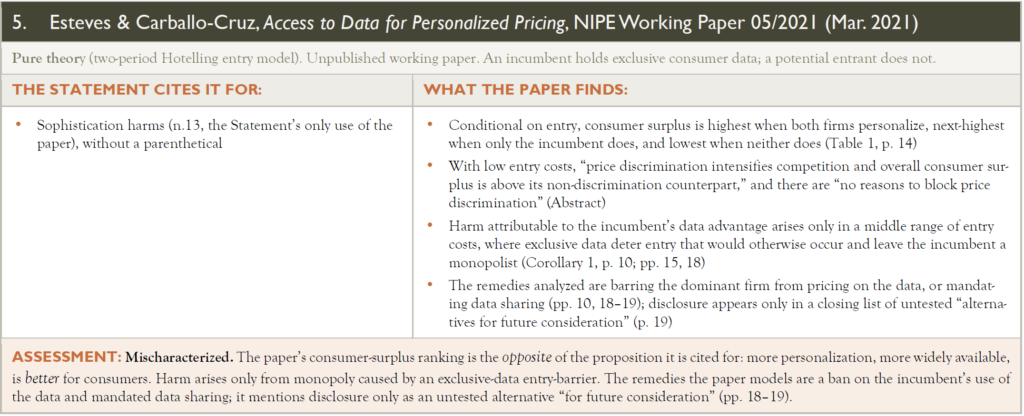

Page references are to the cited works; note numbers (n.8–n.13) are the Proposed Statement’s. Quotations from the Statement are at 3–4.
[1] Berin Szoka, Tom Struble, Geoffrey A. Manne & Ben Sperry, Comments of TechFreedom & the International Center for Law & Economics in Response to Big Data: A Tool for Inclusion or Exclusion? 11–12 (FTC Project No. P145406, 2014), https://www.laweconcenter.org/resources/comments-response-ftc-workshop-big-data-tool-inclusion-exclusion (“tailoring prices more closely to an individual’s willingness to pay means that more transactions will take place than otherwise would have, with more consumers having access to the product and more consumers’ desires being satisfied. And price differentiation generally means that the poor pay less, not more, for the same goods.”).
[2] Dirk Auer, Justin (Gus) Hurwitz, Geoffrey A. Manne, Julian Morris & Kristian Stout, Privacy, Antitrust, and the Economic Approach to the Regulation of Consumer Data 5–7 (ICLE Comment 4, FTC Hearings on Competition & Consumer Protection in the 21st Century, Project No. P181201, 2018), https://laweconcenter.org/resources/icle-comments-the-regulation-of-consumer-data; Int’l Ctr. for Law & Econ., The Weakness of Interventionist Claims: Summary Comments on the FTC Hearings on Competition & Consumer Protection in the 21st Century 10, 139–40 (2019), https://laweconcenter.org/resources/icle-comments-ftc-hearings-on-competition-consumer-protection-in-the-21st-century-summary (“there are many cases where personalized pricing reduces deadweight loss and increases access to a product or service for those with a lower willingness-to-pay”).
[3] Geoffrey A. Manne, Daniel Gilman & Kristian Stout, Comments of the International Center for Law & Economics: FTC Advance Notice of Proposed Rulemaking, Trade Regulation Rule on Commercial Surveillance and Data Security (Docket No. FTC-2022-0053, R111004, Nov. 21, 2022), https://laweconcenter.org/wp-content/uploads/2022/11/ICLE-Commercial-Surveilance-ANPR-Comments-v4.pdf.
[4] Geoffrey A. Manne et al., Comments on Canadian Competition Bureau Discussion Paper on Algorithmic Pricing and Competition (Int’l Ctr. for Law & Econ., Aug. 4, 2025), https://laweconcenter.org/wp-content/uploads/2025/08/Canada-Algorithmic-pricing-and-competition-1.pdf.
[5] Ian Adams, Eric Fruits & Brian Albrecht, ICLE Comments to Competition Bureau Canada on Examining the Food Supply Chain 9–12, 27 (Int’l Ctr. for Law & Econ. 2026), https://laweconcenter.org/resources/icle-comments-to-competition-bureau-canada-on-examining-the-food-supply-chain.
[6] Brian C. Albrecht et al., Food-Retail Competition, Antitrust Law, and the Kroger/Albertsons Merger (Int’l Ctr. for Law & Econ., White Paper No. 2023-10-17, 2023), https://laweconcenter.org/wp-content/uploads/2023/10/Kroger-Albertsons-Merger-Full-Paper.pdf.
[7] Eric Fruits, The Waterbed Effect and the Price of ‘Pricing Fairness’ (Int’l Ctr. for Law & Econ., Issue Brief No. 2026-03-17, 2026), https://laweconcenter.org/wp-content/uploads/2026/03/Grocery-Pricing-Legislation-2026.pdf.
[8] Eric Fruits, Too Much on the Menu: Disclosure Overload and Crowding Out in Food-Delivery Regulation (Int’l Ctr. for Law & Econ., Issue Brief No. 2026-08-21, Aug. 21, 2026), https://laweconcenter.org/wp-content/uploads/2026/08/Delivery-Pricing-Literature-Review-v3-2026.pdf; Brian C. Albrecht et al., Comments of the International Center for Law & Economics: Rule on Unfair or Deceptive Fees in Online Food Delivery Services (FTC Project No. P267101, May 18, 2026) [hereinafter Online Food Delivery Comments], https://laweconcenter.org/wp-content/uploads/2026/05/FTC-Delivery-Fees-2026.pdf.
[9] See Daniel J. Gilman, Fine Print for Every Price: The FTC’s One-Size-Fits-All Guidance, Truth on the Mkt. (Aug. 28, 2026),https://truthonthemarket.com/2026/08/28/fine-print-for-every-price-the-ftcs-one-size-fits-all-guidance; Alden Abbott, Your Price May Vary: The FTC’s Personalized-Pricing Puzzle, Truth on the Mkt. (Sept. 2, 2026), https://truthonthemarket.com/2026/09/02/your-price-may-vary-the-ftcs-personalized-pricing-puzzle.
[10] Fed. Trade Comm’n, Proposed Enforcement Policy Statement Regarding Personalized Pricing, Docket No. FTC-2026-1057, Doc. No. FTC-2026-1057-0001 (Aug. 19, 2026), https://downloads.regulations.gov/FTC-2026-1057-0001/content.pdf [hereinafter Proposed Statement].
[11] Id. at 1.
[12] Id. at 3.
[13] See Geoffrey A. Manne, Bringing Antitrust’s Economic and Institutional Limits to the FTC’s Consumer Protection Authority 12–13 (Int’l Ctr. for Law & Econ. 2014), https://www.laweconcenter.org/resources/bringing-antitrusts-economic-institutional-limits-ftcs-consumer-protection-authority (explaining that Section 5(n)’s requirements “serve to impose an error cost approach on unfairness questions, limiting both the likelihood and harm of erroneous over-enforcement”).
[14] See Geoffrey A. Manne, Error Costs in Digital Markets, in The GAI Report on the Digital Economy 33, 48 (2020), https://laweconcenter.org/resources/error-costs-in-digital-markets (“Rebuttable presumptions are sometimes employed as a cost-saving substitute for direct evidence when economic theory predicts a relatively high probability of competitive harm.”).
[15] See Adams, Fruits & Albrecht, supra note 5, at 2 (“If enforcement condemns lawful discounting, loyalty pricing, or algorithm-driven responses to market conditions, firms may abandon those practices across their operations to avoid liability. Market forces cannot readily restore the lost benefits.”).
[16] See Geoffrey A. Manne, The Hydraulic Theory of Disclosure Regulation and Other Costs of Disclosure, 58 Ala. L. Rev. 473, 477, 485–86 (2007) [hereinafter Manne, Hydraulic Theory] (“Disclosure regulation makes some forms of behavior more expensive relative to others. Rational actors will respond by shifting some conduct into the comparatively cheaper outlets. And these alternative behaviors may actually be less beneficial than the regulated, deterred behavior.”).
[17] Proposed Statement, supra note 10, at 5.
[18] Int’l Harvester Co., 104 F.T.C. 949, 1059 (1984).
[19] 15 U.S.C. § 45(n) (2024); FTC v. Corpay, Inc., 164 F.4th 807, 840 (11th Cir. 2026) (“As ‘unless’ conveys, the three factors that follow it are mandatory for a finding that a practice is ‘unfair.’”).
[20] FTC Policy Statement on Unfairness, 104 F.T.C. 1070, 1073 (1984) (appended to Int’l Harvester Co., 104 F.T.C. 949 (1984)).
[21] Proposed Statement, supra note 10, at 4 & n.13.
[22] See infra Part II.C and the Appendix.
[23] Proposed Statement, supra note 10, at 6.
[24] Int’l Harvester, 104 F.T.C. at 1062.
[25] Trade Regulation Rule on Commercial Surveillance and Data Security, 87 Fed. Reg. 51,273, 51,293 (Aug. 22, 2022) (advance notice of proposed rulemaking) (dissenting statement of Commissioner Noah Joshua Phillips); id. at 51,298 (dissenting statement of Commissioner Christine S. Wilson).
[26] Proposed Statement, supra note 10, at 4.
[27] See Gilman, supra note 9.
[28] Manne, Gilman & Stout, supra note 3, at 15, 47 (urging the Commission to explain how its Section 5 authority applies to data practices and noting that “[s]uch guidance would, of necessity, account for the assessment of countervailing benefits too”); Berin Szóka & Geoffrey A. Manne, The Federal Trade Commission: Restoring Congressional Oversight of the Second National Legislature 67 (Int’l Ctr. for Law & Econ. 2016), https://laweconcenter.org/resources/wstate-manneg-20160524-sd004 (arguing that guidance should explain how the Commission will measure “concepts like materiality, weighing injury with benefits, and measuring reasonable avoidability”).
[29] Proposed Statement, supra note 10, at 8.
[30] See Brief of Amici Curiae International Center for Law & Economics and TechFreedom in Support of Petitioner at 26–27, LabMD, Inc. v. FTC, No. 16-16270 (11th Cir. 2017), https://laweconcenter.org/resources/amicus-brief-icle-techfreedom-labmd-inc-v-federal-trade (arguing that treating informal guidance as the source of “legally enforceable duties” creates a “de facto rulemaking[]” that bypasses Section 18’s safeguards).
[31] See James M. Lacko & Janis K. Pappalardo, Fed. Trade Comm’n Bureau of Econ., Improving Consumer Mortgage Disclosures: An Empirical Assessment of Current and Prototype Disclosure Forms ES-1 (2007), https://www.ftc.gov/sites/default/files/documents/reports/improving-consumer-mortgage-disclosures-empirical-assessment-current-and-prototype-disclosure-forms/p025505mortgagedisclosurereport.pdf.
[32] Proposed Statement, supra note 10, at 1; see also id. at 3–4.
[33] Id. at 3 (emphasis added).
[34] Id. at 4.
[35] See Lars A. Stole, Price Discrimination and Competition, in 3 Handbook of Industrial Organization 2221, 2239–43 (Mark Armstrong & Robert Porter eds., 2007) (reviewing the models of Thisse & Vives and of Corts).
[36] Id.
[37] James C. Cooper, Luke Froeb, Daniel P. O’Brien & Steven Tschantz, Does Price Discrimination Intensify Competition? Implications for Antitrust, 72 Antitrust L.J. 327, 342 (2005).
[38] Andrew N. Ferguson, Comm’r, Fed. Trade Comm’n, Concurring Statement, Surveillance Pricing Intermediaries 1 (Matter No. P246202, July 23, 2024), https://www.ftc.gov/system/files/ftc_gov/pdf/surveillance-pricing-6b-ferguson-concurrence.pdf.
[39] Proposed Statement, supra note 10, at 3. In January 2025, Commission staff described its summary of the Section 6(b) responses as preliminary and disclaimed any assessment of illegal conduct. Fed. Trade Comm’n, FTC Surveillance Pricing 6(b) Study: Research Summaries—A Staff Perspective 2 (Jan. 2025), https://www.ftc.gov/system/files/ftc_gov/pdf/p246202_surveillancepricing6bstudy_researchsummaries_redacted.pdf [hereinafter Research Summaries] (“The format of this work aims to highlight initial observations . . . . This document does not reflect or suggest any assessment as to whether anyone has engaged in illegal conduct.”).
[40] Competition & Mkts. Auth., Pricing Algorithms: Economic Working Paper on the Use of Algorithms to Facilitate Collusion and Personalised Pricing ¶ 7.14, at 38 (CMA94, 2018) (describing the European Commission’s 2018 mystery shopping study of 160 e-commerce websites in eight member states: “Price differences were only observed in 6% of tests, and the median price difference observed was less than 1.6%.”); see also Competition & Mkts. Auth., The Commercial Use of Consumer Data ¶¶ 3.69–3.70, at 92 (CMA38, 2015) (“we did not receive a clear indication of examples where price discrimination using consumer data was being used to the likely detriment of consumers”; “Firms may be wary of damaging their reputation or brand value by being seen to do this.”).
[41] Alberto Cavallo, Are Online and Offline Prices Similar? Evidence from Large Multi-Channel Retailers, 107 Am. Econ. Rev. 283, 295 (2017).
[42] Stefano DellaVigna & Matthew Gentzkow, Uniform Pricing in U.S. Retail Chains, 134 Q.J. Econ. 2011, 2011 (2019).
[43] Proposed Statement, supra note 10, at 3–4 nn.8, 11–13.
[44] The paper the Commission relies on most, citing it for each of its economic claims, models the seller as a monopolist and states that it “do[es] not consider the impact of personalized pricing in a competitive market.” Jean-Pierre Dubé & Sanjog Misra, Personalized Pricing and Consumer Welfare, 131 J. Pol. Econ. 131, 180 (2023).
[45] See Stole, supra note 35, at 2231–32 & n.19.
[46] Benjamin Reed Shiller, Approximating Purchase Propensities and Reservation Prices from Broad Consumer Tracking, 61 Int’l Econ. Rev. 847, 861 (2020).
[47] Id. at 862 tbl.4.
[48] Id. at 867.
[49] Dubé & Misra, supra note 44, at 157–58.
[50] Id. at 134–35.
[51] Nicholas Buchholz et al., Personalized Pricing and the Value of Time: Evidence from Auctioned Cab Rides, 93 Econometrica 929, 930, 934 (2025).
[52] Id. at 952–53 & tbl.VII.
[53] Dubé & Misra, supra note 44, at 159 (“we also do not expect any competitive response from other platforms”).
[54] Buchholz et al., supra note 51, at 934.
[55] Andrew Rhodes & Jidong Zhou, Personalized Pricing and Competition, 114 Am. Econ. Rev. 2141, 2152 (2024) (stating in Proposition 1 that, where the market is fully covered, “relative to uniform pricing, personalized pricing harms firms and benefits consumers in aggregate”).
[56] Buchholz et al., supra note 51, at 954.
[57] Dubé & Misra, supra note 44, at 167.
[58] Shiller, supra note 46, at 862.
[59] Rhodes & Zhou, supra note 55, at 2152–53, 2162–63; see also Proposed Statement, supra note 10, at 4 n.13.
[60] Rhodes & Zhou, supra note 55, at 2157 & n.23 (thresholds); id. at 2163, 2165 (remedies).
[61] Buchholz et al., supra note 51, at 952.
[62] Id. at 952–53 & tbl.VII.
[63] Dubé & Misra, supra note 44, at 157, 165–67 & tbl.8. Every personalized price exceeds the uninformative $99 status quo, ranging from $126 to $6,292. A comparison with $99 thus shows every buyer paying more. The authors use the optimal uniform price “as our base case, not $99, since the former reflects the textbook inverse-elasticity-rule pricing that would be predicted for a maturing company.” Id. at 158, 165.
[64] Rhodes & Zhou, supra note 55, at 2144 n.7, 2155 (“With partial market coverage, personalized pricing increases welfare by expanding demand, but it boosts profit so much that in aggregate consumers suffer from it.”).
[65] Against a uniform price, consumer surplus falls 0.50% in Shiller and 2.25% in Buchholz et al. Shiller, supra note 46, at 861 tbl.3; Buchholz et al., supra note 51, at 953 tbl.VII. Dubé and Misra estimate a 25% decline against the optimal uniform price, even though most potential customers would receive lower price offers. Dubé & Misra, supra note 44, at 166–67. In Buchholz et al., adding price sensitivity to personalization based on wait sensitivity alone also lowers consumer surplus, but only slightly. Buchholz et al., supra note 51, at 953 tbl.VII.
[66] Buchholz et al., supra note 51, at 953 tbl.VII, 954–55 & fig.5 (the inside-option share rises 7.28% relative to uniform pricing; 62.5% of consumers gain; the most price- and wait-sensitive riders gain most); Dubé & Misra, supra note 44, at 167, 171–72 (63% of personalized prices fall below the optimal uniform price; smaller firms with part-time staff are most likely to benefit); Shiller, supra note 46, at 861 tbl.3, 862 (subscribers rise 3.12%; “most consumers receive lower prices when prices are personalized, and hence the majority are slightly better off”); see also Rhodes & Zhou, supra note 55, at 2153, 2155 (under partial coverage, personalized pricing “expands total demand and strictly increases total welfare”).
[67] FTC Policy Statement on Unfairness, supra note 20, at 1073.
[68] See Buchholz et al., supra note 51, at 954–55; Dubé & Misra, supra note 44, at 172; Shiller, supra note 46, at 862, 867.
[69] 15 U.S.C. § 45(n) (2024).
[70] Shiller, supra note 46, at 861 tbl.3; Buchholz et al., supra note 51, at 953 tbl.VII; Dubé & Misra, supra note 44, at 166–67 & tbl.8. Dubé and Misra compare personalized prices capped at $499 with the optimal uniform price of $327. Uncapped personalization reduces total consumer surplus by 25% against that benchmark. Capped personalization reduces it by 11.45% against the $249 uniform price ZipRecruiter later adopted. Id. at 166 tbl.8, 167.
[71] Dubé & Misra, supra note 44, at 167, 179.
[72] The Unfairness Policy Statement lists “reduced incentives to innovation and capital formation” among the costs of a remedy that must be considered. FTC Policy Statement on Unfairness, supra note 20, at 1073–74.
[73] See, e.g., Ohio v. American Express Co., 585 U.S. 529 (2018).
[74] See Stole, supra note 35, at 2231–32 & n.19.
[75] Buchholz et al., supra note 51, at 953 tbl.VII; Shiller, supra note 46, at 861 tbl.3. Buchholz et al. note that increased platform use need not mean an equal increase in total travel because their model’s outside option includes taking “another form of transportation.” Buchholz et al., supra note 51, at 939. The relevant question is how pricing affects users’ decisions to book trips on the platform; the distance traveled matters less to that question.
[76] Proposed Statement, supra note 10, at 4 & n.13.
[77] Id.
[78] Dubé & Misra, supra note 44, at 142–43.
[79] Id. at 131 (emphasis added).
[80] Id. at 171–72.
[81] Id. at 180.
[82] Id. at 136, 172.
[83] Proposed Statement, supra note 10, at 4 n.13.
[84] Rhodes & Zhou, supra note 55, at 2163 (“[A]symmetry in information and timing allows the firms to better segment the market, increasing industry profit. Consequently, consumer surplus ends up being lowest in the mixed regime.”).
[85] Id. at 2142 (“We focus on the limit case of personalized pricing, i.e., first-degree price discrimination, where firms can perfectly infer individual consumers’ preferences”); id. at 2162 n.30 (“it would also be interesting to consider other information structures and investigate how the impact of price discrimination changes with the amount of information that firms have access to”).
[86] Buchholz et al., supra note 51, at 953 tbl.VII.
[87] Id. at 952–53 & tbl.VII.
[88] Id. at 953.
[89] Id. at 932.
[90] Id. at 953 tbl.VII, 954–55 & fig.5.
[91] Ginger Zhe Jin, Liad Wagman & Mengyi Zhong, Surveillance Pricing: A Cautionary Summary of Potential Harms and Solutions, CPI Antitrust Chron., July 2025, at 4.
[92] Id. (emphasis added).
[93] Id.
[94] Id. at 5.
[95] Id. (citing Rhodes & Zhou, supra note 55).
[96] Id. at 9 (emphasis added).
[97] Id.
[98] Id.
[99] Rosa-Branca Esteves & Francisco Carballo-Cruz, Access to Data for Personalized Pricing: Can It Raise Entry Barriers and Abuse of Dominance Concerns? 10, 15, 18 (NIPE Working Paper No. 05/2021, Mar. 2021). The Proposed Statement misdates the paper by four years. See Proposed Statement, supra note 10, at 4 n.13 (citing the paper as “NIPE Working Papers, NIPE, Universidade do Minho (May 2025)”).
[100] Esteves & Carballo-Cruz, supra note 99, at 14 tbl.1.
[101] Id. at 15 (“conditional on entry, consumer surplus is in fact maximized when both firms are able to use data for personalized prices”).
[102] Id. at 1.
[103] Id.
[104] Mark Armstrong & John Vickers, Discriminating Against Captive Customers, 1 Am. Econ. Rev.: Insights 257, 257–58, 263 (2019).
[105] Brian C. Albrecht, Price Competition and the Use of Consumer Data 1–2 (working paper, June 12, 2026), https://briancalbrecht.com/albrecht_price_competition_consumer_data.pdf.
[106] Dirk Bergemann, Benjamin Brooks & Stephen Morris, The Limits of Price Discrimination, 105 Am. Econ. Rev. 921, 921–23 (2015).
[107] See Rhodes & Zhou, supra note 55, at 2164; Esteves & Carballo-Cruz, supra note 99, at 1, 17–18.
[108] Proposed Statement, supra note 10, at 5.
[109] Id.
[110] Proposed Statement, supra note 10, at 3; see also id. at 1 (personalized pricing is “a long-established norm in some markets”).
[111] Id. at 1.
[112] Gilman, supra note 9 (“How many consumers must hold that expectation? How consistently? Must a clear majority share it?”); see also Albrecht et al., Online Food Delivery Comments, supra note 8, at 7 (“A first-time user’s expectations differ materially from those of a customer placing a hundredth order.”).
[113] Council of Econ. Advisers, Big Data and Differential Pricing 17 (2015).
[114] FTC Policy Statement on Deception, 103 F.T.C. 174, 176 & n.8 (1984) (appended to Cliffdale Assocs., Inc., 103 F.T.C. 110 (1984)).
[115] FTC Policy Statement on Deception, supra note 114, at 182; Int’l Harvester, 104 F.T.C. at 1057; see also Geoffrey A. Manne, R. Ben Sperry & Berin Szoka, In the Matter of Nomi Technologies, Inc.: The Dark Side of the FTC’s Latest Feel-Good Case 5, 10–11 (ICLE White Paper 2015-1, 2015), https://laweconcenter.org/resources/nomi-white-paper (objecting to the Commission’s treatment of the absence of an in-store notice as an implied representation and observing that “for an implied promise to be deemed material (and thus deceptive) under the DPS, the FTC must adduce some proof: either that it was, in fact, intended, or that it was, in fact, material”).
[116] FTC Policy Statement on Deception, supra note 114, at 175–76.
[117] Int’l Harvester, 104 F.T.C. at 1057, 1059.
[118] Id. at 1059–60.
[119] Id. at 1063–64, 1070.
[120] Id. at 1058 & n.29; see also id. at 1062 (limiting mandatory disclosure “to those core aspects of a transaction that virtually all consumers would consider essential to an informed decision”).
[121] See Int’l Harvester, 104 F.T.C. at 1060 (“Since the seller will have no way of knowing in advance which disclosure is important to any particular consumer, he will have to make complete disclosures to all.”).
[122] Proposed Statement, supra note 10, at 6 n.24 (quoting P. Lorillard Co. v. FTC, 186 F.2d 52, 58 (4th Cir. 1950)) (“to tell less than the whole truth is a well-known method of deception”).
[123] P. Lorillard Co. v. FTC, 186 F.2d 52, 58 (4th Cir. 1950) (“The fault with this advertising was not that it did not print all that the Reader’s Digest article said, but that it printed a small part thereof in such a way as to create an entirely false and misleading impression, not only as to what was said in the article, but also as to the quality of the company’s cigarettes.”). The Commission itself cites Lorillard as a half-truth case, not a silence case. Int’l Harvester Co., 104 F.T.C. at 1057 & n.25.
[124] FTC v. Standard Educ. Soc’y, 302 U.S. 112, 114–16 (1937) (salespeople represented that a set of books was free, that the prospect had been specially selected, and that the regular price exceeded the offered price; the Commission found each representation false).
[125] Proposed Statement, supra note 10, at 5.
[126] Proposed Statement, supra note 10, at 7.
[127] FTC v. Colgate-Palmolive Co., 380 U.S. 374, 387 (1965).
[128] Proposed Statement, supra note 10, at 5 n.19 (quoting Colgate-Palmolive, 380 U.S. at 387).
[129] 15 U.S.C. § 45(n) (2024) (emphasis added).
[130] Corpay, 164 F.4th at 840 (“As ‘unless’ conveys, the three factors that follow it are mandatory for a finding that a practice is ‘unfair.’”); see also Proposed Statement, supra note 10, at 5 n.17 (citing Corpay, 164 F.4th at 839).
[131] Proposed Statement, supra note 10, at 7–8.
[132] 15 U.S.C. § 45(n) (2024).
[133] Proposed Statement, supra note 10, at 3.
[134] Id. at 6.
[135] FTC Policy Statement on Unfairness, supra note 20, at 1073.
[136] Id. at 1073.
[137] See Proposed Statement, supra note 10, at 6 n.24 (citing Priester et al. and Xia et al. on consumers’ perceptions of fairness); Geoffrey A. Manne & Kristian Stout, Comments of the International Center for Law & Economics, Informational Injury Workshop 40–41 (FTC Project No. P175413, 2017), https://laweconcenter.org/resources/comments-international-center-law-economics-matter-informational-injury-workshop-ftc (quoting the legislative history of Section 5(n): “Emotional impact and more subjective types of harm alone are not intended to make an injury unfair.”).
[138] Proposed Statement, supra note 10, at 6.
[139] Id. at 6.
[140] Id. at 6 n.20.
[141] Corpay, 164 F.4th at 825–27, 838–42.
[142] Proposed Statement, supra note 10, at 6.
[143] Proposed Statement, supra note 10, at 6 n.22.
[144] 15 U.S.C. § 1681m(a)(1)–(4) (2024); see id. § 1681g(f)(1)(C) (key factors). The quoted statement appears in § 1681m(a)(3)(B).
[145] 15 U.S.C. § 1691(d)(2)–(3) (2024).
[146] 15 U.S.C. § 1691(d)(2)(B) (2024).
[147] 15 U.S.C. § 1691(d)(6) (2024).
[148] 15 U.S.C. §§ 1681m(h)(1), (h)(5), 1681g(f)(1)(B)–(E) (2024).
[149] 15 U.S.C. § 1681m(b)(1) (2024).
[150] Proposed Statement, supra note 10, at 6 n.23 (citing Cal. Ins. Code §§ 791.02, 791.10; Va. Code Ann. § 38.2-602; Wash. Admin. Code ch. 284-30A).
[151] 15 U.S.C. § 45(n) (2024).
[152] Proposed Statement, supra note 10, at 6 n.21.
[153] FTC Policy Statement on Unfairness, supra note 20, at 1075–76.
[154] Proposed Statement, supra note 10, at 6.
[155] Proposed Statement, supra note 10, at 7.
[156] Adams, Fruits & Albrecht, supra note 5, at 27 (“retailers should clearly disclose final prices and truthfully present discounts and reference prices”); Albrecht et al., Online Food Delivery Comments, supra note 8, at 7–8, 12.
[157] Int’l Harvester, 104 F.T.C. at 1062 (adding that “virtually any piece of information may be useful to some consumers,” and that a disclosure duty grounded in unfairness requires “a full cost-benefit analysis, in which we weigh the consumer benefits of disclosure against their likely costs”).
[158] Exec. Office of the President, Big Data: Seizing Opportunities, Preserving Values 65 (2014).
[159] Council of Econ. Advisers, supra note 113, at 17.
[160] Petra Persson, Attention Manipulation and Information Overload, 2 Behav. Pub. Pol’y 78, 96–97 (2018).
[161] Frank H. Easterbrook & Daniel R. Fischel, Mandatory Disclosure and the Protection of Investors, 70 Va. L. Rev. 669, 709 (1984).
[162] Persson, supra note 160, at 101.
[163] Id. at 97. Both results come from a formal model, illustrated with examples rather than tested against market data. They show that the seller responses Persson describes are available to any firm subject to a disclosure mandate, but they do not show how often firms use them.
[164] Manne, Hydraulic Theory, supra note 16, at 480–81 (“As this Article suggests, however, mandatory disclosure has important and ill-considered consequences; it is not merely regulatory ‘chicken soup.’”).
[165] Id. at 506.
[166] Id. at 506–07 (“It is precisely individual shareholders who are not in a position to evaluate complex information regarding, for example, executive pay packages. But it is also precisely these individuals at whom mandatory disclosures are directed.”).
[167] Proposed Statement, supra note 10, at 7.
[168] Manne, Hydraulic Theory, supra note 16, at 510–11.
[169] Like other agencies before it. See id. at 497 (“Unfortunately, the SEC does not appear to consider the relevant, marginal question. . . . The broad-brushed nature of federal regulation effectively precludes a firm-by-firm marginal analysis.”); see also id. at 491 (“Regulators are limited in their ability to predict the effects of their regulations . . . . Even well-intended regulation is bound to have unintended consequences . . . .”).
[170] OECD, Enhancing Online Disclosure Effectiveness 14, 31 (OECD Digital Econ. Papers No. 335, 2022) (quoting Omri Ben-Shahar & Carl E. Schneider, The Failure of Mandated Disclosure, 159 U. Pa. L. Rev. 647, 686 (2011)).
[171] See Trade Regulation Rule on Unfair or Deceptive Fees, 90 Fed. Reg. 2066, 2066 (Jan. 10, 2025) (codified at 16 C.F.R. pt. 464).
[172] See Rule on Unfair or Deceptive Rental Housing Fee Practices, 91 Fed. Reg. 12,325 (Mar. 13, 2026) (advance notice of proposed rulemaking).
[173] See Proposed Statement, supra note 10, at 1 n.1.
[174] Lisa Robinson, Kip Viscusi & Richard Zeckhauser, Efficient Warnings, Not “Wolf or Puppy” Warnings, in The Future of Risk Management 227, 241 (Howard Kunreuther et al. eds., 2019).
[175] OECD, Enhancing Online Disclosure Effectiveness, supra note 170, at 6.
[176] Howard Beales & Todd J. Zywicki, Junkyard Dogs: The Law and Economics of “Junk” Fees, CPI Antitrust Chron., Apr. 2023, at 6, https://laweconcenter.org/resources/junkyard-dogs-the-law-and-economics-of-junk-fees/.
[177] Anna Priester et al., A Special Price Just for You: Effects of Personalized Dynamic Pricing on Consumer Fairness Perceptions, 19 J. Revenue & Pricing Mgmt. 99, 106–08 (2020).
[178] Oren Bar-Gill, Cass R. Sunstein & Inbal Talgam-Cohen, Algorithmic Harm in Consumer Markets, 15 J. Legal Analysis 1, 10, 25 (2023).
[179] OECD, The Effects of Online Disclosure About Personalised Pricing on Consumers 5, 9–13 (OECD Digital Econ. Papers No. 303, 2021).
[180] Id. at 5.
[181] Id. at 27.
[182] Id. at 27.
[183] Id. at 26.
[184] The OECD’s later report emphasizes the prominence and repetition of the tested notices: the disclosures were “succinct, substantial in size, seen repeatedly, and accompanied every single personalised price. OECD, Enhancing Online Disclosure Effectiveness, supra note 170, at 14.
[185] Id.
[186] Willem H. van Boom et al., Consumers Beware: Online Personalized Pricing in Action! How the Framing of a Mandated Discriminatory Pricing Disclosure Influences Intention to Purchase, 33 Soc. Just. Rsch. 331 (2020).
[187] Id. at 335–37.
[188] Id. at 343–45.
[189] Allison Nicoletti & Christina Zhu, Economic Consequences of Transparency Regulation: Evidence from Bank Mortgage Lending, 61 J. Acct. Rsch. 1827, 1846–51 (2023).
[190] Id. at 1832.
[191] Natasha Clarke et al., Calorie (Energy) Labelling for Changing Selection and Consumption of Food or Alcohol, 2025 Cochrane Database of Systematic Reviews, Art. CD014845, at 2, https://doi.org/10.1002/14651858.CD014845.pub2.
[192] Pasquale E. Rummo et al., Menu Labeling and Calories Purchased in Restaurants in a US National Fast Food Chain, 6 JAMA Network Open e2346851, tbl. 3 (2023).
[193] See Lacko & Pappalardo, supra note 31, at ES-1.
[194] Proposed Statement, supra note 10, at 6.
[195] Proposed Statement, supra note 10, at 6.
[196] Manne, Hydraulic Theory, supra note 16, at 476. The article discusses securities regulation, but its account of how regulated actors respond to disclosure mandates applies beyond that setting.
[197] Id. at 477.
[198] Id. at 485 (“[W]here behavior can be altered at a lower cost than the cost of disclosure, disclosure rules will induce behavioral changes rather than increased information flow.”); id. at 486 (“The magnitude of the hydraulic effect will turn primarily on the degree of cross-elasticity (substitutability) between the impeded (more costly) and the freer (less costly) sources of behavior.”).
[199] Proposed Statement, supra note 10, at 6 n.20 (declining “to take any position on whether some personalized pricing practices are unfair even when fully disclosed to consumers”).
[200] Buchholz et al., supra note 51, at 932, 952 (describing ETA-based pricing as “another non-personalized pricing policy” that platforms may adopt “due to consumer backlash,” under which “[w]ait-time pricing may then give consumers incentives to reveal their high wait-time sensitivity by picking a driver with shorter wait time and higher price”).
[201] Manne, Hydraulic Theory, supra note 16, at 477; see also id. at 487 (observing that, under seat-belt laws, a shift in behavior “does not impose the same risk on, say, pedestrians, who now suffer the ill effects of more reckless driving but earn none of the benefit of ‘safer’ accidents”).
[202] Id. at 477–78.
[203] Stole, supra note 35, at 2226 (conditions for discrimination). The price-gap example in the text is a conditional incentive argument, not an estimate of the proposed notice’s effect.
[204] Xi Li & Krista J. Li, Beating the Algorithm: Consumer Manipulation, Personalized Pricing, and Big Data Management, 25 Mfg. & Serv. Operations Mgmt. 36, 36 (2023).
[205] S. Nageeb Ali, Greg Lewis & Shoshana Vasserman, Voluntary Disclosure and Personalized Pricing, 90 Rev. Econ. Stud. 538, 558–60 (2023).
[206] Dubé & Misra, supra note 44, at 167, 171–72.
[207] DellaVigna & Gentzkow, supra note 42, at 2014, 2033.
[208] Id. at 2055–56 & fig.XI. See also Manne, Hydraulic Theory, supra note 16.
[209] See Fruits, Waterbed Effect, supra note 7, at 14–16 (the Robinson-Patman Act’s effect on discounting, the Antitrust Modernization Commission’s 2007 conclusion, and the pay-transparency evidence of Cullen and Pakzad-Hurson); Geoffrey A. Manne, Written Testimony, Reviving Competition, Part 5: Addressing the Effects of Economic Concentration on America’s Food Supply 19–20 (Int’l Ctr. for Law & Econ. 2022), https://laweconcenter.org/resources/testimony-of-geoffrey-a-manne-reviving-competition-part-5-addressing-the-effects-of-economic-concentration-on-americas-food-supply/ (“The RPA effectively imposes wholesale price uniformity on sellers which deters innovation (or, as noted, price reductions) and new entry.”).
[210] Complaint ¶¶ 7, 21–22, 262, FTC v. Amazon.com, Inc., No. 2:23-cv-01495 (W.D. Wash. Sept. 26, 2023).
[211] See, e.g., Zoë B. Cullen & Bobak Pakzad-Hurson, Equilibrium Effects of Pay Transparency, 91 Econometrica 765, 765 (2023) (finding that state laws protecting workers’ right to inquire about pay were followed by wage declines of about 2%, because employers “credibly refuse to pay high wages to any one worker to avoid costly renegotiations with others”).
[212] Fed. Trade Comm’n, Research Summaries, supra note 39, at 1–2, 10.
[213] See Abbott, supra note 9.
[214] Corpay, 164 F.4th at 838–42 (unfairness count proved through a customer survey, eight internal surveys, internal emails, complaint data, and evidence of what customers were told about the fees); see also id. at 825–27 (record evidence on what customers were told).
[215] Proposed Statement, supra note 10, at 3–4 nn.8, 11–13.
Source: Federal Trade Commission

