Nov
2 2026
The Future of EU Competition Law: Regulating at Machine Speed?
Conference Panels


What are you looking for?




Conference Panels

INTEREST OF AMICI CURIAE[1] Amici are scholars of antitrust law and economics at leading universities and research institutions across the United States. Their names, titles, . . .
Amici are scholars of antitrust law and economics at leading universities and research institutions across the United States. Their names, titles, and academic affiliations are listed in the Appendix. All possess relevant expertise and experience in antitrust law and economics.
Amici share an interest in promoting the public interest through a body of antitrust law that remains grounded in sensible rules informed by sound economic analysis. That includes advising against standards that courts are ill-suited to apply and against decisions that fail to consider the procompetitive and pro-consumer benefits of bundling and bundled discounts, as well as their potential costs, in context.
Nielsen did not appeal the district court’s ruling that its earlier policy of selling Nationwide only with local data was an unlawful express tie. Pet. App. 23a. This petition concerns the later standalone offer, which the panel treated as continued enforcement of that policy through a “constructive tie.” Id. at 29a-30a. The distinction matters. The ruling against that requirement does not tell a court when a price for Nationwide alone is high enough to impose the same requirement in effect. The panel relied on the fact that buying Nationwide from Nielsen and local data from Eastlan would have cost Cumulus $1.2 million more than Nielsen’s bundle. Id. at 32a. That comparison shows which offer was less expensive. By itself, it does not establish whether the discount excluded rivals through a mechanism other than competition on price. The question is what additional showing courts should require before treating that price difference as coercive.
Amici agree with Petitioner that the decision below conflicts with the Ninth Circuit’s decision in Cascade Health Sols. v. PeaceHealth, 515 F.3d 883 (9th Cir. 2008) and with the Sixth Circuit’s decision in Collins Inkjet Corp. v. Eastman Kodak Co., 781 F.3d 264 (6th Cir. 2015), and that it cannot be reconciled with this Court’s decisions in Verizon Commc’ns Inc. v. Law Offices of Curtis V. Trinko, LLP, 540 U.S. 398 (2004), Pac. Bell Tel. Co. v. linkLine Commc’ns, Inc., 555 U.S. 438 (2009), and Brooke Group Ltd. v. Brown & Williamson Tobacco Corp., 509 U.S. 209 (1993).
The unchallenged ruling on Nielsen’s earlier policy limits what this case can resolve. But the injunction also restricts the price of the later standalone offer, making the standard for evaluating that offer consequential. Pet. App. 100a-101a; 102a-103a. Amici write to explain, as a matter of economics, why the panel’s pricing standard cannot distinguish exclusion from price competition, why it turns district courts into price regulators, why its costs arrive long before any final judgment, and why the Court should require an objective showing based on the seller’s costs.
The panel determined Nielsen’s standalone price was “exorbitant” and “non-cost justified” relative to its bundle. Pet. App. 30a. Every bundled discount creates a gap between the standalone and bundle prices. Where a bundle is otherwise lawful, adding a standalone option does not make it unlawful merely because buyers prefer the bundle. But the availability of that option does not establish that the underlying bundle is lawful. Courts therefore need a standard that distinguishes a discount from a price condition that excludes rivals. Nielsen’s national and local ratings share much of the cost of the same local surveys, and no economic principle yields a single correct division of the shared cost between the products. That makes “cost justification” for a price difference a different inquiry from whether the effective price of the tied product covers its incremental cost. The benchmarks the courts below used were other prices, not costs. And “exorbitant” supplies no measurable threshold for liability.
Because the panel’s theory does not require the plaintiff to show costs, it can produce mandatory injunctions in short order while requiring court supervision of prices with no known end date. The case below illustrates the problem. Cumulus obtained an injunction ten weeks after filing suit, and the district court has since rejected Nielsen’s subsequent offers in an order now stayed pending appeal. State enforcers and private plaintiffs began citing the decision within days. Pet. at 25–26. Sellers facing allegations of unlawful bundled discounts will have every reason to settle, so the question, and the circuit conflict, are not likely to reach this Court often, or to be presented as cleanly as they are here.
The decision below also assigns to district courts tasks that they are ill-suited to perform. To mandate a division of shared costs among products is a policy choice. When Congress required cost-based prices for telephone network elements, the Federal Communications Commission needed a national rulemaking to make that choice, and this Court reviewed the result in Verizon Commc’ns Inc. v. FCC, 535 U.S. 467 (2002). The decision below leaves the same kind of choice to a single district court on an expedited record. This Court has, moreover, “repeatedly emphasized the importance of clear rules in antitrust law.” linkLine, 555 U.S. at 452; see also Town of Concord v. Bos. Edison Co., 915 F.2d 17, 22 (1st Cir. 1990) (Breyer, C.J.) (antitrust rules “must be clear enough for lawyers to explain them to clients”). Indeed, courts are “ill suited ‘to act as central planners, identifying the proper price, quantity, and other terms of dealing.’” linkLine, 555 U.S. at 452 (quoting Trinko, 540 U.S. at 408).
Finally, the panel’s pricing standard does not distinguish a discount that attracts customers from a price condition that excludes rivals. The panel also upheld findings that Nielsen’s Network Policy impeded Eastlan’s access to large broadcasters. Pet. App. 37a–39a. It carried those effects forward to the standalone offer because it treated that offer as continued enforcement of the policy. Id. at 39a. That reasoning makes the standard for evaluating the later offer central. A price gap alone cannot supply the missing distinction. The Sixth and Ninth Circuits require a showing tied to the seller’s costs in the pricing practices they addressed. The Court should require an objective, cost-based showing here. Such a rule may permit some exclusionary conduct to escape liability, but this Court accepted that tradeoff in Brooke Group because arbitrary condemnation of price cuts deters price competition.
The panel’s pricing standard would govern bundled offers throughout the economy. Its standard gives sellers and courts nothing to measure. Its costs fall on sellers at the preliminary-injunction stage, before any court decides the case on the merits. And it gives district courts a price-setting role that this Court has refused to assign them. It also misreads the economics of bundled pricing and deepens a conflict among circuits. Each reason supports review.
The panel’s test of coercion has two parts. A standalone price must be “exorbitant” relative to the bundle, and the difference between the two prices must be “non-cost justified.” Pet. App. 30a, 33a–34a. The first part turns on the size of the gap between the standalone and bundle prices. The second turns on the seller’s costs. Economics gives a court no way to answer either question as the panel framed it, and the comparisons the courts below used in place of an answer do not measure what the test asks about.
Bundled pricing is among the most common pricing practices in the economy. A 2025 article in the American Economic Review describes tiered bundles, in which each more expensive package includes everything in the cheaper ones, as “widely adopted across various industries, including streaming services (e.g., Netflix), software companies (e.g., Slack), e-commerce platforms (e.g., Shopify), and most recently AI services (e.g., OpenAI).” Frank Yang, Nested Bundling, 115 Am. Econ. Rev. 2970, 2970 (2025). Marketing scholars open their synthesis of the subject with the observation that “[b]undling is pervasive in today’s markets.” Stefan Stremersch & Gerard J. Tellis, Strategic Bundling of Products and Prices: A New Synthesis for Marketing, 66 J. Mktg. 55, 55 (2002). Leading industrial-organization textbooks address it, and one devotes a full chapter to it. See, e.g., Dennis W. Carlton & Jeffrey M. Perloff, Modern Industrial Organization 324–30 (4th ed. 2005); Paul Belleflamme & Martin Peitz, Industrial Organization: Markets and Strategies ch. 11 (2010). The Ninth Circuit adopted its cost-based test in part because of “the endemic nature of bundled discounts in many spheres of normal economic activity.” Cascade Health, 515 F.3d at 903.
Most of these sellers practice what economists call mixed bundling. They both offer each product separately and offer the products together at a lower combined price. Carlton and Perloff illustrate the practice with a restaurant that sells halibut and pie for $8 each, and a bundle of both for $12. Carlton & Perloff, supra, at 325. Each dish ordered as a separate course is priced at two-thirds the price of the pair. The restaurant sets those prices because its customers value the two dishes differently, not to drive a rival out of business–nothing in the example depends on a rival. Ibid. A large gap between standalone and bundle prices is the ordinary result of selling to customers with different tastes.
The economics literature also shows why no court can say how large a gap is too large. Yang reports that “relatively little is known” about how a multiproduct seller should price its bundles “because characterizations of optimal bundling are generally intractable.” Yang, supra, at 2970. Even for a seller of two goods whose values to customers are independent and additive, the profit-maximizing pricing scheme “remains unknown except for a few special cases.” Ibid. The literature’s “general lesson,” Yang observes, “is that some form of bundling is generically profitable, but characterizing optimal bundling strategies turns out to be very difficult.” Id. at 2975. If economists who specialize in the question cannot specify the right gap between a standalone price and a bundle price, even from the firm’s perspective, a district court has no benchmark for declaring a particular gap “exorbitant.”
The panel’s main evidence of coercion was that standalone Nationwide from Nielsen plus local data from Eastlan would have cost Cumulus $1.2 million more than Nielsen’s bundle. Pet. App. 32a. That figure shows that Nielsen’s offer was the lower one. It does not show that a rival as efficient as Nielsen could not match it. The figure grows when Nielsen cuts its bundle price, when Eastlan raises its local ones, or when Nielsen raises its standalone price. By itself, the figure cannot distinguish a better offer from a penalty on buying separately. The Sixth Circuit rejected this inference. That a seller “appeared to be offering a better deal to customers” than its rival “does not in itself constitute an unlawful tying arrangement,” and a standard resting “solely” on the rival’s product being “significantly more expensive” is “a standard that could too easily treat fair price competition as per se illegal.” Collins Inkjet, 781 F.3d at 270–71. Economists who study ties enforced through price ask instead whether the effective price of the tied product is so low that “alternative producers of the complementary product cannot operate profitably.” Dennis W. Carlton & Michael Waldman, The Strategic Use of Tying to Preserve and Create Market Power in Evolving Industries, 33 RAND J. Econ. 194, 197 (2002). The panel did not ask whether Nielsen’s prices left Eastlan, or an equally efficient rival, unable to operate profitably. It relied instead on the effects of the Network Policy. Pet. App. 39a.
The second half of the panel’s test asks whether the gap between Nielsen’s prices was “cost justified.” Pet. App. 30a, 33a–34a. That question has no single answer when two products are built from shared inputs. Nielsen’s Nationwide report is compiled entirely from its surveys of listeners in more than 270 local markets. Id. at 6a. The costs of both its Nationwide report and its local ones are incurred market by market, in the local surveys. Pet. 5.
Two cost measures describe different production choices. The first is incremental cost, the additional cost of producing Nationwide once the local surveys have been conducted. That is roughly the cost of compiling and delivering the national report. The second is the stand-alone cost, the cost of producing Nationwide if Nielsen sold nothing else. That includes the full cost of surveying every local market. See Gerald R. Faulhaber, Cross-Subsidization: Pricing in Public Enterprises, 65 Am. Econ. Rev. 966 (1975). Neither measure determines how much of the shared survey cost should be reflected in Nationwide’s price. Economists have long recognized that such allocations are arbitrary. As one leading antitrust economist put it, “the allocation of joint costs to a particular product is arbitrary and . . . there is no economic rationale behind any proposed formula for doing so.” David S. Evans, The Antitrust Economics of Multi-Sided Platform Markets, 20 Yale J. Reg. 325, 345 (2003). That difficulty concerns justifying a price difference by allocating shared costs. Asking whether the effective price of the tied product covers its incremental cost is a different inquiry.
The courts below offered no allocation rule. The district court faulted Nielsen for making “no effort to quantify” its costs or “correlate them with its price for standalone Nationwide,” Pet. App. 92a, without saying what a correlated price would be. The resulting injunction forbids a “commercially unreasonable rate” and leaves the meaning of that phrase to later proceedings. Id. at 51a; 102a-103a.
Lacking any cost measure, the courts below compared Nielsen’s standalone offer with other prices. The district court found the offer “ten times more than what Cumulus was paying for Nationwide under its existing contract.” Pet. App. 33a. The earlier contract assigned part of a package price to Nationwide. That allocation did not establish a separately negotiated price for the report. Pet. 8; Pet. App. 71a. The district court itself found it “credible” that the prior contract “constituted a bundled rate for all included markets and services.” Pet. App. 99a. Dividing a bundle price between its components is the same allocation problem in another form. The courts also found the offer “150% higher than the highest price Nielsen had ever previously charged for the product,” Pet. App. 33a, but Nielsen states that no customer situated like Cumulus buys Nationwide alone. Pet. 8.
Those differences between customers matter. The policy that gave rise to this dispute applied only to the 12 customers that operate both a national network and local stations. Pet. App. 8a n.1. Because Nationwide is assembled from the local surveys, a complete Nationwide report has value to such a customer partly as a substitute for the local data it would otherwise buy. See id. at 8a. The value of standalone Nationwide to that customer is therefore different from its value to a network that owns no stations. Whether a price gap of a given size is “exorbitant” for that customer depends on how much of the local information it can draw from the national report. That is a question about demand that no court can answer from a preliminary-injunction record, and the panel’s test requires courts to answer it every time.
A cost-based rule screens out weak pricing claims early, because a plaintiff who cannot allege a below-cost price has no claim. The panel’s rule has no such screen. A plaintiff need only point to a gap between a standalone price and a bundle price and call it too large. The seller must then defend its prices with cost evidence on whatever schedule the plaintiff’s motion sets.
This case shows how quickly that sequence runs. Cumulus filed suit on October 16, 2025, and moved for a preliminary injunction the same day. Pet. App. 57a. After limited discovery and a three-day hearing, the district court entered a mandatory injunction on December 30. Pet. 7. The injunction bars Nielsen from charging “a commercially unreasonable rate” for standalone Nationwide and treats as presumptively reasonable any rate at or below the highest 2026 rate Nielsen charges any broadcaster. Pet. App. 102a–103a.
The enforcement proceedings that followed show what such an injunction means in practice. Cumulus sought enforcement two weeks after the panel ruled, while issuance of the mandate was still pending. Pet. 10. Nielsen’s replacement offers priced standalone service at less than 50 percent of the amount the panel had condemned. Ibid. Cumulus disputed the prices and the proposed contract’s term, pricing method, and commercial justification. Ibid. Following an evidentiary hearing, the district court ruled for Cumulus. It required a revised offer by the next afternoon and imposed monetary sanctions for each day of noncompliance. Ibid. The Second Circuit has stayed that order pending an expedited appeal. Id. at 11. Under the injunction, every price Nielsen quotes to Cumulus is subject to review by a federal court, and the injunction runs for the “pendency of this litigation.” Pet. App. 103a–104a.
The theory will not stay confined to this case. Section 4 of the Clayton Act awards a prevailing plaintiff three times its damages plus attorney’s fees. 15 U.S.C. § 15(a). A liability rule that requires no showing of below-cost pricing and turns on a court’s view of whether a price gap is too large is attractive to any plaintiff that buys from a multiproduct seller. Within days of the decision, the District of Columbia and a coalition of 33 state Attorneys General cited it in the United States’ monopolization suit against Live Nation, and private plaintiffs invoked it in the Google advertising-technology litigation. Pet. 25–26. Respondent’s own counsel described the decision as “a landmark appellate victory.” Pet. 26.
The same features that make the theory attractive to plaintiffs make it unlikely to reach this Court again on a clean record. A seller enjoined from charging an “unreasonable” price, whose every new offer can be challenged on pain of contempt, has strong reasons to settle rather than litigate to final judgment. This case presents the question as one of law. The panel held “as a matter of law” that constructive tying through pricing can violate Section 2, Pet. App. 54a, and Cumulus has never contended that any price was below cost, Pet. 2. Few future cases will separate the legal question from the facts so cleanly.
Delay has costs of its own. A liability rule affects transactions before any lawsuit is filed: sellers set prices that reflect the liability costs they expect to bear. See A. Mitchell Polinsky & Steven Shavell, The Uneasy Case for Product Liability, 123 Harv. L. Rev. 1437, 1459 (2010). Under the decision below, every multiproduct seller in the Second Circuit must now ask how a court might view the gap between its standalone and bundle prices. A seller with power over one product cannot avoid the rule by refusing to sell that product separately, because the refusal is itself deemed a tie. See Pet. App. 23a, 86a. What it can do is narrow the gap, by raising the bundle price, lowering the standalone price, or ending the discount altogether. Each of these shrinks or removes the discount, and the buyers the discount attracted buy less. If the standalone markup helped pay for shared inputs, the seller must also raise other prices or spend less on those inputs. These effects will continue for as long as the question remains open.
This Court has declined to read the Sherman Act to make judges price regulators, because courts lack both the standards and the tools to set prices. The decision below requires district courts to set prices. It also requires them to do so by allocating shared costs among products, a task that even expert agencies with statutory mandates treat as a policy choice.
“The mere possession of monopoly power, and the concomitant charging of monopoly prices, is not only not unlawful; it is an important element of the free-market system.” Trinko, 540 U.S. at 407. Courts are “ill suited” to “act as central planners, identifying the proper price, quantity, and other terms of dealing.” Id. at 408. A pricing rule without objective content leaves firms with “no safe harbor for their pricing practices” and makes liability “a moving target.” linkLine, 555 U.S. at 453. The supervision of prices and terms is a role that federal judges “should never aspire to.” NCAA v. Alston, 594 U.S. 69, 103 (2021).
The panel recited the first of those principles. Pet. App. 34a. It then held that Nielsen’s price was unlawful because a court found it too high, and it affirmed an injunction that makes the district court the arbiter of every future standalone price Nielsen offers to Cumulus. The panel’s discussion of that injunction shows the problem in its own words. It did not decide whether a prohibition on “unreasonable” prices “may be too ambiguous on its own,” relying on the safe harbor instead. Id. at 52a. It also faulted Nielsen because it “failed to describe in its briefs or at oral argument what a more specific version of the district court’s injunction would look like,” treating that failure as evidence that the injunction was specific enough. Id. at 52a–53a. The panel placed on the defendant the burden of supplying a pricing standard that the court itself could not articulate. A legal rule that cannot be articulated by the court applying it or the party bound by it is the kind of rule Trinko and linkLine foreclose.
The cost half of the panel’s test requires a court to decide how much of Nielsen’s shared survey costs the Nationwide report should bear. This Court has seen what that kind of decision requires. The Telecommunications Act of 1996 directed regulators to set cost-based rates for incumbent carriers’ network elements. The FCC defined the relevant cost as the long-run incremental cost of each element plus “a reasonable allocation of forward-looking common costs,” which it defined as costs that “cannot be attributed directly to individual elements.” Verizon, 535 U.S. at 496 (quoting 47 C.F.R. § 51.505(a), (c)(1)).
Defining the costs to be shared did not settle how to share them. The FCC had to choose among allocation methods, and it barred one of them outright. It concluded that “an allocation methodology that relies exclusively on allocating common costs in inverse proportion to the sensitivity of demand for various network elements and services may not be used,” because loading common costs onto the elements customers could least do without would raise the price of those bottleneck inputs and deter entry. Id. at 516 (quoting FCC order). Economics supplied candidate methods, but the choice among allocation methods was a judgment about competitive effects, made by an expert agency acting under an express statutory mandate, on a national record, subject to court review.
The same opinion recounts how courts fared when they attempted cost-based rate review themselves. The “fair value” standard of Smyth v. Ames, 169 U.S. 466, 546 (1898), “proved to be a troublesome mandate,” and ratemaking moved to specialized agencies as “this job became more complicated.” Verizon, 535 U.S. at 477, 481. The decision below assigns the same kind of allocation to a single district court, on an expedited preliminary-injunction record, with no statute directing cost-based pricing and no rule for how the allocation should be made.[2] The Second Circuit itself once recognized the difficulty. In the decision on which the panel relied, it found it “impossible on the record before us to determine whether ABC was justified in reverting to its higher . . . prices.” Am. Mfrs. Mut. Ins. Co. v. Am. Broad.-Paramount Theatres, Inc., 388 F.2d 272, 283 (2d Cir. 1967).[3]
Petitioner explains why the decision conflicts with this Court’s pricing and tying precedents. Pet. 18–22. Three points of economics reinforce that showing. The panel’s “constructive tying” label does not change the pricing practice at issue. The Sixth and Ninth Circuits require an objective, cost-based showing before condemning the pricing practices they addressed, and the panel imposed no such condition. And a cost-based rule’s errors are the kind this Court chose to accept in Brooke Group.
A simple example shows why the label does not matter. Suppose a seller charges $100 for product A alone, $50 for product B alone, and $120 for both purchased together. A buyer of the bundle saves $30 compared with buying each product separately. One can label that a $30 discount on the bundle or a $30 premium on separate purchases. The prices are identical either way. Economists call the practice of offering, and pricing, both the bundle, as such, and its constituent products, “mixed bundling.” William James Adams & Janet L. Yellen, Commodity Bundling and the Burden of Monopoly, 90 Q.J. Econ. 475, 475 (1976); Carlton & Perloff, supra, at 324–28. Calling the standalone price “exorbitant” and the arrangement a “constructive tie” describes the same three prices in different words.
The Sixth Circuit recognized as much. It treated a claim that price differences coerced customers into buying a bundle as “the special case of a tie enforced solely through differential pricing,” and held that such a tie “is not unlawful unless the differential pricing is the economic equivalent of selling the tied product below the defendant’s cost.” Collins Inkjet, 781 F.3d at 272. Offering customers a better deal than a rival can match, the court explained, is price competition. Id. at 270–71. Although Collins Inkjet arose under Section 1, the coercion element it addressed is the same one the panel addressed here. Pet. 14 n.1. The Ninth Circuit left open whether its test governs a tying claim, Cascade Health, 515 F.3d at 916 n.27, but the Sixth Circuit applied a cost-based test to precisely that claim. A price structure that is lawful in the Sixth Circuit unless it amounts to below-cost pricing can be unlawful in the Second Circuit whenever a court finds the gap too large. The tying label does not take this case outside the conflict.
When a plaintiff’s complaint is that a seller’s prices are too attractive, this Court requires proof that the prices fall “below an appropriate measure” of the seller’s costs. Brooke Group, 509 U.S. at 222. The Sixth and Ninth Circuits apply the same principle to bundled pricing. The Ninth Circuit counts the full bundle discount against the product on which the seller faces competition and asks whether the resulting price of that product is below the seller’s incremental cost. Cascade Health, 515 F.3d at 906. The Sixth Circuit asks whether a price difference used to induce purchase of a bundle “is the economic equivalent of selling the tied product below the defendant’s cost.” Collins Inkjet, 781 F.3d at 272. In each case, a seller can tell before it sets its prices whether they are lawful, and a court can decide the question from evidence about cost rather than from its own view of whether a price gap is too large.
The Court can resolve the conflict among the Second, Third, Sixth, and Ninth Circuit Courts of Appeal, in favor of a workable cost-based standard, without endorsing every detail of the test applied by either the Sixth or the Ninth Circuit. The essential holding is that a court may not impose liability for bundled pricing without an objective showing based on the seller’s costs. Two circuits require such a showing. The Third Circuit, under LePage’s, and now the Second Circuit, impose no price-cost condition. Cf. LePage’s Inc. v. 3M, 324 F.3d 141 (3d Cir. 2003).
The decision below also goes further than the Third Circuit’s condemnation of rebates payable only when customers purchase products from several lines. LePage’s, 324 F.3d at 154–55. There, the Circuit Court had at least found that the plaintiff could not “make a comparable offer.” Id. at 155. The panel here condemned a quoted price—a standing offer—for a standalone product and never asked whether a rival as efficient as Nielsen could match the bundled price. Pet. 16. LePage’s has been widely criticized for considering the breadth of the discounter’s product line rather than the complaining rival’s efficiency, which allows a less efficient rival to block discounts that benefit consumers. See, e.g., Thomas A. Lambert, Evaluating Bundled Discounts, 89 Minn. L. Rev. 1688, 1722 (2005); Daniel A. Crane, Multiproduct Discounting: A Myth of Nonprice Predation, 72 U. Chi. L. Rev. 27, 29 (2005). The decision below has the same flaw without even LePage’s limited inquiry into whether the rival could compete.
A cost-based rule will not catch every bundled discount that harms competition. This Court accepted that limitation for single-product pricing in Brooke Group. Above-cost price cutting, the Court explained, either “reflects the lower cost structure of the alleged predator” or “is beyond the practical ability of a judicial tribunal to control without courting intolerable risks of chilling legitimate price cutting.” 509 U.S. at 223. The Court has since repeated that “[t]he mechanism by which a firm engages in predatory pricing—lowering prices—is the same mechanism by which a firm stimulates competition.” Weyerhaeuser Co. v. Ross-Simmons Hardwood Lumber Co., 549 U.S. 312, 320 (2007) (quoting Brooke Group, 509 U.S. at 226). The Ninth Circuit argued that Brooke Group’s safe harbor for above-cost discounts on a single product rests not on a theory “that above-cost pricing strategies can never be anticompetitive, but rather on a cost-benefit rejection of a more nuanced rule.” Cascade Health, 515 F.3d at 904. The reasoning rests on a comparison of errors. A court that wrongly condemns a price cut deters other sellers from cutting prices, and that deterrence is difficult to reverse. A court that wrongly permits a discount leaves the market’s own forces, including entry, to correct it. See Frank H. Easterbrook, The Limits of Antitrust, 63 Tex. L. Rev. 1, 2-3 (1984). The panel’s rule offers nothing to weigh against those costs, because it supplies no measure of when a price gap becomes unlawful.
When 3M sought review of LePage’s, the United States recommended that the Court “await further development of the case law, and further insights from academic commentary, before attempting to devise a standard to govern an important business practice of currently uncertain exclusionary effect.” Pet. 16–17 (quoting Brief for the United States as Amicus Curiae 15–16, 3M Co. v. LePage’s Inc., 542 U.S. 953 (2004) (No. 02-1865)). Both conditions have been met. Other courts of appeals have since addressed the question, see Pet. 12–18, and the Third Circuit itself has said that “several of the bases on which [it] distinguished Brooke Group” in LePage’s “have been undermined by intervening Supreme Court precedent, which counsels caution in extending LePage’s.” ZF Meritor, LLC v. Eaton Corp., 696 F.3d 254, 274 n.11 (3d Cir. 2012). Economic work since 2004 has identified when above-cost bundled discounts can exclude rivals and has proposed tests based on the seller’s costs or the price it would charge without the challenged conduct. Patrick Greenlee, David Reitman & David S. Sibley, An Antitrust Analysis of Bundled Loyalty Discounts, 26 Int’l J. Indus. Org. 1132, 1135, 1138 (2008); Einer Elhauge, Tying, Bundled Discounts, and the Death of the Single Monopoly Profit Theory, 123 Harv. L. Rev. 397, 468 (2009). None of these proposals measures coercion by the gap between standalone and bundled prices, as the panel did. Choosing among them requires the same comparison of errors that led this Court in Brooke Group to adopt a cost-based rule despite the risk that some harmful above-cost pricing might go unremedied. 509 U.S. at 223. LePage’s remains binding in the Third Circuit, and litigants continue to rely on it. The conflict will not resolve itself.
For the foregoing reasons, the petition for a writ of certiorari should be granted.
[1] No counsel for a party authored this brief in whole or in part, and no party or counsel for a party made a monetary contribution intended to fund its preparation or submission. No person other than amici and their counsel made a monetary contribution to the preparation or submission of this brief. Notification pursuant to and as required by this Court’s Rule 37.2 has been given to all parties’ counsel of record.
[2] The experience of courts with the cost-justification proviso of the Robinson-Patman Act, which requires a seller to justify price differences between customers by differences in cost, is to the same effect. See United States v. Borden Co., 370 U.S. 460 (1962).
[3] The pricing practice at issue in Loew’s, on which the panel relied, Pet. App. 25a–26a, has itself long been understood by economists as a form of price discrimination rather than an effort to extend market power from one product to another. See George J. Stigler, United States v. Loew’s Inc.: A Note on Block-Booking, 1963 Sup. Ct. Rev. 152 (1963).
Source: U.S. Supreme Court
Introduction and Summary The International Center for Law & Economics (ICLE) respectfully submits these comments on the Taiwan Fair Trade Commission’s (TFTC) Public Consultation Report . . .
The International Center for Law & Economics (ICLE) respectfully submits these comments on the Taiwan Fair Trade Commission’s (TFTC) Public Consultation Report and Policy Statement on Generative Artificial Intelligence and Competition.[1] We commend the TFTC for a thoughtful, economically grounded document whose method and conclusions reflect the best of the modern law & economics tradition.[2]
The Policy Statement adopts a sound analytical approach. It opens with the maxim ex facto jus oritur—law arises from the facts—and honors that commitment throughout.[3] It adopts four guiding principles: issue-driven and evidence-based analysis, attention to a nexus with Taiwan’s markets, preservation of market contestability (the ability to enter markets and challenge incumbents), and case-by-case assessment under the rule of reason.[4]
The Policy Statement cautions against equating scale, data, or computing power with market dominance. It rejects reliance on market structure alone, recognizes the potential benefits of partnerships, and distinguishes domestic firms’ competitive disadvantages from competition-law violations. The TFTC’s commitment to evidence-based, case-specific assessment offers a valuable alternative to the European Union’s prescriptive approach to digital competition under the Digital Markets Act.[5]
Part I explains why these principles deserve support. Part II suggests clarifications to help firms and enforcers apply them consistently, particularly to ecosystems, entry, talent, and integration. Our recommendations seek to preserve the flexibility and attention to evidence that make the Policy Statement valuable. Part III concludes.
The Policy Statement’s insistence on a concrete theory of competitive harm to guide enforcement priorities is among its most important features.[6] As the document recognizes, a theory of harm links specific conduct, a mechanism, and a competitive effect. The theory alone does not establish that the mechanism operates in the market concerned.
In rapidly evolving markets, a plausible account of how an incumbent might exclude rivals cannot substitute for evidence that the conduct is likely to harm competition. Prospective assessment nonetheless remains appropriate. Enforcers need not wait for harm to occur, provided evidence supports the predicted harm.
Enforcement in artificial intelligence (AI) markets should replace hype and preconceived views with careful, evidence-based analysis.[7] Uncertainty in nascent markets increases the risk that premature intervention will suppress beneficial conduct.[8] The TFTC’s approach appropriately requires sufficient evidence to justify intervention while leaving room for innovation and experimentation.
The Policy Statement rightly cautions against equating the scale and volume of data and computing power with market dominance or a lack of contestability.[9] The OpenAI–Cerebras computing agreement, reported discussions involving OpenAI and Anthropic over biotech data, the Adobe–Runway partnership, and the BMW–Innoviz collaboration illustrate the importance of specialized suppliers and complementary capabilities. Scale in one activity does not automatically establish market power in another.[10]
The economic reasons for this caution vary across AI activities. Inference—running a trained model to generate outputs—entails variable costs. Those costs do not, however, negate substantial fixed costs, sunk investments, or economies of scale in model development and cloud infrastructure. An entrant also need not match a frontier model’s capabilities across every task to compete effectively for a particular use. Smaller, specialized models may offer an attractive combination of cost and performance.[11] Treating AI as a single market or monolithic input obscures differences in demand, production costs, and opportunities for entry across the “AI stack”—the layers of infrastructure, models, and applications that support AI services.[12]
Oversimplification is particularly problematic when assessing the competitive significance of data access. That significance depends, among other things, on which data a task requires, whether public, licensed, or synthetic alternatives are adequate, and whether claimed advantages persist as methods improve. Data volume alone does not establish a bottleneck that excludes rivals.
Open-weight models, which make their trained parameters available for others to use or adapt, can also reduce development costs for entrants. The TFTC should assess their availability alongside proprietary alternatives without prescribing a preferred business model. Any intervention should identify the particular constraint that prevents effective competition.[13]
The Policy Statement rightly reflects the mainstream economic rejection of the structure-conduct-performance (SCP) paradigm, which links market structure to firms’ conduct and market outcomes.[14] It declines to presume illegality from market structure unless the evidence shows that structure determines the overall competitive effect. It also expressly directs attention to demand and user choice.[15] Concentration alone cannot establish durable market power or consumer harm, as it may also reflect economies of scale, superior performance, or successful innovation.[16]
A consumer-welfare approach should assess price, output, quality, and innovation, including privacy and security where users value them. The number of suppliers or standalone products is not itself a measure of consumer welfare. Moreover, integrated offerings can improve welfare even when they reduce some forms of choice.
The report records stakeholders’ concern that unnecessary burdens on mergers and acquisitions may weaken innovation, while the Policy Statement recognizes that strategic alliances can promote innovation and competition.[17] These observations support a receptive, effects-based approach to AI partnerships. Acquisition can provide an important exit strategy for startups. Partnerships can supply the funding, computing resources, and complementary capabilities needed to commercialize their work.
The TFTC should be especially wary of treating an incumbent’s acquisition as suspect merely because the incumbent might hypothetically have developed the target’s business itself. That “growth through acquisition” theory rests on a fringe reading of antitrust law that, if generalized, could diminish acquisition-driven growth across the economy.[18] A credible independent-entry counterfactual—a prediction of how the incumbent would have entered without the acquisition—requires evidence of likely entry, its timing, and its competitive significance. Technical or financial capacity alone is insufficient.[19]
Recent empirical work also counsels against categorical assumptions. Florian Ederer, Regina Seibel, and Timothy Simcoe find little support for the often-claimed position that digital incumbents’ acquisitions systematically “kill” innovation.[20] They conclude instead that such transactions often reflect complementary capabilities and wider technology diffusion.[21]
The same error is particularly salient in AI markets. Firms may face criticism for acquiring or partnering to obtain complementary capabilities, and also for building those capabilities internally. This regulatory bind risks chilling the investments and collaborations needed for innovation.[22] The broader literature finds that voluntary vertical integration—combining activities at different stages of production or distribution—frequently benefits consumers. That evidence supports requiring a demonstration of harm before treating integration as anticompetitive.[23]
The appropriate comparison is with the opportunities realistically available without the transaction. Alternative financing may arrive later, cost more, or lack the computing and commercial support a partner supplies. Contractual protections may enable investments tailored to a particular commercial relationship rather than exclude rivals. These considerations require evidence about the agreement’s terms and alternatives. They do not establish that every restriction is efficient. Preventing established technology firms from entering through partnerships can also protect today’s leading AI providers from an important source of rivalry.[24]
Among the Policy Statement’s clearest analytical strengths is its distinction between policies addressing domestic firms’ limited capital or lower turnover and conduct that harms competition.[25] Competition law protects the competitive process and users’ welfare. It should not engineer a particular industrial structure or favor firms because of their nationality.
The report’s discussion of incentives and subsidies need not imply endorsement. Any such measures require their own justification, accounting for their fiscal costs, effects on entry, and risk of protecting less efficient firms.
We likewise commend the TFTC’s competition advocacy under Article 46 of the Fair Trade Act—in particular its warning that proposed data-sharing requirements may weaken firms’ incentives to innovate and compete.[26] Scrutiny of regulatory barriers to entry complements enforcement. The same attention to incentives should inform any proposed access or interoperability remedy—a requirement to provide access to resources or enable systems to work together. Its expected benefits should justify the costs to investment, privacy, security, and implementation. Its scope and duration should also be no broader than necessary to address the demonstrated problem.
Competition advocacy could also examine whether data-localization requirements—rules governing where firms store or process data—and other compliance obligations unnecessarily restrict access to computing resources or raise adoption costs for smaller firms. That inquiry should distinguish customers’ voluntary preferences from regulatory constraints, assess the stated privacy and security objectives, and consider whether less restrictive measures could achieve them.[27]
The TFTC rightly recognizes that Taiwan’s competitive context differs from that of other jurisdictions and that comparative experience requires adaptation to local conditions. The European model, which some jurisdictions have rushed to adopt, has not demonstrated superior outcomes. Before adopting it, authorities should assess its economic rationale and suitability to local conditions.[28]
The Policy Statement also appropriately notes that earlier Microsoft tying cases—concerning the sale of products together—did not involve generative AI.[29] Those cases may inform analysis, but they cannot establish the effects of a different arrangement under different competitive conditions. Authorities should assess the benefits of integration alongside any restriction of choice. The availability of more standalone products does not by itself demonstrate greater consumer welfare.[30]
We offer the following observations in the same constructive spirit as the above. Clarifying how the TFTC will apply its principles would improve predictability for businesses and help preserve the Policy Statement’s evidence-based, case-specific approach.
The Policy Statement places particular importance on promoting competition as AI ecosystems form.[31] Early attention can help the TFTC identify conduct likely to exclude rivals before harm becomes difficult to remedy. The accompanying discussion of the Apple–Google arrangement and Google’s integration across AI activities identifies useful subjects for inquiry. The existence of a partnership or an integrated provider, however, should not itself create a presumption of harm.[32]
We respectfully encourage the TFTC to clarify that this principle calls for heightened vigilance—a readiness to investigate conduct in emerging ecosystems under the rule of reason. It should not authorize preventive rules that prescribe market structure.
The document’s own ecosystem analysis supports this distinction. Where firms compete “for the market”—to establish a leading ecosystem—the relevant focus is competition between ecosystems or brands. Preserving rivalry within an ecosystem is not an end in itself. Competition between ecosystems can discipline conduct within them, while restrictions on rivalry within an ecosystem may support investment and competition between integrated offerings.[33]
The TFTC should test the strength of this competitive constraint in each case, rather than assume it is either absent or sufficient. Rules that dictate how an ecosystem must be organized risk suppressing the integration and experimentation through which providers compete.
The Policy Statement’s attention to competition within and between ecosystems is welcome.[34] An ecosystem can itself constitute the relevant market where users choose among competing systems and the integration of complementary services determines the offering’s performance. Defining markets solely around individual components can exclude the very competition that constrains a provider.
In AI, customers may choose among combinations of models, computing resources, development tools, and applications whose usefulness depends on how they work together. Common governance, compatibility rules, and coordinated investment help produce that value. They form part of the competitive offering and should not carry a presumption that they restrict competition and require removal.[35]
Market definition should therefore examine users’ willingness to switch among offerings based on the dimensions on which they compete, including quality, functionality, and innovation. The question is whether an increase in price or a decline in performance would cause enough users to switch to make that change unprofitable. The analysis should account for changes in demand and participation across components that materially depend on one another.
Depending on the evidence, the relevant alternatives may include other ecosystems, less integrated combinations, or non-AI products and services. Providers may compete through different combinations of internal development, partnerships, and purchased inputs. Antitrust should not privilege one organizational form over another.[36]
This approach gives practical effect to the TFTC’s attention to demand. Neither a narrow product label nor the description of a collection of products as an ecosystem should predetermine the market.
The Policy Statement recognizes that current indicators—competitor counts, prices, sales, and market-share changes—may not adequately capture competition in a rapidly evolving sector. It therefore proposes examining the potential and probability of entry.[37] We agree with this forward-looking conception of contestability, associated with William J. Baumol. The threat of entry can discipline incumbents even where few firms operate. The relevant question is whether that threat constrains their conduct, rather than whether the market contains a preferred number of competitors.[38]
Left unspecified, “potentiality and probability of entry” can cut both ways. Without a concrete evidentiary test, it can become an open-ended license to intervene whenever an incumbent appears large. The TFTC should instead specify whether entry or expansion is likely, timely, and sufficient to constrain the conduct at issue. Neither current concentration nor the mere possibility of entry should be considered conclusive.
This economic conception of contestability differs from the European regulatory approach. Reducing an incumbent’s advantages or increasing the number of rivals does not establish that consumers are better off. Network effects (the value a service gains as more people use it), economies of scale, and accumulated capabilities may reflect successful competition. Compelling firms to share or surrender those advantages can weaken investment without strengthening competitive constraints. Contestability should discipline the exercise of market power, rather than protect competitors from the consequences of competition.[39]
Error-cost analysis—weighing the expected costs of mistaken intervention and nonintervention—should inform the enforcement decision. The TFTC should weigh the expected costs of mistaken intervention and nonintervention, including lost innovation and the ability of entry to correct market power.[40] Evidence of multi-homing—using multiple providers—and competition on data localization and security, which the TFTC identifies in Taiwan, is relevant to that assessment.[41] Its significance depends on whether users can shift meaningful workloads at reasonable cost, rather than simply maintain accounts with multiple providers. This distinction would make contestability a practical inquiry into competitive constraints while retaining appropriate caution about intervention.
The TFTC should likewise assess switching costs over the customer relationship and against realistic alternatives. Some costs reflect data transfer, retraining, or the distinctive functionality customers chose. Competition to attract customers may also produce discounts and other benefits that compensate for anticipated migration costs.
The relevant inquiry is whether a particular restriction impairs competition, accounting for total costs, customers’ ability to anticipate contractual terms, and available alternatives. Neither competition at the initial contracting stage nor the existence of switching costs is conclusive. Requiring uniform products or costless switching could sacrifice differentiation without improving consumer welfare.[42]
The separation of industrial policy and competition law should also guide the treatment of noncompete clauses. The Policy Statement refers to Taiwan’s interest in stemming the outflow of talent and key technologies.[43] We encourage the TFTC to distinguish that industrial-policy objective from competition-relevant justifications, such as protecting trade secrets or enabling investment in training. The TFTC should assess those justifications on their merits, irrespective of the nationality of the firms or workers concerned.
The competitive assessment should also distinguish among types of restraint. A restriction reasonably necessary to a productive collaboration raises different questions from an agreement among competing employers simply to refrain from hiring workers or competing on compensation. The economics support effects-based review of ancillary restraints—restrictions reasonably necessary to a broader productive arrangement. They do not support a blanket rule-of-reason safe harbor for labor-market cartels.[44]
Subject to Taiwan’s applicable legal rules, the analysis should consider the restraint’s scope, duration, effect on workers’ opportunities, and substantiated efficiencies. National talent retention should not substitute for competitive analysis.
The Policy Statement lists acquihires—arrangements to recruit a firm’s team—alongside no-poach and noncompete clauses among talent-related practices warranting attention.[45] We encourage the TFTC to resist the view that acquihires are inherently suspect and assess their likely effects under the applicable legal standards. Hiring a team does not itself establish that a competitor has disappeared. These arrangements can serve different economic functions, and their competitive effects depend on their terms and the realistic alternatives available to the firms involved.[46]
Three distinctions would assist that inquiry. First, the labor-market conditions identified in the TFTC’s report may cut either way. They do not necessarily establish a scarcity of AI workers. Rising wages may attract additional workers, while retraining may alleviate shortages. Rising wages may also reflect scarcity, and the TFTC’s record identifies different training requirements for different AI roles that may limit retraining’s effectiveness. The inquiry should examine the specific skills concerned, sources of additional labor (e.g., retraining, education, and immigration), available substitutes, and the time needed to recruit or train alternatives.[47]
Second, the structural-merger framework fits acquihires poorly. Labor is not a commodity that firms can “acquire,” and employment relationships cannot transfer without workers’ consent. A team’s movement also has different competitive effects from the permanent transfer of a productive asset. Retention, employee choice, contractual restrictions, and the capabilities remaining at the target all matter. The typical case nevertheless has few of the hallmarks of a traditional merger.[48]
Third, the transactions most often invoked as cautionary tales are poor examples. In AI inference, the cost of querying a model at GPT-3.5-level performance fell more than 280-fold between November 2022 and October 2024.[49] In such a market, portraying a talent-and-licensing deal as eliminating a uniquely formidable rival assumes an unlikely course of events without the deal. A credible case requires evidence that the target would otherwise have remained a meaningful competitive constraint and that the transaction is likely to remove that constraint.[50]
To be clear, an acquihire can still be anticompetitive. Where a transaction removes a meaningful competitive constraint, the TFTC should examine whether it falls within the applicable legal provisions and whether the evidence establishes harm.
But acquihires can also enable entrepreneurial exit, transfer practical knowledge embedded in cohesive teams, and sustain the labor mobility and reputational incentives on which startup ecosystems depend.[51] These benefits belong in an effects-based assessment and support caution about treating the transaction’s form as evidence of competitive injury.
As noted, the Policy Statement rightly cautions against equating scale with dominance.[52] It also expresses concerns that larger firms may continue to grow and that markets may tend toward winner-takes-all outcomes.[53]
The TFTC should clarify the Policy Statement’s exception for circumstances in which market structure could determine competitive effects. Any such inference should explain why the observed structure reflects or enables a restriction of competition rather than superior performance or efficient scale. An undefined exception risks restoring the very presumption the Policy Statement otherwise rejects. Specifying the necessary evidence and distinguishing merger review from conduct cases would avoid that result.
A large firm’s growth is not inherently a competitive problem, particularly when the sector also grows through more output, lower prices, better integration, and higher quality. The relevant distinction is between exclusionary conduct that harms competition and growth through competition on the merits. Enforcement should target the former. The latter remains lawful even when it enlarges a firm’s market power.
Access to capital, vertical integration, and scale can support lower costs, better products, and innovation. Market power acquired through superior performance is not itself an antitrust violation. Enforcement should protect competition rather than particular competitors.[54]
At the same time, sector-wide growth does not establish that every practice is benign. The relevant inquiry is how the conduct changes competition and consumer welfare compared with realistic conditions without it, accounting for likely efficiencies.[55]
Tying and bundling likewise require attention to likely exclusion and consumer benefits under the applicable standards. Integration alone cannot establish harm. Any proposed remedy should account for the agency’s limited information about product design and the risk of impairing beneficial integration.[56]
The consultation identifies uncertainty about AI-assisted pricing and recognizes these tools’ potential benefits. The TFTC’s evidence-based approach should distinguish independent use of pricing software from agreements or information exchanges that facilitate coordination. Common software, similar recommendations, or parallel prices should not alone establish concerted action.
Relevant questions include what information firms share, whether it is public or competitively sensitive, whether firms retain independent pricing discretion, and what evidence establishes coordination under the Fair Trade Act. This approach would preserve effective enforcement against unlawful coordination while allowing firms and consumers to benefit from lawful uses of pricing technology.[57]
The TFTC’s Policy Statement offers a valuable example of economically grounded, evidence-based competition policy. We commend its insistence on concrete theories of harm, its economically informed treatment of partnerships and acquisitions, its separation of competition law from industrial policy, and its commitment to local evidence and case-by-case assessment.
Our suggested clarifications would help preserve these commitments against exceptions that reinstate presumptions against scale, integration, or entrepreneurial exit. Recognizing competition between ecosystems, assessing entry and switching in their economic context, and requiring a credible assessment of what would happen without an acquisition would make the Policy Statement’s principles more effective in practice.
We also support addressing the identified competition concerns through the existing Fair Trade Act.[58] Before adopting AI-specific prohibitions, the TFTC should identify a concrete deficiency in existing law and assess whether the proposed rule’s benefits justify its compliance and innovation costs. Taiwan can protect consumers and competition while preserving the investment, integration, and experimentation through which AI services improve.
[1] Authored by Geoffrey A. Manne, president and founder of the International Center for Law & Economics (ICLE), and Lazar Radic, senior scholar at ICLE. ICLE is a nonprofit, nonpartisan research center based in Portland, Oregon, dedicated to building the intellectual foundations for sensible, economically grounded policy. ICLE promotes law & economics methods to inform public policy and has filed comments and analyses with competition and regulatory authorities across numerous jurisdictions.
[2] Taiwan Fair Trade Comm’n, Public Consultation Report and Policy Statement on Generative Artificial Intelligence and Competition (Mar. 2026), https://www.ftc.gov.tw/upload/833774aa-edbd-42a5-a41e-5d71045a3e6c.pdf [hereinafter Policy Statement]. Page references follow the document’s printed page numbers.
[3] Policy Statement, supra note 2, at 47 (quoting Louis D. Brandeis, The Living Law, 10 Ill. L. Rev. 461, 467 (1916)).
[4] Id. at 61.
[5] Regulation (EU) 2022/1925, 2022 O.J. (L 265) 1 (Digital Markets Act). See generally Dirk Auer, Geoffrey A. Manne & Sam Bowman, Should ASEAN Antitrust Laws Emulate European Competition Policy?, 67 Sing. Econ. Rev. 1637 (2022), https://doi.org/10.1142/S0217590821430025.
[6] Policy Statement, supra note 2, at 50–51 & n.27 (describing theories of competitive harm as narratives linking conduct, mechanism, and effect).
[7] Lazar Radic & Kristian Stout, What Is the Relevant Product Market in AI?, in Artificial Intelligence and Competition Policy (Alden Abbott & Thibault Schrepel eds., 2024) (author manuscript at 5, 20), https://laweconcenter.org/wp-content/uploads/2024/09/ssrn-4927505.pdf [hereinafter Relevant Product Market]. Manuscript pinpoints count PDF pages beginning with the first page.
[8] Relevant Product Market, supra note 7, manuscript at 14 (discussing Jonathan M. Barnett, The Case Against Preemptive Antitrust in the Generative Artificial Intelligence Ecosystem, in Artificial Intelligence and Competition Policy (Alden Abbott & Thibault Schrepel eds., 2024) (author manuscript at 8)).
[9] Policy Statement, supra note 2, at 58 (cautioning against equating the scale and volume of data and computing power with market dominance or a lack of contestability).
[10] Id. at 57–58 & nn.34–38.
[11] For example, Google’s January 2026 TranslateGemma release includes a translation-specific 12-billion-parameter model that outperformed the general Gemma 3 27-billion-parameter baseline on Google’s reported translation benchmark, using fewer than half as many parameters. See David Vilar & Kat Black, TranslateGemma: A New Suite of Open Translation Models, Google (Jan. 15, 2026), https://blog.google/innovation-and-ai/technology/developers-tools/translategemma.
[12] See Andrei Hagiu & Julian Wright, Artificial Intelligence and Competition Policy, 103 Int’l J. Indus. Org. 103134, at 9–10 (2025), https://doi.org/10.1016/j.ijindorg.2025.103134; Policy Statement, supra note 2, at 54; Relevant Product Market, supra note 7, manuscript at 1–2, 6–8.
[13] See Geoffrey A. Manne et al., ICLE Comments to DOJ on Promoting Competition in Artificial Intelligence §§ I.C–D (Int’l Ctr. for L. & Econ., July 15, 2024), https://laweconcenter.org/resources/icle-comments-to-doj-on-promoting-competition-in-artificial-intelligence [hereinafter DOJ AI Comments]; Hagiu & Wright, supra note 12, at 9–10; Kristian Stout & Thomas A. Hemphill, A Framework for Understanding and Evaluating AI Commercialization Strategies 5–8 (Int’l Ctr. for L. & Econ., Issue Brief, Aug. 27, 2025), https://laweconcenter.org/resources/a-framework-for-understanding-and-evaluating-ai-commercialization-strategies.
[14] See Steven Berry, Martin Gaynor & Fiona Scott Morton, Do Increasing Markups Matter? Lessons from Empirical Industrial Organization, 33 J. Econ. Persp. 44, 45–48 (2019), https://doi.org/10.1257/jep.33.3.44 (explaining why concentration–performance correlations cannot identify the competitive mechanism or its welfare consequences).
[15] Policy Statement, supra note 2, at 58–59.
[16] See Auer, Manne & Bowman, supra note 5, at 1679–80 (examining the limitations of concentration-based inferences); Berry, Gaynor & Scott Morton, supra note 14, at 45–48.
[17] Policy Statement, at 45–46 & 48.
[18] See Geoffrey A. Manne & Justin (Gus) Hurwitz, Build, Buy, or Both?: On the Antitrust Laws’ Supposed Preference for “Internal Growth” over Acquisitions, 26 Nev. L.J. 53, 80–87 (2025), https://scholars.law.unlv.edu/nlj/vol26/iss1/3.
[19] See, e.g., FTC v. Meta Platforms, Inc., 654 F. Supp. 3d 892, 934–35 (N.D. Cal. 2023) (requiring a feasible and reasonably probable path to independent entry rather than an inference from resources alone). See also Lazar Radic, Imaginary Consensus as a Legitimizing Philosophy of the New Antitrust Meta-Narrative 5 (Int’l Ctr. for L. & Econ., Issue Brief, Jan. 31, 2025) [hereinafter Imaginary Consensus].
[20] See, e.g., Cristina Caffarra, Gregory S. Crawford & Tommaso Valletti, “How Tech Rolls”: Potential Competition and “Reverse” Killer Acquisitions, CPI Antitrust Chron., May 2020, at 13, 14–16, https://www.competitionpolicyinternational.com/wp-content/uploads/2020/05/AC-May-II.pdf (arguing that acquisitions can eliminate both the target’s potential challenge and the acquirer’s own innovation effort, and favoring presumptions against such transactions).
[21] Florian Ederer, Regina Seibel & Timothy Simcoe, Digital (Killer?) Acquisitions 51 (Nat’l Bureau of Econ. Rsch., Working Paper No. 35762, 2026) (“[T]he evidence is more consistent with complementarity than with suppression: innovation does not decline after these deals, and the acquired technologies diffuse more widely.”).
[22] See Dirk Auer & Mario A. Zúñiga, AI Partnerships and Competition: Damned if You Buy, Damned if You Don’t 17–21 (Int’l Ctr. for L. & Econ., White Paper, Aug. 19, 2025) (forthcoming Eur. Competition L. Rev.), https://laweconcenter.org/wp-content/uploads/2025/08/AI-partnerships-and-competition.pdf.
[23] See Geoffrey A. Manne, Kristian Stout & Eric Fruits, The Fatal Economic Flaws of the Contemporary Campaign Against Vertical Integration, 68 U. Kan. L. Rev. 923, 957 (2020); Francine Lafontaine & Margaret Slade, Vertical Integration and Firm Boundaries: The Evidence, 45 J. Econ. Lit. 629, 680 (2007), https://doi.org/10.1257/jel.45.3.629. See also Imaginary Consensus, supra note 19, at 5.
[24] See Manne & Hurwitz, supra note 18, pt. III; DOJ AI Comments, supra note 13, at 22–24; Geoffrey A. Manne, Dirk Auer & Mario A. Zúñiga, ICLE Comments to UK Competition and Markets Authority on AI Partnerships (Int’l Ctr. for L. & Econ., May 9, 2024), https://laweconcenter.org/resources/icle-comments-to-uk-competition-and-markets-authority-on-ai-partnerships.
[25] Policy Statement, supra note 2, at 49–50.
[26] Id. at 50 & n.26. See also DOJ AI Comments, supra note 13, § I.D (discussing how mandatory data sharing can weaken investment incentives).
[27] See Policy Statement, supra note 2, at 8–10, 39, 50, 54 (discussing localization, computing access, and competition advocacy).
[28] See generally Auer, Manne & Bowman, supra note 5, at 1640 (arguing that the EU model’s appeal partly reflects its accommodation of politically useful populist narratives about bigness and robber barons that more evidence-based regimes resist).
[29] Policy Statement, supra note 2, at 49.
[30] See Auer, Manne & Bowman, supra note 5, at 1657–58 (criticizing the failure to weigh asserted consumer-choice benefits against integration efficiencies in the European Microsoft litigation).
[31] Policy Statement, supra note 2, at 56.
[32] Id. at 56 & nn.32–33 (noting the Apple–Google arrangement to adopt Gemini for Siri and Apple Intelligence, and concerns about Google’s full-stack vertical integration).
[33] See Auer, Manne & Bowman, supra note 5, at 1664–65; Policy Statement, supra note 2, at 59–60.
[34] Policy Statement, supra note 2, at 59–60.
[35] See Geoffrey A. Manne, Ecosystem Market Definition: Systems Competition, Dynamic Analysis, and the Limits of Ecosystem Theories of Harm, in Conglomerates and Ecosystems in the Digital Era ch. 12, §§ 12.3–12.4 (Justin (Gus) Hurwitz, Geoffrey A. Manne & Jeffrey Prince eds., Cambridge Univ. Press forthcoming) (Sept. 10, 2026 draft).
[36] See Manne, supra note 35, §§ 12.3–12.4; Manne & Hurwitz, supra note 18, pt. III; Relevant Product Market, supra note 7, manuscript at 14–20.
[37] Policy Statement, supra note 2, at 55–56.
[38] See William J. Baumol, Contestable Markets: An Uprising in the Theory of Industry Structure, 72 Am. Econ. Rev. 1, 3–4 (1982); Geoffrey A. Manne, Lazar Radic & Dirk Auer, Regulate for What? A Closer Look at the Rationale and Goals of Digital Competition Regulations, 22 Berkeley Bus. L.J. 201, 235–41 (2025), https://doi.org/10.15779/Z38M03Z022.
[39] See Manne, Radic & Auer, supra note 38, at 235–41.
[40] See Baumol, supra note 38, at 3–4; Frank H. Easterbrook, The Limits of Antitrust, 63 Tex. L. Rev. 1, 2–3 (1984).
[41] Policy Statement, supra note 2, at 53–54, 59–60.
[42] See Brian Albrecht & Geoffrey A. Manne, ICLE Response to the FTC’s Cloud Computing RFI § II.B (Int’l Ctr. for L. & Econ., June 21, 2023), https://laweconcenter.org/resources/icle-response-to-the-ftcs-cloud-computing-rfi; Geoffrey A. Manne et al., ICLE Comments on the CMA’s Provisional Findings on the Cloud Services Market §§ IV–V (Int’l Ctr. for L. & Econ., Feb. 18, 2025), https://laweconcenter.org/resources/icle-comments-on-the-cmas-provisional-findings-on-the-cloud-services-market; Policy Statement, supra note 2, at 12–15, 51–52, 59–60.
[43] Policy Statement, supra note 2, at 54–55 & n.29.
[44] See Brief for International Center for Law & Economics and Scholars of Law and Economics as Amici Curiae Supporting Appellees at 17–19, Giordano v. Saks Inc., No. 23-600 (2d Cir. Nov. 3, 2023), https://laweconcenter.org/wp-content/uploads/2023/11/2023.11.03-Saks-ICLE-Amicus-Motion-and-Brief-As-Filed.pdf. This example applies U.S. law. Although the economics are the same, Taiwan’s law may differ.
[45] Policy Statement, supra note 2, at 52.
[46] See, e.g., Selcukhan Ünekbas, Acquihires and Other Antitrust Ghost Stories, Truth on the Mkt. (Mar. 25, 2026), https://truthonthemarket.com/2026/03/25/acquihires-and-other-antitrust-ghost-stories; Onyeka Aralu & Dirk Auer, Acquihires and Antitrust: When Buying the Team Isn’t Buying the Company, Truth on the Mkt. (Apr. 9, 2026), https://truthonthemarket.com/2026/04/09/acquihires-and-antitrust-when-buying-the-team-isnt-buying-the-company.
[47] Policy Statement, supra note 2, at 52; cf. Ünekbas, supra note 46.
[48] See John F. Coyle & Gregg D. Polsky, Acqui-Hiring, 63 Duke L.J. 281, 293–99, 303–05 (2013), https://scholarship.law.duke.edu/dlj/vol63/iss2/1; Beril Boyacioglu, Mahmut N. Özdemir & Samina Karim, Acqui-hires: Redeployment and Retention of Human Capital Post-Acquisition, 45 Strategic Mgmt. J. 205, 205–07 (2024), https://doi.org/10.1002/smj.3556. See also Aralu & Auer, supra note 46.
[49] See Stanford Inst. for Human-Centered Artificial Intelligence, Artificial Intelligence Index Report 2025 41 (2025), https://hai.stanford.edu/assets/files/hai_ai_index_report_2025.pdf (reporting a decline from $20 to $0.07 per million tokens for GPT-3.5-level MMLU performance, using a 3:1 weighted average of input and output token prices).
[50] See Eric Fruits et al., ICLE Comments to FTC and DOJ on Premerger Notifications § IV.B (Int’l Ctr. for L. & Econ., May 22, 2026), https://laweconcenter.org/resources/icle-comments-to-ftc-and-doj-on-premerger-notifications.
[51] See Coyle & Polsky, supra note 48, at 283–85, 294–95, 309–16; Boyacioglu, Özdemir & Karim, supra note 48, at 205–07; Aralu & Auer, supra note 46; Ünekbas, supra note 46.
[52] Policy Statement, supra note 2, at 58.
[53] Id. at 55, 59.
[54] See Imaginary Consensus, supra note 19, at 5; Lafontaine & Slade, supra note 23, at 680.
[55] Policy Statement, supra note 2, at 59.
[56] Id. at 32, 58–59.
[57] See Policy Statement, supra note 2, at 37, 46, 50 n.26; Eric Fruits et al., ICLE Comments on DOJ/FTC Guidance on Business Collaborations §§ IV.A–B (Int’l Ctr. for L. & Econ., 2026), https://laweconcenter.org/resources/icle-comments-on-doj-ftc-guidance-on-business-collaborations; Ian Adams et al., ICLE Comments to Competition Bureau Canada on Anti-Competitive Conduct and Agreements (Int’l Ctr. for L. & Econ., 2026), https://laweconcenter.org/resources/icle-comments-to-competition-bureau-canada-on-anti-competitive-conduct-and-agreements.
[58] See Policy Statement, supra note 2, at 39–41, 61.
Source: Taiwan Fair Trade Commission
Imagine you have a business that earns zero economic profit. It exactly covers its costs, including the return needed to attract investors, but nothing more. . . .
Imagine you have a business that earns zero economic profit. It exactly covers its costs, including the return needed to attract investors, but nothing more. Is this the end state of competition? Is there anything left for competition to do?
Sure. If another company comes along with lower costs, it can drive prices down. That’s always a possibility, and an important one in real markets. But is there anything else competition can do in the more traditional sense, where new rivals take time to enter a market but eventually erode profits?
There’s one more way to compete. Suppose a company comes along that has no technological edge or lower costs. It can still compete on pricing—by changing the pricing structure, rather than simply setting a lower price.
The rival could charge an upfront fee, offer a bundled deal, or charge different customers different amounts. That last possibility takes us to price discrimination, which is usually described as simply a way for sellers to charge customers more.
The Federal Trade Commission (FTC) appears to share that view. It just ordered nine companies to report whether they charge different people different prices. The FTC worries that companies use data “to estimate the highest price they can charge each consumer.”
But price discrimination can also be how a competitor offers customers a better deal and wins their business. To see how, we need to start with the problem of paying for fixed costs—the expenses a business incurs regardless of how much it sells.
Source: Truth on the Market
ICLE’s invitation-only Big Ideas Workshop series brings together early- and mid-career scholars to discuss important ideas in law & economics. Presented by ICLE Senior Fellows, . . .
I. Introduction The International Center for Law & Economics (ICLE) thanks the Ministry of Law (MinLaw) and the Intellectual Property Office of Singapore (IPOS) for . . .
The International Center for Law & Economics (ICLE) thanks the Ministry of Law (MinLaw) and the Intellectual Property Office of Singapore (IPOS) for the opportunity to comment on the Public Consultation on Artificial Intelligence and Singapore’s Intellectual Property Regime.
ICLE is a nonprofit, nonpartisan, global research and policy center based in Portland, Oregon, United States. It promotes law & economics methods and economic evidence to inform public policy. Its scholars have written extensively on copyright, technology, and innovation, including licensing copyrighted works for artificial intelligence (AI) training, exceptions for computational data analysis, and the treatment of AI outputs under competition principles. ICLE has also addressed these issues in jurisdictions considering reforms relevant to Singapore, including through comments to the European Commission on the Copyright in the Digital Single Market Directive and its application to AI.
Because Singapore’s framework offers an influential model for copyright policy in the AI era, this consultation will help shape policy choices beyond Singapore’s borders. We commend MinLaw and IPOS for seeking broad public input before proposing changes.
The Copyright Act 2021 already provides a foundation for AI training and the protection of rights holders’ legitimate interests. Its computational data analysis (CDA) exception allows developers to train models using works they lawfully access.[1] But rights holders also retain tools to control and charge for access, including paywalls, contracts, and licenses. The exception does not authorize developers to circumvent those access controls.[2] The consultation correctly treats the CDA exception and commercial licensing as complementary channels. Together, they provide a sound basis for responsible AI development.[3]
Market evidence illustrates why both channels are important. Developers face substantial difficulty valuing each work’s contribution to model training. Major licensing deals generally cover entire catalogs, with developers negotiating access through large rights holders and aggregators.[4] These arrangements can supply substantial volumes of data, but they cannot readily extend to every work that training uses.
Synthetic data—that is, data generated artificially—and licensed datasets can supplement training material and reduce some valuation difficulties. Their usefulness varies across training stages, however, and they remain largely supplements to the extensive underlying data that training requires.[5] The CDA exception enables developers to use lawfully accessed works beyond the reach of licensing agreements.
There is an economic basis to this division. The CDA exception addresses uncertainty about input values ex ante—before training begins—and enables access at scale. It also gives developers greater legal certainty than frameworks that depend on case-by-case fair-use determinations.[6]
Licensing, meanwhile, allows parties to price the additional value of curated catalogs, platform feeds, and other organized datasets. Developers can pay for high-quality, vetted material and avoid some of the costs of collecting data from public sources.[7] The two channels perform distinct functions. The exception enables lawful training without individual negotiations, while licensing establishes prices for commercially valuable access and services. Requiring licenses for every training input would undermine the certainty that makes experimentation affordable, particularly for smaller developers.[8]
These comments address three questions. First, where should contractual control over access end and the CDA exception begin? Second, how do the exception’s assumptions about valuing individual works align with a market that trades largely in catalogs and datasets? Third, who should bear the cost of preventing infringing outputs—a legally distinct question from the use of inputs for training?[9]
The economic analysis and available evidence support Singapore’s current framework. Importing the European Union’s (EU) transparency duties and rights-reservation mechanisms, which allow rights holders to opt out of certain training uses, would raise compliance costs while leaving central copyright questions unresolved.[10] These measures would add administrative and copyright burdens of the kind developers already face under uneven implementations of text-and-data-mining exceptions across EU member states.[11]
Singapore should first clarify the boundaries between the CDA exception, access controls, and commercial licensing through guidance. That experience should inform any later assessment of the need for additional obligations.
The consultation’s questions about rights-holder safeguards turn partly on a valuation problem. No accepted method currently measures the value of an individual copyrighted work within a training dataset.[12] A work’s contribution depends on the model’s design, the training objective, the other material available, and duplication across inputs.[13] Its importance to a human reader or viewer may reveal little about its contribution to a model trained on billions of inputs.
Timing also matters, as a work may add more value early in training than after the model has encountered similar material. Researchers continue to develop valuation methods, but most assess collections or subject areas rather than the individual works that a work-by-work licensing system would need to price.[14] The U.S. Copyright Office identifies the related practical obstacle that the cost of locating a rights holder and negotiating permission may exceed the value of the license.[15]
Research on orphan works—works whose rights holders cannot be identified or located—offers a parallel. Maurizio Borghi, Kris Erickson, and Marcella Favale find that locating rights holders for mass digitization entails substantial costs before bargaining or enforcement begins.[16] Even a reliable valuation method would leave those costs intact.
The Google Books litigation illustrates the difficulty of securing permissions at scale. Google had the resources and technology to digitize millions of books and agreed to fund a Book Rights Registry to locate rights holders and distribute payments under a proposed class-action settlement.[17] The court nevertheless rejected the settlement, partly because it would authorize future uses of works without their owners’ affirmative consent, including orphan works. It concluded that arrangements for exploiting unclaimed books belonged more appropriately to Congress.[18]
The proposed comprehensive digital library did not emerge from that settlement. Google’s unlicensed search and snippet functions instead survived under fair use, a result the Supreme Court declined to review.[19] The episode illustrates how substantial resources and a willingness to pay can still leave major legal and practical barriers to assembling permissions. AI training datasets can encompass an even broader range of works.
Michael Heller describes the underlying coordination problem as the “tragedy of the anticommons.” When many owners hold separate rights to exclude others, the cost of assembling permissions can prevent valuable uses of a resource.[20] AI training can present that problem on a vast scale, involving millions of rights holders, some unidentifiable, whose works may each make only a small contribution. Singapore’s CDA exception helps avoid that gridlock.
These considerations inform both licensing policy and creator compensation. Markets generally price access to catalogs and datasets, while compulsory schemes would still need workable rates and distribution rules. How creators share in licensing revenue also depends on their contracts with publishers and other aggregators. The following subsections explain why Singapore should allow these commercial arrangements to develop before imposing new obligations.
The first consequence concerns what licensing markets actually price. Large enterprise deals generally cover access to catalogs, archives, subscription feeds, and databases, rather than each work’s contribution to training.[21] Major AI licensing arrangements commonly aggregate rights at this level.[22]
The CDA exception’s lawful-access condition supports these transactions. Section 244 requires developers to respect controls over access, including paywalls, passwords, and applicable database terms.[23] Singapore’s framework therefore supports commercial negotiations at the level markets can currently value—access to collections of works.
Bundled agreements further complicate valuation. As Matthew Sag and Peter K. Yu explain, AI partnerships often combine training rights with summaries, attribution, and hyperlinks. [24] Confidential contract terms make it difficult to determine how much of a reported deal price reflects training rights alone.
The difficulty of valuing individual training inputs also complicates proposals for compulsory licensing or mandatory levies. These systems require administrators to set rates and decide how to distribute payments. Yet valuation research offers no dependable measure of an individual work’s contribution to training. That gap complicates both pricing and distribution, even when a scheme pools royalties rather than assesses them work by work. Rate-setting also requires substantial administrative resources and can generate costly disputes even when values are measurable.[25]
The United Kingdom’s review of copyright and AI found no case for legislating licensing terms and concluded that licensing should remain a matter for commercial negotiation.[26] The U.S. Copyright Office likewise concluded that compulsory licensing should await evidence of market failure.[27]
Singapore’s consultation identifies no market failure that requires such intervention. Emerging markets for catalog licenses provide further reason to allow commercial arrangements to develop. Both the CDA framework and AI licensing markets remain young. More practical experience would help policymakers assess their performance before introducing costly and contentious legislative changes.
The distribution of licensing revenue warrants further study. A review of major AI training-data deals announced between 2020 and 2025 finds that most agreements studied exclude original creators from compensation because publishers, platforms, and archives hold the relevant rights.[28]
This pattern alone does not establish a market failure. Training requires vast collections of works, which makes large catalog holders natural negotiating partners. Direct deals between individual creators and major AI developers may remain uncommon because the cost of negotiating each agreement can exceed the value of the creator’s contribution to training.
Concerns about how creators share in licensing revenue therefore point first to their contracts with publishers and other aggregators. Many existing agreements predate commercial AI training and may not account for its value. As parties negotiate or renew contracts, they can address training uses explicitly through provisions that define the rights granted and allocate licensing revenue.
These adjustments are likely to use familiar contractual tools, including renewal provisions, revised royalty terms, and clear definitions of training rights. They do not inherently require new legislation. As creators negotiate compensation for training uses, aggregators’ costs and obligations can change, informing the terms they negotiate with AI developers. Contractual adjustment can thus carry through the licensing chain.
Policymakers should give that process time to develop. Premature intervention could constrain contractual experimentation and introduce a compulsory licensing system that would be difficult to administer. Such a system would also likely rely on large aggregating bodies, much as music licensing relies on performing rights organizations. It could reproduce the existing distribution of revenue while adding compliance costs.
Aggregation also lowers the cost of licensing each work, helping new sellers enter the market.[29] Singapore should allow voluntary licensing arrangements to mature and assess their effects before concluding that they fail creators. The consultation itself should be commended for recognizing market-based licensing as a pathway to fair returns for rights holders.[30]
The consultation asks “whether the scope and applications of the exception [are] sufficiently clear.”[31] The central uncertainty concerns how the CDA exception interacts with contractual terms. Sections 243 and 244 preserve rights holders’ ability to control and charge for lawful access through paywalls, database restrictions, and licensing arrangements.[32] Section 187, meanwhile, voids contractual terms to the extent they directly or indirectly exclude or restrict uses the exception permits.[33]
The challenge lies in distinguishing legitimate access conditions from restrictions that undermine the exception. An expansive reading of “indirectly” could invalidate ordinary commercial terms and discourage the catalog-level licensing arrangements discussed in Section II.
Singapore should clarify this boundary through a functional distinction between conditions governing access and restrictions on computational analysis after lawful access. IPOS guidance, supported by practical examples, could preserve the exception’s protections while giving parties greater confidence to negotiate. That approach would also allow policy to respond as licensing practices develop.
The consultation’s scenarios illustrate the uncertainty about which contract terms remain enforceable.[34] Does a personal-use or noncommercial-use restriction indirectly limit the CDA exception if it says nothing about computational analysis? Does a confidentiality clause over a licensed catalog survive? What about a term specifying how a user may access the material? These provisions can determine whether a rights holder will offer access at all. Yet the consultation provides no clear framework for assessing them.
Section 187 reflects a legislative judgment about which contractual restrictions should yield to the CDA exception. Although the Copyright Act 2021 predates the generative AI boom and illustrates computational analysis through image classification, its rationale extends beyond that technology.[35] The government has confirmed that the exception covers machine learning across technologies, including generative AI, consistent with interpreting legislation to accommodate technological change.[36]
The underlying economics also remain relevant. Requiring individual licenses for dispersed training inputs can make valuable uses prohibitively expensive. That problem may be greater for frontier models, which draw on more works without making individual contributions easier to value.
Section 187 addresses this problem by preventing parties from contracting out of the exception. Without that protection, rights holders could require developers to negotiate permission for uses the statute otherwise permits. A clause expressly prohibiting AI training presents the clearest case for applying this statutory protection.
The difficulty lies in the provision’s treatment of terms that “indirectly” restrict the exception. An expansive interpretation could reach ordinary conditions governing access, including terms that support the licensing markets the Act otherwise accommodates.
Paywalls, logins, rate limits, and personal-use licenses do not necessarily prohibit computational analysis. They may instead define the conditions under which a user can obtain material. Section 244 makes lawful access a condition of the CDA exception.[37] The two provisions therefore require a coherent boundary. Section 244 governs entitlement to access, while section 187 limits contractual restrictions on uses the exception permits.
Without clearer guidance, parties cannot reliably predict whether an access condition will later count as an indirect restriction. The consultation describes that assessment as “highly fact-specific.”[38] The consequences also vary across transactions. Uncertainty about standard access terms can affect many users, while uncertainty about a negotiated catalog license can undermine the terms that make a substantial commercial agreement worthwhile.
Rules that prevent parties from varying statutory entitlements can also discourage useful agreements tailored to different works and commercial needs.[39] The valuation problem discussed in Section II illustrates the stakes. No accepted method measures an individual work’s contribution to AI training.[40] That contribution depends on the model, training objective, existing dataset, and overlap with other inputs.[41] The U.S. Copyright Office likewise observes that identifying a rights holder and negotiating permission may cost more than the license is worth.[42]
These conditions favor agreements covering collections of works. Catalog holders can price access without assigning a separate value to every input. But those agreements require confidence that ordinary commercial provisions—including confidentiality obligations, limits on permitted activities, and access-method requirements—will remain enforceable.
Uncertainty about section 187 can raise the price of a license ex ante or prevent an agreement altogether. The United Kingdom’s copyright and AI review found no case for legislative intervention in licensing terms.[43] Similar restraint should guide the interpretation of rules that could invalidate those terms.
Guidance should distinguish terms governing access from terms restricting computational analysis after lawful access. Genuine access conditions should remain enforceable. Restrictions on subsequent use should stand only to the extent they respect the CDA exception.
The inquiry should focus on what a term does. Does it govern whether and how a user may obtain material, or does it prohibit computational analysis of copies the user has lawfully obtained? Access-method requirements and server-load limits ordinarily fall in the first category. They govern delivery and protect the systems that provide access.
Personal-use restrictions can perform both functions. A provision defining who may obtain access can serve as an access condition. To the extent it also prohibits computational analysis of lawfully obtained copies, it must yield to the exception.
Confidentiality obligations ordinarily support commercial access and should generally remain enforceable. Parties price those obligations into their agreement. An incidental effect on training should not alone invalidate a genuine confidentiality provision, although labeling a training prohibition “confidentiality” should not shield it from section 187.
This approach would preserve the statutory protection while giving parties greater confidence to negotiate. Outright exclusions of the CDA exception would fail. Genuine access conditions would stand. Terms combining both functions would remain enforceable only to the extent consistent with the statute. Although some cases would still require close analysis, a functional framework would reduce reliance on uncertain judgments about a drafter’s intent.
The consultation asks whether case law, legislative amendment, or nonbinding guidance should clarify the boundary between access conditions and restrictions on use.[44] Litigation takes time, and the consultation acknowledges that Singapore’s limited copyright litigation may leave these questions unresolved for years.[45] Legislative amendment could fix a boundary before licensing practice has sufficiently developed.
IPOS should instead publish illustrative guidance explaining how section 187 applies to common contract terms. It should distinguish access conditions from restrictions on computational analysis and explain when a term “indirectly” restricts the CDA exception.
Comparative research on copyright and user contracts identifies model licenses and codes of conduct as useful responses when contractual terms conflict with statutory exceptions. [46] IPOS guidance could serve a similar purpose by helping parties draft enforceable access conditions that preserve the CDA exception.[47]
Guidance would also allow IPOS to respond as licensing arrangements and data-valuation methods develop.[48] It would preserve the distinction between legal obligations and the voluntary technical measures the consultation considers separately.[49] Those measures include the Robots Exclusion Protocol, through which website operators communicate automated-access preferences. The consultation appropriately proposes keeping such voluntary measures outside legislation.[50]
The same measured approach should govern the contract boundary. Singapore should first clarify how its existing rules apply, allowing commercial practice and further evidence to inform any later legislative changes.
The consultation appropriately distinguishes the use of copyrighted inputs for training from infringement through downstream outputs.[51] Some courts have resisted treating that distinction as a bright-line rule.[52] Liability for infringing outputs should nevertheless turn on each party’s conduct, knowledge, and practical ability to prevent infringement at reasonable cost. Placing obligations on those best positioned to distinguish lawful uses from infringement encourages effective precautions while preserving the benefits of general-purpose technology.[53]
Singapore’s existing law provides a suitable framework. In RecordTV, the Court of Appeal assessed the alleged authorizer’s control, relationship with the infringer, reasonable preventive steps, and actual or constructive knowledge—what it knew or reasonably should have known. The court emphasized that these factors require consideration together. The ability to prevent infringement by shutting down a service did not itself establish a duty to do so. It ultimately held that RecordTV had not authorized its users to infringe MediaCorp’s copyright.[54]
Supplying a general-purpose AI tool capable of lawful uses should likewise be insufficient, by itself, to establish liability for users’ infringing outputs. Liability becomes more plausible where a developer deliberately designs a product to reproduce protected expression without authorization or knowingly facilitates infringement in circumstances satisfying the authorization test. A developer also remains responsible for its own infringing acts.
A firm deploying an AI system may exercise substantial control through its choice of data sources, system instructions, and product features. Retrieval-augmented generation (RAG), which allows a model to draw on external material when answering requests, illustrates the point. A RAG system deliberately configured to deliver unauthorized copies presents a stronger case for liability than a general research assistant. Deliberately avoiding knowledge of users’ infringement, or continuing to facilitate it after receiving credible evidence, should also inform the assessment.[55]
Reasonable safeguards should weigh strongly against authorization liability. Depending on the service, these might include controls on prompts seeking unauthorized reproduction, limits on access to protected material, and procedures for responding to credible infringement notices. Such precautions would not, of course, excuse a provider’s own direct infringement.[56]
Users often control the conduct most directly connected to infringement. They choose their requests, may direct the reproduction of existing works, and decide how to use or distribute the results. Liability should ordinarily follow that infringing conduct. Intentional wrongdoing presents a particularly clear case, but infringement and culpability remain distinct questions.[57] Singapore’s protection against damages for innocent infringement reflects that distinction. It addresses what a user knew or reasonably could have known without eliminating other remedies.[58]
The same principles should apply when users employ AI agents—software that carries out tasks on their behalf. A person should not escape responsibility for directing unauthorized copying merely because software performs the intermediate steps. Applying the RecordTV framework requires examining who sets the agent’s objectives, selects its sources, grants access and publication permissions, and can review or stop its actions.
A user who instructs an agent to reproduce and distribute protected works presents a strong case for responsibility. Unexpected conduct outside the user’s instructions should not, by itself, establish authorization liability. Where the deployer retains the relevant control and the user supplies only a broad objective, the deployer may bear greater responsibility. The assessment should follow the parties’ actual conduct and control.[59]
Copyright policy should place obligations where they can most effectively reduce infringement, with due regard for the cost of restricting lawful activity.[60]
Singapore should clarify the boundaries of its copyright framework while preserving its core. The consultation confirms that the CDA exception covers generative AI, commercial development, and training.[61] The economic rationale remains sound. As training draws on more works, the costs of identifying rights holders, valuing individual contributions, and negotiating separate permissions become more consequential.
The exception and commercial licensing serve complementary functions. The exception enables training on lawfully accessed material at scale, while licensing markets price access to catalogs, curated datasets, and related services.[62] Those markets also allow creators and aggregators to negotiate how they share revenue from training uses. Policymakers should give these arrangements time to develop before imposing compulsory licensing, levies, or additional compliance obligations.
IPOS should clarify the contract boundary through practical guidance. Genuine access conditions should remain enforceable, while restrictions on computational analysis of lawfully obtained copies should yield to the CDA exception. Guidance can help parties distinguish these functions and adapt as licensing practices mature.[63]
Responsibility for infringing outputs should follow conduct, knowledge, and practical control under the Court of Appeal’s existing authorization framework. Reasonable safeguards should weigh against authorization liability, while leaving responsibility for direct infringement intact. The same principles should govern developers, deployers, users, and those directing AI agents.[64]
These recommendations require no legislative amendment. Guidance, existing legal principles, and evidence from developing markets provide a proportionate response to the consultation’s concerns.[65] Singapore should make its framework more predictable and allow experience to establish whether further intervention is necessary.
[1] Copyright Act 2021, §§ 243–244 (Sing.).
[2] Ministry of Law & Intellectual Property Office of Singapore, Public Consultation on Artificial Intelligence and Singapore’s IP Regime ¶ 30 (Aug. 26, 2026) [hereinafter Public Consultation].
[3] Id. ¶ 17.
[4] Hamidah Oderinwale & Anna Kazlauskas, The Economics of AI Training Data: A Research Agenda (arXiv:2510.24990v3, 2026) (examining AI training-data licensing deals involving major rights holders from 2020 to 2025).
[5] See Feiyang Kang et al., Demystifying Synthetic Data in LLM Pre-training: A Systematic Study of Scaling Laws, Benefits, and Pitfalls, at 1–3 (arXiv:2510.01631, 2025) (examining how synthetic data’s benefits and limitations vary across training stages).
[6] See Kristian Stout, Ben Sperry & Subiksha Ramakrishnan, Generative AI: When Fair Use Becomes Unfair Competition, 32 Geo. Mason L. Rev. 779 (2026) (examining the economic foundations of copyright and AI training).
[7] Public Consultation, supra note 2, ¶¶ 19, 30.
[8] Stout et al., supra note 6, at 779, 781–85 (examining the transaction costs of individualized licensing and the limits of fair use as a substitute for legal certainty).
[9] Public Consultation, supra note 2, ¶¶ 22–28, 41–50.
[10] Kristian Stout & Giuseppe Colangelo, ICLE Comments to the European Commission on Copyright in the Digital Single Market Directive (Int’l Ctr. for L. & Econ., June 25, 2026).
[11] João Pedro Quintais, Generative AI, Copyright and the AI Act, 56 Comput. L. & Sec. Rev. 106107, at 5–7 (2025), https://doi.org/10.1016/j.clsr.2025.106107.
[12] Oderinwale & Kazlauskas, supra note 4.
[13] Id. at 3, 11–12; see also Kang et al., supra note 5, at 1–3.
[14] Oderinwale & Kazlauskas, supra note 4, at 3, 11–12.
[15] U.S. Copyright Office, Copyright and Artificial Intelligence, Part 3: Generative AI Training 71, 104 (pre-publication version May 2025).
[16] Maurizio Borghi, Kris Erickson & Marcella Favale, With Enough Eyeballs All Searches Are Diligent: Mobilizing the Crowd in Copyright Clearance for Mass Digitization, 16 Chi.-Kent J. Intell. Prop. 135, 149–53 (2016), https://scholarship.kentlaw.iit.edu/ckjip/vol16/iss1/6.
[17] Authors Guild v. Google, Inc., 770 F. Supp. 2d 666 (S.D.N.Y. 2011) (rejecting the amended settlement); Authors Guild v. Google, Inc., 954 F. Supp. 2d 282 (S.D.N.Y. 2013), aff’d, 804 F.3d 202 (2d Cir. 2015), cert. denied, 578 U.S. 941 (2016).
[18] Authors Guild v. Google, Inc., 770 F. Supp. 2d 666, 677–81 (S.D.N.Y. 2011) (rejecting the proposed settlement and concluding that Congress should address the exploitation of unclaimed works).
[19] Authors Guild v. Google, Inc., 954 F. Supp. 2d 282 (S.D.N.Y. 2013), aff’d, 804 F.3d 202 (2d Cir. 2015), cert. denied, 578 U.S. 941 (2016).
[20] Michael A. Heller, The Tragedy of the Anticommons: Property in the Transition from Marx to Markets, 111 Harv. L. Rev. 621 (1998); Michael A. Heller & Rebecca S. Eisenberg, Can Patents Deter Innovation? The Anticommons in Biomedical Research, 280 Science 698 (1998).
[21] See Oderinwale & Kazlauskas, supra note 4, at 7–8, 17–18; see also Public Consultation, supra note 2, ¶ 19 (discussing commercial licensing as a complementary channel).
[22] Oderinwale & Kazlauskas, supra note 4, at 7–8, 17–18 (cataloging licensing deals from 2020 to 2025 and their concentration among rights aggregators).
[23] Copyright Act 2021, § 244 (Sing.); Public Consultation, supra note 2, ¶ 30.
[24] Matthew Sag & Peter K. Yu, The Globalization of Copyright Exceptions for AI Training, 74 Emory L.J. 1163, 1216–17 (2025), https://scholarlycommons.law.emory.edu/elj/vol74/iss5/4.
[25] U.S. Copyright Office, supra note 15, at 95–97, 104–06 (explaining that rate-setting requires substantial administrative resources and that compulsory licenses warrant use only in exceptional cases).
[26] Dep’t for Sci., Innovation & Tech. & Dep’t for Culture, Media & Sport, Report on Copyright and Artificial Intelligence § G, ¶¶ 41, 63–64 (Mar. 2026) [hereinafter Report on Copyright and Artificial Intelligence].
[27] U.S. Copyright Office, supra note 15, at 104–06.
[28] Oderinwale & Kazlauskas, supra note 4, at 7–8, 17–18.
[29] Id. (explaining that aggregation reduces transaction costs per work).
[30] Public Consultation, supra note 2, at 5 & fig. 1 (discussing market-based licensing as a pathway to fair returns for rights owners).
[31] Id. at 8, question A(I)(b).
[32] Copyright Act 2021, §§ 243–244 (Sing.); Public Consultation, supra note 2, ¶ 30.
[33] Copyright Act 2021, § 187 (Sing.).
[34] Public Consultation, supra note 2, ¶¶ 31–32.
[35] Id. ¶¶ 22–24.
[36] Id. ¶ 23.
[37] Copyright Act 2021, § 244 (Sing.).
[38] Public Consultation, supra note 2, ¶ 32.
[39] See generally Stout et al., supra note 6.
[40] Oderinwale & Kazlauskas, supra note 4.
[41] Id. at 1–3.
[42] U.S. Copyright Office, supra note 15, at 104.
[43] Report on Copyright and Artificial Intelligence, supra note 26, § G, ¶¶ 41, 63–64.
[44] Public Consultation, supra note 2, question A(II)(b)(i).
[45] Id. ¶ 39.
[46] Estelle Derclaye & Marcella Favale, Copyright and Contract Law: Regulating User Contracts: The State of the Art and a Research Agenda, 18 J. Intell. Prop. L. 65, 138–39 (2010), https://digitalcommons.law.uga.edu/jipl/vol18/iss1/4.
[47] Id.
[48] Oderinwale & Kazlauskas, supra note 4, at 11–12.
[49] Public Consultation, supra note 2, ¶¶ 33–37.
[50] Id. ¶ 31.
[51] Kristian Stout, Geoffrey A. Manne & Emily Corbeille, ICLE Comments on Artificial Intelligence and Copyright § III.B, at 21–24 (Int’l Ctr. for L. & Econ., Oct. 30, 2023).
[52] Stout et al., supra note 6, at 794–95 (discussing Kadrey v. Meta).
[53] Stout & Colangelo, supra note 10, § II.
[54] RecordTV Pte Ltd v. MediaCorp TV Singapore Pte Ltd, [2010] SGCA 43, ¶¶ 50, 59–62 (Sing.).
[55] Id. ¶¶ 50, 56–59; see also Geoffrey A. Manne & Kristian Stout, Passive Resistance and Contributory Liability, Truth on the Mkt. (June 22, 2015).
[56] RecordTV, [2010] SGCA 43, ¶¶ 50, 60–62.
[57] Stout et al., supra note 51, § III.B.1, at 21–22; Copyright Act 2021, § 306 (Sing.).
[58] Copyright Act 2021, § 306 (Sing.).
[59] RecordTV, [2010] SGCA 43, ¶¶ 50, 59–62.
[60] Kristian Stout & Geoffrey A. Manne, The Law & Economics of Online Intermediary Liability 1–2 (Int’l Ctr. for L. & Econ., Oct. 2021).
[61] Public Consultation, supra note 2, ¶¶ 22–28.
[62] Oderinwale & Kazlauskas, supra note 4, at 7–8, 17–18; U.S. Copyright Office, supra note 15, at 104–06.
[63] Copyright Act 2021, §§ 187, 243–244 (Sing.); Public Consultation, supra note 2, ¶¶ 30–32.
[64] RecordTV, [2010] SGCA 43, ¶¶ 50, 59–62.
[65] Public Consultation, supra note 2, ¶¶ 41–50.
Source: Singapore Ministry of Law & the Intellectual Property Office of Singapore
I. Introduction and Overview The International Center for Law & Economics (ICLE) submits these comments in response to the Federal Communications Commission’s (FCC) public notice . . .
The International Center for Law & Economics (ICLE) submits these comments in response to the Federal Communications Commission’s (FCC) public notice on radiofrequency (RF) exposure issues remanded by the U.S. Court of Appeals for the D.C. Circuit in Environmental Health Trust v. FCC.[1] ICLE is a nonprofit, nonpartisan research center that applies law & economics to public policy. Its work promotes sound economic analysis and consumer welfare, particularly in dynamic, technology-driven markets such as telecommunications.
The FCC’s RF exposure limits aim to protect human health and reflect the best available scientific evidence. Periodic review helps ensure that those limits account for new research. Most concerns in the record, however, reflect fears that the scientific evidence does not substantiate. Those concerns deserve a clear response. Allowing them to drive restrictions that offer no demonstrated health benefits would impose substantial costs on American wireless technology and the consumers who rely on it.
The FCC can resolve the remanded issues through a thorough explanation of the evidence. The Administrative Procedure Act (APA) requires reasoned agency decision-making and leaves the FCC room to retain its existing limits if it adequately justifies them. The court identified gaps in the FCC’s explanation, including its treatment of record evidence and several substantive issues.
The record supports the FCC’s decision, and subsequent research has found no substantial evidence of harm that would justify changing the rules. On remand, the FCC should address the court’s concerns directly and explain why the cited studies and other record evidence do not warrant changes to its exposure limits.
Under the APA’s arbitrary-and-capricious standard, a reviewing court sets aside agency action that is “arbitrary, capricious, an abuse of discretion, or otherwise not in accordance with law.”[2] The agency must “examine the relevant data and articulate a satisfactory explanation for its action including a ‘rational connection between the facts found and the choice made.’” The court, however, may not “substitute its judgment for that of the agency.”[3] This standard requires agency action to be “reasonable and reasonably explained.” The court’s role is to ensure that the agency “has acted within a zone of reasonableness” by reasonably considering the relevant issues and explaining its decision.[4]
The D.C. Circuit recognized that two features of this case warrant especially deferential review. First, the Commission’s 2019 order was “akin to a refusal to initiate a rulemaking,” which receives a “high degree of deference.”[5] Second, the issues involve “highly technical determinations of the kind courts are ill-equipped to second-guess.”[6] When an agency exercises its “special expertise, at the frontiers of science,” judicial review “must generally be at its most deferential.”[7]
The Supreme Court’s decision in Loper Bright Enterprises v. Raimondo, 603 U.S. 369 (2024), requires courts to exercise independent judgment when interpreting statutes. It does not displace deferential review of an agency’s scientific judgments. Congress expressly directed the FCC to “prescribe and make effective rules regarding the environmental effects of radio frequency emissions.”[8] Evaluating the scientific evidence falls within that assigned responsibility.
The court remanded the 2019 order without vacating it, leaving the existing rules in force. The FCC may reach the same result if it adequately explains its reasoning. On remand, an agency may offer “a fuller explanation of the agency’s reasoning at the time of the agency action” or “deal with the problem afresh” through new action.[9] The first option permits the agency to elaborate on its original reasons. New reasons require new agency action and compliance with the applicable procedural requirements.
The Commission need not establish that its standards are the best possible standards. Even when an agency changes policy, it “need not demonstrate to a court’s satisfaction that the reasons for the new policy are better than the reasons for the old one; it suffices that the new policy is permissible under the statute, that there are good reasons for it, and that the agency believes it to be better.”[10] The APA also “imposes no general obligation on agencies to conduct or commission their own empirical or statistical studies.” The agency may reasonably rely on the evidence before it.[11] When the science remains unsettled, the D.C. Circuit has upheld the FCC’s decision to “maintain a stance of what appears to be watchful waiting” because tentative studies did not establish risks sufficient to require action.[12]
Deference still requires a reasoned explanation. As Environmental Health Trust makes clear, conclusory statements and references to broad scientific assessments may leave important record evidence unanswered.[13] The FCC must therefore address the specific evidence the court identified, particularly the five studies cited by the majority.[14]
The Commission must also explain its own reasoning when relying on other expert agencies. It may credit the Food and Drug Administration (FDA) and other expert bodies, but it “may not . . . rely on an outside expert’s silence or conclusory statements in lieu of some reasoned explanation for its decision.”[15] When adopting an expert body’s conclusion, the FCC should explain how that body addressed the evidence at issue.
The record supports retaining the current RF exposure limits. The FCC can satisfy the remand by addressing the identified evidence directly and explaining why it does not establish harms that warrant changing those limits.
The record’s claims of harm to children rely largely on unvalidated exposure estimates, findings that lack consistent replication, and results the authors themselves describe as preliminary. Subsequent research has not supplied clear confirmation of those findings.
The most prominent child-specific submission the court cited was a letter from the American Academy of Pediatrics.[16] It argued that “[c]urrent FCC standards do not account for the unique vulnerability and use patterns specific to pregnant women and children.”[17] The letter offers a precautionary policy recommendation from a respected organization, but it identifies no study demonstrating harm to children from exposure below the FCC’s limits. It asks the Commission to give particular attention to vulnerable populations.
As the FCC explained, the standard cell phone compliance test accounts for children as well as adults.[18] On remand, the Commission should explain more fully how that testing protects vulnerable populations. It should also detail the FDA’s analysis and explain how that analysis supports the existing limits.
Some submissions question whether compliance testing adequately accounts for children. Om P. Gandhi et al. argue that the Specific Anthropomorphic Mannequin (SAM)—the model head used in testing—reflects a large adult head. They estimate that a 10-year-old’s specific absorption rate (SAR), a measure of absorbed RF energy, can exceed the SAM estimate by as much as 153%.[19]
That estimate does not establish harm to children. First, the study concerns energy absorption rather than health effects. Even accepting its estimates, a smaller margin below an exposure limit does not establish that exposure at or below that limit causes harm. Second, its computational models depend on assumptions about tissue properties and phone placement. Kenneth R. Foster and Chung-Kwang Chou, who reviewed the same literature, concluded that children do not systematically experience greater exposure.[20] Third, experiments using physical models of 3- and 8-year-old children’s heads found that SAM remained conservative—it provided a protective estimate of exposure for those models.[21]
The court also cited a study by Milena Foerster et al. as evidence the FCC had not adequately addressed.[22] The study followed roughly 670 Swiss adolescents for one year and associated higher estimated cumulative brain exposure from phone calls with lower scores for figural memory—the ability to remember visual patterns and shapes.
The FCC can reasonably find that this study does not warrant a rule change. The authors expressly cautioned that “[o]ur findings do not provide conclusive evidence of causal effects and should be interpreted with caution until confirmed in other populations.”[23] The association appeared for figural memory but not verbal memory. The authors also acknowledged studies reporting improved working memory with RF exposure.[24] Moreover, they estimated brain exposure from reported use, operator records, and phone models rather than measuring it directly.[25]
Although the FCC has limited this proceeding to the record before the court, later research provides additional context. A World Health Organization (WHO)-commissioned review pooled data from studies that followed children over time. It found little to no association between mobile phone use and learning and memory, executive function (skills used to plan and manage tasks), or complex attention. The reviewers rated the evidence as very low to low certainty.[26]
Research on prenatal exposure also warrants careful interpretation. A 2017 analysis pooled data on 83,884 mother-child pairs from five countries. It found a small association between maternal phone use and children’s hyperactivity and inattention, but no statistically significant association with overall behavioral problems. The authors cautioned that “[t]he interpretation of these results is unclear as uncontrolled confounding may influence both maternal cell phone use and child behavioral problems.”[27] In other words, other factors could account for the association.
A 2024 WHO review of human observational studies likewise found substantial uncertainty about RF exposure and female reproductive outcomes. The reviewers could not combine the studies of mobile phone exposure and congenital anomalies or miscarriage into pooled estimates.[28]
These limitations leave uncertainty, but they do not establish harm below the current limits. The APA requires the FCC to explain why the record does not warrant changing its rules. The child-specific studies do not reliably demonstrate such harm, and subsequent reviews have not supplied the confirmation needed to justify stricter limits.
The court directed the Commission to address “the health implications of long-term exposure to RF radiation.”[29] The FCC should begin by explaining why exposure duration alone does not undermine its limits. Those limits regulate energy absorption over specified averaging periods and aim to protect against continuous, indefinite exposure.[30] Tissue heating—the established mechanism of RF harm—depends on the balance between energy absorption and heat dissipation, rather than a lifetime accumulation of exposure.[31] Claims of long-term harm below the limits therefore require evidence of persistent or cumulative effects that those limits do not address, including possible nonthermal mechanisms. The cited studies do not reliably establish such effects.
One study directly at issue, by Henrietta Nittby et al., reported increased leakage of albumin, a blood protein, into rats’ brains seven days after a single two-hour exposure.[32] The finding warrants a response, but related experiments have produced contrary results. Jill M.S. McQuade et al. tested whether RF exposure increased albumin leakage across the blood-brain barrier—the tightly joined cells that help protect the brain—and found no significant increase under their experimental conditions.[33] The FCC should explain how the differences in experimental design and results affect the weight it assigns to Nittby’s findings.
Another cited review, by Igor Yakymenko et al., reported oxidative effects in 93 of 100 studies and argued that low-intensity RF exposure could cause oxidative stress, a cellular imbalance that can contribute to disease.[34] Judge Karen LeCraft Henderson identified two important limitations. The review defined “low-intensity” exposure against the International Commission on Non-Ionizing Radiation Protection’s higher standard, rather than the FCC’s lower limits, and it did not assess the quality of the studies it counted.[35]
Counting positive findings cannot establish harm below the FCC’s limits without examining study design, exposure measurements, and temperature controls. The review also did not establish how many studies involved exposures below those limits. A subsequent systematic review by Felix Meyer et al. assessed study quality and rated most of the evidence as low or very low certainty.[36] These limitations support retaining the existing limits while continuing to evaluate the research.
The court also cited the BioInitiative Report for evidence that low-level RF exposure damages human sperm and their DNA.[37] The report offers limited support for regulatory changes. Its authors self-published it, it is not a peer-reviewed systematic review, and it provides neither a reproducible search strategy nor a systematic assessment of study quality. Henderson observed that it “has been widely discredited as a biased review of the science.”[38]
Later WHO-commissioned reviews reinforce the need for caution in interpreting these claims. They rated evidence of adverse effects on human sperm exposed in laboratory conditions as low certainty. The review of human observational studies found no clear adverse effect on male fertility, with very low to low certainty.[39]
The roughly 200 commenters who attributed “radiation sickness” to chronic exposure also deserve a respectful response. Their symptoms may be real even when RF exposure does not explain them. A review of 46 blinded studies—experiments in which participants did not know when electromagnetic fields were present—found no robust evidence that exposure triggered symptoms in people reporting electromagnetic sensitivity. The studies instead supported a role for perceived exposure and expectations of harm in triggering acute symptoms.[40]
The FCC should explain these findings and their limits directly. Some cited research does not establish effects below the Commission’s exposure limits, other findings lack consistent replication, and later reviews continue to identify substantial uncertainty. Taken together, the evidence supports retaining the current limits while monitoring research on long-term exposure.
The court’s environmental holding was narrow. The FCC “should have said something about its sister agency’s view rather than ignore it altogether.” The court expressly allowed the Commission to conclude that “the link between RF radiation and environmental harms is too weak to warrant an amendment to its RF radiation limits.”[41] The record supports that conclusion.
The court focused on the Department of the Interior’s 2014 letter to the National Telecommunications and Information Administration. The letter criticized the FCC’s reliance on tissue heating as “a criterion now nearly 30 years out of date and inapplicable today.”[42] Yet it also acknowledged a substantial evidentiary gap. “[T]o date, no independent, third-party field studies have been conducted in North America on impacts of tower electromagnetic radiation on migratory birds.”[43] Its principal concerns about communications towers involved bird collisions with towers and guy wires, and the effects of lighting. The FCC addresses those physical hazards through its antenna-structure and lighting rules.[44]
The Commission should also acknowledge the limits of human exposure standards. Its rules protect people, and international standards do not establish wildlife-specific limits. Birds and insects can enter areas inaccessible to the public, including directly in front of base station antennas.
That possibility warrants consideration, but it does not itself establish a need for stricter limits. Even evidence of risk to individual animals would leave a separate question about effects on wildlife populations. The record provides no reliable basis for concluding that these exposures cause population-level harm. The FCC should explain the evidentiary gaps, assess any expected benefits of tighter limits against their costs, and commit to coordinating future research with the U.S. Fish and Wildlife Service.
A particularly rigorous study by Svenja Engels et al. illustrates the distinction between a biological response and demonstrated environmental harm.[45] In double-blinded experiments at the University of Oldenburg, European robins lost their ability to orient using Earth’s magnetic field amid urban electromagnetic noise. Their orientation returned when screening reduced noise between 50 kilohertz (kHz) and 5 megahertz (MHz).
Three limitations matter for this proceeding. First, the experiments concerned broadband noise at roughly 2 kHz to 5 MHz, a range that includes AM radio and unintentional emissions from everyday electronics. They did not test the much higher frequencies—commonly 600 MHz and above—used by cellular networks, Wi-Fi, and 5G wireless services. The FCC should distinguish its Part 15 controls on unintentional emissions from its RF exposure limits when explaining the study’s regulatory implications.
Second, the study measured caged birds’ orientation in an expected migratory direction. It did not measure injury, mortality, or population effects. Nor did it test the sun and stars, which provide other navigational cues for migrating birds.
Third, birds oriented normally without screening at sites one to two kilometers outside the city. That finding suggests a localized effect under the tested conditions, rather than establishing harm to migratory birds generally. The study demonstrates that a specialized sensory system can respond to extremely weak fields. It does not establish that the FCC’s exposure limits fail to protect wildlife.
Broader reviews reinforce the need to distinguish uncertainty from demonstrated harm. The FCC cites an environmental review by the Australian Radiation Protection and Nuclear Safety Agency (ARPANSA). In that work, Australian government scientists screened more than 24,000 articles and identified 334 relevant studies of RF effects on animals and plants. The vast majority involved laboratory experiments rather than field observations.[46] A follow-up analysis found that study quality predicted effect size better than exposure level or duration.[47] The authors emphasized the shortage of high-quality studies and the need for further research, particularly at 5G frequencies.
A 2019 review by Adam J. Vanbergen et al. reached a similarly cautious conclusion about pollinators. It characterized knowledge of risks from human-generated electromagnetic radiation as “inconclusive, unresolved, or only partly established.” Robust evidence of RF effects on pollinator abundance or diversity came from a single study that reported both positive and negative effects, depending on the pollinator group and location.[48]
These findings support further research and a clear explanation of the existing record. They do not establish an environmental benefit from stricter RF exposure limits.
The D.C. Circuit required a fuller explanation of the FCC’s decision, leaving the Commission free to retain its RF exposure limits with adequate justification. Across the remanded issues—children’s health, long-term exposure, and environmental effects—the cited studies have important limits. Modeled absorption does not establish health harm, preliminary findings require confirmation, and biological responses do not necessarily demonstrate adverse health or population effects. Later reviews continue to identify substantial uncertainty.
The FCC should address the evidence the court identified, explain its reasoning, and show how the expert assessments it credits account for that evidence. It should also acknowledge gaps in the research, respond respectfully to public concerns, and commit to continued monitoring and coordination with other expert agencies.
A thorough explanation can satisfy the remand while preserving standards the evidence supports. Changes to those standards should rest on demonstrated risks and expected benefits sufficient to justify their costs to wireless networks and the consumers who rely on them.
[1] Reassessment of Federal Communications Commission Radiofrequency Exposure Limits and Policies, ET Docket No. 13-84, Public Notice, DA 26-997 (Sept. 17, 2026), https://docs.fcc.gov/public/attachments/DA-26-997A1.pdf.
[2] 5 U.S.C. § 706(2)(A).
[3] Motor Vehicle Mfrs. Ass’n v. State Farm Mut. Auto. Ins. Co., 463 U.S. 29, 43 (1983).
[4] FCC v. Prometheus Radio Project, 592 U.S. 414, 423 (2021).
[5] Env’t Health Tr. v. FCC, 9 F.4th 893, 903 (D.C. Cir. 2021) (citing Am. Horse Prot. Ass’n v. Lyng, 812 F.2d 1, 4–5 (D.C. Cir. 1987)).
[6] Id.
[7] Balt. Gas & Elec. Co. v. Nat. Res. Def. Council, Inc., 462 U.S. 87, 103 (1983).
[8] Telecommunications Act of 1996, Pub. L. No. 104-104, § 704(b), 110 Stat. 56, 152 (directing the Commission to “prescribe and make effective rules regarding the environmental effects of radio frequency emissions” within 180 days).
[9] Dep’t of Homeland Sec. v. Regents of the Univ. of Cal., 591 U.S. 1, 20–21 (2020).
[10] FCC v. Fox Television Stations, Inc., 556 U.S. 502, 515 (2009).
[11] FCC v. Prometheus Radio Project, 592 U.S. 414, 427 (2021).
[12] EMR Network v. FCC, 391 F.3d 269, 274 (D.C. Cir. 2004).
[13] Env’t Health Tr. v. FCC, 9 F.4th 893, 903 (D.C. Cir. 2021).
[14] Id. at 903–04.
[15] Id. at 905.
[16] Letter from Thomas K. McInerny, President, Am. Acad. of Pediatrics, to Mignon L. Clyburn, Acting Chairwoman, FCC, & Margaret A. Hamburg, Comm’r, FDA, ET Docket No. 13-84 (Aug. 29, 2013), https://www.fcc.gov/ecfs/document/6017465568/1.
[17] Id. at 1.
[18] Proposed Changes in the Commission’s Rules Regarding Human Exposure to Radiofrequency Electromagnetic Fields; Reassessment of Federal Communications Commission Radiofrequency Exposure Limits and Policies, ET Docket Nos. 03-137, 13-84 & 19-226, Resolution of Notice of Inquiry, Second Report and Order, Notice of Proposed Rulemaking, and Memorandum Opinion and Order, 34 FCC Rcd. 11687, 11696 (2019), https://docs.fcc.gov/public/attachments/FCC-19-126A1_Rcd.pdf.
[19] Om P. Gandhi et al., Exposure Limits: The Underestimation of Absorbed Cell Phone Radiation, Especially in Children, 31 Electromagnetic Biology & Med. 34 (2012), https://pubmed.ncbi.nlm.nih.gov/21999884.
[20] Kenneth R. Foster & Chung-Kwang Chou, Are Children More Exposed to Radio Frequency Energy from Mobile Phones than Adults?, 2 IEEE Access 1497 (2014), https://ieeexplore.ieee.org/document/6982034.
[21] Marie-Christine Gosselin et al., Experimental Evaluation of the SAR Induced in Head Phantoms of Three- and Eight-Year-Old Children, E95-B IEICE Trans. Commc’ns 3215 (2012), https://www.jstage.jst.go.jp/article/transcom/E95.B/10/E95.B_3215/_article.
[22] Milena Foerster et al., A Prospective Cohort Study of Adolescents’ Memory Performance and Individual Brain Dose of Microwave Radiation from Wireless Communication, 126 Env’t Health Persps. 077007 (2018), https://pubs.acs.org/evhpaz/article-pdf/doi/10.1289/EHP2427/66406634/ehp2427.pdf.
[23] Id. at 077007-12.
[24] Id. at 077007-11.
[25] Id.
[26] Geza Benke et al., The Effects of Radiofrequency Exposure on Cognition: A Systematic Review and Meta-Analysis of Human Observational Studies, 188 Env’t Int’l 108779 (2024), https://pubmed.ncbi.nlm.nih.gov/38821015.
[27] Laura Birks et al., Maternal Cell Phone Use During Pregnancy and Child Behavioral Problems in Five Birth Cohorts, 104 Env’t Int’l 122 (2017), https://pmc.ncbi.nlm.nih.gov/articles/PMC5506372.
[28] Eugenie Evelynne Johnson et al., The Effects of Radiofrequency Exposure on Adverse Female Reproductive Outcomes: A Systematic Review of Human Observational Studies with Dose-Response Meta-Analysis, 190 Env’t Int’l 108816 (2024), https://pubmed.ncbi.nlm.nih.gov/38880062.
[29] Env’t Health Tr. v. FCC, 9 F.4th 893, 914 (D.C. Cir. 2021).
[30] See 47 C.F.R. § 1.1310(c), (e)(1) tbl. 1 (2025) (setting specific absorption rate and maximum permissible exposure limits, with a 30-minute averaging period for general population/uncontrolled exposure).
[31] See Off. of Eng’g & Tech., FCC, OET Bulletin No. 56, Questions and Answers About Biological Effects and Potential Hazards of Radiofrequency Electromagnetic Fields 6–7, 14 (4th ed. Aug. 1999), https://transition.fcc.gov/Bureaus/Engineering_Technology/Documents/bulletins/oet56/oet56e4.pdf.
[32] Henrietta Nittby et al., Increased Blood–Brain Barrier Permeability in Mammalian Brain 7 Days After Exposure to the Radiation from a GSM-900 Mobile Phone, 16 Pathophysiology 103 (2009), https://pubmed.ncbi.nlm.nih.gov/19345073.
[33] See Jill M.S. McQuade et al., Radiofrequency-Radiation Exposure Does Not Induce Detectable Leakage of Albumin Across the Blood-Brain Barrier, 171 Radiation Rsch. 615 (2009), https://pubmed.ncbi.nlm.nih.gov/19580497.
[34] Igor Yakymenko et al., Oxidative Mechanisms of Biological Activity of Low-Intensity Radiofrequency Radiation, 35 Electromagnetic Biology & Med. 186 (2016), https://pubmed.ncbi.nlm.nih.gov/26151230.
[35] Env’t Health Tr. v. FCC, 9 F.4th 893, 915–16 (D.C. Cir. 2021) (Henderson, J., dissenting in part).
[36] See Felix Meyer et al., The Effects of Radiofrequency Electromagnetic Field Exposure on Biomarkers of Oxidative Stress In Vivo and In Vitro: A Systematic Review of Experimental Studies, 194 Env’t Int’l 108940 (2024), https://pubmed.ncbi.nlm.nih.gov/39566441 (rating most evidence of RF-induced oxidative stress as low or very low certainty).
[37] BioInitiative Working Grp., BioInitiative 2012: A Rationale for Biologically-Based Exposure Standards for Low-Intensity Electromagnetic Radiation (Cindy Sage & David O. Carpenter eds., Dec. 31, 2012), https://www.infrastructure.gov.au/sites/default/files/submissions/BioInitiative_Working_Group.pdf.
[38] Env’t Health Tr., 9 F.4th at 916 n.3 (Henderson, J., dissenting in part).
[39] See Eugenia Cordelli et al., Effects of Radiofrequency Electromagnetic Field (RF-EMF) Exposure on Male Fertility: A Systematic Review of Experimental Studies on Non-Human Mammals and Human Sperm In Vitro, 185 Env’t Int’l 108509 (2024), https://pubmed.ncbi.nlm.nih.gov/38492496 (rating evidence of adverse effects on human sperm exposed in vitro as low certainty); Robert P.W. Kenny et al., The Effects of Radiofrequency Exposure on Male Fertility: A Systematic Review of Human Observational Studies with Dose-Response Meta-Analysis, 190 Env’t Int’l 108817 (2024), https://pubmed.ncbi.nlm.nih.gov/38880061 (finding no clear adverse effect on male fertility, with very low to low certainty).
[40] G. James Rubin et al., Idiopathic Environmental Intolerance Attributed to Electromagnetic Fields (Formerly “Electromagnetic Hypersensitivity”): An Updated Systematic Review of Provocation Studies, 31 Bioelectromagnetics 1 (2010), https://pubmed.ncbi.nlm.nih.gov/19681059.
[41] Env’t Health Tr., 9 F.4th at 910.
[42] Letter from Willie R. Taylor, Dir., Off. of Env’t Pol’y & Compliance, U.S. Dep’t of the Interior, to Eli Veenendaal, Nat’l Telecomm. & Info. Admin., U.S. Dep’t of Com. (Feb. 7, 2014), https://www.ntia.doc.gov/files/ntia/us_doi_comments.pdf.
[43] Id. at 4.
[44] See 47 C.F.R. pt. 17 (2025) (governing antenna-structure construction, marking, and lighting).
[45] Svenja Engels et al., Anthropogenic Electromagnetic Noise Disrupts Magnetic Compass Orientation in a Migratory Bird, 509 Nature 353 (2014), https://pubmed.ncbi.nlm.nih.gov/24805233.
[46] Ken Karipidis et al., What Evidence Exists on the Impact of Anthropogenic Radiofrequency Electromagnetic Fields on Animals and Plants in the Environment: A Systematic Map, 12 Env’t Evid. 9 (2023), https://pmc.ncbi.nlm.nih.gov/articles/PMC11378816 (identifying 334 relevant studies among 24,432 articles and reporting that the vast majority of included studies involved laboratory experiments).
[47] Chris Brzozek et al., Investigating the Impact of Anthropogenic Radiofrequency Electromagnetic Fields on Animals and Plants in the Environment: Analysis from a Systematic Map, 81 Int’l J. Env’t Stud. 2343 (2024), https://www.tandfonline.com/doi/full/10.1080/00207233.2024.2375861#d1e2244 (finding that study quality better predicts effect size than exposure level or duration).
[48] Adam J. Vanbergen et al., Risk to Pollinators from Anthropogenic Electro-Magnetic Radiation (EMR): Evidence and Knowledge Gaps, 695 Sci. Total Env’t 133833 (2019).
Source: Federal Communications Commission
I. Introduction and Overview The International Center for Law & Economics (ICLE) submits these comments in response to the Department of Health and Human Services’ . . .
The International Center for Law & Economics (ICLE) submits these comments in response to the Department of Health and Human Services’ (HHS) Request for Information on Electromagnetic Fields (EMFs), Radiofrequency (RF) Radiation, and Wireless Radiation Exposure.[1] ICLE is a nonprofit, nonpartisan research center that applies law & economics to public policy. Its work promotes sound economic analysis and consumer welfare, particularly in dynamic, technology-driven markets such as telecommunications.
These comments focus on Question 12, which asks what scientific evidence supports potential adverse health effects from radiofrequency (RF) exposure below current federal limits. The evidence does not establish significant adverse health effects at exposure levels permitted under Federal Communications Commission (FCC) rules.
Large studies that follow participants over time and systematic reviews commissioned by the World Health Organization (WHO) find no increased cancer risk. Controlled studies show no impairment of cognition or sleep, and reviews of human studies find no adverse effects on fertility or pregnancy. Blinded experiments, in which participants do not know whether exposure occurs, consistently find that RF exposure does not cause the symptoms attributed to electromagnetic hypersensitivity.
Studies reporting harm rely predominantly on older case-control designs vulnerable to errors in participants’ recollections, animal experiments involving whole-body exposures far above public limits whose findings other studies have not replicated, and compilations that count positive findings without weighing study quality.
Uncertainty remains, particularly for higher-frequency bands, prenatal exposure, and very long-term use. That uncertainty reflects research gaps rather than evidence of harm. HHS should base its assessment on the systematic evidence and direct new federal research toward those gaps.
The RFI asks what scientific evidence exists on potential health effects from RF exposure below current federal limits.[2] It also asks commenters to “clearly distinguish established evidence from emerging findings and areas of uncertainty.”[3] HHS should assess the full body of evidence, weighing study design, exposure measurement, and replication.
These comments draw principally on peer-reviewed systematic reviews, large studies that follow participants over time, and expert agency assessments. Subsection A reviews the major assessments, including 12 WHO-commissioned systematic reviews. Subsections B through F examine cancer, cognition and sleep, fertility and development, oxidative stress, and symptoms attributed to RF exposure.
Several themes connect these findings. A measurable biological change does not necessarily indicate harm. Laboratory results require careful assessment before they can establish human risk at everyday exposures. Personal accounts deserve attention, but attributing symptoms to RF exposure requires evidence of causation.
Taken together, the evidence establishes no adverse health effects below current federal limits. Confidence varies across outcomes, and important research gaps remain. Those gaps warrant targeted research and continued monitoring, but do not themselves establish a basis for changing exposure standards.
Systematic reviews and expert assessments offer the most reliable guide to the extensive RF safety literature because they weigh study quality. Taken together, they establish no adverse health effects in humans at exposures below current limits. They also identify important uncertainties, including low confidence in some findings, unresolved animal results, and limited research on higher-frequency bands. HHS should ground its assessment in this evidence and direct new research toward those gaps.
The most comprehensive recent effort comprises 12 systematic reviews commissioned by the World Health Organization (WHO) and published in Environment International between 2023 and 2025.[4] The reviews of human studies found no clear evidence of adverse effects, although confidence in the findings varied:
Switzerland’s expert group on non-ionizing radiation reviewed all 12 WHO-commissioned reviews. It found that human observational studies offer little indication of substantial health effects in healthy people at everyday exposure levels. It also cautioned that the overall evidence remains too uncertain and mixed to support firm conclusions.[9]
Major regulatory and scientific bodies likewise have found no established harm below applicable exposure limits. The U.S. Food and Drug Administration (FDA) reviewed animal and human population studies published between 2008 and 2018 and found insufficient evidence that RF exposure causes tumors.[10] The European Commission’s Scientific Committee on Health, Environmental and Emerging Risks found no moderate or strong evidence of adverse effects from short- or long-term exposure below European Union limits.[11] The International Commission on Non-Ionizing Radiation Protection found neither evidence of adverse health effects below its previous exposure restrictions nor evidence of a mechanism that would predict such effects.[12] These assessments provide no basis to conclude that current FCC guidelines inadequately protect public health.
HHS will receive submissions citing individual studies that report biological effects and compilations that tally those findings. Such submissions can distort the overall picture when they overlook study quality. In RF research, stronger study designs and more accurate exposure measurements tend to produce fewer reported effects. One systematic review of base-station studies found that “the more sophisticated the exposure assessment, the less likely it was that an effect would be reported.”[13] A meta-analysis of millimeter-wave studies similarly found smaller reported effects as study quality improved.[14]
Compilations such as the BioInitiative Report therefore offer poor guides to the evidence when they count positive findings without adequately assessing study design, radiation-dose measurements, or temperature controls.[15] HHS should give greater weight to systematic reviews that assess these features and use established methods to rate confidence in their conclusions.
Cancer is the most extensively studied potential health effect of RF exposure. The strongest human evidence comes from prospective cohort studies, which record phone use before diagnosis and follow participants over time. This design avoids asking patients to reconstruct their exposure after learning they have cancer—a central source of recall bias in case-control studies.
The international COSMOS study followed 264,574 adults in five European countries and calibrated self-reported phone use against operator records. Participants in the highest tenth of cumulative call time had no greater risk of glioma, meningioma, or acoustic neuroma than light users. The study also found no association between glioma and 15 or more years of use.[16]
The UK Million Women Study followed 776,156 women for 14 years, during which 3,268 developed brain tumors. It found no increased risk overall, by tumor type, or in the temporal and parietal lobes nearest the phone. Right- and left-sided tumors occurred at similar rates, although people more often hold phones on the right side.[17] A nationwide Danish cohort of approximately 420,000 early subscribers likewise found no increased risk.[18]
Research involving younger people points in the same direction. MOBI-Kids, the largest study of brain tumors in young people, compared 899 patients ages 10 to 24 with 1,910 controls across 14 countries and found no evidence of a causal association.[19] A national UK study also found no association between estimated prenatal exposure to base stations and early childhood cancer.[20]
Systematic reviews reinforce these findings. The WHO-commissioned review of 63 human studies from 22 countries found no association between mobile phone use and glioma, meningioma, acoustic neuroma, pituitary or salivary gland tumors, or childhood brain tumors, including after 10 or more years of use. It rated that conclusion as moderately certain.[21] A companion review found no association with leukemia, lymphoma, or thyroid cancer and also examined base-station and occupational exposure.[22]
Population trends provide a further check. If mobile phone use caused a substantial share of brain tumors, widespread adoption should eventually produce a detectable increase in incidence. The FDA’s 2020 review instead noted that public cancer registries showed a slight decline in brain tumors despite a large increase in mobile phone use over two decades.[23]
Positive human findings come principally from INTERPHONE and Swedish case-control studies by Lennart Hardell and colleagues.[24] These studies asked people who already had brain tumors to recall years of phone use. Patients’ recollections can introduce bias, including overestimates of past exposure.[25] The larger risks reported by Hardell’s studies have not appeared in prospective cohorts and conflict with flat national incidence trends.[26] These case-control studies supplied the principal human evidence for the International Agency for Research on Cancer’s (IARC) 2011 classification of RF radiation as possibly carcinogenic. That assessment preceded COSMOS, the Million Women Study update, MOBI-Kids, and the WHO-commissioned reviews.
Animal findings also require careful interpretation. The National Toxicology Program (NTP) reported “clear evidence” of malignant heart schwannomas—tumors of nerve-supporting cells—in male rats and some evidence of gliomas.[27] Several features limit what those findings establish about human risk.
The rats received whole-body exposure for nine hours a day over two years at 1.5, 3, or 6 watts per kilogram (W/kg), roughly 19 to 75 times the public whole-body limit of 0.08 W/kg. The tumor findings appeared in male rats, but not female rats or mice of either sex. The FDA also noted no clear relationship between exposure dose and heart tumors.[28]
Exposed male rats lived longer than unexposed controls, whose unusually short survival could have reduced the number of tumors observed in the comparison group. The FDA, which nominated the study, concluded that its findings “should not be applied to human cell phone usage.”[29]
The Ramazzini Institute likewise reported more heart schwannomas in male rats only at the highest of three exposures to a signal resembling base-station emissions.[30] Its exposure levels were roughly 1,000 times lower than the NTP’s, yet it reported a similar effect. That discrepancy complicates a causal interpretation based on dose. After reviewing both studies, the International Commission on Non-Ionizing Radiation Protection concluded that their findings “do[] not provide evidence that radiofrequency EMF is carcinogenic.”[31]
Subsequent studies have not reproduced the rat findings. In a coordinated partial replication, Japanese and Korean teams used the same rat strain, signal type, and whole-body exposure of 4 W/kg. Both teams reported no reproducible carcinogenic effects or damage to genetic material.[32] Australia’s radiation protection agency also noted that a separate systematic review rated the animal evidence as low or inadequate. It further explained that RF energy at these frequencies reaches a rat’s heart but does not penetrate to a human’s heart.[33]
The weight of the evidence does not establish that RF exposure below federal limits causes cancer. HHS should give greatest weight to prospective cohort studies and systematic reviews, incorporate IARC’s re-evaluation when available, and support continued monitoring of long-term cohorts as patterns of use evolve.
RF exposure at levels typical of mobile phone use can produce small, measurable changes in brain electrical activity. The evidence does not, however, establish that those changes impair thinking, memory, or sleep.
The WHO-commissioned review of 76 human experimental studies found that short-term RF exposure did not reduce performance across seven areas of cognition. Most findings carried high or moderate certainty.[34] A companion review of observational studies, mostly involving children, found little to no association with learning, memory, executive function (the ability to plan and manage tasks), or attention.[35]
A Swiss adolescent cohort often cited as contrary evidence linked estimated brain exposure to poorer figural memory, which involves recalling visual patterns. It found no effect on verbal memory, and studies in other countries have not replicated the finding. The Swiss study’s authors cautioned that it did not provide “conclusive evidence of causal effects.”[36]
The largest field study of sleep near base stations followed 397 residents at 10 German sites without prior mobile service.[37] Researchers installed an experimental base station and monitored sleep at home on nights when it was on or off. Neither participants nor the researchers assessing sleep knew the exposure status.
The study found no effect on measured or self-reported sleep quality. Residents concerned about base stations slept worse even on nights without exposure, linking poorer sleep to concern rather than the RF signal. These findings align with the WHO-commissioned review of blinded experiments, which found with moderate to high certainty that RF exposure does not cause symptoms.[38]
Some recent studies report poorer sleep during RF exposure. One small experiment using 2.45-gigahertz exposure during sleep found reduced self-reported sleep quality.[39] Such findings warrant follow-up, but unreplicated individual studies carry less weight than larger blinded studies. Observational studies linking devices in children’s bedrooms to poorer sleep also struggle to separate RF exposure from screen use, nighttime light, and notifications, each of which can disrupt sleep.
The evidence does not establish that RF exposure below federal limits impairs cognition or sleep. HHS should prioritize studies that follow children over time and blinded sleep experiments that measure exposure directly.
Human studies have not established adverse effects of RF exposure on fertility, pregnancy, or child development. Reviewers have nevertheless expressed particular caution about this evidence, and HHS should acknowledge its limits.
The WHO-commissioned review of human observational studies found no clear adverse effect on male fertility or sperm quality, although it rated the evidence as very low to low certainty.[40] A 2014 meta-analysis often cited as evidence of harm reported approximately 8% to 9% reductions in sperm motility and viability—the ability to move and survive. Most included studies, however, exposed sperm samples in laboratory dishes rather than studying exposure in men. None of the studies involving men measured actual RF dose, and the authors lacked data on smoking and age.[41] The WHO-commissioned review of laboratory studies likewise found inconsistent, low-certainty evidence of effects on human sperm.[42]
For pregnancy outcomes, the WHO-commissioned review found no consistent effect on birth weight, preterm birth, miscarriage, or congenital anomalies. The evidence remained very uncertain because few rigorous studies exist.[43]
Studies using the Danish National Birth Cohort linked maternal phone use during pregnancy to behavioral problems in children at age 7.[44] Several limitations weaken a causal interpretation. Mothers recalled their phone use approximately seven years after pregnancy, when they already knew about their children’s behavior. That timing creates a risk that knowledge of the outcome influenced their recollections.
Comparisons between siblings largely eliminated the association, suggesting that shared family characteristics, potentially including parenting practices, could explain it.[45] During calls, a phone held at the mother’s head also exposes the fetus to only a small fraction of the mother’s exposure. Other cohort research has not consistently reproduced the association.[46]
The largest pooled analysis, covering 83,884 mother-child pairs in five countries, found no significant association with overall behavioral problems and only a small association with hyperactivity and inattention. Its authors cautioned that “uncontrolled confounding”—other factors associated with both maternal phone use and child behavior—could explain the findings.[47]
These uncertainties warrant further research. Switzerland’s expert group concluded that the evidence cannot rule out an effect on the fetus and recommended treating pregnant women and their unborn children as a potentially vulnerable group.[48] That recommendation reflects the limits of available evidence and does not establish harm.
HHS should prioritize prospective studies that measure exposure during pregnancy and early childhood, along with well-controlled animal studies using exposures relevant to people. These studies would provide a stronger basis for assessment than the existing animal findings and observational studies that cannot adequately separate RF exposure from other influences.
Oxidative stress—an imbalance between reactive oxygen molecules and the body’s antioxidant defenses—is a proposed mechanism through which low-level RF exposure might cause disease. A frequently cited review reported that 93 of 100 peer-reviewed studies found oxidative effects from low-intensity RF exposure.[49] But it counted positive findings without assessing study design, exposure measurement, or temperature controls.
The review also defined “low-intensity” by reference to the International Commission on Non-Ionizing Radiation Protection’s limit of 2 W/kg, rather than the lower U.S. limits. As Judge Karen LeCraft Henderson observed in her partial dissent in Environmental Health Trust v. FCC, “it is uncertain how many, if any,” of those studies examined exposures below federal limits.[50]
The WHO-commissioned systematic review, which assessed study quality, reached a more qualified conclusion. It found some indications of oxidative stress in a few rodent tissues—including blood, testes, and the thymus—but no consistent changes elsewhere. It rated nearly all the evidence as low or very low certainty.[51] Exercise, heat, diet, and other ordinary stimuli also affect oxidative stress markers. A temporary change in a marker alone does not establish harm.
Reviews likewise have not confirmed RF-induced DNA damage, one proposed consequence of oxidative stress. A systematic review of cell studies found, with moderate confidence, no genotoxic effect (damage to genetic material) from RF exposure.[52] The 2026 Japanese and Korean partial replications of the NTP study also found no DNA damage or chromosomal abnormalities in exposed rats.[53]
The evidence does not establish oxidative stress as a pathway from RF exposure below federal limits to disease. HHS should support carefully controlled research to test that hypothesis and determine whether reported biological changes have consequences for health.
HHS has invited individuals and families to describe health experiences they associate with RF exposure.[54] Many submissions will likely describe headaches, fatigue, sleep disruption, and difficulty concentrating—symptoms often attributed to “electromagnetic hypersensitivity,” also known as idiopathic environmental intolerance attributed to electromagnetic fields. These symptoms deserve serious attention. The evidence does not establish RF exposure as their cause.
Blinded provocation studies directly test that proposed link by exposing people who report sensitivity to real or sham fields without telling them which. A systematic review of 46 such studies involving 1,175 participants found no robust evidence that exposure triggered symptoms. It did find support for a nocebo effect, in which the expectation of harm produces symptoms.[55] People who report sensitivity also perform no better than others at identifying when a field is on.[56] The WHO-commissioned review of experimental studies likewise found, with moderate to high certainty, that RF exposure does not cause headaches or other self-reported symptoms.[57]
Field studies reinforce these findings. In the German blinded experiment discussed above, residents concerned about base stations slept worse even on nights when the experimental station was off.[58] A systematic review of base-station studies found fewer reported effects as exposure assessment improved. It concluded that strong evidence weighs against acute symptoms at exposures up to 10 volts per meter, a measure of electric field strength.[59] Population studies likewise show no association between measured RF exposure and tinnitus, migraine, or nonspecific symptoms.[60]
Critics argue that provocation studies use exposures that are too brief, test the wrong signals, or overlook delayed reactions. Reviewers have also identified methodological limitations in individual experiments.[61] Those concerns warrant attention, but the studies span many frequencies, signal types, exposure durations, and research groups. No single design limitation readily explains their consistent failure to detect an effect.
Personal accounts can document suffering and guide research questions, but they cannot establish that RF exposure caused the symptoms. HHS should assess those accounts alongside controlled studies and the broader evidence. Because concern about exposure can itself produce symptoms, public communications that overstate RF risks may worsen the problems they seek to address.
HHS should support clinical approaches that address symptoms directly and research into their causes. The evidence provides no sound basis to expect exposure-avoidance measures to relieve these symptoms.
Question 13 asks how 5G, 6G, Wi-Fi, satellite communications, smart meters, and other technologies affect cumulative exposure. HHS should focus on the RF energy that reaches the body across sources. Exposure depends on transmitter power, distance, transmission time, and frequency, which affects how deeply energy penetrates tissue. A service’s name reveals little about those factors.
Federal limits already take this approach. FCC rules restrict the rate at which the body absorbs RF energy, as well as field strength or power density at a given frequency, regardless of the service producing it.[62] A smart meter and a 5G base station operating at similar frequencies and producing the same field at a person’s location create comparable exposure conditions.
Measurements illustrate why technology labels offer a poor proxy for exposure. Smart meters transmit at roughly the power of a mobile phone but generally in brief bursts. Vermont field measurements found a maximum time-averaged exposure of 0.068% of the FCC limit at 1 foot from a meter, falling to approximately 0.0013% at 10 feet.[63] Typical Wi-Fi exposure in Australian classrooms measured 0.0002% of the applicable limit, below exposure from broadcast radio.[64] Measurements at 100 locations near 5G base stations using large antenna arrays to direct signals toward users found actual exposures of 0.04% to 1.1% of international reference levels, well below theoretical worst-case estimates.[65]
Device placement and use patterns affect absorbed energy, but established exposure-related hazards do not depend on the service label. The evidence does not establish different health risks among technologies that comply with applicable limits. HHS should assess combined exposure using measured levels and realistic operating conditions.
Less-studied frequency bands, including millimeter waves, warrant targeted research. Gaps in that research do not establish danger. Treating each new service as a distinct health hazard without evidence risks delaying technologies that meet existing safety standards and deliver substantial public benefits.
The extensive scientific record does not establish adverse health effects from RF exposure below current federal limits. Large prospective cohorts, WHO-commissioned systematic reviews, and expert agency assessments support that conclusion across cancer, cognition, sleep, reproduction, and self-reported symptoms, although confidence varies by outcome.
HHS should weigh study quality, exposure measurement, and replication. Measurable biological changes alone do not establish harm, and personal accounts cannot establish causation. Assessments of new technologies should likewise focus on actual exposure across sources.
Important uncertainties remain, particularly for prenatal exposure, very long-term use, and less-studied frequency bands. These gaps warrant targeted research and continued monitoring. They do not establish that current standards inadequately protect public health. Clear communication should acknowledge uncertainty while avoiding unsupported warnings that may themselves worsen symptoms.
ICLE appreciates the opportunity to comment and urges HHS to ground its assessment in the weight of the evidence.
[1] Request for Information on Electromagnetic Fields (EMFs), Radiofrequency (RF) Radiation, and Wireless Radiation Exposure, 91 Fed. Reg. 59,792 (Sept. 21, 2026), https://www.federalregister.gov/documents/2026/09/21/2026-19252/request-for-information-on-electromagnetic-fields-emfs-radiofrequency-rf-radiation-and-wireless [hereinafter RFI].
[2] Id. at 59,793.
[3] Id.
[4] See Jos Verbeek et al., Systematic Reviews and Meta-Analyses for the WHO Assessment of Health Effects of Exposure to Radiofrequency Electromagnetic Fields, An Introduction, 203 Env’t Int’l 109751 (2025), https://www.sciencedirect.com/science/article/pii/S0160412025005021?via%3Dihub.
[5] Ken Karipidis et al., The Effect of Exposure to Radiofrequency Fields on Cancer Risk in the General and Working Population: A Systematic Review of Human Observational Studies—Part I: Most Researched Outcomes, 191 Env’t Int’l 108983 (2024), https://www.sciencedirect.com/science/article/pii/S0160412024005695?via%3Dihub#s0400.
[6] Xavier Bosch-Capblanch et al., The Effects of Radiofrequency Electromagnetic Fields Exposure on Human Self-Reported Symptoms: A Systematic Review of Human Experimental Studies, 187 Env’t Int’l 108612 (2024), https://www.sciencedirect.com/science/article/pii/S0160412024001983?via%3Dihub#s0130.
[7] Blanka Pophof et al., The Effect of Exposure to Radiofrequency Electromagnetic Fields on Cognitive Performance in Human Experimental Studies: Systematic Review and Meta-Analyses, 191 Env’t Int’l 108899 (2024), https://www.sciencedirect.com/science/article/pii/S0160412024004859?via%3Dihub.
[8] Ryan P.W. Kenny et al., The Effects of Radiofrequency Exposure on Male Fertility: A Systematic Review of Human Observational Studies with Dose–Response Meta-Analysis, 190 Env’t Int’l 108817 (2024), https://doi.org/10.1016/j.envint.2024.108817; Emma E. Johnson et al., The Effects of Radiofrequency Exposure on Adverse Female Reproductive Outcomes: A Systematic Review of Human Observational Studies with Dose-Response Meta-Analysis, 190 Env’t Int’l 108816 (2024), https://www.sciencedirect.com/science/article/pii/S0160412024004021?via%3Dihub.
[9] Swiss Expert Grp. on Electromagnetic Fields & Non-Ionising Radiation (BERENIS), Newsletter Special Issue: Assessment of WHO-Commissioned Systematic Reviews on Health Effects of RF-EMF 2 (Dec. 2025), https://www.bafu.admin.ch/dam/en/sd-web/eJ9UQK3V4VeM/Newsletter%20BERENIS%20Special%20Issue%20-%20December%202025.pdf [hereinafter BERENIS Newsletter].
[10] U.S. Food & Drug Admin., Review of Published Literature Between 2008 and 2018 of Relevance to Radiofrequency Radiation and Cancer (Feb. 2020), https://www.fda.gov/media/135043/download.
[11] Sci. Comm. on Health, Env’t & Emerging Risks (SCHEER), Opinion on the Need of a Revision of the Annexes in the Council Recommendation 1999/519/EC and Directive 2013/35/EU (Apr. 18, 2023), https://health.ec.europa.eu/system/files/2023-06/scheer_o_044.pdf.
[12] Int’l Comm’n on Non-Ionizing Radiation Prot., Guidelines for Limiting Exposure to Electromagnetic Fields (100 kHz to 300 GHz), 118 Health Physics 483 (2020), https://www.ovid.com/jnls/health-physics/fulltext/10.1097/hp.0000000000001210~guidelines-for-limiting-exposure-to-electromagnetic-fields.
[13] Martin Röösli et al., Systematic Review on the Health Effects of Exposure to Radiofrequency Electromagnetic Fields from Mobile Phone Base Stations, 88 Bull. World Health Org. 887, 887 (2010), https://pubmed.ncbi.nlm.nih.gov/21124713.
[14] Andrew W. Wood et al., Meta-Analysis of In Vitro and In Vivo Studies of the Biological Effects of Low-Level Millimetre Waves, 31 J. Exposure Sci. & Env’t Epidemiology 606, 611 (2021), https://pmc.ncbi.nlm.nih.gov/articles/PMC7962924.
[15] See Health Council of the Neth., BioInitiative Report, No. 2008/17E, at 4–5 (Sept. 2, 2008), https://www.healthcouncil.nl/documents/2008/09/02/bioinitiative (concluding that selective use of scientific data and other shortcomings prevent the BioInitiative report from providing “an objective and balanced reflection of the current state of scientific knowledge”).
[16] Maria Feychting et al., Mobile Phone Use and Brain Tumour Risk—COSMOS, a Prospective Cohort Study, 185 Env’t Int’l 108552 (2024), https://pubmed.ncbi.nlm.nih.gov/38458118.
[17] Joachim Schüz et al., Cellular Telephone Use and the Risk of Brain Tumors: Update of the UK Million Women Study, 114 J. Nat’l Cancer Inst. 704 (2022), https://pubmed.ncbi.nlm.nih.gov/35350069.
[18] Patrizia Frei et al., Use of Mobile Phones and Risk of Brain Tumours: Update of Danish Cohort Study, 343 BMJ d6387 (2011), https://pmc.ncbi.nlm.nih.gov/articles/PMC3197791.
[19] Gemma Castaño-Vinyals et al., Wireless Phone Use in Childhood and Adolescence and Neuroepithelial Brain Tumours: Results from the International MOBI-Kids Study, 160 Env’t Int’l 107069 (2022), https://pubmed.ncbi.nlm.nih.gov/34974237.
[20] Paul Elliott et al., Mobile Phone Base Stations and Early Childhood Cancers: Case-Control Study, 340 BMJ c3077 (2010), https://pubmed.ncbi.nlm.nih.gov/20570865.
[21] Karipidis et al., supra note 5.
[22] Ken Karipidis et al., The Effect of Exposure to Radiofrequency Fields on Cancer Risk in the General and Working Population: A Systematic Review of Human Observational Studies—Part II: Less Researched Outcomes, 196 Env’t Int’l 109274 (2025), https://www.sciencedirect.com/science/article/pii/S016041202500025X?via%3Dihub#s0315.
[23] U.S. Food & Drug Admin., supra note 10, at 4.
[24] See INTERPHONE Study Grp., Brain Tumour Risk in Relation to Mobile Telephone Use: Results of the INTERPHONE International Case–Control Study, 39 Int’l J. Epidemiology 675 (2010), https://academic.oup.com/ije/article-abstract/39/3/675/631387; Lennart Hardell & Michael Carlberg, Mobile Phone and Cordless Phone Use and the Risk for Glioma—Analysis of Pooled Case-Control Studies in Sweden, 1997–2003 and 2007–2009, 22 Pathophysiology 1 (2015), https://pubmed.ncbi.nlm.nih.gov/25466607.
[25] See Hardell & Carlberg, supra note 24, at 5 (attributing results to “participation bias or other methodological limitations” and noting “implausible values of reported use”).
[26] See Hardell & Carlberg, supra note 24, at 1 (reporting threefold odds of glioma among those who first used a mobile phone more than 25 years earlier, with a 95% confidence interval of 1.7–5.2); Mark P. Little et al., Mobile Phone Use and Glioma Risk: Comparison of Epidemiological Study Results with Incidence Trends in the United States, 344 BMJ e1147 (2012), https://pmc.ncbi.nlm.nih.gov/articles/PMC3297541 (concluding that the elevated risks reported by the Swedish study “are not consistent with observed incidence trends in US population data”).
[27] Nat’l Toxicology Program, NTP TR 595 (2018), https://ntp.niehs.nih.gov/sites/default/files/ntp/htdocs/lt_rpts/tr595_508.pdf.
[28] See Press Release, Nat’l Insts. of Health, High Exposure to Radio Frequency Radiation Associated with Cancer in Male Rats (Nov. 1, 2018), https://www.nih.gov/news-events/news-releases/high-exposure-radio-frequency-radiation-associated-cancer-male-rats; see also Statement from Jeffrey Shuren, Dir., Ctr. for Devices & Radiological Health, U.S. Food & Drug Admin., on the National Toxicology Program’s Report on Radiofrequency Energy Exposure (Nov. 1, 2018), https://www.fda.gov/news-events/press-announcements/statement-jeffrey-shuren-md-jd-director-fdas-center-devices-and-radiological-health-recent-national.
[29] Statement from Jeffrey Shuren, supra note 28.
[30] L. Falcioni et al., Report of Final Results Regarding Brain and Heart Tumors in Sprague-Dawley Rats Exposed from Prenatal Life Until Natural Death to Mobile Phone Radiofrequency Field Representative of a 1.8 GHz GSM Base Station Environmental Emission, 165 Env’t Rsch. 496 (2018), https://pubmed.ncbi.nlm.nih.gov/29530389.
[31] Int’l Comm’n on Non-Ionizing Radiation Prot., ICNIRP Note on Recent Animal Carcinogenesis Studies 6 (2018), https://www.icnirp.org/cms/upload/publications/ICNIRPnote2018.pdf.
[32] Katsumi Imaida et al., The International Collaborative Animal Study of Mobile Phone Radiofrequency Radiation Carcinogenicity and Genotoxicity: The Japanese Study, 209 Toxicological Scis. 1 (2026), https://pmc.ncbi.nlm.nih.gov/articles/PMC13078595/pdf/kfag002.pdf; Hye Sun Kim et al., The International Collaborative Animal Study of the Carcinogenicity and Genotoxicity of Mobile Phone Radiofrequency Radiation: The Korean Study, 209 Toxicological Scis. kfag001 (2026), https://pmc.ncbi.nlm.nih.gov/articles/PMC13017829/pdf/kfag001.pdf.
[33] Austl. Radiation Prot. & Nuclear Safety Agency, Study of Experimental Animals and Cancer Provides No Reason to Change ARPANSA’s Assessment of Safety of Wireless Technology (May 2025), https://www.arpansa.gov.au/study-experimental-animals-and-cancer-provides-no-reason-change-arpansas-assessment-safety-wireless-technology.
[34] Pophof et al., supra note 7.
[35] Geza Benke et al., The Effects of Radiofrequency Exposure on Cognition: A Systematic Review and Meta-Analysis of Human Observational Studies, 188 Env’t Int’l 108779 (2024), https://pubmed.ncbi.nlm.nih.gov/38821015.
[36] Milena Foerster et al., A Prospective Cohort Study of Adolescents’ Memory Performance and Individual Brain Dose of Microwave Radiation from Wireless Communication, 126 Env’t Health Persps. 077007 (2018), https://pubmed.ncbi.nlm.nih.gov/30044230.
[37] Heidi Danker-Hopfe et al., Do Mobile Phone Base Stations Affect Sleep of Residents? Results from an Experimental Double-Blind Sham-Controlled Field Study, 22 Am. J. Hum. Biology 613 (2010), https://pubmed.ncbi.nlm.nih.gov/20737608.
[38] Bosch-Capblanch et al., supra note 6.
[39] Nicole Bijlsma et al., Does Radiofrequency Radiation Impact Sleep?, 12 Frontiers in Pub. Health 1481537 (2024), https://pubmed.ncbi.nlm.nih.gov/39534742.
[40] Kenny et al., supra note 8.
[41] Jessica A. Adams et al., Effect of Mobile Telephones on Sperm Quality: A Systematic Review and Meta-Analysis, 70 Env’t Int’l 106, 110 (2014), https://pubmed.ncbi.nlm.nih.gov/24927498.
[42] Eugenia Cordelli et al., Effects of Radiofrequency Electromagnetic Field (RF-EMF) Exposure on Male Fertility: A Systematic Review of Experimental Studies on Non-Human Mammals and Human Sperm In Vitro, 185 Env’t Int’l 108509 (2024), https://www.sciencedirect.com/science/article/pii/S0160412024000953?via%3Dihub.
[43] Johnson et al., supra note 8.
[44] Hozefa A. Divan et al., Cell Phone Use and Behavioral Problems in Young Children, 66 J. Epidemiology & Cmty. Health 524 (2012), https://jech.bmj.com/content/66/6/524.long.
[45] Madhuri Sudan et al., Complexities of Sibling Analysis When Exposures and Outcomes Change with Time and Birth Order, 24 J. Exposure Sci. & Env’t Epidemiology 482 (2014), https://pubmed.ncbi.nlm.nih.gov/24064530.
[46] Mònica Guxens et al., Maternal Cell Phone and Cordless Phone Use During Pregnancy and Behaviour Problems in 5-Year-Old Children, 67 J. Epidemiology & Cmty. Health 432 (2013), https://pubmed.ncbi.nlm.nih.gov/23386674.
[47] Laura Birks et al., Maternal Cell Phone Use During Pregnancy and Child Behavioral Problems in Five Birth Cohorts, 104 Env’t Int’l 122 (2017), https://pmc.ncbi.nlm.nih.gov/articles/PMC5506372/pdf/nihms866566.pdf.
[48] BERENIS Newsletter, supra note 9, at 5.
[49] Igor Yakymenko et al., Oxidative Mechanisms of Biological Activity of Low-Intensity Radiofrequency Radiation, 35 Electromagnetic Biology & Med. 186 (2016), https://pubmed.ncbi.nlm.nih.gov/26151230.
[50] Env’t Health Tr. v. FCC, 9 F.4th 893, 915–16 (D.C. Cir. 2021) (Henderson, J., dissenting in part).
[51] Felix Meyer et al., The Effects of Radiofrequency Electromagnetic Field Exposure on Biomarkers of Oxidative Stress In Vivo and In Vitro: A Systematic Review of Experimental Studies, 194 Env’t Int’l 108940 (2024), https://pubmed.ncbi.nlm.nih.gov/39566441.
[52] Stefania Romeo et al., Genotoxicity of Radiofrequency Electromagnetic Fields on Mammalian Cells In Vitro: A Systematic Review with Narrative Synthesis, 193 Env’t Int’l 109104 (2024), https://www.sciencedirect.com/science/article/pii/S0160412024006901?via%3Dihub.
[53] See Imaida et al., supra note 32; see also Kim et al., supra note 32.
[54] RFI, supra note 1, at 59,793.
[55] G. James Rubin et al., Idiopathic Environmental Intolerance Attributed to Electromagnetic Fields (Formerly “Electromagnetic Hypersensitivity”): An Updated Systematic Review of Provocation Studies, 31 Bioelectromagnetics 1, 1 (2010), https://pubmed.ncbi.nlm.nih.gov/19681059.
[56] Martin Röösli, Radiofrequency Electromagnetic Field Exposure and Non-Specific Symptoms of Ill Health: A Systematic Review, 107 Env’t Rsch. 277, 277 (2008), https://www.sciencedirect.com/science/article/abs/pii/S0013935108000601?via%3Dihub (pooling seven studies involving 182 participants who identified as sensitive to electromagnetic fields and 332 controls).
[57] Bosch-Capblanch et al., supra note 6.
[58] Danker-Hopfe et al., supra note 37.
[59] Röösli et al., supra note 13, at 893–94.
[60] Martin Röösli et al., The Effects of Radiofrequency Electromagnetic Fields Exposure on Tinnitus, Migraine and Non-Specific Symptoms in the General and Working Population: A Systematic Review and Meta-Analysis on Human Observational Studies, 183 Env’t Int’l 108338 (2024), https://sfrp.asso.fr/wp-content/uploads/2024/04/Roosli-2024.pdf.
[61] See Kristina Schmiedchen et al., Methodological Limitations in Experimental Studies on Symptom Development in Individuals with Idiopathic Environmental Intolerance Attributed to Electromagnetic Fields (IEI-EMF)—A Systematic Review, 18 Env’t Health 88 (2019), https://pubmed.ncbi.nlm.nih.gov/31640707.
[62] 47 C.F.R. § 1.1310(c), (e)(1) tbl. 1.
[63] Vt. Dep’t of Pub. Serv., Vermont Smart Meter Health Report (Feb. 24, 2014), https://publicservice.vermont.gov/sites/dps/files/documents/2014%20Scientific%20and%20Public%20Health%20Agency%20Perspectives%20on%20Radio%20Frequency%20Fields%20Related%20to%20Smart%20Meters.pdf.
[64] Ken Karipidis et al., Exposure to Radiofrequency Electromagnetic Fields from Wi-Fi in Australian Schools, 175 Radiation Prot. Dosimetry 432 (2017), https://pmc.ncbi.nlm.nih.gov/articles/PMC5927334.
[65] Christian Bornkessel et al., Measurement and Analysis of RF EMF Exposure to 5G Mobile Communication Base Stations with Beamforming, BioEM 2023 (June 3, 2025), http://db-thueringen.de/servlets/MCRFileNodeServlet/dbt_derivate_00067067/ilm1-202520015.pdf.
Source: U.S. Department of Health and Human Services
I. Introduction The International Center for Law & Economics (ICLE) respectfully submits these comments in the above-captioned docket. ICLE is a nonprofit, nonpartisan research organization that applies law & economics...
The International Center for Law & Economics (ICLE) respectfully submits these comments in the above-captioned docket. ICLE is a nonprofit, nonpartisan research organization that applies law & economics analysis to legal and policy questions, including communications policy. We support View A of the proposal for Agenda Item 9.2 of the 2027 World Radiocommunication Conference (WRC-27), WAC-27_073.[1]
The proposal would establish provisional equivalent power flux-density (epfd) limits—a measure of satellite interference—under Article 22 of the International Telecommunication Union’s Radio Regulations. Those limits would reflect protection criteria the Federal Communications Commission (FCC) has already adopted. Together with the accompanying Agenda Item 10 proposal, View A would also place possible reform of Radio Regulation No. 22.2 and its associated provisions on the agenda for the study cycle following WRC-27.[2]
The case for updating these limits is substantial. Article 22 governs how much interference non-geostationary satellite systems may impose on geostationary networks, whose satellites remain over a fixed point on Earth. Its numerical limits date to the 1997 and 2000 World Radiocommunication Conferences and reflect deployment assumptions that predate commercial traffic at scale on any non-geostationary fixed-satellite system. The Commission addressed this mismatch domestically in its Modernizing Spectrum Sharing for Satellite Broadband Report and Order, released in May 2026. That order adopted performance-based protection criteria as an alternative to epfd compliance.[3] The international rules governing the same interference relationship now lag their domestic counterparts and warrant an update.
Our support rests on two qualifications. First, ICLE takes no position on the engineering dispute between View A’s proponents and those supporting View B, which would add a second layer of protection to the same limits.[4] Second, our support concerns the proposal’s structure: its grounding in adopted domestic criteria, its transition design, and its built-in mechanism for permanent reform. These comments evaluate those features without resolving the technical disagreement.
Article 22’s epfd limits began as a provisional measure at the 1997 World Radiocommunication Conference. The 2000 conference revised them to ensure continued protection of geostationary networks in the fixed-satellite and broadcasting-satellite services.[5] But the revised limits reflect a deployment environment that no longer exists. At the time, no large non-geostationary system operated commercially in the affected bands. The drafters therefore relied on projected parameters to set protection criteria for systems that had yet to launch.[6]
Subsequent conferences recognized the need for review but left the limits unchanged. The 2023 World Radiocommunication Conference directed the International Telecommunication Union’s Radiocommunication Sector (ITU-R) to study the epfd limits, including those referenced in Radio Regulation No. 22.5K, to ensure continued protection of geostationary networks. It instructed ITU-R to report the results to WRC-27 without changing the regulations.[7] Earlier, the director’s report to the 2015 conference had called for reviewing or confirming the assumptions underlying the existing values and the power limits in Annex 1 to Resolution 76. These studies produced analysis but no revised limits. The rules governing the central interference relationship in the fixed-satellite service still reflect a study cycle that long predates operational non-geostationary systems.
The industry’s economics make outdated rules costly. A non-geostationary satellite operator must build and launch a viable initial constellation before selling its first connection.[8] Its capital commitment precedes revenue by years. With that cost structure, regulatory uncertainty raises the return investors demand to bear the risk. Uncertain market-access terms can increase capital costs, delay deployment, and cause a prospective system to lose an investor.
Geostationary operators face a similar problem. They plan over decades and must account for the risk that interference will degrade their networks throughout that period. Both groups must make long-term investments under rules whose future application remains uncertain.
Static limits create additional costs as satellite deployments evolve. Limits that are too loose allow aggregate interference to erode geostationary link quality. Limits that are too strict bar deployments that current measurements would support. Neither error necessarily appears in a single filing, but both can accumulate over time, discourage investment, and weaken deployment incentives.
Article 22 exists to manage interference between satellite systems.[9] Its limits should therefore reflect the interference those systems actually produce. As the gap between calibration and application grows, the rules increasingly protect outdated assumptions rather than operating networks. The 1997 and 2000 limits now govern systems their drafters never envisioned, without an effective mechanism to revisit the assumptions behind them.
View A of the Agenda Item 9.2 proposal addresses the mismatch between outdated regulatory limits and current operational and economic realities through three structural features. It draws its limits from protection criteria the Commission has already adopted, preserves existing investments while giving operators clear rules for future commitments, and pairs provisional limits with a study mandate for permanent reform.
First, View A derives its limits from the protection criteria in the Spectrum Sharing Order and U.S. contributions to Working Party 4A, the ITU-R group responsible for fixed-satellite service matters.[10] The Commission adopted performance-based protection criteria as an alternative to epfd compliance in the covered U.S. Ku-band and Ka-band downlink bands—the frequencies satellites use to transmit to Earth. Those criteria evaluate interference through its effects on data throughput and service availability, accounting for satellites’ orbital positions, rather than relying on a single legacy constraint.[11]
Using those criteria for provisional international limits would both reflect how non-geostationary systems actually operate and align the domestic and international rules governing the same interference relationship. That alignment matters for an industry that requires substantial capital commitments amid considerable uncertainty. An operator designing and deploying a costly global system could work from a common set of protection criteria, reducing compliance costs and the ambiguity that encourages fragmented regulatory requirements.
Second, the provisional limits would become available to new and existing filings on Nov. 13, 2027. Systems for which the ITU received complete coordination or notification information before that date, and that comply with the prior Article 22 limits, could continue to use those limits. Systems that update their filings under the provisional limits would retain their original filing priority upon a favorable finding.
This transition accommodates both existing and prospective investments. It protects firms that have already committed resources to completed filings and coordination work from retroactive disruption. It also gives prospective investors a rule they can assess before committing capital. Clear expectations about how regulators will judge interference can encourage investment alongside improvements in the rules themselves. Preserving the position of operators that participated under the older limits also avoids discouraging future investment through fears that later revisions will upset established expectations.
Third, the proposal creates a path for further correction. It pairs the interim limits with a study mandate directed toward the 2031 World Radiocommunication Conference (WRC-31). The studies would cover reform of Radio Regulation No. 22.2 and its associated provisions, including the epfd limits and Resolution 76.[12]
A scheduled review gives affected parties a credible opportunity to raise concerns and develop evidence for reform. The proposal expressly recognizes that further studies may be warranted, and the next conference would have both a mandate and a record on which to act. Permanent limits encourage parties to treat the numbers as final and litigate their defects later. Provisional limits with a scheduled review encourage parties to produce evidence that can inform the next decision.
The proposal also promotes consistency across bands. Protection standards for modern systems should not depend on which conference last revised a particular band’s rules. The Spectrum Sharing Order’s performance-based approach provides consistent protection criteria across the covered Ku-band and Ka-band downlink bands. That includes the lower and upper Ka-band provisions, whose differing limits the proposal identifies as unjustified by the studies.[13] Consistent criteria simplify compliance for global systems and reduce the need to defend outdated, band-specific judgments in each negotiation.
View B would adopt View A’s limits but add epfd limits that apply 100% of the time.[14] Its proponents argue that View A relies on only one element of the Commission’s protection framework—the criterion governing service unavailability—and therefore leaves some interference risks unaddressed. Their concern centers on “in-line” events, when a non-geostationary satellite passes directly through the center of a geostationary link’s antenna beam. View B would expressly cap interference during those alignments rather than leave it as a residual risk.
The disagreement has an economic dimension. Each protection criterion accounts for a different type of failure across a different range of interference events. A criterion that applies for a specified percentage of time focuses on interference during that period; an all-times criterion also constrains events outside it. The latter addresses “tail risk”—less frequent events that may cause substantial harm. The Commission’s adopted framework combines assessments of data throughput, service availability, and orbital geometry.[15] View B argues that the provisional international limits should incorporate a similar combination of protections.
View A, meanwhile, draws on adopted domestic criteria and U.S. contributions to Working Party 4A, giving it an evidentiary foundation.[16] Deployment experience can help establish whether those limits adequately address tail risk, including the aggregate behavior of constellations at scales the 2000-era drafters did not model. The WRC-31 study mandate provides a route for bringing that evidence into the record. Adopting provisional limits now, with a scheduled review, allows modernization to proceed while preserving an opportunity to refine the rules as evidence develops.
That provisional structure supports choosing View A without resolving the engineering dispute as a permanent matter. The Commission can assess which approach the current record supports while preserving a path to correction if new evidence warrants one. View A expressly provides that path.[17] On the structural grounds addressed in these comments, it offers the more reasonable approach at this stage: adopt evidence-based provisional limits and examine View B’s concerns through the scheduled review.
View A protects both geostationary and non-geostationary systems. Geostationary operators receive protection criteria grounded in adopted standards rather than legacy assumptions, along with a scheduled review that can strengthen those criteria if the evidence warrants.[18] Non-geostationary entrants receive clear rules before committing capital and retain their filing priority when they update under the provisional limits and obtain a favorable finding.[19] Existing systems for which the ITU received complete filings before Nov. 13, 2027, and that comply with the prior Article 22 limits, can continue to use those limits. Each party’s protection rests on the rules themselves, giving operators clear rights rather than requiring them to rely on one another’s restraint.
A balanced regime also builds institutional credibility and encourages participation in future reviews. Spectrum governance at the International Telecommunication Union proceeds through agreement among more than 190 administrations.[20] Delegates must demonstrate to their domestic constituents how the rules protect their systems. A proposal that makes those protections clear to incumbents, entrants, and investors gives delegations a basis for agreement while preserving political capital for issues where interests conflict.[21]
A review process that keeps pace with industry developments also better reflects investment needs. Rules that preserve an outdated status quo invite parties to reopen the same disputes at each conference. Clear, mutual protections build trust and can make future negotiations more efficient.
The United States should take care at implementation to preserve the limits’ provisional character. Both sides may come to treat the adopted numbers as permanent and resist studies that could change them. The Commission’s approach offers a useful model: it supplements the legacy epfd framework with alternative criteria tied to measurable effects.[22] The international framework should preserve that connection between evidence and protection.
The United States should therefore support the provisional limits and the study mandate as a single package. The review provides a path to correct limits that prove inadequate, while the limits provide an operational framework whose performance the review can assess. Keeping the two together gives operators rules they can invest under today and a credible process for improving those rules tomorrow.
The Commission should support View A in WAC-27_073 and preserve its three structural commitments throughout the interagency process. The provisional Article 22 limits should draw on the Commission’s adopted protection criteria, aligning domestic and international rules for the same interference relationship.[23] The transition should protect existing investments through grandfathering and filing-priority preservation while giving prospective investors clear rules before they commit capital.[24] The WRC-31 study mandate should remain integral to the package, ensuring a scheduled review informed by deployment evidence.[25]
Together, these commitments address the costs of outdated limits: uncertain investment conditions, fragmented compliance requirements, and protections that no longer reflect operating systems. They give both geostationary incumbents and non-geostationary entrants clear protections while building the trust needed for future negotiations. The review also provides a credible forum to examine View B’s concerns without requiring the Commission to resolve the engineering dispute permanently now.
View A offers a path from decades-old assumptions to limits grounded in adopted criteria and open to revision as evidence develops. Its structure preserves interference protection while enabling modernization, without treating any operator’s preferred limits as final. The Commission should carry the provisional limits and study mandate forward as a single package.
[1] WRC-27 Advisory Committee, Draft Proposal, Agenda Item 9.2, WAC-27_073 (Sept. 29, 2026), reprinted in FCC Office of International Affairs, Public Notice, DA 26-1052, attach. A, at 78–96 (Sept. 29, 2026) (printed pagination) [hereinafter WAC-27_073].
[2] See id., View A, Draft New Resolution [Provisional Article 22 limits], recognizing para. (a), at 85, further resolves, at 86; WRC-27 Advisory Committee, Draft Proposal, Agenda Item 10, WAC-27_074 (Sept. 29, 2026), reprinted in FCC Office of International Affairs, Public Notice, DA 26-1052, attach. A, at 97–100 (Sept. 29, 2026), Draft New Resolution [PP-1], resolves, agenda item 1.x, at 98, Draft New Resolution [RR No. 22.2 REFORM], resolves to invite ITU-R paras. 1–2, at 100 [hereinafter WAC-27_074].
[3] Modernizing Spectrum Sharing for Satellite Broadband, Report and Order, FCC 26-26, paras. 3, 14, 81 & n.285, 90, app. A (May 1, 2026), 91 Fed. Reg. 26,928 (May 13, 2026) (amending 47 C.F.R. § 25.146(a)(3) but delaying the amendments’ effective date until a further Federal Register notice) [hereinafter Spectrum Sharing Order].
[4] See WAC-27_073, supra note 1, introductory statement, at 78–80.
[5] Id., View A, Draft New Resolution [Provisional Article 22 limits], considering paras. (a)–(c), at 84; see also id., View A, Background, at 81–82.
[6] See Gerald Adams, Out of Orbit: How Outdated Spectrum Rules Hold Back Satellite Broadband (Int’l Ctr. for Law & Econ. Aug. 12, 2026), https://laweconcenter.org/resources/out-of-orbit-how-outdated-spectrum-rules-hold-back-satellite-broadband.
[7] WAC-27_073, supra note 1, View A, Background, third–fourth paras., at 81, Draft New Resolution [Provisional Article 22 limits], considering further paras. (a)–(c), at 84.
[8] See Kristian Stout & Michael Calabrese, Competition in the Low-Earth-Orbit Satellite Industry, Truth on the Mkt. (Oct. 10, 2023), https://truthonthemarket.com/2023/10/10/competition-in-the-low-earth-orbit-satellite-industry.
[9] See Adams, supra note 6.
[10] WAC-27_073, supra note 1, introductory statement, at 78, View A, Background, at 82–83.
[11] Spectrum Sharing Order, supra note 3, paras. 3, 14, 50, 54, 58–63, 81 & n.285, app. A (amending 47 C.F.R. § 25.146(a)(3)).
[12] WAC-27_073, supra note 1, View A, Draft New Resolution [Provisional Article 22 limits], recognizing para. (a), at 85, further resolves, at 86; WAC-27_074, supra note 2, Draft New Resolution [RR No. 22.2 REFORM], resolves to invite ITU-R paras. 1–2, invites the 2031 World Radiocommunication Conference, at 100.
[13] Comments of the International Center for Law & Economics, Modernizing Spectrum Sharing for Satellite Broadband, SB Docket No. 25-157 (July 28, 2025), https://laweconcenter.org/wp-content/uploads/2025/07/2025-EPFD-Comments.pdf; see also Spectrum Sharing Order, supra note 3, paras. 61, 82; WAC-27_073, supra note 1, View A, Draft New Resolution [Provisional Article 22 limits], considering further paras. (d)–(f), at 85.
[14] WAC-27_073, supra note 1, introductory statement (View B discussion), at 78–80.
[15] Spectrum Sharing Order, supra note 3, paras. 3, 14, 47, 57, 63, app. A (amending 47 C.F.R. § 25.146(a)(3)).
[16] WAC-27_073, supra note 1, introductory statement, at 78, View A, Background, at 82–83, Draft New Resolution [Provisional Article 22 limits], recognizing para. (a), at 85, further resolves, at 86; WAC-27_074, supra note 2, Draft New Resolution [RR No. 22.2 REFORM], resolves to invite ITU-R paras. 1–2, at 100.
[17] WAC-27_073, supra note 1, View A, Draft New Resolution [Provisional Article 22 limits], recognizing para. (a), at 85, further resolves, instructs the Director of the Radiocommunication Bureau, at 86.
[18] Id., introductory statement, at 78, View A, Background, at 82–83, Draft New Resolution [Provisional Article 22 limits], further resolves, at 86.
[19] Id., View A, Draft New Resolution [Provisional Article 22 limits], resolves paras. 1, 4–5, at 86.
[20] See Gerald Adams et al., Low Earth Orbit Satellites: Policies to Promote Spectrum Sharing, Foster Competition, and Close Digital Divides (Int’l Ctr. for Law & Econ. & New America Oct. 2025), https://laweconcenter.org/wp-content/uploads/2025/10/Low_Earth_Orbit_Satellites_FINAL.pdf.
[21] See WAC-27_073, supra note 1, View A, Draft New Resolution [Provisional Article 22 limits], resolves paras. 1–5, further resolves, at 86.
[22] Spectrum Sharing Order, supra note 3, paras. 3, 14, 81 & n.285, 83, app. A.
[23] WAC-27_073, supra note 1, introductory statement, at 78, View A, Background, at 82–83.
[24] Id., View A, Draft New Resolution [Provisional Article 22 limits], resolves paras. 1, 4–5, at 86.
[25] Id., View A, Draft New Resolution [Provisional Article 22 limits], recognizing para. (a), at 85, further resolves, at 86; WAC-27_074, supra note 2, Draft New Resolution [PP-1], resolves, agenda item 1.x, at 98, Draft New Resolution [RR No. 22.2 REFORM], resolves to invite ITU-R paras. 1–2, invites the 2031 World Radiocommunication Conference, at 100.
Source: Federal Communications Commission
I. Introduction and Overview The International Center for Law & Economics (ICLE) submits these comments in response to the Federal Communications Commission’s (FCC) Notice of Proposed Rulemaking (NPRM) on ensuring...
The International Center for Law & Economics (ICLE) submits these comments in response to the Federal Communications Commission’s (FCC) Notice of Proposed Rulemaking (NPRM) on ensuring children’s safe use of screens.[1] ICLE is a nonprofit, nonpartisan research center that applies law & economics methods to public policy. Its work promotes sound economic analysis and consumer welfare, particularly in dynamic, technology-driven markets such as telecommunications.
ICLE welcomes the FCC’s efforts to modernize and improve the E-Rate program. Connecting schools and libraries is a critical mission of the Universal Service Fund (USF). Through E-Rate, people who cannot afford or access broadband at home—or choose not to subscribe—can still benefit from connectivity.
Those benefits come at a cost. When E-Rate spending adds no value or harms its intended beneficiaries, consumers bear a higher tax on their broadband bills without a meaningful benefit.[2] The FCC should therefore review its rules, ensure that funding serves the purposes Congress prescribed, and limit spending that does not.
Subsidies are generally defensible only as a second-best policy tool—when better options are unavailable. That constraint matters even more when a tax on a particular service, rather than general tax revenue, funds the subsidy: Every dollar of support comes from the same subscribers the program seeks to serve. Among the programs USF supports, E-Rate is nevertheless the least objectionable. Its focus on connecting schoolchildren targets a benefit that plausibly exceeds the burden on ratepayers.
The FCC should not, however, use this proceeding to impose restrictions on connectivity in schools and libraries that exceed its statutory authority and do little to advance the program’s goals. E-Rate focuses on access to broadband services. Congress limited its content restrictions to specific categories it deemed harmful to minors; it did not grant the FCC broad authority to dictate how schools and libraries use that connectivity.
Even if Congress had granted that authority, current evidence suggests that screen-time limits do little, if anything, to improve outcomes or protect students. The FCC should focus on running E-Rate efficiently and targeting support to schools that need help connecting their students, rather than mandating how they use those tools and services.
E-Rate’s statutory purpose is to connect schools and libraries, not to guarantee better educational outcomes. The FCC should assess the program on that basis and target support to institutions that need it to maintain affordable access. This approach would preserve the connectivity Congress requires while reducing unnecessary spending and the burden on telecommunications consumers.
Section 254 of the Communications Act frames the schools-and-libraries program in terms of access. Among the universal service principles Congress established, schools, classrooms, and libraries “should have access to advanced telecommunications services.”[3] The statute directs the FCC to “enhance, to the extent technically feasible and economically reasonable, access to advanced telecommunications and information services” for elementary and secondary school classrooms and libraries.[4] The “educational purposes” language in § 254(h)(1)(B) defines which services qualify for a discount, regardless of educational outcomes. This focus reflected conditions when Congress passed the Telecommunications Act of 1996: Only 14% of classrooms had internet access, and legislators viewed that access as critical to preparing students for the future.[5]
The FCC’s goals likewise focus on access. When it modernized E-Rate in 2014, the agency adopted three performance goals: ensuring affordable access to high-speed broadband sufficient to support digital learning, maximizing cost-effectiveness, and simplifying the application process.[6] None measures student learning. The NPRM acknowledges that neither Congress nor the FCC has set goals for educational outcomes.[7]
Some nevertheless defend E-Rate as an investment in learning itself. But empirical studies find no statistically significant improvements in student achievement in mathematics, reading, or science, even after allowing for delayed effects.[8] If improved educational outcomes is essential to justify continued spending, the program should end.
Judged by access, however, E-Rate has largely succeeded. Today, 99.3% of America’s schools have a high-speed broadband connection, and at least some would lack that connectivity without the subsidy. Maintaining connectivity, however, requires recurring spending. Most E-Rate funding now supports existing connections rather than new ones.
In funding year 2025, applicants requested about $1.8 billion for Category One services—the recurring internet access and data transmission services that connect schools and libraries to the network.[9] They requested another $1.4 billion for Category Two internal connections, including Wi-Fi access points, routers, and switches that wear out and require replacement every few years.[10]
Many districts could absorb these costs without E-Rate. Others could not. Rural areas face higher average costs of providing broadband and, consequently, higher prices. Low-income communities have limited local tax bases. In both, recurring service costs can exceed what local budgets can support. Without E-Rate, schools and libraries risk letting connections degrade, delaying equipment replacement, or switching to lower-capacity service—potentially undoing gains the program has already funded.
E-Rate’s value lies in the connectivity it provides to students. But many schools can meet their students’ technology needs without shifting those costs to telecommunications consumers nationwide. If the FCC narrows the program, it should focus on whether recipients need the support. The strongest case for subsidies arises where the market would not otherwise sustain affordable service. That supports targeting assistance to institutions that need it, rather than subsidizing districts that could readily pay for connectivity themselves.
The FCC should make clear that better targeting does not, by itself, justify a subsidy. Even a targeted subsidy can impose costs that exceed its benefits once the agency accounts for deadweight loss—the economic value lost when the surcharge discourages communications use. Support is warranted only where connectivity gains for schools that would otherwise go without affordable service exceed that loss. No one has demonstrated that balance across the program. Each funding year, the FCC should bear the burden of justifying support; ratepayers should not have to keep funding connections that districts would purchase anyway. Nor would invoking better educational outcomes materially change the analysis in this proceeding: Research finds that E-Rate largely does not improve those outcomes.
These reforms matter because mandatory contributions from telecommunications providers finance USF, and providers pass those costs to customers through line-item surcharges.[11] The contribution factor—the rate used to calculate providers’ payments—functions as one of the largest hidden taxes on American telecommunications consumers. Its burden is also regressive, falling more heavily on consumers with less ability to pay.[12]
These surcharges tax users regardless of their ability to pay and impose economic costs beyond the revenue they collect. Each increase in an already high contribution factor destroys proportionally more value by discouraging communications use.[13] Reducing E-Rate spending where recipients no longer need it to maintain access would directly ease that burden. A smaller, better-targeted program would lower consumers’ bills, reduce distortions in communications markets, and relieve pressure to tax broadband itself to sustain a fund whose obligations have outgrown its contribution base.
The FCC cannot, however, eliminate E-Rate entirely. The program remains an important means of connecting students to modern communications and learning tools, and Section 254 expressly requires support for schools and libraries. That requirement does not oblige the FCC to preserve E-Rate’s current scope. Instead, the agency must follow the statute’s limits, rather than allow the program’s history to dictate its size.
The Supreme Court upheld USF’s structure because § 254 limits the FCC to funding essential, affordable, and widely used services for the recipients Congress designated, including schools and libraries.[14] Courts no longer broadly defer to agency interpretations, and the statute’s use of “shall” does not leave the FCC free to withhold the required support. Ending E-Rate entirely would require congressional action. This proceeding should therefore focus on narrowing the program.
The Children’s Internet Protection Act (CIPA) authorizes targeted content restrictions, not general limits on internet use. The FCC should not extend those conditions beyond Congress’ directive. Even if the agency had that authority, the evidence does not establish that screen-time limits on E-Rate-funded networks would improve learning or protect students. Such limits would impose costs on schools and libraries, restrict instructional technology, and burden students who depend on school connectivity.
The NPRM asks whether CIPA gives the FCC authority to restrict internet access.[15] CIPA allows the agency to impose certain conditions on schools and libraries that receive E-Rate support. It requires them, for example, to adopt policies that prevent minors from accessing obscene material and material harmful to minors.[16] But that authority concerns specific categories of speech unprotected as to minors, not internet use generally.
CIPA regulates the content minors may access, not how long they may spend online. Its filtering requirements turn on defined content categories. A covered school or library must certify that it enforces a “technology protection measure” that blocks access to visual depictions that are obscene, constitute child pornography, or, for minors, are “harmful to minors.”[17] The statute defines a “technology protection measure” as technology that blocks or filters access to the specified material, rather than the internet generally.[18] “Harmful to minors” covers only visual depictions that appeal to a prurient interest, depict sexual conduct in a patently offensive way, and lack serious literary, artistic, political, or scientific value for minors.[19] These provisions identify content that schools must block; they do not authorize the FCC to regulate the time, frequency, or volume of internet use.
The Supreme Court upheld CIPA in United States v. American Library Association in part because Congress identified specific categories of content that public funds should not support in schools and libraries.[20] The Court treated the law as a targeted funding condition that limited access to unprotected or harmful images. It also relied on the ease of disabling filters for adults to address concerns about the law’s breadth.[21]
Congress has broad latitude to attach conditions to federal assistance, but it may not “induce” recipients to engage in unconstitutional conduct, including violations of students’ First Amendment rights.[22] Extending CIPA’s restrictions to all constitutionally protected content—even through a limit on how long minors may access it—would raise serious First Amendment concerns.[23]
The NPRM’s proposed internet safety policy requirements would go beyond the targeted speech restrictions the Court upheld. Section 254(l) requires those policies to address minors’ access to “inappropriate matter.”[24] “Matter” refers to content that could harm students. A screen-time limit would restrict access to a much broader range of content, regardless of whether it poses that harm.
The NPRM also suggests that “unauthorized access” could include exceeding a prescribed number of hours online.[25] That reading ignores the statutory context. Congress paired “unauthorized access” with “hacking” and “other unlawful activities,” placing it alongside computer intrusions and illegal conduct, rather than ordinary use of a school network beyond a time limit.
The Supreme Court rejected a similar reading in Van Buren v. United States. It held that the Computer Fraud and Abuse Act’s phrase “exceeds authorized access” concerns whether a user may enter a system or a particular area within it, rather than whether the user misuses access already available to them.[26] Reading CIPA’s “unauthorized access” language to cover otherwise permitted use would turn an anti-hacking provision into a general usage cap that Congress never enacted.
Congress also expressly reserved decisions about inappropriate content to local authorities. Section 254(l)(2) assigns those decisions to the local school board, educational agency, library, or other responsible authority. It bars federal agencies from establishing criteria for those decisions, reviewing them, or considering the criteria when administering E-Rate. A federally prescribed screen-time limit would bypass that directive by allowing the FCC to decide what harms minors and impose restrictions on that basis.
Even if CIPA authorizes the FCC to condition E-Rate funding on screen-time restrictions, the evidence that those restrictions protect students or improve educational outcomes is weak. The NPRM assumes that reducing children’s time on school-owned screens and networks would improve learning and protect them from harms such as bullying.[27] The research does not establish that premise.
Several recent research reviews, including ICLE’s, find that digital technology use typically explains less than 1% of the variation in adolescent well-being.[28] A 2025 meta-analysis combining results from 46 studies found an association of 0.061, below the 0.10 threshold researchers generally consider the minimum of evidentiary interest.[29] A Cambridge review of 143 studies covering nearly 1.1 million adolescents found that social media use accounts for roughly 1.4% of the variation in anxiety and depression.[30]
Even these small associations may overstate technology’s effects. Self-reported screen time correlates weakly with logged use, and adolescents who already struggle often turn to their devices more. That can produce a positive correlation between device use and distress without showing that the devices caused it.
For educational outcomes, school phone restrictions offer the strongest available evidence. They are the only device-use policies that multiple rigorous studies have evaluated across different periods and jurisdictions. Their effects on achievement are modest and inconsistent:
A 2024 literature review also found stronger evidence of benefits to social well-being than to academic performance.[35] At most, phone restrictions may produce small academic gains in some settings and none in others.
Those studies also evaluate a different intervention from the one the NPRM proposes. Removing students’ personal phones from classrooms addresses a distraction that competes with instruction. A screen-time limit on E-Rate-funded networks would instead restrict school-managed, filtered, and largely instructional technology use while leaving personal phones untouched. Nothing in the phone-restriction literature shows that capping instructional technology use improves achievement, and evidence on mandatory time limits points in the opposite direction.
Moreover, students with phones and cellular data could simply leave the E-Rate-funded network. The rule would restrict supervised, filtered access while pushing use onto unfiltered connections. Students who depend on school connectivity because they lack alternatives would bear the greatest burden.
The evidence likewise does not support screen-time mandates as an anti-bullying measure. The NPRM cites Abrahamsson’s finding that smartphone bans in middle schools reduce bullying.[36] But that study concerns personal phones—a policy schools and states are already adopting. A federal limit on E-Rate network use would add nothing to those policies and would not reach phones using cellular service. Restricting access for students without cellular service could instead increase social exclusion.
ICLE’s review also found that evidence linking device use to harm through bullying and social exclusion is generally weak and often contradictory.[37] Bullying is a behavioral problem. Limiting minutes online does not address the associated offline behaviors.[38]
Schools already have better tools to address these concerns. CIPA requires them to educate students about appropriate online behavior, including cyberbullying awareness and response. These initiatives address bullying’s causes and effects while preparing students to navigate online spaces inside and outside the classroom. Research also suggests that programs teaching adolescents healthy technology-use strategies improve long-term well-being more effectively than outright restrictions.[39]
Screen-time restrictions would impose real costs: compliance burdens on schools and libraries, displacement of instructional technology, and harm to students who rely on school networks. The FCC should not adopt restrictions whose costs outweigh their limited benefits.
Schools nationwide are already experimenting with phone restrictions and adjusting instructional technology use in response to parents, teachers, and independent research. That includes findings, noted in the NPRM, that writing on paper offers advantages over using digital devices.[40] Local authorities can tailor these choices to districts, schools, and individual students, then revise them as evidence develops. The FCC should allow that process to continue rather than impose a uniform rule the evidence does not support.
E-Rate has expanded connectivity for schools and libraries, including for people who lack internet access at home. The FCC should preserve those gains while targeting support to institutions that need it to maintain affordable access. Congress requires that support, but not the program’s current size. Reducing unnecessary subsidies would ease the burden on telecommunications consumers without sacrificing E-Rate’s statutory purpose.
The FCC should not condition that support on screen-time limits. CIPA authorizes targeted content restrictions, not general limits on internet use, and reserves decisions about inappropriate material to local authorities. Even if the FCC had broader authority, the evidence does not establish that limits on E-Rate-funded networks would improve learning or protect students. Such limits would impose compliance costs, displace instructional technology, and burden students who depend on school connectivity.
The FCC should focus on efficient funding and affordable access, while allowing schools and libraries to tailor technology policies to local needs and emerging evidence.
[1] Ensuring Children’s Safe Use of Screens and E-Rate Funded Services et al., WC Docket No. 26-133 et al., Notice of Proposed Rulemaking and Further Notice of Proposed Rulemaking, FCC 26-41 (June 26, 2026), https://docs.fcc.gov/public/attachments/FCC-26-41A1.pdf [hereinafter NPRM].
[2] See generally Reply Comments of the Int’l Ctr. for Law & Econ., Reforming the High-Cost Program for an All-IP Future; Connect America Fund: A National Broadband Plan for Future High-Cost Universal Service Support, WC Docket Nos. 26-96 & 10-90 (Sept. 1, 2026), https://laweconcenter.org/wp-content/uploads/2026/09/USF-High-Cost-Comments.pdf.
[3] 47 U.S.C. § 254(b)(6).
[4] Id. § 254(h)(2).
[5] News Release, Fed. Commc’ns Comm’n, FCC Launches Modernization of E-Rate Program (July 19, 2013), https://apps.fcc.gov/edocs_public/attachmatch/DOC-322288A1.pdf.
[6] Modernizing the E-Rate Program for Schools and Libraries, WC Docket No. 13-184, Report and Order and Further Notice of Proposed Rulemaking, 29 FCC Rcd. 8870, 8880–94, ¶¶ 22–62 (2014) [hereinafter 2014 First E-Rate Order].
[7] NPRM, supra note 1, ¶ 28.
[8] Several studies have found that E-Rate has little impact on student achievement. Goolsbee and Guryan found that E-Rate increased the number of connected classrooms by 66% but had no measurable effect on student achievement. Austan Goolsbee & Jonathan Guryan, The Impact of Internet Subsidies in Public Schools (Nat’l Bureau of Econ. Rsch., Working Paper No. 9090, 2002), https://ssrn.com/abstract=321356. Hazlett, Schwall, and Wallsten found that E-Rate spending had no measurable effect on SAT scores in North Carolina from 1999 through 2013. Thomas W. Hazlett, Benjamin Schwall & Scott Wallsten, The Educational Impact of Broadband Subsidies for Schools Under E-Rate (May 17, 2016) (unpublished manuscript), https://ssrn.com/abstract=2796048. Tecza, Wallsten, and Lee found, at most, a minuscule relationship between broadband subsidies and school performance. Jakub Tecza, Scott Wallsten & Yoojin Lee, Do Broadband Subsidies for Schools Improve Students’ Performance? Evidence from Florida (Tech. Pol’y Inst., May 2023), https://techpolicyinstitute.org/wp-content/uploads/2023/05/do-broadband-subsidies-for-schools-improve-students-performance.pdf.
[9] Wireline Competition Bureau Directs USAC to Fully Fund Eligible Category One and Category Two E-Rate Requests, CC Docket No. 02-6, Public Notice, 40 FCC Rcd. 3190 (2025).
[10] Id.
[11] See Comments of the Int’l Ctr. for Law & Econ., Lifeline and Link Up Reform and Modernization et al., WC Docket No. 11-42 et al., at 3 (May 4, 2026), https://laweconcenter.org/wp-content/uploads/2026/05/Lifeline-Comments.pdf.
[12] Id.
[13] See Brian Albrecht, No, You Can’t Just Compare Tariff Rates and Income-Tax Rates, Truth on the Mkt. (Oct. 3, 2025), https://truthonthemarket.com/2025/10/03/no-you-cant-compare-tariff-rates-and-income-tax-rates.
[14] FCC v. Consumers’ Rsch., 606 U.S. 656 (2025).
[15] NPRM, supra note 1, ¶ 29.
[16] 47 U.S.C. § 254(h)(5)(B).
[17] Id.
[18] 47 U.S.C. § 254(h)(7).
[19] Id.
[20] See United States v. Am. Libr. Ass’n, 539 U.S. 194 (2003).
[21] Id. at 211–13.
[22] Id. at 214.
[23] See NetChoice v. Jones, 822 F. Supp. 3d 656 (E.D. Va. 2026) (finding that Virginia’s one-hour daily limit on social media use likely violated the First Amendment). Content-based restrictions aimed at protecting minors receive intermediate scrutiny only when they target speech unprotected as to minors. See Free Speech Coal. v. Paxton, 606 U.S. 461, 492 (2025).
[24] 47 U.S.C. § 254(l).
[25] NPRM, supra note 1, ¶ 38.
[26] Van Buren v. United States, 593 U.S. 374 (2021).
[27] NPRM, supra note 1, ¶ 5.
[28] Lura Forcum, Julian Morris & Ben Sperry, The Forbidden Feed: Adolescent Well-Being and the Limits of Social-Media Regulation 14 (Int’l Ctr. for Law & Econ., Sept. 15, 2026), https://laweconcenter.org/resources/the-forbidden-feed-adolescent-well-being-and-the-limits-of-social-media-regulation.
[29] Id at 9.
[30] Id.
[31] Louis-Philippe Beland & Richard Murphy, Ill Communication: Technology, Distraction & Student Performance, 41 Labour Econ. 61 (2016).
[32] David Figlio & Umut Özek, The Impact of Cellphone Bans in Schools on Student Outcomes: Evidence from Florida (Annenberg Inst., EdWorkingPaper No. 25-1315, 2025), https://doi.org/10.26300/9y5r-yx11.
[33] Sara Abrahamsson, Smartphone Bans, Student Outcomes and Mental Health (Norwegian Sch. of Econ., Discussion Paper Series in Econ. No. 1/2024, 2024), https://papers.ssrn.com/sol3/papers.cfm?abstract_id=4735240.
[34] Victoria A. Goodyear et al., School Phone Policies and Their Association with Mental Wellbeing, Phone Use, and Social Media Use (SMART Schools): A Cross-Sectional Observational Study, 51 Lancet Reg’l Health Eur. 101211 (2025), https://doi.org/10.1016/j.lanepe.2025.101211.
[35] Forcum et al., supra note 28, at 21.
[36] NPRM, supra note 1, at 52; Abrahamsson, supra note 33.
[37] Forcum et al., supra note 28, at 11–13.
[38] Id.
[39] Id. at 39–40.
[40] NPRM, supra note 1, at 52.
Source: Federal Communications Commission
I. Introduction The International Center for Law & Economics (ICLE) welcomes the opportunity to comment on the Ministry of Industry and Trade’s (MOIT) draft decree . . .
The International Center for Law & Economics (ICLE) welcomes the opportunity to comment on the Ministry of Industry and Trade’s (MOIT) draft decree replacing Decree No. 75/2019/NĐ-CP on sanctioning administrative violations in the field of competition (the Draft Decree).[1] These comments build on ICLE’s Feb. 2, 2026, and June 16, 2026, submissions on the draft law amending the Competition Law (the Draft Law) and should be read together with those submissions.[2]
The Draft Decree establishes the sanctions framework for the Draft Law. It sets fines, remedies, aggravating and mitigating factors, and the method for calculating illicit profit. It also restates the elements of the new platform-related abuses of dominance and unfair competition offenses.
In our June submission, we urged MOIT to keep the standards governing liability in primary legislation. The Draft Decree now partly defines those standards and fully defines their consequences. How MOIT will prove, remedy, and penalize the new abuses therefore matters as much as how the Draft Law describes them.
The remaining comments proceed in four parts. Section II identifies reforms MOIT should preserve. Section III explains why the conduct targeted by the new abuses does not warrant presumptive condemnation. Section IV proposes specific changes to the elements required to establish liability, remedies, fines, profit disgorgement (the recovery of profits from unlawful conduct), the new unfair competition offenses, and liability for facilitating violations. Section V sets out our recommendations.
Several changes in the Draft Decree reflect sound policy that reduces the risk and cost of enforcement errors. MOIT should retain them in the final text
Abolition of forced restructuring. The Draft Decree removes the remedy requiring a dominant or monopoly firm to restructure (Article 3(3)(c) of Decree No. 75/2019/NĐ-CP and the corresponding points in the abuse provisions). MOIT’s explanatory note offers sound reasons for this change. Restructuring intrudes deeply on property rights and corporate governance; affects employees, shareholders, and creditors; and has lacked a workable procedure. Behavioral remedies—orders governing a firm’s conduct—can address exclusionary effects with far less risk. This change reflects the principle stated in both of ICLE’s earlier submissions that targeted cease-and-desist orders are preferable to prescriptive or structural intervention.
Removal of ill-suited supplementary penalties. The Draft Decree removes license suspensions, confiscation of exhibits and instruments, and revocation of business registration. As MOIT observes, competition violations arise from commercial decisions, rather than physical instruments. Revoking a firm’s registration in addition to imposing high fines and disgorgement would be disproportionate and deter investment.
Proportionate treatment of procedural merger violations. Failing to notify a concentration or implementing it before clearance constitutes a procedural breach. The Draft Decree replaces turnover-based fines for these breaches with a fixed range of 1 billion to 2 billion Vietnamese dong (VND) (Article 22). It reserves turnover-based fines for prohibited concentrations and breaches of clearance conditions (Articles 20 and 21). This graduated approach matches the severity of the sanction to the severity of the harm. Section IV.A proposes applying the same logic to the new platform abuses.
Legal certainty. The five-year limitation period (Article 7), clearer allocation of sanctioning authority (Articles 38–40), and separation of competition procedure from general administrative procedure (Article 42) improve predictability. So do the three-year cap on the disgorgement period and the exclusion of disgorgement where the firm earned no profit (Article 8(2) and (8)).
Effects qualifiers and carve-outs. The foreclosure and harm requirements in Article 12(1)(g)–(k), and the exceptions for data protection, trade secrets, and cybersecurity in points (h) and (i), are welcome. Section IV.A explains how MOIT should complete these provisions.
Article 12(1)(g)–(k) identifies four practices as abuses of dominance: favoring the firm’s own or affiliated products, restricting users’ ability to switch, refusing or conditioning users’ access to their transaction data, and using nonpublic data generated by users or business partners to compete with them. Article 13(1)(a) extends all four to dominant firms, whose dominance the Competition Law can presume at a 30% market share.
These practices require careful, case-by-case analysis. The Draft Decree’s foreclosure and harm requirements are welcome, but a complete effects test must also account for efficiencies and consumer benefits. Evidence on vertical integration and self-preferencing supports that approach, especially because the provisions reach ordinary business practices beyond digital platforms. Several provisions would also compel firms to share assets or provide access to rivals, raising concerns about investment incentives. Liability standards and sanctions should reflect these competing effects.
The Draft Decree requires a showing of foreclosure—conduct that restricts rivals’ access to markets—and harm for each new category of abuse. We welcome that choice. A complete effects test, however, must also weigh harms against benefits. As drafted, Article 12(1) asks whether conduct has adverse effects but gives the firm no opportunity to show that efficiencies outweigh those effects. Combined with an undefined “likely” standard and near-automatic maximum fines, this approach risks treating much beneficial conduct as unlawful. The evidence must establish that these practices harm competition often enough to justify a test that disregards their benefits.
Competition law reserves per se treatment—automatic condemnation without examining competitive effects—for conduct that always or almost always harms competition. That principle led the U.S. Supreme Court to assess vertical restraints—or restrictions between firms at different levels of a supply chain—under the rule of reason in Continental T.V. v. GTE Sylvania and Leegin.[3] The rule of reason weighs a practice’s competitive harms and benefits. The Court of Justice of the European Union likewise required proof of exclusionary effects in Intel and, specifically for self-preferencing, in Google Shopping.[4]
To be clear, these practices can harm competition. But the evidence does not establish that they do so reliably enough to justify treating them as suspect by default.
Self-preferencing—favoring a firm’s own products or services—is a form of vertical integration. The empirical literature finds that vertical integration usually lowers costs and improves quality.[5] Studies of platforms point in the same direction. ICLE’s February submission reviewed this evidence in detail, including studies of Facebook’s integration of Instagram; Google Photos; console ecosystems; and an Amazon field experiment. In that experiment, hiding Amazon’s private-label products reduced consumer surplus—the value consumers receive above what they pay—by 5.5%, while demoting those products in rankings produced no gain.[6]
Some studies find harm in particular settings. Those findings underscore that effects depend on context and support case-by-case analysis.
Article 12’s breadth raises the stakes, as the provision extends beyond digital platforms. Under the Competition Law, a firm is presumed dominant when it holds a 30% share of a relevant market. Groups of firms can also be collectively dominant, even when each holds well below 30%.
Article 12(1)(g) would therefore apply to a supermarket chain favoring its own brands, a hospital group directing patients to its own laboratory, or a manufacturer supplying an affiliated distributor on better terms. Economies depend on these ordinary forms of vertical integration.
Three of the four practices would effectively impose a duty to deal—an obligation to provide access to rivals. Point (h) limits a firm’s control over switching and portability, or users’ ability to move their data between services. Point (i) requires access to data on terms that are not “unreasonable.” Point (g), read with the “other measures” remedy discussed in Section IV.B, could require access to technical specifications or interfaces.
Competition law has long treated forced sharing as exceptional. In Bronner, the Court of Justice of the European Union required that access be indispensable, that refusal eliminate all effective competition, and that no objective justification exist.[7] The General Court applied a version of that test to interoperability—the ability of systems to work together—in Microsoft.[8]
In Android Auto, the Court held that Bronner’s indispensability condition does not apply where a dominant firm developed a platform to host third parties rather than solely for its own use.[9] European Union competition scholars have criticized the judgment for abandoning the premise, shared by Magill and Bronner, that indispensability protects investment incentives. They also warn that the judgment leaves firms unable to determine in advance whether their platforms still qualify for Bronner’s protection.[10]
U.S. law takes an even more skeptical view of compelled access, as Trinko illustrates.[11] The economic rationale is straightforward. Mandated access lowers the return on the investment that created the asset and encourages rivals to rely on the incumbent’s infrastructure rather than build their own.
Points (h) and (i) contain none of these safeguards. Dominance, which the law can presume at a 30% market share, together with “unreasonable conditions,” would suffice to trigger the access obligation.
The Draft Decree should pair clear liability standards with proportionate remedies and sanctions. The following subsections recommend consistent proof of foreclosure and consumer harm, workable justifications, and safeguards for compelled access. They also propose limits on remedial discretion, fines calibrated to harm and legal certainty, and disgorgement confined to profits caused by the infringement. Finally, they recommend narrowing unfair competition and facilitation liability, preventing duplicate sanctions, and coordinating enforcement with Vietnam’s related regulatory frameworks.
The effects qualifiers in Article 12(1) provide a sound starting point, but the drafting leaves three gaps. MOIT should close them in the Draft Decree where the Draft Law permits, and amend the Draft Law where necessary. The catch-all provision also needs narrowing.
First, use a consistent standard of harm. Point (h) covers conduct that causes or is likely to cause harm to customers. Points (g), (i), and (k) cover only harm the conduct has caused. The text also separates foreclosure and harm with a semicolon, leaving unclear whether the authority must prove both.
Every item should use the same formula. The competition authority should bear the burden of proving, on the evidence, that the conduct forecloses or is likely to foreclose rivals that are at least as efficient, and that it significantly harms or is likely to harm consumers through higher quality-adjusted prices, lower output, or reduced innovation. Quality-adjusted prices account for differences in product quality. Harm to a less efficient competitor should be insufficient. “Likely” should mean more probable than not. The authority should have to establish both foreclosure and consumer harm.
Second, provide a general justification. The Draft Decree lacks broad, workable grounds for justifying the listed practices. Its only express exceptions concern data protection, trade secrets, and cybersecurity in points (h) and (i), and it offers no guidance on how the authority should assess them. Firms engage in these practices for many other legitimate reasons, including product quality, reliability, fraud prevention, cost recovery, and the integration of complementary features.
MOIT should expressly allow firms to justify conduct that is objectively necessary or whose efficiencies outweigh its restrictive effects. Once the firm raises that justification, the authority should bear the burden of rebutting it. If MOIT concludes that the Draft Law leaves no room for such a justification, the Draft Decree should, at minimum, treat demonstrated efficiencies as a mitigating factor under Article 6(1).
Third, add safeguards for access duties. For points (h) and (i), and any application of point (g) that would require access to interfaces or specifications, liability should require proof that access is indispensable for rivals to compete and that refusal would eliminate effective competition in the relevant market, in line with Bronner. Any access order should allow the firm to recover its costs and protect its users’ security.
Finally, narrow the catch-all in point (l). Point (l) sanctions any abuse of dominance “prohibited under other laws.” As ICLE noted in its June submission, this cross-reference makes liability depend on statutes outside competition law, including the Law on Digital Transformation, without an effects test. The Competition Law should expressly list any additional prohibited conduct and subject it to the same standard as the other items.
The Draft Decree’s move toward behavioral remedies is welcome. Two provisions nonetheless reintroduce the discretion that removing forced restructuring was meant to eliminate.
The “other measures” remedy. Article 12(2)(d) allows the authority to require “other measures where necessary” to remedy the restrictive effects of self-preferencing, switching restrictions, data access refusals, data use, and several other abuses. Article 13(2)(d) applies the same power to every abuse of a monopoly position, and Article 36(3)(b) extends it to facilitation. The text places no limits on these measures.
This clause could produce interoperability mandates, compelled data sharing, or product redesign orders. ICLE has documented the costs of such obligations in the European Union, including degraded search features and delayed product launches. We also described their security risks as a persistent “live wire” into user accounts. An open-ended remedy undermines the predictability the Draft Decree otherwise improves.
MOIT should replace the “other measures” clause with an exhaustive list of remedies. Each remedy should be necessary and proportionate to the harm found, and the authority should choose the least restrictive effective option. Access, interoperability, or data-sharing remedies should be available only where the conditions in Section IV.A are met. The decision should specify terms protecting security and allowing cost recovery. Firms should also have an opportunity to propose commitments addressing the authority’s concerns before it imposes a remedy.
Price control. Articles 12(2)(c) and 13(2)(c) allow the authority to place a dominant or monopoly firm’s buying prices, selling prices, or other trading conditions “under the control of the competent state authority.” Ongoing price supervision turns a competition authority into a price regulator—a concern ICLE raised in June about the “unreasonable terms” prohibition.
If MOIT retains this remedy, it should limit its use to proven exploitative pricing in markets with high, durable barriers to entry. Any price-control order should have a defined duration, undergo periodic review, and explain why a cease-and-desist order would be insufficient.
Articles 5 and 6 would produce severe fines for the new abuses almost automatically. That approach is ill-suited to conduct whose competitive effects the evidence shows to be ambiguous.
The midpoint rule and new aggravating factors. Article 5(9), which carries over Article 4(8) of Decree No. 75/2019/NĐ-CP unchanged, starts an abuse fine at the midpoint of the 1%–10% range, or 5.5% of turnover in the relevant market. One aggravating factor raises the fine above the midpoint, up to 7.75%. Two or more require the 10% maximum.
The Draft Decree replaces the existing, unquantified aggravating factor for large-scale violations (Article 5(2)(e) of Decree No. 75/2019/NĐ-CP) with three quantified factors in Article 6(2). They apply when the conduct involves at least 30% of the relevant market (point (h)), the value of the products concerned reaches VND 10 billion (point (i)), or the conduct lasts more than one year (point (k)).
These thresholds will be met in nearly every abuse case. Because the law presumes dominance at a 30% market share, point (h) effectively repeats an element of the offense. A firm large enough to be dominant will almost always exceed VND 10 billion in affected sales, and most exclusionary conduct lasts more than a year before an investigation concludes. A dominant firm found to have engaged in self-preferencing for more than a year would therefore face the 10% maximum by default, before the authority assesses the actual harm.
MOIT should make three changes. First, exclude abuse of dominance or monopoly from point (h), because treating an element of the offense as an aggravating factor counts the same fact twice. Second, set point (i)’s value threshold relative to the relevant market’s size or the firm’s turnover. Third, allow the authority to depart downward from the midpoint where the established harm is limited.
A graduated approach to new abuses. The Draft Decree already distinguishes procedural merger breaches from substantive violations. The same logic should apply to conduct that becomes unlawful for the first time. Article 12(1)(g)–(k) creates new legal standards whose boundaries firms and the authority cannot yet predict. Heavy fines under uncertain standards deter potentially lawful conduct—a particularly costly enforcement error in innovative markets.
For a defined transition period, a first finding under these provisions should lead to a cease-and-desist order or warning. Fines should apply only if the firm continues the conduct after the decision. At minimum, Article 6(1) should list reasonable reliance on the pre-amendment law as a mitigating factor.
Tenfold increases in fine levels. The Draft Decree substantially raises several fixed monetary fine ranges and maximums. It increases the maximum for “other” violations from VND 200 million to VND 2 billion and the fallback range for firms with zero turnover from VND 100 million–200 million to VND 1 billion–2 billion.
Monetary caps and ranges may improve predictability, but a tenfold increase requires justification based on the conduct’s seriousness, the need for deterrence, and the risk of overdeterrence. MOIT should ensure that actual fines remain proportionate to intent, material competitive harm, and the violation’s substantive or procedural nature. The authority should retain discretion to impose lower fines where the conduct caused no material harm, involved uncertain legal standards, or the firm promptly remedied it.
Removal of the criminal-law ceiling. Article 5(1) removes the requirement that administrative fines for cartels and abuse remain below the lowest criminal fine. ICLE does not oppose aligning the Draft Decree with the Draft Law. Removing this ceiling nevertheless raises the stakes of the concerns above and strengthens the case for calibrating fines to proven harm.
Articles 8 and 9 provide welcome structure for confiscating illicit profit, which previously lacked a stated calculation method. Their formula, however, would systematically overstate the gain attributable to an infringement.
Measure profit against lawful conduct. Article 9(1) defines illicit profit as the money received from the infringing conduct minus the direct costs of generating it. Under Article 9(2), that money includes all revenue from sales in the relevant market connected to the conduct during the infringement period. This formula treats the entire margin on affected sales as illicit.
But a firm found to have favored its own products would have sold most of those products anyway. Only the additional profit caused by the infringement is illicit. The correct measure is the difference between the profit the firm actually earned and what it would have earned had it complied with the law. Economists and courts use this comparison to quantify overcharges and lost profits in damages actions. It should apply here as well.
Allow deductions for common and indirect costs. Article 9(3) and (4) exclude costs that are not directly tied to producing and distributing the affected products. For many firms, particularly digital platforms, most costs are common or fixed. They include research and development, infrastructure, security, and operating the platform as a whole. Excluding these costs treats the return on those investments as unlawful gain. The Draft Decree should allow firms to allocate common and indirect costs to the affected products using recognized accounting methods.
Require reasoned estimates that firms can challenge. Article 9(5) and (6) allow the authority to estimate profit when a firm’s records are incomplete. Some estimation power is necessary. The authority should state its assumptions, use conservative values where data are uncertain, and allow the firm to challenge the estimate before the decision becomes final.
Credit disgorgement against the fine. A firm may face a fine of up to 10% of relevant turnover alongside confiscation of its profit. When the authority imposes both for the same conduct, it should credit the amount disgorged against the fine or account for it when setting the fine. Otherwise, the firm faces two penalties for the same gain.
The Draft Decree sets sanctions for three new unfair competition offenses created by the Draft Law. These offenses apply to firms of any size. All three raise concerns.
Abuse of distribution rights (Article 29). Article 29 imposes fines of VND 300 million–450 million for refusing to grant distribution or sales rights, granting them on unreasonable conditions, revoking or declining to renew them, or treating similarly situated distributors differently, in each case “without good reason.”
These are ordinary decisions about organizing distribution. Manufacturers select, terminate, and differentiate among distributors to protect quality, reward performance, prevent free riding on promotional investment, and maintain brand standards. When a supplier lacks market power, a distributor that loses its rights can turn to competing suppliers, and any dispute belongs in contract law. Condemning these decisions without regard to market power treats vertical restraints as suspect, contrary to the evidence discussed in Section III. It also unnecessarily interferes with freedom of contract.
MOIT should delete Article 29. If it retains the provision, liability should require that the supplier hold significant market power or that the distributor depend economically on it, and that the conduct harm competition in the downstream market—the market in which the distributor operates. The Draft Decree should also list legitimate reasons for these decisions, including performance, quality and safety standards, brand protection, compliance, and reorganization of the supplier’s distribution network.
Confusing signs (Article 30). Article 30 sanctions the use of confusing signs and indications. Trademark, unfair competition, advertising, and consumer protection rules already address this conduct. Parallel sanctions under the Draft Decree risk duplicative enforcement and overdeterrence.
Liability should require proof that the sign is likely to cause material confusion among an appreciable number of consumers and that the conduct materially affects competition. Similarity alone should be insufficient. The aggravating factor for conduct that reaches many customers online should depend on the scale and seriousness of the harm. Online activity or a large audience should not automatically trigger it.
Deceptive interface design (Article 31). Article 31 targets “dark patterns”—interface designs that mislead or manipulate users. It covers false scarcity or urgency signals, interfaces that highlight one option and obscure others, wording that places “psychological pressure” on customers, and unnecessary cancellation steps. Deceptive design can harm consumers, but the provision has three problems.
Liability under Article 31 should require proof that the design is likely to cause an average customer to make a decision they would not otherwise have made, a standard familiar from unfair commercial practices law. The authority should coordinate enforcement with consumer protection authorities, and an express rule should prevent sanctions under both regimes for the same conduct. Aggravation should depend on the scale of harm.
Where the alleged harm concerns consumer deception, the consumer protection regime should ordinarily provide the primary enforcement route. Competition-law sanctions should require a material effect on competitive conditions, such as foreclosure of rivals or harm to the competitive process.
Facilitation (Article 36). Article 36 sanctions organizing, coercing, encouraging, or assisting a firm to engage in a prohibited practice. It raises the fine for assisting a restrictive practice to VND 500 million–1 billion, up from VND 30 million–50 million under Decree No. 75/2019/NĐ-CP.
We welcome the requirement that assistance be intentional, which partly addresses ICLE’s June concerns about the “aiding” provision in Article 8 of the Draft Law. The provision still lacks a materiality requirement. Software developers, data providers, consultants, and trade associations routinely supply services that clients could misuse. Liability should require proof that the assistance substantially contributed to the infringement and exclude the ordinary provision of generally available goods and services. MOIT should also replace Article 36(3)(b)’s “other measures” remedy as proposed in Section IV.B.
Overlap with the Law on Digital Transformation. As ICLE explained in both earlier submissions, the Law on Digital Transformation (Law No. 148/2025/QH15) already regulates data access and portability for designated dominant platforms. Article 12(1)(h) and (i) would sanction closely related conduct under a separate regime that a different authority enforces.
The Draft Decree should expressly protect conduct that complies with the Law on Digital Transformation’s data-access and portability obligations from sanctions under points (h) and (i). It should also prevent sanctions under both regimes for the same conduct.
Coordination with the decree on market power. MOIT is also preparing a decree to replace Decree No. 35/2020/NĐ-CP, detailing market definition and market-share calculations under Articles 9 and 10 of the Competition Law. Its treatment of digital indicators of market power will determine how many firms fall within the provisions discussed above.
For the reasons given in ICLE’s June submission, user numbers, data, network effects, and ecosystem integration should inform an effects-based inquiry. These indicators should serve as evidence within that inquiry, without creating presumptions of market power.
The Draft Decree makes meaningful progress. It removes disproportionate, unworkable sanctions, calibrates merger penalties to the seriousness of the breach, and attaches effects requirements to the new platform-related abuses. The remaining weaknesses concern both liability and its consequences. Incomplete effects tests, open-ended remedies, near-automatic maximum fines, and overstated illicit profits risk deterring conduct that benefits consumers.
MOIT should preserve these reforms while ensuring that enforcement accounts for competitive benefits, protects investment incentives, and provides predictable standards across digital and traditional markets. We recommend that MOIT:
These changes would help Vietnam address demonstrable competitive harm while preserving the integration, investment, and product design that benefit Vietnamese consumers.
[1] Ministry of Indus. & Trade (Viet.), Comparison and Explanatory Table of the Draft Decree Replacing Decree No. 75/2019/NĐ-CP on Sanctioning Administrative Violations in the Field of Competition (Sept. 26, 2026), https://vibonline.com.vn/du_thao/du-thao-nghi-dinh-thay-quy-dinh-ve-xu-phat-vi-pham-hanh-chinh-trong-linh-vuc-canh-tranh. Article references refer to the Draft Decree unless otherwise stated.
[2] Dirk Auer, Dario Oliveira Neto, Lazar Radic, Selcukhan Ünekbas & Mario A. Zúñiga, Comments of the International Center for Law & Economics: Vietnam Ministry of Industry and Trade Proposed Amendments to Law No. 23/2018/QH14 (Competition Law) (Int’l Ctr. for L. & Econ., Feb. 2, 2026) [hereinafter Auer et al., February Comments]; Dirk Auer & Lazar Radic, Comments of the International Center for Law & Economics: Vietnam Ministry of Industry and Trade Draft Law Amending Law No. 23/2018/QH14 (Competition Law) (Int’l Ctr. for L. & Econ., June 16, 2026) [hereinafter Auer & Radic, June Comments].
[3] Cont’l T.V., Inc. v. GTE Sylvania Inc., 433 U.S. 36 (1977); Leegin Creative Leather Prods., Inc. v. PSKS, Inc., 551 U.S. 877 (2007).
[4] Case C-413/14 P, Intel Corp. v. Comm’n, ECLI:EU:C:2017:632 (Sept. 6, 2017); Case C-48/22 P, Google LLC & Alphabet Inc. v. Comm’n (Google Shopping), ECLI:EU:C:2024:726 (Sept. 10, 2024).
[5] Francine Lafontaine & Margaret Slade, Vertical Integration and Firm Boundaries: The Evidence, 45 J. Econ. Literature 629 (2007); James C. Cooper, Luke M. Froeb, Dan O’Brien & Michael G. Vita, Vertical Antitrust Policy as a Problem of Inference, 23 Int’l J. Indus. Org. 639 (2005).
[6] Auer et al., February Comments, supra note 2, at 5–6 (discussing, among other studies, Chiara Farronato, Andrey Fradkin & Alexander MacKay, Vertical Integration and Consumer Choice: Evidence from a Field Experiment (Nat’l Bureau of Econ. Rsch., Working Paper No. 34135, 2025)).
[7] Case C-7/97, Oscar Bronner GmbH & Co. KG v. Mediaprint, ECLI:EU:C:1998:569, ¶¶ 38–41 (Nov. 26, 1998).
[8] Case T-201/04, Microsoft Corp. v. Comm’n, ECLI:EU:T:2007:289 (Sept. 17, 2007).
[9] Case C-233/23, Alphabet Inc. v. Autorità Garante della Concorrenza e del Mercato (Android Auto), ECLI:EU:C:2025:110, ¶¶ 49, 52 (Feb. 25, 2025), https://eur-lex.europa.eu/legal-content/EN/TXT/?uri=celex:62023CJ0233.
[10] Pablo Ibáñez Colomo, Case C-233/23, Android Auto (II): How the Judgment Departs from Magill/IMS Health (and Bronner), Chillin’Competition (Mar. 12, 2025), https://chillingcompetition.com/2025/03/12/case-c-233-23-android-auto-ii-how-the-judgment-departs-from-magill-ims-health-and-bronner; David Fåhraeus & Giulio Preti, A Landmark Judgment in the Refusal to Deal Doctrine: Android Auto (Case C-233/23) and Bronner’s Future in Digital Platform Markets, 11 Eur. Papers 195, § 9.2 (2026).
[11] Verizon Commc’ns Inc. v. Law Offs. of Curtis V. Trinko, LLP, 540 U.S. 398 (2004).
Source: Vietnam Ministry of Industry and Trade
Introduction: In this interview, Onyeka Aralu, a competition fellow at the International Centre for Law & Economics, discussed the dynamics behind Uber’s exit from Nigeria . . .
Introduction: In this interview, Onyeka Aralu, a competition fellow at the International Centre for Law & Economics, discussed the dynamics behind Uber’s exit from Nigeria and what the country needs to attract long-term investment commitments. He spoke with Jide Akintunde, Managing Editor of Financial Nigeria publications.
Jide Akintunde (JA): Uber did not publicly provide a detailed explanation for its decision to exit Nigeria, although many observers have linked the move to the company’s broader shift towards autonomous mobility and robotaxi investments, amongst other reasons. What deductions can be made about Uber’s exit and Nigeria’s place in the company’s long-term strategy?
Onyeka Aralu (OA): Uber’s exit can be attributed to several factors: fierce local competition, an inability or unwillingness to fully adapt its business model to local conditions, and macroeconomic challenges such as currency volatility. Recent reporting also points to the fact that, due to the economic challenges, Uber was paying drivers more than it charged passengers on some short trips, in some cases by 23%. Its long-term strategy towards autonomous vehicles is a factor, although it is less important in the grand scheme of things, particularly in a market where autonomous deployment is not imminent.
Uber has said it remains committed to Africa. In fact, it still operates in Ghana, Kenya, South Africa and Egypt. While the company has exited Nigeria, it could re-enter the market once conditions are more suitable. The barriers to entry for ride-hailing are low; the key infrastructure is the platform itself. Moreover, Uber has acquired a level of brand recognition which is unlikely to diminish in the minds of Nigerians in the foreseeable future, which may facilitate entry at a future date if the Nigerian market becomes more attractive.
Source: Financial Nigeria
ICLE Senior Scholar Daniel J. Gilman joined a DLA Piper webinar on the Federal Trade Commission’s evolving rulemaking agenda and its implications for businesses and . . .
ICLE Senior Scholar Daniel J. Gilman joined a DLA Piper webinar on the Federal Trade Commission’s evolving rulemaking agenda and its implications for businesses and consumers. Gilman criticized changes under former Chair Lina Khan that concentrated authority and weakened internal deliberation, and warned that monetary remedies should reflect demonstrated consumer harm. He urged the FTC to ground rulemaking and enforcement in evidence, procedural safeguards, and careful assessment of costs and benefits, while expressing cautious optimism about improvements to merger-reporting requirements. Video of the full panel is embedded below.
Source: DLA Piper
ICLE Academic Affiliate Thibault Schrepel joined SCOPE Global Exchange to discuss about the draft EU merger guidelines and the need to make theories of harm . . .
ICLE Academic Affiliate Thibault Schrepel joined SCOPE Global Exchange to discuss about the draft EU merger guidelines and the need to make theories of harm testable. He proposes writing those theories down, dating them, and checking later whether their predictions proved correct. He also explains how computational tools can assess the draft’s consistency with past commission decisions and court rulings. Video of the full interview embedded below.
Source: SCOPE Global Exchange
ICLE President and Founder Geoffrey A. Manne joined SCOPE Global Exchange to discuss the draft EU Merger Guidelines and how merger review should handle fast-moving . . .
ICLE President and Founder Geoffrey A. Manne joined SCOPE Global Exchange to discuss the draft EU Merger Guidelines and how merger review should handle fast-moving digital markets. He explains why uncertainty calls for more evidence and case-by-case analysis, and why merger decisions should account for the consumer benefits lost when a beneficial deal is wrongly blocked. Video of the full interview is embedded below.
Source: SCOPE Global Exchange
ICLE Senior Scholar Julian Morris joined We Made This Political to discuss research on social media and adolescent well-being and how age restrictions operate in . . .
ICLE Senior Scholar Julian Morris joined We Made This Political to discuss research on social media and adolescent well-being and how age restrictions operate in practice. The conversation covered Australia’s under-16 social-media ban and China’s gaming limits, the distinction between statistical significance and effect size, and how parents can help teenagers develop judgment about technology use.
Source: We Made This Political
I. Introduction Artificial intelligence (AI) is reshaping the debate over competition policy in digital markets. Generative AI, which produces text, images, and other content, could disrupt established business models and...
Artificial intelligence (AI) is reshaping the debate over competition policy in digital markets. Generative AI, which produces text, images, and other content, could disrupt established business models and patterns of competition. AI assistants and agents—tools that answer requests or carry out tasks on users’ behalf—are already changing how people browse the web, search for information, and shop online.
Several competition authorities have launched inquiries into both the development and delivery of these services. Their investigations cover both the upstream activities through which firms design and train generative AI models and the downstream applications that bring those models to users.[1] Authorities are examining how AI applications may become platforms in their own right, alongside concerns that limited access to cloud computing, semiconductor chips, training data, and technical expertise could constrain new competitors. Incumbents that control several stages of this process may favor their own AI assistants and agents, protecting established businesses and limiting competition from new services.
These developments may also shift competition away from individual products and toward integrated services, with firms increasingly competing through ecosystems of connected products and services.[2] That prospect raises two emerging concerns: Established ecosystems could exclude rival AI providers, while AI assistants and agents could themselves become new gateways through which businesses reach consumers. The result could be a new form of market concentration organized around a handful of ecosystems.[3]
The rise of AI is also testing digital-market regulations that several jurisdictions adopted only a few years ago.[4] These regimes largely targeted a small group of major technology firms, without AI specifically in view. Generative AI could alter the market conditions and business models on which those rules rest, calling their scope and underlying rationale into question.[5] Jurisdictions that adopted ex ante regulation—rules imposed in advance to address anticipated competitive harms—are therefore already reviewing whether their frameworks can accommodate AI-powered services.[6]
Indeed, traditional antitrust enforcement may gain renewed importance precisely because it can adapt to these changes. Purpose-built regulation can deliver immediate, targeted responses, but its specificity can also leave it vulnerable to technological change. Competition law generally moves more slowly, yet its broader standards allow authorities to assess new business practices as markets evolve.
The European Commission’s first review of the Digital Markets Act (DMA) illustrates this tradeoff.[7] The Commission undertook a consultation on whether the DMA could adequately address AI-powered services and whether it should revise the law’s list of “core platform services”—the categories of digital services subject to its requirements—or the obligations attached to them. The Commission acknowledged that the DMA cannot address every competition issue across the AI value chain. Where new conduct falls outside its obligations, traditional antitrust enforcement must therefore play a complementary role.[8]
AI may therefore change more than the distribution of market power. It could also shift competition policy away from its recent emphasis on ex ante digital-market regulation and restore a larger role for case-by-case antitrust enforcement.
This brief examines Taiwan’s alternative approach. The Taiwan Fair Trade Commission (TFTC) set out that approach in its 2023 White Paper on Competition Policy in the Digital Economy[9] and reaffirmed it in its 2026 Public Consultation Report and Policy Statement on Generative Artificial Intelligence and Competition.[10] The TFTC addresses emerging competition concerns issue by issue under existing competition law. Its cautious stance toward digital-market regulation predates the rise of generative AI, making Taiwan a useful case study of how an established antitrust framework can respond to technological change.
The TFTC’s extension of this approach to generative AI offers an opportunity to assess whether authorities can address new competitive challenges by adapting their analytical tools, rather than creating a separate regulatory regime. Its 2026 report provides a concrete basis for examining the potential advantages of ex post antitrust enforcement—intervention in response to conduct—in rapidly changing markets.
Section II of this issue brief uses the DMA as the principal benchmark to compare models of ex ante digital-market regulation and assess their adaptability to AI. Section III examines Taiwan’s approach to ex ante regulation and the framework it has developed to weigh multiple factors as market conditions change. Section III.A surveys other Asian jurisdictions to assess whether Taiwan stands apart or leads a broader regional shift in competition policy.
Section IV examines the relationship between regulation and antitrust enforcement in the AI era, asking whether this technology could restore competition law to the central role it has lost in recent digital-market policy. Section V concludes.
Over the past five years, policymakers have turned to ex ante regulation to address the distinctive features of digital markets and the power of large online platforms. These initiatives share a premise: traditional antitrust enforcement needs additional tools to address platform conduct before competitive harm takes hold.
The DMA stands as an early and prominent example of this shift. It also reflects the European Union’s ambition to shape regulation beyond its borders through the “Brussels effect,” whereby EU standards influence business practices and policy elsewhere.[11]
The regimes differ substantially, however, in scope and design. The DMA prescribes obligations for defined service categories. The UK tailors requirements to individual firms and activities. Japan focuses on mobile ecosystems, while Germany supplements case-by-case antitrust enforcement with special powers over designated firms.
AI tests each model’s ability to adapt as services, business models, and sources of market power change. Their differences highlight the tradeoff between speed and specificity on one side and flexibility on the other. For jurisdictions still considering new rules, these experiences also underscore the continuing role of traditional competition law in addressing conduct that regulatory categories may fail to capture.
The Digital Markets Act identifies both substantive and procedural limits to traditional antitrust enforcement.[12] Competition rules address particular forms of market power—most notably dominance within a defined market—and specific categories of anticompetitive conduct. Enforcement also operates mainly ex post, requiring authorities to conduct detailed assessments of complex facts and economic conditions. These rules may leave gaps when firms control important gateways between businesses and consumers but do not meet the conventional threshold for dominance.
The DMA responds through a two-step framework. First, it identifies “core platform services”: categories of digital services whose economic characteristics make them particularly susceptible to weak competition and unfair practices.[13] Those characteristics may allow providers to acquire a gatekeeping position.[14] Second, the DMA designates a provider as a gatekeeper if it meets three cumulative criteria: it significantly affects the European Union’s internal market; its core platform service provides an important gateway through which businesses reach users; and it holds, or is likely soon to hold, an entrenched and durable position.[15]
Designated gatekeepers must comply with a set of obligations that largely reflect concerns European competition authorities previously addressed through antitrust enforcement. Indeed, nearly every obligation traces back to conduct by a major digital platform that authorities had already scrutinized.[16]
This architecture creates difficulties for adapting the DMA to AI. A fixed list of service categories, coupled with detailed obligations drawn from past cases, have proven ill-suited to the complexity and pace of change in digital markets.[17] To allow for future adaptation, the DMA authorizes the European Commission to investigate markets, propose additional categories of core platform services, and update gatekeeper obligations to address new practices.[18] Substantive and procedural constraints nevertheless limit these mechanisms.[19]
The nature of AI makes those limits even more consequential. Recent proceedings show that the DMA can reach AI features embedded in designated core platform services through the obligations that already apply to those services.[20] But standalone AI applications remain outside its scope if they do not fit an existing service category, regardless of their competitive significance or their provider’s market position.
The Commission’s first review of the DMA notably brought the law’s treatment of new AI entrants to the forefront.[21] Expert observers have advised the Commission that AI could strengthen existing gatekeepers or create new ones.[22] In particular, AI agents could become gateways between businesses and consumers, challenging firms that currently control access to digital markets.
Scholars have proposed two routes for adapting the DMA. Some favor market investigations to assess whether the law should add AI-related categories of core platform services.[23] Others argue that existing categories—particularly virtual assistants—are broad enough to encompass AI agents.[24]
The Commission has, at least initially, opted for a cautious approach.[25] It recognized AI’s potential as a general-purpose technology—one with applications across many sectors—while emphasizing that the technology and its uses continue to evolve.[26] Rather than immediately expand the list of core platform services, the Commission committed to monitoring AI developments and enforcing the DMA where AI forms part of a designated service or constitutes a distinct service eligible for designation.[27]
More specifically, the Commission plans to assess whether certain AI services qualify as virtual assistants and whether it should use the DMA’s existing mechanisms to update the obligations applicable to them.[28] For now, it considers the framework adequate to address existing gatekeepers’ strategies and their integration of AI into designated services.[29]
Only a few months later, however, the Commission took a more expansive approach under the Digital Services Act (DSA),[30] designating ChatGPT as a very large online search engine.[31] It described ChatGPT as a hybrid AI service that responds to users’ prompts and queries, including by searching the web. In other words, rather than classify the service by its full range of capabilities, the Commission focused on a particular function that brought it within the DSA’s definition of an online search engine.[32]
That decision raises questions about the coherence of the Commission’s approach across the two laws. Why move promptly to bring AI services within the DSA while taking a wait-and-see approach under the DMA? And because the laws define online search engines in identical terms, does ChatGPT’s DSA designation signal a broader change in how the Commission classifies AI services? In its DMA review, the Commission had instead highlighted virtual assistants as a possible category for standalone AI services.
The Commission’s work on Google’s search-data-sharing obligations adds another dimension. In that proceeding, it concluded that AI chatbots with search functions qualify to receive data under Article 6(11) of the DMA. That position suggests that the existing DMA framework can, in some circumstances, accommodate AI services that perform functions comparable to online search engines.[33]
These developments expose a broader regulatory challenge. Generative AI applications can act as platforms, connect businesses with users, and perform search functions, often within a single service. As their capabilities evolve, they will almost certainly continue to resist easy classification within established legal categories. Frameworks built around fixed categories of digital services therefore risk becoming outdated as AI applications develop new functions and business models.
A regulatory regime’s ability to keep pace with technology depends on its design and the institutions that enforce it. The United Kingdom’s approach offers greater scope than the DMA to adapt to AI and its effects on competition.[34]
Under the Digital Markets, Competition and Consumers Act (DMCCA), the Competition and Markets Authority (CMA) may designate a firm as having “strategic market status” in a digital activity if it holds substantial and entrenched market power and a position of strategic significance. The key distinction from the DMA lies in what follows designation. The UK regime allows the CMA to tailor binding requirements to each firm’s activities and business model, rather than apply a common set of obligations across designated firms.
The CMA has two principal tools. Conduct requirements govern how a designated firm must behave in the relevant digital activity. They can address existing concerns and prevent practices that exploit the firm’s position to harm consumers or businesses, or undermine fair competition.
Pro-competition interventions give the CMA broader powers to address the sources of market power. Following a market investigation, the authority may take measures to address factors that prevent, restrict, or distort competition in the designated activity. These interventions can change the underlying competitive conditions, extending beyond rules governing particular conduct. Together, the two tools give the UK regime greater adaptability than the DMA’s more prescriptive framework.
The designation process also differs. Under the DMA, the European Commission may designate a platform that meets the quantitative thresholds within 45 working days. The DMCCA instead requires a nine-month investigation, including a forward-looking assessment covering at least five years. Anush Ganesh, Jasper van den Boom, and Kena Zheng describe this contrast as the UK’s regulatory “tortoise” and the EU’s “hare.”[35] The longer UK process allows more time to assess how emerging technologies could reshape competition, including developments that authorities cannot fully anticipate when they intervene.
Whether the CMA will extend the regime beyond established technology firms to emerging AI providers remains an open question. So far, it has focused on large digital ecosystems. Its proposed requirements for Google nevertheless illustrate how the framework can respond to AI.
The CMA is considering how AI assistants and agents should affect Google’s proposed user-choice requirements, including those involving Chrome and the Android operating system. Google has made substantial changes to its search service: integrating the latest Gemini Flash model, redesigning the search box, adding conversational follow-up through AI Mode, and announcing Search agents. In response, the CMA proposes making eligibility for Google’s search choice screen—the interface through which users select a search service—technology-neutral. This would allow competing AI assistants to appear among the available options.[36]
Japan’s Mobile Software Competition Act (MSCA), also known as the Smartphone Act, offers a third regulatory model. The law took effect at the end of 2025 and broadly follows the DMA’s approach, imposing comparable prohibitions and obligations within a much narrower scope.[37] It targets Apple’s and Google’s control over key parts of mobile ecosystems: operating systems, app stores, smartphone browsers, and smartphone search engines.
This design may create some of the same difficulties the DMA faces in adapting to AI. But its narrower reach also limits those difficulties. Much of the digital economy falls outside the MSCA’s ex ante rules, leaving traditional competition law as the principal means of addressing competitive concerns in those markets.
The MSCA’s limited scope may therefore reduce its exposure to regulatory obsolescence. Authorities can assess new AI services and business models outside the regulated activities through case-by-case antitrust enforcement, without first fitting them into the statute’s predefined service categories.
Germany offers a fourth model. Its 2021 competition-law reform gave the national competition authority additional powers over firms with “paramount significance for competition across markets.”[38] Section 19a of the German Competition Act allows the authority to prohibit specified practices by designated firms, which bear the burden of demonstrating that their conduct has an objective justification. The substantial overlap in the firms and practices covered has earned the provision the label “mini-DMA.”
The German model operates within competition law and illustrates how authorities can adapt that framework to new challenges. Its overlap with the DMA nevertheless raises concerns about fragmented enforcement and regulatory coherence.
Section 19a occupies an intermediate position between traditional ex post antitrust enforcement and prescriptive ex ante regulation. Shifting the burden of proof to designated firms may offer some of the speed and effectiveness associated with advance regulation. Preserving their opportunity to justify the conduct retains the flexibility of case-by-case assessment and avoids treating the specified practices as per se violations.
These models differ in scope, design, and enforcement, but AI exposes a common limitation of ex ante intervention in rapidly changing markets. Rules that prescribe conduct in advance depend on regulators’ ability to identify the sources of market power, anticipate how competition will evolve, and determine which practices could threaten contestability or fairness. Technological change can quickly unsettle those judgments by reshaping products, business models, market boundaries, and the competitive significance of individual firms. Traditional ex post antitrust enforcement offers greater scope to assess conduct as those conditions change.
The experience to date of digital-market regulation offers a cautionary lesson for Australia, Brazil, India, and Turkey as they consider their own regimes. Rules designed only a few years ago already face technologies policymakers did not anticipate. AI can create new services and business models while reshaping the sources and distribution of market power. Any new regime must account for that uncertainty.
In Australia, the Australian Competition and Consumer Commission (ACCC) completed a five-year inquiry into digital platform services with its final report in 2025.[39] The ACCC has examined digital platform markets since 2017 and has recommended a new ex ante competition regime, which the government supports. Its final report proposed UK-style mandatory, service-specific codes of conduct to prevent competitive harms through flexible, targeted rules. Although the ACCC urged timely legislative action, the government has yet to introduce a bill.
The report notably took a more cautious position on AI. It raised concerns about major platforms integrating generative AI into their core products and services, but acknowledged that the technology’s competitive effects remain uncertain. The report concludes that further analysis is necessary to assess the nature and intensity of competition in the sector.[40] Given AI’s rapid development and potential use throughout the economy, the ACCC emphasized that any new regime must remain flexible enough to monitor emerging technologies and their effects on digital platform competition.[41]
Brazil has moved further toward legislation. Bill No. 4,675/2025 advanced under an urgency procedure and through a revised committee report in 2026, but subsequently stalled amid disagreements among party leaders and broader trade tensions with the United States.[42] Drawing principally on the UK model, the bill would amend Brazil’s competition law and create a Digital Markets Superintendency within the Administrative Council for Economic Defense (CADE), the national competition authority. The new body could designate firms as having “systemic relevance” in digital markets for up to 10 years and impose tailored obligations drawn from a nonexhaustive statutory list.
Turkey’s proposed competition-law amendment has remained stalled since 2022. It broadly follows the DMA, defining core platform services, providing for the designation of firms with significant market power, and prescribing an exhaustive list of obligations for those firms.
While these proposals await enactment, Brazilian and Turkish authorities continue to use existing antitrust powers to address AI-related concerns. Both have adopted interim measures to preserve rival AI assistants’ access to WhatsApp’s business interface, through which providers connect their services to the platform.[43] These actions resemble the relief granted by the European Commission and Italy’s competition authority, discussed in Section IV. The Turkish Competition Authority has also launched an inquiry into how AI is changing market structures and competition.[44]
India presents a different trajectory. Its Digital Competition Bill has effectively remained on hold within the executive branch since 2024, pending a market study of appropriate designation thresholds.[45] There has nevertheless been renewed parliamentary pressure. In August 2026, a committee called for a “shift from a reactive to a proactive, ex ante regulatory framework.”[46]
Like the DMA, the proposed Indian regime would identify core digital services and authorize the Competition Commission of India (CCI) to designate firms as “systemically significant digital enterprises” using quantitative and qualitative criteria. Designated firms would then face prescriptive obligations governing their conduct.
The CCI’s 2025 AI market study nevertheless reflects doubts about the suitability of that approach for AI-driven competition.[47] The study examines how AI is changing competition within the technology sector and across industries that use it. It identifies risks from market concentration, algorithmic collusion—coordination facilitated by algorithms—and anticompetitive conduct, alongside potential gains in innovation, efficiency, and new market opportunities.[48]
After reviewing how other jurisdictions address these concerns, the CCI favored a voluntary self-audit framework and guidance for firms deploying AI systems.[49] That approach reflects greater caution about imposing prescriptive rules while the technology and its competitive effects continue to evolve.
Taiwan offers an alternative to the regulatory models discussed above. The TFTC’s 2026 report on generative AI sets out how existing competition law can address the sector’s emerging challenges.[50] It commits to a rule-of-reason approach, weighing conduct’s procompetitive and anticompetitive effects case by case.[51]
This stance predates the emergence of generative AI. In its 2023 White Paper on Competition Policy in the Digital Economy, the TFTC distinguished ex ante regulation from competition law’s original purpose. It described regulation as addressing “the problem of market failure through replacing the ‘market’ with the ‘government’.”[52] The choice between ex ante and ex post intervention therefore turns on comparative institutional costs—“which approach incurs lower social costs”—and the government’s role in the market, expressed as the difference between “steering” and “rowing” the boat.[53]
The TFTC cautioned that any role for competition authorities in administering such regulation “should be prudently assessed.”[54] DMA-style requirements and prohibitions shift authorities from reviewing conduct after the fact to controlling it in advance. That shift raises a contested institutional question: Should competition authorities exercise these regulatory powers?[55]
The white paper also questioned approaches that infer competitive harm primarily from market structure, particularly the proposition that “bigness is badness.”[56] It notes that dominant firms have lost their positions when high prices, insufficient innovation, or other weaknesses created opportunities for rivals.[57] Those experiences support the principle that competition law should not punish firms merely for being “too big.”[58]
The TFTC instead committed to an issue-driven approach focused on “resolving problems based on each case, absorbing new knowledge under existing analysis structure, studying new analysis tools, and refining the standards of lawfulness for each kind of potential anti-competitive activity.”[59] Its legislative proposals accordingly sought targeted changes to existing competition law, preserving that framework while refining its tools.[60]
The white paper’s closing observation anticipated the challenges AI would bring:
As the digital economy features frequent innovation, short life cycles, and noticeable dynamic competition, the best enforcement principle at this stage is ‘issue-driven’.[61]
The 2026 AI report carries this approach forward. It confirms that the white paper’s principles should guide enforcement in generative AI markets.[62] It also warns against inferring unlawful conduct from market structure alone. Structural indicators should support a presumption of anticompetitive conduct only when evidence shows that market structure decisively determines the practice’s overall competitive effects.[63]
The report identifies a possible shift toward ecosystem-based competition in AI: rivalry among integrated bundles of services, alongside competition among individual products and firms.[64] It also describes markets in which firms cooperate and compete at the same time. Providers of foundation models—general-purpose models that support a range of AI applications—form alliances to secure chips, data, and computing capacity. They also partner with smaller firms and startups at different stages of the AI supply chain. Rapid technological change and uncertainty help explain these relationships.[65]
Ecosystem competition complicates several core antitrust tasks. Authorities must account for competitive benefits and harms across the different groups an ecosystem serves when defining markets, assessing market power, and evaluating justifications for conduct.[66] Strong competition among ecosystems may even call a finding of dominance into question, rather than simply reduce concern about how a dominant firm behaves.
Traditional structural indicators may miss this distinction. Market shares, concentration, and entry barriers primarily measure competition “in” a market. They may give an incomplete picture when firms compete “for” the market through innovation and a successful firm’s leading position may prove temporary.[67]
For the TFTC, these challenges strengthen the case for a rule-of-reason assessment of competition both within and among ecosystems.[68] Large firms may reinforce their positions by drawing on advantages in resources, computing capacity, and talent. At the same time, rapid advances in AI models, applications, and business models can lower barriers to creating new products, raise productivity, and support innovation and the integration of AI across different fields.[69]
Authorities must weigh these effects together. The TFTC’s framework calls for examining whether restrictions within an ecosystem entrench its position against competing ecosystems. It also asks how readily users can substitute open models for closed ones, and how that choice affects market definition, market power, and opportunities for entry. Another consideration is multi-homing—the use of multiple services—which may limit the effects of restrictions within any single ecosystem.[70]
The assessment must also test claimed efficiencies, including improvements in quality and stronger competition among ecosystems, and account for innovation when weighing competitive effects. These considerations require evidence about how particular services, restrictions, and business relationships work.
Taiwan’s approach illustrates the flexibility of ex post enforcement. Its multifactor framework can evolve as authorities gain evidence and markets change. Questions such as how readily open-source models substitute for proprietary models, or how commonly users rely on multiple services, remain variables to investigate in each case.
That flexibility matters when technology changes the competitive significance of the conduct under review. If AI markets require this degree of detailed, case-specific analysis, any ex ante regime faces a difficult task in prescribing appropriate conduct in advance, whatever its institutional design.
Taiwan’s caution has parallels elsewhere in Asia. Several competition authorities within the Association of Southeast Asian Nations (ASEAN) have favored guidance and existing competition law over a catalogue of ex ante digital-market obligations. Singapore, Malaysia, and the Philippines have each examined digital platform markets and, for now, favored this approach. South Korea has stepped back from a comprehensive regime while continuing to pursue narrower, sector-specific legislation.
The region nevertheless presents a spectrum of approaches. Thailand, Vietnam, and Indonesia offer important counterexamples to this cautious trend. Across these jurisdictions, authorities confront the same tension the TFTC identifies between the predictability of advance rules and the adaptability of case-by-case enforcement.
Singapore illustrates the cautious approach. Its National AI Strategy 2.0 identifies agility as a regulatory principle, which its preference for voluntary tools reflects.[71] The Infocomm Media Development Authority (IMDA) launched the AI Verify toolkit in 2022 to help firms assess their systems against internationally recognized governance principles, without requiring them to disclose the results to regulators.[72] In late 2025, the Competition and Consumer Commission of Singapore (CCS) and IMDA launched the AI Markets Toolkit, extending voluntary self-assessment to compliance with existing competition law.[73]
CCS Chief Executive Alvin Koh has expressed similar caution about adopting a DMA-style regime. He has emphasized that the DMA’s overall effectiveness remains uncertain and that digital-market regulation must reflect local conditions. Singapore leaves open the possibility of future intervention, subject to careful calibration.[74] CCS also leads an ASEAN-wide study of AI markets, extending this emphasis on gathering evidence to the regional level.[75]
The Malaysia Competition Commission (MyCC) reached a comparable position after an 18-month review of four digital subsectors.[76] Although the review identified substantial concentration, its public summary largely recommended guidelines, coordination among agencies, transparency measures, and stronger institutional capacity. Its sole recommendation contemplating enforcement concerned parity clauses—terms that restrict businesses’ ability to offer different prices through competing channels—and would rely on existing competition law.[77]
MyCC has also proposed a central digital-economy task force to develop a regional framework aligned with ASEAN standards, rather than a Malaysian gatekeeper regime.[78] At the American Bar Association’s Spring Meeting, MyCC representatives cited limited enforcement capacity, fragmented regulation, and uncertainty about technologies such as AI as reasons for caution about ex ante rules.[79]
Senior Philippine competition officials expressed similar reservations at the same meeting.[80] A 2024 study published by the Philippine Competition Commission had left several options open, including dedicated digital-market legislation and stronger enforcement under existing competition law.[81]
South Korea presents a more mixed picture. The Korea Fair Trade Commission (KFTC) abandoned its proposed Platform Competition Promotion Act, conceived as a counterpart to the DMA, following industry opposition and diplomatic pressure. But narrower ex ante intervention remains on the agenda. Proposed amendments to the Telecommunications Business Act would require designated mobile operating-system providers to give third parties access to specified hardware and software functions so their services can work with those platforms.[82] These requirements would operate within existing sector-specific legislation and cover a much narrower range of activities than the abandoned comprehensive regime.
The KFTC’s December 2024 generative AI report leaves its broader direction open.[83] It recognizes both intense competition across the AI ecosystem and concerns about potentially anticompetitive practices. Given the sector’s dynamism, the KFTC calls for further consideration of whether authorities should address such conduct preemptively or retrospectively through changes to the existing framework.
Thailand has moved toward closer scrutiny of digital platforms. The Trade Competition Commission of Thailand (TCCT) has proposed guidelines for assessing conduct by multisided e-commerce platforms—services that connect different groups, such as sellers and buyers.[84] It has also consulted on revisions to guidelines covering digital platforms, wholesale and retail trade, and on-demand delivery services.[85]
The draft e-commerce guidelines identify a broad range of potentially unfair practices, without making them per se violations. They would apply even where a platform lacks a dominant market position. The TCCT has also established two subcommittees to strengthen oversight of digital platforms and modern wholesale and retail businesses.[86]
Thailand is separately considering a Digital Platform Economy Bill modeled closely on the DMA, which officials had expected to submit to Parliament in 2026.[87] In August, the minister of digital economy and society slowed the process and ordered revisions. The minister considered the EU-inspired approach too stringent and called for rules better suited to Thai conditions.[88]
Vietnam’s proposals combine elements of digital-market regulation with conventional competition-law enforcement. The Ministry of Industry and Trade has proposed platform-specific methods for calculating market shares and additional factors for assessing market power, including data collection and user scale. The proposals also target self-preferencing, restrictions on switching, denial of access to users’ transaction data, and preferential access to commercially sensitive data.[89]
These restrictions would approach per se prohibitions in one important respect. Authorities would still need to establish foreclosure and competitive harm, but dominant firms could not invoke an efficiency defense. The rules would nevertheless operate ex post within an abuse-of-dominance framework and apply across the economy to dominant firms, rather than only to designated digital platforms.
Vietnam thus offers a hybrid model, importing substantive features of digital-market regulation into traditional competition law. It also differs from Germany’s approach, which uses a special designation process and shifts the burden to designated firms to justify specified conduct.
Indonesia’s plans remain less developed, but its competition authority has called for a dedicated Digital Markets Law. The chair of the Indonesian Competition Commission, known by its Indonesian abbreviation KPPU, cited the complexity of digital platforms, algorithmic self-preferencing, and AI as reasons to adopt a DMA-style framework.[90]
These approaches do not reveal a settled regional consensus, but they do show that authorities can scrutinize AI and digital platforms through several institutional routes. The central question remains how much conduct policymakers should prescribe in advance and how much they should assess through enforcement as evidence and markets develop.
AI is testing the assumptions behind the recent wave of digital-market regulation. Regimes adopted over the past five years sought to address market structures that policymakers viewed as entrenched and resistant to competition. A technology capable of creating new services, changing how users reach businesses, and challenging established firms could unsettle the assumptions about durable market power that was seen to justify those rules.
This uncertainty strengthens the comparative case for traditional antitrust enforcement. Ex ante regimes translate predictions about competitive problems into predefined obligations. Their effectiveness depends on regulators identifying the sources of market power, anticipating how competition will develop, and determining which practices could threaten contestability or fairness. Rapid technological change makes those judgments especially difficult.
AI illustrates the problem. It is changing competitive relationships, creating new gateways between businesses and consumers, and opening opportunities to challenge firms that appeared entrenched when policymakers designed the rules. It may also produce conduct that regulators could not reasonably have anticipated. Existing obligations could consequently miss emerging harms or restrict practices that changing market conditions have made benign or even beneficial.
Detailed rules also create opportunities for circumvention. Firms may satisfy formal requirements while pursuing alternative strategies with similar competitive effects. A catalogue of obligations cannot anticipate every response, particularly when firms have strong incentives and the technical capacity to redesign products and commercial practices around regulatory constraints.
Keeping such rules effective requires continuous monitoring, interpretation, and revision. Those efforts impose costs and can erode a principal claimed advantage of ex ante regulation—greater predictability and legal certainty. Because revisions generally follow market developments, authorities face a persistent tension between stable rules and adaptable enforcement.
Traditional antitrust has its own costs, including lengthy proceedings, complex analysis, and uncertainty. Its case-specific approach nevertheless offers a significant advantage in changing markets.[91] Authorities can assess conduct against the competitive conditions in which it occurs, adapting their analysis as products, business models, and market boundaries evolve.
Taiwan illustrates how this flexibility can work. The TFTC treats technological and market uncertainty as factors to investigate in each case. Its rule-of-reason framework can weigh competition within and among AI ecosystems while accounting for the pressure new entrants exert on established firms.
The reason that scope matters is that a framework organized around designated technology incumbents may struggle both to classify AI applications that become new gateways and to address new providers that challenge existing firms or acquire gatekeeping power themselves. Case-by-case antitrust analysis can examine these developments from the outset, without first fitting them into predetermined service categories.
The European Commission acknowledged this continuing role for antitrust in its first DMA review. It recognized that the DMA cannot address every competition concern across the AI value chain and that competition law must complement the regulation when novel conduct falls outside its obligations.[92] The Commission cited two antitrust investigations: one into Google’s use of online content for AI services and another into Meta’s restrictions on competing AI assistants’ access to WhatsApp.[93]
The Meta AI proceedings also demonstrate that antitrust need not always await the conclusion of a lengthy investigation. Interim measures allow authorities to act quickly to preserve competition while they assess the merits.[94] To prevent serious and potentially irreparable harm in the emerging market for AI assistants, the Commission and the Italian Competition Authority ordered Meta to restore rival assistants’ access to WhatsApp’s business interface on the terms that applied before its policy change.[95]
These proceedings suggest a role for competition law that extends beyond filling gaps in the DMA. Antitrust can address conduct that policymakers could not anticipate and generate evidence about how new markets work. The Commission has indicated that it will draw on its investigations when assessing the need for additional regulation.
Ex post enforcement can therefore serve two connected purposes. It can respond to emerging competitive concerns and build the knowledge needed to determine whether subsequent ex ante intervention is justified—and what form it should take.
AI is testing the assumptions behind the recent turn toward digital-market regulation. Rules designed around established gatekeepers and familiar business practices must now accommodate new services, emerging intermediaries, and competition among ecosystems. Fixed service categories and prescriptive obligations risk missing new harms while constraining conduct that changing market conditions have made beneficial.
Taiwan demonstrates how competition law can adapt to this uncertainty. The TFTC’s rule-of-reason framework examines competition within and among ecosystems, weighs efficiencies and innovation, and accounts for challenges from new entrants. It treats market structure as evidence to assess, rather than a sufficient basis for inferring unlawful conduct. This approach builds on Taiwan’s longstanding preference for refining existing antitrust tools as new problems arise.
Other Asian jurisdictions show varying degrees of caution, alongside proposals for broader intervention. The differences among the DMA, the UK’s tailored requirements, Japan’s narrower rules, and Germany’s special enforcement powers are also relevant to future comparative inquiries. Policymakers must assess each model’s institutional costs and capacity to adapt to local conditions. Frequent revisions may improve responsiveness, but they also weaken the predictability that advance regulation promises.
Antitrust enforcement carries costs of delay, complexity, and uncertainty. Yet interim measures can preserve competition while investigations proceed, and case-specific analysis can generate the evidence needed to assess future regulation. The European Commission’s AI investigations illustrate both functions.
AI therefore warrants a reconsideration of the presumption favoring ex ante digital-market rules. Taiwan offers a practical alternative: investigate concrete concerns, assess competitive effects, and adapt enforcement as evidence develops. That approach preserves room for innovation while building a firmer basis for deciding whether additional regulation is necessary.
[1] See, e.g., Autorité de la Concurrence, Conversational Agents: The Autorité Starts Inquiries Ex Officio with a View to Issuing an Opinion (Jan. 9, 2026), https://www.autoritedelaconcurrence.fr/en/press-release/conversational-agents-autorite-starts-inquiries-ex-officio-view-issuing-opinion; Japan Fair Trade Comm’n, Report Regarding Generative AI Version. 2.0 (Apr. 16, 2026), https://www.jftc.go.jp/en/pressreleases/yearly-2026/April/260416.html; Taiwan Fair Trade Comm’n, Public Consultation Report and Policy Statement on Generative Artificial Intelligence and Competition (2026), https://www.ftc.gov.tw/internet/english/doc/docDetail.aspx?uid=179&docid=18369 [hereinafter Taiwan AI Report]; Autorité de la Concurrence, Opinion on the Competitive Functioning of the Generative Artificial Intelligence Sector, Opinion No. 24-A-05 (June 28, 2024), https://www.autoritedelaconcurrence.fr/sites/default/files/commitments/2024-09/24a05_eng.pdf; Competition & Mkts. Auth., AI Foundation Models: Update Paper (Apr. 11, 2024), https://www.gov.uk/government/publications/ai-foundation-models-update-paper; Autoridade da Concorrência, Competition and Generative Artificial Intelligence (Nov. 2023), https://www.concorrencia.pt/sites/default/files/documentos/Issues%20Paper%20-%20Competition%20and%20Generative%20Artificial%20Intelligence.pdf. See also Org. for Econ. Coop. & Dev., Artificial Intelligence and Competitive Dynamics in Downstream Markets (2025), https://doi.org/10.1787/ccf0624a-en; Org. for Econ. Coop. & Dev., Competition in Artificial Intelligence Infrastructure (2025), https://doi.org/10.1787/623d1874-en.
[2] Giuseppe Colangelo & Ariel Ezrachi, AI Ecosystems, Power Shifts, and EU Competition Law Enforcement (2026), https://papers.ssrn.com/sol3/papers.cfm?abstract_id=6841798.
[3] See, e.g., Similarweb, 2026 Generative AI Landscape: The Evolution of AI Search (2026), https://www.similarweb.com/corp/reports/2026-generative-ai-landscape (showing that AI chatbots are becoming major internet destinations as platforms integrate AI into search, social media, commerce, and productivity tools that already reach billions of users).
[4] See, e.g., Philipp Hacker, Johann Cordes & Janina Rochon, Regulating Gatekeeper Artificial Intelligence and Data: Transparency, Access and Fairness Under the Digital Markets Act, the General Data Protection Regulation and Beyond, 15 Eur. J. Risk Regul. 49 (2024).
[5] See, e.g., Giuseppe Colangelo, Is AI the End of the DMA as We Know It?, GRUR Int’l (forthcoming).
[6] See, e.g., European Comm’n, Consultation on the First Review of the Digital Markets Act (July 3, 2025), https://digital-markets-act.ec.europa.eu/consultation-first-review-digital-markets-act_en [hereinafter DMA Review Consultation]; European Comm’n, Review of the Digital Markets Act: Call for Evidence for an Initiative, Ares(2025)6881572 (2025), https://eur-lex.europa.eu/legal-content/EN/TXT/?uri=intcom:Ares(2025)6881572 [hereinafter DMA Review Call for Evidence].
[7] Regulation (EU) 2022/1925 of the European Parliament and of the Council of 14 September 2022 on Contestable and Fair Markets in the Digital Sector and Amending Directives (EU) 2019/1937 and (EU) 2020/1828 (Digital Markets Act), 2022 O.J. (L 265) 1 [hereinafter Digital Markets Act].
[8] European Comm’n, Commission Staff Working Document Accompanying the Report on the Review of Regulation (EU) 2022/1925 (Digital Markets Act), in Accordance with Article 53 Thereof, at 48, SWD(2026) 123 final (Apr. 28, 2026) [hereinafter DMA Review Staff Working Document].
[9] Taiwan Fair Trade Comm’n, White Paper on Competition Policy in the Digital Economy (Summary) (Dec. 2023), https://www.ftc.gov.tw/upload/c1697761-9974-412f-b6cb-28befbc9e8d3.pdf.
[10] Taiwan AI Report, supra note 1.
[11] Anu Bradford, The Brussels Effect: How the European Union Rules the World (2020).
[12] Digital Markets Act, recital 5.
[13] Id. recital 13.
[14] Id. recital 2.
[15] Id. art. 3(1).
[16] See, e.g., Fiona Scott Morton & Cristina Caffarra, The European Commission Digital Markets Act: A Translation, VoxEU (Jan. 5, 2021), https://cepr.org/voxeu/columns/european-commission-digital-markets-act-translation.
[17] See, e.g., Marco Cappai & Giuseppe Colangelo, Taming Digital Gatekeepers: The “More Regulatory Approach” to Antitrust Law, 41 Comput. L. & Sec. Rev. 105559 (2021).
[18] Digital Markets Act, art. 19.
[19] Id. art. 12(2).
[20] See European Comm’n, Commission Seeks Feedback on Measures to Ensure Interoperability with Google’s Android Under the Digital Markets Act (Apr. 27, 2026), https://ec.europa.eu/commission/presscorner/detail/en/ip_26_887; European Comm’n, Commission Sends Preliminary Findings to Alphabet Under the Digital Markets Act (Mar. 19, 2025), https://ec.europa.eu/commission/presscorner/detail/en/ip_25_811.
[21] DMA Review Consultation, supra note 6; DMA Review Call for Evidence, supra note 6.
[22] High-Level Grp. for the Digit. Mkts. Act, Public Statement on Artificial Intelligence (May 22, 2024), https://digital-markets-act.ec.europa.eu/high-level-group-digital-markets-act-public-statement-artificial-intelligence-2024-05-22_en.
[23] See, e.g., Thibault Schrepel, The Taxonomy Trap: AI Paradigm Shifts and the DMA (June 19, 2026), https://ssrn.com/abstract=6961084; Jan-Frederick Göhsl, Future Proofing the DMA for Agentic AI: Lessons from the AI Act, 48 World Competition 315 (2025); Ayse Gizem Yasar et al., Integration of Generative AI in the Digital Markets Act: Contestability and Fairness from a Cross-Disciplinary Perspective (LSE Law, Soc’y & Econ. Working Papers, No. 4/2024, 2024), https://papers.ssrn.com/sol3/papers.cfm?abstract_id=4769439.
[24] See, e.g., Friso Bostoen & Jan Krämer, How Future-Proof Is the DMA? A Case Study of AI Agents, J. Competition L. & Econ. (Mar. 24, 2026), https://doi.org/10.1093/joclec/nhag005; Peter Georg Picht, DMA—Innovation (2026), https://papers.ssrn.com/sol3/papers.cfm?abstract_id=6409478.
[25] European Comm’n, Report on the Review of Regulation (EU) 2022/1925 (Digital Markets Act), in Accordance with Article 53 Thereof, at 9–11, COM(2026) 178 final (Apr. 28, 2026) [hereinafter DMA Review Report].
[26] DMA Review Staff Working Document, supra note 8, § 4.2.3.
[27] DMA Review Report, supra note 25, at 11.
[28] Id.; DMA Review Staff Working Document, supra note 8, § 4.2.3.
[29] DMA Review Report, supra note 25, at 9–11.
[30] Regulation (EU) 2022/2065 of the European Parliament and of the Council of 19 October 2022 on a Single Market for Digital Services and Amending Directive 2000/31/EC (Digital Services Act), 2022 O.J. (L 277) 1 [hereinafter Digital Services Act].
[31] European Comm’n, Commission Designates ChatGPT, Reddit, Roblox Under Digital Services Act (Aug. 31, 2026), https://ec.europa.eu/commission/presscorner/detail/en/ip_26_1772.
[32] Digital Services Act, art. 3(j). Italy’s competition and communications authorities have disagreed over how to classify AI chatbots under the Act. The communications authority argues that they qualify as AI-powered search engines and thus as intermediary services within its supervisory remit as Italy’s Digital Services Coordinator. The competition authority has rejected that classification in three cases, finding that an optional, user-activated web-search function does not, by itself, make an AI chatbot an online search engine providing an intermediary service. See Autorità Garante della Concorrenza e del Mercato, DeepSeek/Informativa su “allucinazioni”, Case PS12942, Decision No. 31784 (Dec. 16, 2025); Autorità Garante della Concorrenza e del Mercato, Mistral AI/Informativa su “allucinazioni”, Case PS12968, Decision No. 31864 (Feb. 17, 2026); Autorità Garante della Concorrenza e del Mercato, Nova AI Chatbox/Informativa su “allucinazioni”, Case PS12973, Decision No. 31935 (Apr. 21, 2026).
[33] European Comm’n, Commission Provides Guidance to Google for AI Interoperability on Android and Sharing of Google Search Data Under the Digital Markets Act (July 16, 2026), https://ec.europa.eu/commission/presscorner/api/files/document/print/en/ip_26_1634/IP_26_1634_EN.pdf.
[34] Digital Markets, Competition and Consumers Act 2024, c. 13 (UK).
[35] Anush Ganesh, Jasper van den Boom & Kena Zheng, The Hare and the Tortoise: Appraising the Different Designation Procedures in EU and UK Digital Regulation, Maastricht J. Eur. & Compar. L. (Sept. 28, 2026), https://doi.org/10.1177/1023263X261487289.
[36] Competition & Mkts. Auth., Google’s General Search Services: Proposed User Choice Conduct Requirement (Sept. 23, 2026), https://www.gov.uk/government/consultations/googles-general-search-services-proposed-user-choice-conduct-requirement.
[37] Act on Promotion of Competition for Specified Smartphone Software, Act No. 58 of 2024 (Japan).
[38] Gesetz gegen Wettbewerbsbeschränkungen [GWB] [Competition Act], § 19a (Ger.) (as amended by the GWB Digitalisation Act of 2021).
[39] Austl. Competition & Consumer Comm’n, Digital Platform Services Inquiry: Final Report (Mar. 2025), https://www.accc.gov.au/about-us/publications/serial-publications/digital-platform-services-inquiry-2020-25-reports/digital-platform-services-inquiry-final-report-march-2025.
[40] Id. at 302–03.
[41] Id.
[42] Projeto de Lei No. 4.675, de 2025 [Bill No. 4,675 of 2025], Câmara dos Deputados (Braz.), https://www.camara.leg.br/proposicoesWeb/fichadetramitacao?idProposicao=2562481. See also Dario Oliveira Neto, Brazil’s Gatekeeper Bill Gets a Tuneup, Not a Rethink, Truth on the Mkt. (July 17, 2026), https://truthonthemarket.com/2026/07/17/brazils-gatekeeper-bill-gets-a-tuneup-not-a-rethink (discussing the bill’s expedited procedure, revised text, stalled floor vote, and potential trade friction with the United States).
[43] Conselho Administrativo de Defesa Econômica, Cade abre inquérito contra Meta e aplica medida preventiva suspendendo Novos Termos do WhatsApp sobre IA (Jan. 12, 2026), https://www.gov.br/cade/pt-br/assuntos/noticias/cade-abre-inquerito-contra-meta-e-aplica-medida-preventiva-suspendendo-novos-termos-do-whatsapp-sobre-ia; Rekabet Kurumu, It Was Decided to Initiate an Investigation and Impose an Interim Measure on Meta (June 5, 2026), https://www.rekabet.gov.tr/en/Guncel/it-was-decided-to-initiate-an-investigat-55485d2fcc60f11193eb0050568549fa.
[44] Rekabet Kurumu, Competition Authority Launched Sector Inquiry on AI (Apr. 7, 2026), https://www.rekabet.gov.tr/en/Guncel/competition-authority-launched-sector-in-00e7fb1b8332f11193f70050568585c9.
[45] See Comm. on Digit. Competition L., Ministry of Corp. Affs., Report of the Committee on Digital Competition Law (2024), https://www.mca.gov.in/bin/dms/getdocument?mds=gzGtvSkE3zIVhAuBe2pbow%253D%253D&type=open.
[46] Standing Comm. on Fin., Lok Sabha, Thirty-Seventh Report: Action Taken by the Government on the Observations/Recommendations Contained in the Twenty-Fifth Report on “Evolving Role of Competition Commission of India in the Economy, Particularly the Digital Landscape” 2 (Aug. 10, 2026), https://www.medianama.com/wp-content/uploads/2026/08/10Aug2026_ParliamentaryCommitteeFinanceReport.pdf.
[47] Competition Comm’n of India, Market Study on Artificial Intelligence and Competition (2025), https://www.cci.gov.in/images/marketstudie/en/market-study-on-artificial-intelligence-and-competition1759752172.pdf.
[48] Id. at 71.
[49] Id. at 99–101.
[50] Taiwan AI Report, supra note 1.
[51] Id. at 58, 61.
[52] Taiwan Fair Trade Comm’n, White Paper on Competition Policy in the Digital Economy, supra note 9, at 92.
[53] Id.
[54] Id.
[55] Id. at 22.
[56] Id. at 21.
[57] Id. at 21–23.
[58] Id.
[59] Id. at 92.
[60] Id. at 90, 92.
[61] Id. at 92.
[62] Taiwan AI Report, supra note 1, at 48.
[63] Id. at 59.
[64] Id. at 48, 56. See also Jan-Frederick Göhsl, What if Disruption Really Happens—Are Competition Law and Digital Regulation Fit for a New Era of AI-Driven Competition?, 22 J. Competition L. & Econ. 311 (2026) (arguing that incumbents protecting legacy services and successful, well-funded entrants can both engage in practices that tip AI markets and create new AI ecosystems).
[65] Taiwan AI Report, supra note 1, at 47.
[66] Id. at 48.
[67] Id. at 60.
[68] Id. at 59. See also Colangelo & Ezrachi, supra note 2.
[69] Taiwan AI Report, supra note 1, at 59.
[70] Id. at 60.
[71] Smart Nation & Digit. Gov’t Off. & Ministry of Commc’ns & Info., National Artificial Intelligence Strategy 2.0: AI for the Public Good, for Singapore and the World 54 (2023), https://file.go.gov.sg/nais2023.pdf.
[72] Ministry of Commc’ns & Info., Infocomm Media Dev. Auth. & Pers. Data Prot. Comm’n, Singapore Launches World’s First AI Testing Framework and Toolkit to Promote Transparency; Invites Companies to Pilot and Contribute to International Standards Development (2022), https://www.imda.gov.sg/resources/press-releases-factsheets-and-speeches/press-releases/2022/sg-launches-worlds-first-ai-testing-framework-and-toolkit-to-promote-transparency.
[73] Competition & Consumer Comm’n of Sing., AI Markets Toolkit (Sept. 26, 2025), https://www.ccs.gov.sg/resources/ai-markets-toolkit.
[74] Alvin Koh, The View from Singapore: A TOTM Q&A with Alvin Koh, Truth on the Mkt. (Apr. 22, 2026), https://truthonthemarket.com/2026/04/22/the-view-from-singapore-a-totm-qa-with-alvin-koh.
[75] Competition & Consumer Comm’n of Sing., International Fora (July 7, 2026), https://www.ccs.gov.sg/about-ccs/international-relations/international-fora.
[76] Malay. Competition Comm’n, Market Review on the Digital Economy Ecosystem Under the Competition Act 2010 (Feb. 10, 2026), https://www.mycc.gov.my/market-review.
[77] See also Lilien Wong & Ooi Ji Shan, Malaysia Competition Law: MyCC 2026 Digital Economy Market Review, Lexology (Mar. 12, 2026), https://www.lexology.com/library/detail.aspx?g=1cc9a743-3673-4070-812e-56591a2ab251.
[78] See Esther Lee & Jose Barrock, Special Report: MyCC Opening Digital Economy Pandora’s Box, The Edge Malay. Wkly. (Feb. 9, 2026), https://theedgemalaysia.com/node/792407.
[79] James Konstantin Galvez, Malaysia, Philippines Antitrust Regulators Hold Back on Ex-Ante Digital Rules, MLex (Mar. 26, 2026), https://www.mlex.com/mlex/articles/2457785/malaysia-philippines-antitrust-regulators-hold-back-on-ex-ante-digital-rules.
[80] Id.
[81] Jestoni A. Olivo, Digital Platforms and Online Advertising: A Guide for Competition Policy (Phil. Competition Comm’n, Market Study No. 01, 2024), https://phcc.gov.ph/file-manager/file-manager/POSTS/PCC-Market-Study-2024-01-Digital-Platforms-and-Online-Advertising_compressed.pdf.
[82] South Korea’s Telecom Business Act Amendments Target Closed Mobile OS Ecosystems, MLex (May 28, 2026), https://www.mlex.com/mlex/antitrust/articles/2482676.
[83] Korea Fair Trade Comm’n, Generative AI and Competition (Dec. 2024), https://www.ftc.go.kr/eng/selectBbsNttView.do?key=564&bordCd=822&nttSn=13613.
[84] Trade Competition Comm’n of Thai., Draft Notification on Guidelines for Considering Unfair Trade Practices and Monopolistic or Anti-Competitive Conduct in Multi-Sided Platform Businesses (E-Commerce Digital Platform Services), https://tcct.or.th/assets/portals/1/files/Multi_sided_Platform.pdf (last visited Sept. 30, 2026).
[85] Trade Competition Comm’n of Thai., TCCT to Revise Guidelines on Digital Platforms, Wholesale-Retail Trade, and On-Demand Delivery Services, Press Release No. 12/2569 (July 31, 2026), https://www.tcct.or.th/assets/portals/1/files/Press_12_69.pdf.
[86] Trade Competition Comm’n of Thai., TCCT Establishes Two Subcommittees to Intensify Oversight of Digital Platforms and Set Modern Trade Rules, Press Release No. 9/2569 (July 7, 2026), https://www.tcct.or.th/assets/portals/1/files/Press_09_2569.pdf.
[87] Joseph O’Connor, Bhumjaithai Led Government Targets Online Platforms with New Digital Platform Bill with Stronger Powers, Thai Exam’r (July 20, 2026), https://www.thaiexaminer.com/thai-news-foreigners/2026/07/20/bhumjaithai-led-government-targets-online-platforms-with-new-digital-platform-bill-with-stronger-powers.
[88] The Nation Editorial Team, Digital Minister Slows Platform Bill and Rethinks Fees Charged to Businesses, Nation Thai. (Aug. 14, 2026), https://www.nationthailand.com/news/policy/40069775.
[89] Ministry of Indus. & Trade of Viet., Draft Decree on Administrative Penalties for Violations in the Field of Competition (Sept. 22, 2026), https://moit.gov.vn/du-thao-van-ban/du-thao-nghi-dinh-quy-dinh-ve-xu-phat-vi-pham-hanh-chinh-trong-linh-vuc-canh-tranh.html.
[90] Indonesia Antitrust Regulator Proposes Digital Markets Law over AI, Platform Risks, MLex (May 27, 2026), https://www.mlex.com/mlex/articles/2482120/indonesia-antitrust-regulator-proposes-digital-markets-law-over-ai-platform-risks.
[91] See also Göhsl, supra note 64 (arguing that uncertainty about the DMA’s scope and its ability to address emerging gatekeepers leaves a vital role for competition law, particularly through more forward-looking enforcement).
[92] DMA Review Staff Working Document, supra note 8, § 4.2.3. See also DMA Review Report, supra note 25, at 10.
[93] European Comm’n, Commission Imposes Interim Measures on Meta to Preserve Free Access to WhatsApp for Rival AI Assistants (June 9, 2026), https://ec.europa.eu/commission/presscorner/detail/en/ip_26_1276 [hereinafter Meta WhatsApp Interim Measures]; European Comm’n, Commission Opens Investigation into Possible Anticompetitive Conduct by Google in the Use of Online Content for AI Purposes (Dec. 9, 2025), https://ec.europa.eu/commission/presscorner/detail/en/ip_25_2964.
[94] See, e.g., Autorité de la Concurrence, Opinion on the Competitive Functioning of the AI Agents Sector, Opinion No. 26-A-05, ¶ 354 (July 17, 2026), https://www.autoritedelaconcurrence.fr/en/opinion/competitive-functioning-artificial-intelligence-ai-agents-sector.
[95] Meta WhatsApp Interim Measures, supra note 93; Autorità Garante della Concorrenza e del Mercato, Meta AI: The Italian Competition Authority Orders Meta to Suspend the Terms Excluding Competing AI Chatbots from WhatsApp (Dec. 24, 2025), https://en.agcm.it/en/media/press-releases/2025/12/A576.
Executive Summary The proposed settlement of the longstanding multidistrict Visa and Mastercard antitrust litigation would reduce interchange fees and expand merchants’ options for card acceptance, . . .
The proposed settlement of the longstanding multidistrict Visa and Mastercard antitrust litigation would reduce interchange fees and expand merchants’ options for card acceptance, surcharging, and steering. Meanwhile, various state legislative carveouts, led by Illinois’ Interchange Fee Prohibition Act, seek to eliminate interchange fees on taxes and/or gratuities. Both approaches aim to lower merchants’ acceptance costs, but the multidistrict litigation settlement would deliver broader relief with far lower merchant compliance costs—in addition to weakening the case for legislative carveouts.
The settlement’s average interchange reduction would equal roughly 0.1% of covered credit card sales, comparable to Illinois’ projected gross carveout savings. Merchants on interchange-plus pricing would receive the reduction directly, while savings under blended pricing would depend on processors’ adjustments. Carveouts would also require costly system upgrades or reimbursement claims, potentially consuming smaller merchants’ savings. Lower settlement rates would further shrink carveout benefits, concentrating gains among large retailers. Merchants recovering their acceptance costs through surcharges would have little additional benefit to gain.
The two interventions would also interact in costly ways. The settlement’s caps would constrain efforts to offset carveout losses through interchange adjustments, shifting costs toward cardholders through reduced rewards or higher fees. Federal preemption also appears likely to concentrate the remaining institutional losses on local banks and credit unions. Carveouts could count toward the settlement’s nationwide reduction, reducing relief elsewhere, while implementation would compete for engineering capacity. Both interventions might also shift transactions toward more expensive three-party cards, including American Express and Discover.
The settlement itself would likely impose net economic costs through reduced cardholder benefits and higher fees. State carveouts would add compliance burdens and distortions for increasingly narrow gains. Whether or not the settlement is ultimately approved, Illinois should repeal its carveout, and other states should abandon similar proposals. Capped compensation for electronic tax remittance offers a more direct way to address merchants’ tax-collection costs.
Judge Brian Cogan of the U.S. District Court for the Eastern District of New York granted preliminary approval June 9, 2026, to the proposed settlement of In re Payment Card Interchange Fee and Merchant Discount Antitrust Litigation, a multidistrict litigation proceeding. The 21-year-old antitrust action involves a mandatory class of more than 12 million U.S. merchants—who cannot opt out—suing Visa, Mastercard, and their member banks.[1]
Court-appointed experts value the settlement at roughly $38 billion through 2031. It would reduce average credit interchange rates—the fees merchants’ banks pay card-issuing institutions—by 10 basis points, or 0.1% of transaction value, for five years. It would also freeze posted rates at March 2025 levels, cap standard consumer credit card rates at 1.25% for at least eight years, repeal the honor-all-cards rule requiring merchants to accept all cards within a network, and expand merchants’ rights to surcharge, discount, and negotiate collectively.[2]
While negotiating the settlement, merchant groups pursued a parallel campaign in state legislatures to exclude specific portions of card transactions from interchange fees. Only Illinois has thus far enacted legislation, which remains in legal limbo, with implementation deferred until July 1, 2027.[3] If implemented, the Illinois Interchange Fee Prohibition Act (IFPA) would prohibit retaining interchange fees on the portions of a card transaction attributable to state and local taxes and gratuities.[4]
Similar bills were defeated 46 times in more than two dozen states in 2025 and 2026. None became law. Colorado’s version passed the legislature in May 2026 before Gov. Jared Polis vetoed it.[5] Delaware has considered a bill directed at gratuities, Rhode Island has held hearings, Pennsylvania continues to advance carve-out measures, and Massachusetts has convened a special commission whose remit includes interchange regulation.[6] These proposals rest on the premise that merchants pay too much to accept payment cards, particularly on amounts they collect for the state or pass on as gratuities.
This issue brief builds on my recent commentary on the settlement, earlier papers on state interchange-fee carveouts, and evidence on the effects of interchange regulation across jurisdictions.[7] It examines the settlement’s likely effects in greater detail, summarizes the likely effects of the carveouts, and compares the two interventions and their interactions.
The settlement’s net economic effect is almost certainly negative, but its social cost would likely be significantly lower than that of the state carveouts. It also achieves much of what the carveouts purport to achieve, while making them less effective on their own terms and more expensive to implement.
The settlement would directly reduce the fees many merchants pay by 0.1% of transaction value, with few, if any, compliance requirements. It would also reduce interchange revenue for card-issuing banks and credit unions, which would likely respond by raising other fees, reducing card benefits such as rewards, or both. Some merchants would likely introduce surcharges and steer customers toward cards with lower fees. Evidence suggests that most merchants would retain the savings from lower fees, while those that pass savings on to consumers would share only a small fraction.[8] Cardholders would thus face higher fees and fewer benefits, with largely unchanged prices.
The carveouts would allow merchants to reduce their fees, but most, if not all, would need to make substantial investments in payment-processing systems. For smaller merchants, the cost of systems that automatically exclude taxes and tips from interchange calculations may exceed the savings. Some might instead seek reimbursement by saving receipts and submitting them manually—a costly, error-prone process that would likely require additional auditing. Both approaches would add significant costs to payment processing, leading to higher fees, reduced investment elsewhere, or both.
The carveouts also assume that card issuers will process the exempt portion of each transaction for free. If issuers refuse, customers will have to pay taxes and tips by cash or check. As with the settlement, consumers would see little, if any, reduction in costs, while facing greater inconvenience. Smaller banks would also bear a disproportionate burden because of the high fixed costs of compliance.
The settlement would therefore deliver larger, guaranteed, and more evenly distributed fee reductions to merchants, with practically none of the merchant compliance costs associated with the carveouts. It would also allow merchants to surcharge up to 3% of transaction value, or their processing cost, whichever is lower. Merchants that surcharge could recover all their processing fees, including those attributable to sales taxes and tips.
Section II of this brief examines interchange fees’ role in the broader card-payments system. Section III describes the settlement’s core elements and implications for issuers and merchants. Section IV summarizes the state carveout laws’ aims, mechanics, and current legal status. Section V compares the settlement and carveouts, examines their interactions, and assesses their effects on three-party card systems, in which one company issues cards, serves merchants, and operates the network. Section VI concludes.
Interchange fees help coordinate payment networks and balance participation by merchants and cardholders. This section explains how three- and four-party card systems perform those functions and how merchant pricing arrangements affect the pass-through of interchange reductions. These distinctions help explain why the settlement and state carveouts affect merchants differently and may shift transactions toward three-party systems, which fall outside both interventions
Payment cards in the United States operate under one of two architectures. In a three-party system, such as American Express or Discover, a single company performs all intermediary functions. It issues cards to consumers, acquires payments on merchants’ behalf, and operates the network that authorizes, clears, and settles transactions—approving payments, reconciling transaction details, and transferring funds.
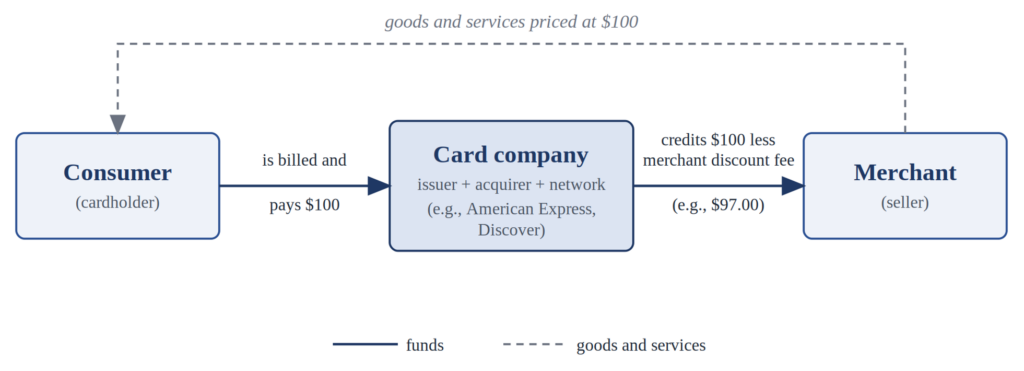
SOURCE: Author’s illustration.
When a cardholder spends $100 at a merchant, the card company bills the cardholder, credits the merchant with $100 less a merchant discount fee, and retains that fee as compensation for its services (Figure 1). Because one firm serves both cardholders and merchants, it balances what cardholders receive against what merchants pay through its pricing on each side.[9]
In a four-party system, separate financial institutions issue cards and acquire payments, connected by a network such as Visa or Mastercard (Figure 2). The cardholder’s bank (the issuer) bills the cardholder. The merchant’s bank (the acquirer) credits the merchant. The network carries the messages needed to authorize or decline, clear, and settle each transaction, charging fees to both banks.
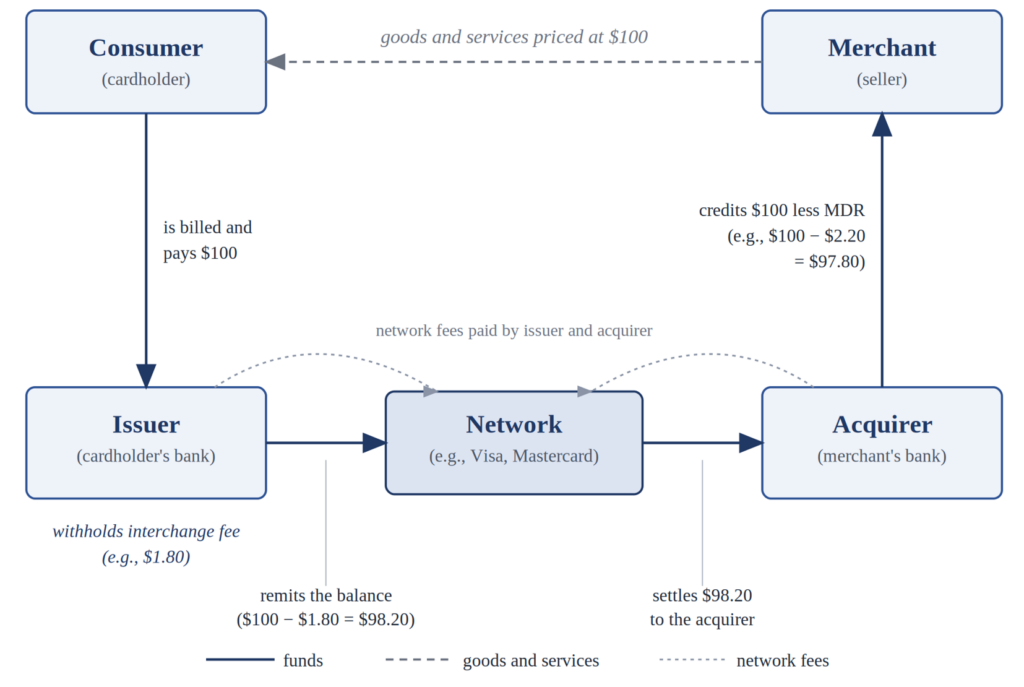
SOURCE: Author’s illustration.
When the issuer transfers funds to the acquirer, it withholds an interchange fee. With roughly 8,500 card-issuing institutions in the United States, bilateral negotiation of these fees would require millions of separate agreements. The networks instead set schedules of default interchange rates that apply unless the parties negotiate their own terms.[10]
The interchange fee typically amounts to between 1% and 2% of a transaction’s value. Treating it simply as compensation for processing a payment dramatically understates its role. It originated as a way to reduce coordination costs and align independent issuers’ and acquirers’ incentives within an open four-party payment network, as I explained in my Truth on the Market post:
A common misconception treats interchange as little more than compensation for processing a transaction. Its role is much broader. Interchange arose as a practical solution to a coordination problem in the original BankAmericard system and later became a way to balance the interests of merchants and consumers.
When BankAmericard, the forerunner of Visa, launched in 1958, it operated as a three-party network. Bank of America issued the cards, signed up merchants, and processed the transactions.
That changed when Bank of America began licensing other banks to issue BankAmericard cards in 1966. At first, the amount an acquiring bank paid to the issuing bank depended on the merchant discount the acquirer charged, or claimed to charge, sometimes adjusted for processing costs. The arrangement proved difficult to administer and audit.
Merchant discounts varied across banks and merchants, which gave acquirers an incentive to understate them. The formula also left acquirers with little or no margin on transactions involving cards issued by other banks. Issuers could receive too little, acquirers had weaker incentives to recruit and serve merchants, and the system encouraged strategic misreporting.
In 1970, Bank of America and its licensees created National BankAmericard Inc., an independent company owned by participating banks. The new organization replaced the uncertain formula with a uniform interchange reimbursement fee.
Set at 1.95% in 1971, the standardized fee separated the issuer’s payment from the merchant discount negotiated by the acquirer. The acquirer could retain the difference between the merchant discount and the interchange fee to cover its own costs.
Interchange therefore began as a way to align the incentives of independent issuers and acquirers in an open payment network. The Interbank Card Association, which operated MasterCharge, the precursor to Mastercard, adopted a similar approach about a year later. Economists later developed a fuller account of why the mechanism worked.[11]
Interchange continues to serve those functions. But arguably, its larger role today is to support subsidies between merchants and cardholders that encourage participation on both sides.
A card network creates value only if enough merchants and cardholders participate. As William F. Baxter showed in a seminal 1983 article, this often requires one side to subsidize the other.[12] Jean-Charles Rochet and Jean Tirole subsequently showed that when the two sides differ in their responsiveness to price, the fee structure that maximizes value typically involves the less price-sensitive side (usually merchants) subsidizing the more price-sensitive side (usually consumers).[13]
These analyses help explain why issuing banks use interchange revenue to fund cardholder benefits, including rewards, interest-free credit during the billing cycle, zero-liability fraud protection, and chargeback rights (the ability to dispute and reverse certain payments). That revenue also supports continuing investment in authorization, tokenization (the replacement of sensitive card details with secure identifiers), and fraud-detection infrastructure, all of which help secure card payments.
Three-party systems instead balance the two sides internally. They have no separate interchange fee because one institution performs all the functions. Instead, the merchant discount fee funds the subsidy. That fee is typically higher than the merchant discount rate acquirers charge in four-party networks.[14]
Merchants receive the transaction amount from their acquirer, less a merchant discount fee calculated using the merchant discount rate (MDR). That fee typically covers interchange, the acquirer’s network fees, and its margin for processing, underwriting, and servicing the transaction. Interchange is by far the largest component, particularly for larger merchants, whose scale reduces the acquirer’s per-transaction margin.
How merchants pay these fees depends on their acquiring arrangement. Larger merchants typically use “interchange-plus” pricing, which transparently passes through the interchange component. Changes in interchange rates therefore flow directly into what the merchant pays.[15]
Smaller merchants often purchase card acceptance on a blended or flat-rate basis. The acquirer or payment processor charges the same all-in rate across multiple card types, despite differences in the interchange fees on individual transactions. Square, for example, lists a standard rate of 2.6% plus $0.15 for in-person card transactions across the major card brands. Square and Stripe also offer online payment products, for transactions in which the card is not physically present, at 2.9% plus $0.30.[16]
Under these arrangements, a change in interchange does not necessarily reach the merchant immediately or proportionately. It initially changes the processor’s margin and affects the merchant’s MDR only if and when the processor revises its blended price.
Both interventions this brief examines target four-party interchange fees exclusively. The settlement binds only Visa, Mastercard, and their issuers. The state carveout statutes address “interchange fees,” which exist as distinct fees only in four-party systems. American Express and Discover’s merchant discount fees therefore fall outside both the settlement and the carveouts.
Section V examines the implications of this asymmetry. In essence, policies that make four-party cards less attractive tend to shift transaction volume toward three-party cards, which have historically cost merchants more to accept.
The proposed settlement would reduce interchange fees and give merchants more flexibility over card acceptance, surcharging, and steering. This section examines those changes, issuers’ likely responses to lost revenue, and the resulting effects on cardholder benefits, payment choices, and merchant costs. The rate relief would require no merchant action, but its broader effects would depend on how issuers, merchants, and consumers respond.
The settlement would make the following changes to interchange fees and card-network rules:[17]
These provisions would take effect quickly. The surcharging changes would begin within 90 days of the Settlement Approval Date, and the rate reductions and caps within roughly four months, timed to the networks’ semiannual rule-release cycle.[19] The Settlement Approval Date turns on the district court’s entry of final judgment. Relief would therefore begin while appeals remain pending unless a court grants a stay.
The proposed changes could significantly reduce issuer revenue. Current card-purchase volume, projections based on recent growth rates, and the settlement’s 10-basis-point reduction provide a starting estimate. Assuming card-purchase volume grows 5% annually, issuers would lose roughly $29 billion over five years, as Figure 3 shows.
The actual revenue loss would depend on how four-party issuers respond to lower interchange fees, how three-party issuers react, and how consumers respond to both. These adjustments would, in turn, prompt further changes in pricing and card use.
Interchange revenue helps fund rewards, introductory offers, fraud protection, and the fixed costs of maintaining card accounts. Four-party issuers would therefore likely recoup at least some lost revenue by reducing rewards, tightening eligibility for richer benefits, raising annual or other account fees, or combining these approaches.
Where regulation has reduced interchange revenue, issuers have responded by cutting costs or recovering income elsewhere. When Regulation II roughly halved the debit interchange retained by covered U.S. banks in 2011, debit rewards programs largely disappeared, free checking at those banks contracted sharply, and monthly maintenance fees and minimum-balance requirements rose. Lower-income customers bore a disproportionate share of that burden. Australian issuers responded to the Reserve Bank of Australia’s interchange standards by cutting rewards and raising annual fees by around 50%. The European Union’s (EU) Interchange Fee Regulation prompted similar adjustments.[20]
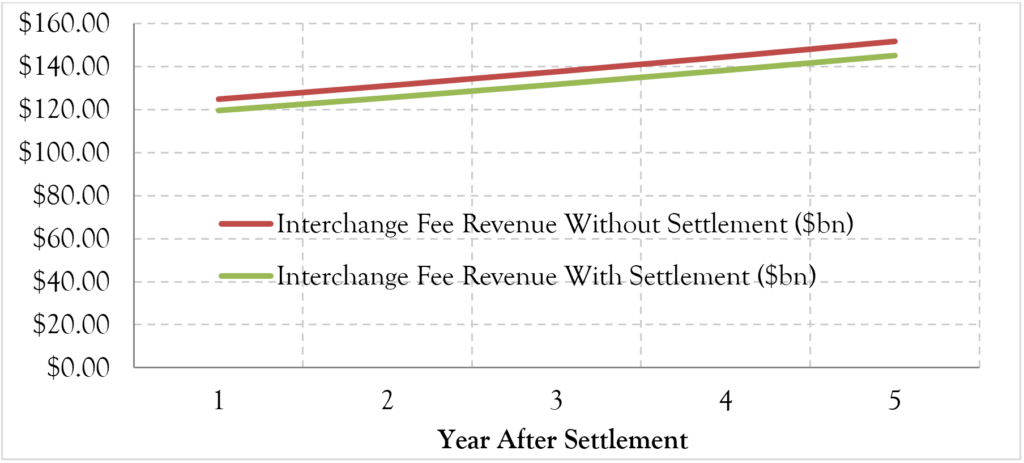
If four-party issuers reduce benefits or raise annual fees, cardholders would likely use those cards somewhat less. That could alter competition with three-party networks such as American Express and Discover. Because the caps do not constrain three-party systems, they could preserve rewards and other benefits, or launch products with higher rewards. Cardholder demand could shift from Visa and Mastercard products toward three-party cards, even as merchants generally pay less to accept four-party cards.
Four-party issuers would anticipate these competitive effects. They might therefore absorb some losses or recover revenue through other charges, such as higher interest rates.
Their choices would ultimately depend on how sensitive different cardholders are to price. If cardholders who carry balances from month to month (revolvers) are less price-sensitive than those who pay in full (transactors), issuers would likely recover more of the loss from revolvers through higher interest charges. Similarly, less price-sensitive holders of ultrapremium cards might face disproportionately higher annual fees. The response would likely vary by card. Holders of airline co-branded cards, for example, might be less price-sensitive than holders of cashback cards, many of whom could switch to three-party cards offering higher rewards.
Merchants’ responses to the new acceptance, surcharging, and discounting rules would also affect issuer revenue, prompting further adjustments by networks and issuers. Merchants would likely surcharge where consumers would accept the added charge or switch to a payment method with lower processing costs. Surcharging would be less attractive where consumers would abandon the transaction or switch to a method that costs the merchant more to accept.
Australia’s experience broadly supports this expectation. After networks removed their no-surcharge rules, surcharging remained far from universal and concentrated among certain merchants and industries. The Reserve Bank of Australia identified airlines and taxis as sectors where unusually high surcharges persisted, and noted that higher surcharges were more common online, where customers generally could not pay cash.[21] In these settings, switching payment methods or abandoning a transaction may impose substantial costs on consumers, giving merchants more room to surcharge.
By allowing surcharges that vary by card category and substantially reducing interchange fees on standard consumer cards, the settlement could help merchants steer consumers toward cards with lower interchange fees. That, at least, is the intention.[22]
But steering carries risks. Some consumers may switch to more expensive payment methods when merchants surcharge certain four-party cards. Uncertainty about surcharges may also prompt cardholders to use an alternative payment method preemptively.
If consumers choose lower-cost cards or other cheaper payment methods, merchants’ acceptance costs could fall. But consumers might instead choose more expensive three-party cards or cash, which also costs merchants more to accept.[23] Declining particular card categories therefore has an uncertain effect on acceptance costs. Some customers would also likely abandon the transaction altogether, potentially reducing merchant income.
Two other features of the settlement deserve attention before turning to the state laws. First, as Judge Cogan observed when granting preliminary approval, no court could have ordered the rate relief after trial because courts lack the power to set rates or regulate prices.[24] Merchants thus secured through settlement relief they could not have obtained at trial.
Second, merchants need take no action to receive the rate relief. The networks would implement the reductions and caps within their existing rate schedules, with an independent auditor verifying compliance at the defendants’ expense. Merchants would not need to buy equipment, alter checkout processes, or submit documentation.
The IFPA prohibits issuers, networks, acquirers, and processors from receiving or charging interchange fees on the tax or gratuity portion of a transaction, provided the merchant transmits that information during authorization or settlement. Merchants that do not transmit the data in real time may instead submit tax documentation within 180 days and receive a credit from the issuer within 30 days. Financial institutions face a $1,000 civil penalty per transaction for violations. Merchants face no liability or penalty for inaccurate or fraudulent reimbursement requests.[25]
As I have described in earlier work, neither point-of-sale terminals nor network messaging standards currently distinguish the tax or tip component of a consumer transaction, largely because they have had no reason to do so. Systems operating identically in every state have always calculated interchange on the total transaction amount.[26] Implementing a carveout would therefore require one of three costly mechanisms:
A significant share of these costs is fixed, placing a disproportionate burden on small and medium-sized merchants and small issuers. Evidence from comparable compliance regimes suggests that these costs can consume much or all of smaller firms’ gross savings. After South Dakota v. Wayfair, Inc. allowed states to require remote sellers to collect sales tax, the U.S. Government Accountability Office found that large businesses absorbed the change with minimal new setup costs, while smaller sellers faced a significant compliance burden. One small online seller spent about $2.25 on compliance for every $1 of tax collected.[28]
Other recent state proposals follow the IFPA’s basic design but differ in ways that compound the problem. For example, while the IFPA covers taxes and gratuities and applies to all issuers, Colorado’s vetoed S.B. 26-134 covered only taxes and exempted issuers with $60 billion or less in assets. That exemption would have excluded more than a third of debit cards and perhaps a quarter of credit cards issued nationwide, along with every card issued by a Colorado-domiciled institution. Merchants would have had to determine, card by card, whether the exemption applied.[29]
Delaware’s bill, meanwhile, addresses gratuities alone. If several such laws took effect, the payment system would face mutually inconsistent carveout standards, each requiring separate screening rules for every transaction processed nationwide.[30]
The IFPA’s legality—and, by extension, that of similar state carveouts—remains contested and precarious. In February 2026, the federal district court hearing the banking industry’s challenge declined to enjoin the IFPA’s interchange-fee provision, reasoning that networks, rather than banks, set the fees.[31]
In April, the Office of the Comptroller of the Currency issued an interim final order finding that federal law preempts the IFPA for national banks and federal savings associations. It also issued an interim final rule confirming that banks’ authority to charge fees extends to fees set by third parties. Following those actions, the 7th U.S. Circuit Court of Appeals vacated the district court’s judgment. On remand, the district court permanently enjoined the interchange-fee provision as applied to national banks, federal savings associations, out-of-state state banks, and payment-card networks.[32]
The National Credit Union Administration then issued a similar rule for federal credit unions, and the district court recently expanded its injunction to cover them as well.[33] Illinois subsequently deferred the IFPA’s effective date a second time, to July 1, 2027.[34]
Unless courts overturn the federal regulators’ actions, the IFPA and similar laws will bind only institutions chartered by the enacting state, which issue a small fraction of cards in circulation. The analysis that follows assumes, for the sake of argument, that the carveouts could take effect at full scope, although that outcome appears unlikely.
Both the settlement and state carveouts aim to lower merchants’ card-acceptance costs. This section compares their likely savings and compliance burdens, then examines how the settlement could further reduce carveout benefits, shift costs toward consumers and local issuers, and complicate implementation. It also considers how surcharging could make carveouts redundant for some merchants and how both interventions could shift transactions toward more expensive three-party cards.
The settlement would reduce merchant acceptance costs directly. The 10-basis-point reduction in average effective interchange equals 0.1% of covered credit card sales and applies automatically across merchants in every state, on the entire transaction amount. For merchants on interchange-plus pricing, the reduction would pass through to the MDR immediately. The settlement expressly provides a proportional reduction for merchants paying negotiated rates. Even many merchants on blended pricing could expect a share over time, as acquirers compete for their business and pass through a durable, independently verified reduction in their largest input cost.[35]
The carveouts promise savings of a similar magnitude. In earlier work, I estimated the IFPA’s gross savings to merchants at roughly 0.1% of the sale amount, reflecting an average combined Illinois sales tax of about 8.86%, gratuities on some transactions, and prevailing interchange rates.[36] The settlement’s average rate reduction is comparable, but merchants need no particular acquiring arrangement to qualify. They need not transmit tax data, buy new terminals or software, or submit rebate claims within a 180-day documentation window. The settlement also covers transactions on cards issued by institutions beyond the state statute’s reach.
The IFPA and similar carveouts would therefore deliver considerably smaller net fee reductions than the settlement. Moreover, once the settlement takes effect, lower interchange rates would further reduce the amounts available through carveouts.
Even at pre-settlement rates, most smaller merchants would see little, if any, net savings from a carveout. Fixed costs for upgraded terminals, software integration, and recordkeeping—or the administrative burden of rebate claims—would absorb much or all of the gross benefit. Merchants on blended pricing might receive no gross benefit at all.[37]
Reducing the gross benefit by a third or more would further narrow the group of merchants for whom a carveout’s benefits exceed its costs. The remaining beneficiaries would principally be the largest retailers, which already spread compliance costs across a large volume of transactions and stood to gain the most from carveouts. Before the settlement, just 10 national chains would receive more than one-fifth of the IFPA’s projected savings.[38] The settlement would intensify that concentration, making the carveout an even more pronounced subsidy to big-box retailers financed by consumers, smaller merchants, and local financial institutions.
The settlement would also give merchants concerned about high-fee cards more options. Under its terms, they could decline premium and commercial cards outright, surcharge them, or offer discounts to steer customers toward cheaper products. Indeed, merchants could surcharge their full processing cost, up to 3% of transaction value.
Merchants using that tool could recover far more than the IFPA or similar carveouts would offer, making the carveouts redundant for them. As discussed below, when a surcharge equals or exceeds the amount a merchant could recover under a state carveout, the merchant’s recovery weakens the rationale for that carveout.
National issuers could respond to a state carveout by seeking adjustments to interchange schedules that spread the loss across merchants nationwide. The settlement, however, largely forecloses that response. It freezes posted rates, caps standard consumer rates, and requires the average effective rate to remain 10 basis points below the benchmark, subject to annual audit.[39] For at least five years, issuers or networks would therefore find it difficult, if not impossible, to lawfully offset carveout losses by adjusting interchange schedules.
Consumers would bear the carveout’s costs more directly through reduced rewards and higher fees. Those costs would reach consumers both inside and outside the enacting state because national issuers adjust terms nationally rather than maintain state-specific rewards schedules.[40] Indeed, most affected consumers would live outside the state, making the effects predominantly extraterritorial.
Local banks and credit unions that remain within the statutes’ reach after the preemption rulings would face a different constraint. They could neither offset the lost revenue through the frozen interchange schedules nor spread it across a national portfolio. The loss would come on top of settlement-driven reductions in their card-program revenue.
The settlement therefore changes who bears a carveout’s costs, making the distribution of those costs worse. A state considering a carveout would still impose diffuse harms on consumers, while concentrating institutional losses on the banks and credit unions its charter system exists to serve.
The settlement measures the average effective interchange rate by dividing the network-set default interchange fees actually assessed on domestic credit transactions by the corresponding sales volume.[41] A state carveout that eliminates interchange on taxes and tips reduces the fees assessed without reducing sales volume, lowering the measured national average.
Mechanically, that reduction would count toward the 10-basis-point reduction the networks owe the merchant class. The networks could then provide correspondingly less rate relief to merchants in the other 49 states. A state enacting a carveout would thus finance part of its local experiment through settlement relief owed to merchants elsewhere.
Whether the independent auditor would treat statutory exclusions this way remains an open question. The agreement addresses individually negotiated reductions but says nothing about state-mandated ones. Either approach creates problems. If statutory exclusions count, carveout states would draw on the class’s recovery to fund their own mandates. If they do not, the networks and auditor would need another layer of state-specific accounting to exclude them from the calculation.
The settlement permits merchants to surcharge at the brand or product level up to their cost of acceptance or 3% of transaction value, whichever is lower.[42] A merchant that recovers its full acceptance cost through a surcharge also recovers interchange on the entire transaction, including taxes and gratuities. For that merchant, a carveout offers no further recovery. Full-cost surcharging therefore removes the basis for that merchant’s argument for a state carveout.
The same reasoning applies, to a lesser extent, to merchants that decline premium and commercial cards or offer discounts to steer customers toward standard cards. Those choices eliminate or reduce the fees from which a carveout would provide a partial exemption.
The remaining benefit of carveouts would therefore accrue principally to merchants that forgo the settlement’s self-help options. The principal reason to do so would be to preserve fast, efficient checkout with minimal risk that customers abandon transactions. That preference would appear to conflict with seeking a carveout that would make payment processing more cumbersome.
After the settlement’s final approval, networks, acquirers, processors, and issuers will have to undertake substantial changes to their systems on a court-supervised schedule. These include identifying premium and commercial cards at checkout, implementing three-tier acceptance, building surcharge notification and reporting systems, and supplying the data the independent auditor requires.[43]
This work would use the same messaging standards, processing systems, and semiannual release cycles needed to implement carveouts. The IFPA’s scheduled July 1, 2027, effective date falls squarely within the settlement’s rollout.[44] Implementing a carveout during that period would compete for engineering capacity with obligations the industry must meet under a federal court order, potentially increasing costs, delays, and errors for both.
The industry would also need to check every acceptance category, surcharge configuration, and rate schedule introduced by the settlement against each state’s carveout rules, and vice versa. These interaction costs did not exist when lawmakers drafted the carveout bills, and none of the states’ fiscal notes—their estimates of legislation’s budgetary effects—accounts for them.
Neither the settlement nor the carveouts apply to three-party systems. American Express and Discover remain free to fund rewards and benefits at whatever level their internal pricing supports. As Visa and Mastercard issuers respond to lower interchange revenue by trimming rewards and raising fees, three-party companies could attract premium cardholders by offering benefits no longer available on four-party cards.
Australia’s experience is instructive. After the Reserve Bank of Australia’s price controls reduced four-party interchange in 2003, banks shifted premium customers toward American Express companion cards—that is, cards offered alongside their Visa or Mastercard products. American Express’s market share rose by about 25% before the regulator extended its standards to cover the arrangement.[45]
Carveouts share this asymmetry and add further friction. The compliance mechanisms described in Section IV, including dual authorizations and expanded transaction messages, would apply only to four-party transactions, making them slower and more prone to checkout failures than unchanged three-party transactions. Merchants using dual authorizations, in particular, should expect greater use of American Express and Discover cards, alongside some shift back to cash.
These consequences undermine both interventions’ aims, especially those of the carveouts. First, migration toward three-party cards would erode merchant savings because those cards cost more to accept. Second, each transaction that shifts to a three-party card would fall outside the carveout, further reducing the law’s already-diminished benefits while leaving its fixed costs unchanged. Third, local banks and credit unions still subject to a carveout after the preemption rulings would lose card volume to three-party competitors, on top of the revenue the statute removes directly.
Consumers who qualify for three-party products could retain rewards, partially offsetting their losses. But that benefit would come with the costs and inconvenience of maintaining additional cards, and would reach only eligible customers. A law that steers transactions toward the most expensive card-acceptance channel would be a strange way to lower merchants’ acceptance costs.
State interchange carveouts arose from merchants’ objection to paying fees on amounts they collect for the state or pass on as gratuities, with no relief in prospect from Congress or the courts. The proposed settlement substantially weakens that rationale. It would reduce interchange across covered transactions nationwide by roughly the same share of sales that carveouts promised in their best case, without imposing merchant compliance costs. Pass-through would depend on merchants’ pricing arrangements, but the settlement would also give them more ways to recover acceptance costs through surcharging and steering.
A carveout would add only a diminished exemption from an already-reduced fee. Merchants would need to incur fixed costs that the settlement makes harder to recover, and relief would reach only cards issued by the shrinking set of institutions left within the statutes’ scope after federal preemption.
The carveouts’ costs would remain and, in several respects, grow. If courts ultimately reject federal preemption, national issuers would spread much of the burden to out-of-state consumers through reduced rewards and changed account terms. Out-of-state merchants could also face lower demand and potentially less settlement relief. If preemption holds, losses would concentrate on local banks and credit unions and their customers.
In either case, small and medium-sized merchants in the enacting state would face compliance costs that could exceed their savings. Many would likely forgo the carveout, further weakening their position relative to larger competitors. Implementation would also compete with the settlement’s court-supervised rollout, while slower four-party transactions and reduced cardholder benefits could shift spending toward more expensive three-party cards.
The settlement itself would likely impose net economic costs, particularly through reduced cardholder benefits and higher fees. Its comparatively lower compliance burden nonetheless makes the case for additional state carveouts weaker.
States seeking to reduce merchants’ tax-collection costs have a more direct tool in the form of capped compensation for electronic remittance, of the kind most states already provide.[46] Requiring a national payment system to administer a local subsidy would add costs and distortions while delivering increasingly narrow benefits. Illinois should repeal its carveout, and other states should abandon similar proposals, regardless of whether the settlement receives final approval.
[1] Memorandum Decision and Order, In re Payment Card Interchange Fee & Merch. Disc. Antitrust Litig., No. 05-md-1720 (BMC) (E.D.N.Y. June 9, 2026) [hereinafter Preliminary Approval Order].
[2] Id. at 6–10; Visa Inc., Current Report (Form 8-K) (Nov. 10, 2025) (attaching Superseding and Amended Definitive Class Settlement Agreement of the Rule 23(b)(2) Class Plaintiffs [hereinafter Settlement Agreement]); Nandita Krishnaswamy, In re Payment Card Interchange Fee and Merchant Discount Antitrust Litigation: Summary of the November 2025 Proposed Settlement, ABA Antitrust L. Sec. (Apr. 1, 2026), https://www.americanbar.org/groups/antitrust_law/resources/newsletters/in-re-payment-card-interchange-fee-merchant-discount-antitrust-litigation.
[3] See Ill. Bankers Ass’n v. Raoul, No. 1:24-cv-07307, slip op. at 2–4, 27–28 (N.D. Ill. June 1, 2026); see also 815 Ill. Comp. Stat. 151/150-1, 151/999-99 (2026) (effective July 1, 2027).
[4] Interchange Fee Prohibition Act, 815 Ill. Comp. Stat. 151/150-1 et seq. (2024).
[5] Colorado Bill To Cut Sales Tax from Interchange Calculation Vetoed, Digital Transactions (June 2026), https://www.digitaltransactions.net/colorado-bill-to-cut-sales-tax-from-interchange-calculation-vetoed; S.B. 26-134, 2026 Reg. Sess. (Colo. 2026).
[6] Patrick Cooley, State Interchange Fee Laws Progress, Payments Dive (Mar. 18, 2026), https://www.paymentsdive.com/news/state-interchange-fee-laws-progress/815072; Gail Cole, Can States Ban Swipe Fees on Taxes and Fees?, Avalara (May 2026), https://www.avalara.com/blog/en/north-america/2026/05/states-ban-swipe-fees-on-taxes-and-fees.html.
[7] Julian Morris, The Price of Peace in the Swipe-Fee Wars, Truth on the Mkt. (July 23, 2026), https://truthonthemarket.com/2026/07/23/the-price-of-peace-in-the-swipe-fee-wars [hereinafter Morris, Price of Peace]; Julian Morris, State Regulation of Interchange Fees (Int’l Ctr. L. & Econ., Nov. 15, 2024), https://laweconcenter.org/resources/state-regulation-of-interchange-fees [hereinafter Morris, State Regulation]; Julian Morris & Ben Sperry, Regulating State Interchange Fees: Evaluating the Likely Effects of the IFPA 8 (Int’l Ctr. L. & Econ., July 7, 2025), https://laweconcenter.org/wp-content/uploads/2025/07/IFPA-Paper-2025.pdf [hereinafter Morris & Sperry, IFPA].
[8] See Julian Morris, Todd J. Zywicki & Geoffrey A. Manne, The Effects of Price Controls on Payment-Card Interchange Fees: A Review and Update 24–27 (Int’l Ctr. L. & Econ., White Paper, Mar. 4, 2022), https://laweconcenter.org/wp-content/uploads/2022/03/Payments-2021-Lit-Review.pdf; Todd J. Zywicki, Ben Sperry & Julian Morris, Credit Cards and the Reverse Robin Hood Fallacy: Do Credit Card Rewards Really Steal from the Poor and Give to the Rich? 14–16 (Int’l Ctr. L. & Econ., Issue Brief, Nov. 4, 2021); Zhu Wang, Scarlett Schwartz & Neil Mitchell, The Impact of the Durbin Amendment on Merchants: A Survey Study, 100 Econ. Q. 183, 189, 198–200 (2014); Vladimir Mukharlyamov & Natasha Sarin, Price Regulation in Two-Sided Markets: Empirical Evidence from Debit Cards, 172 J. Fin. Econ. 104094, 10–11, 15–16 (2025), https://doi.org/10.1016/j.jfineco.2025.104094.
[9] Morris, State Regulation, supra note 7, at 6 (describing three-party networks, in which the card company acts as issuer, acquirer, and network operator, subsidizing cardholders directly through fees charged to merchants).
[10] Id. at 7–9. The number of bilateral agreements required among n institutions is n(n − 1)/2.
[11] Morris, Price of Peace, supra note 7.
[12] See William F. Baxter, Bank Interchange of Transactional Paper: Legal and Economic Perspectives, 26 J.L. & Econ. 541 (1983).
[13] Jean-Charles Rochet & Jean Tirole, Cooperation Among Competitors: Some Economics of Payment Card Associations, 33 RAND J. Econ. 549 (2002); Jean-Charles Rochet & Jean Tirole, Platform Competition in Two-Sided Markets, 1 J. Eur. Econ. Ass’n 990 (2003); Todd J. Zywicki, The Economics of Payment Card Interchange Fees and the Limits of Regulation (Int’l Ctr. L. & Econ., June 2, 2010), https://laweconcenter.org/images/articles/zywicki_interchange.pdf; Ohio v. Am. Express Co., 585 U.S. 529, 545 (2018).
[14] Jack Caporal, Average Credit Card Processing Fees and Costs in America, Motley Fool Money (updated June 23, 2026), https://www.fool.com/money/research/average-credit-card-processing-fees-costs-america (reporting Helcim’s 2026 weighted effective rates).
[15] Morris, State Regulation, supra note 7, at 9–10 (describing interchange-plus and blended acquirer pricing); Morris & Sperry, IFPA, supra note 7, at 14–18.
[16] Understanding Our Fees, Square, https://squareup.com/us/en/payments/our-fees (last visited Aug. 9, 2026) (listing standard processing fees of 2.6% plus $0.15 for card-present transactions and 2.9% plus $0.30 for online transactions using Square’s API); Pricing, Stripe, https://stripe.com/pricing (last visited Aug. 9, 2026) (listing standard U.S. pricing of 2.9% plus $0.30 per successful transaction for domestic cards).
[17] Settlement Agreement, supra note 2, ¶¶ 48–53; Preliminary Approval Order, supra note 1, at 9–10.
[18] Settlement Agreement, supra note 2, ¶¶ 39–47; Preliminary Approval Order, supra note 1, at 6–9. A group must include at least two merchants, incorporate as a U.S. nonprofit, and comply with applicable antitrust standards. Groups may submit proposals concerning interchange rates and rate categories, merchant rules and fees, acceptance, surcharging, and other network practices. Visa and Mastercard must consider qualifying proposals in good faith and engage in reasonable, bona fide negotiations when a proposal offers commercially reasonable benefits. They need not agree to the rates the group seeks.
[19] Settlement Agreement, supra note 2, ¶¶ 39, 48(a).
[20] Morris, Zywicki & Manne, supra note 8; Todd J. Zywicki, Geoffrey A. Manne & Julian Morris, Unreasonable and Disproportionate: How the Durbin Amendment Harms Poorer Americans and Small Businesses (Int’l Ctr. L. & Econ., Apr. 2017), https://laweconcenter.org/wp-content/uploads/2017/08/icle-durbin_update_2017_final-1.pdf.
[21] Reserve Bank of Austl., Regulatory Developments in Retail Payments, in Payments System Board Annual Report 2012 (2012) (reporting that approximately 36% of surveyed merchants imposed a surcharge on at least one accepted credit card and that very large merchants surcharged more often); Reserve Bank of Austl., The Payments System (Supplementary Submission to the Financial System Inquiry, Aug. 2014) (observing that market forces ordinarily constrain excessive surcharging because merchants consider its effect on the customer experience, while identifying the taxi and air-travel industries as exceptions); Cameron Dark, Chay Fisher, Kim McBey & Ed Tellez, Payment Surcharges: Economics, Regulation and Enforcement, Reserve Bank of Austl. Bull., Dec. 2018 (identifying airlines as a prominent source of excessive surcharging and noting reports of higher surcharges more often for online transactions, where customers generally could not pay cash); Reserve Bank of Austl., Excessive Surcharging, in Review of Card Payments Regulation: Conclusions Paper (May 2016) (discussing $7–$8 fixed-dollar airline surcharges and explaining why they could substantially exceed acceptance costs on low-value airfares).
[22] Preliminary Approval Order, supra note 1, at 9–10.
[23] Julian Morris & Ben Sperry, The Cost of Payments: A Review (Int’l Ctr. L. & Econ., Aug. 2024), https://laweconcenter.org/resources/the-cost-of-payments-a-review.
[24] Preliminary Approval Order, supra note 1, at 22 (citing Prentis v. Atl. Coast Line Co., 211 U.S. 210, 226 (1908)); Settlement Agreement, supra note 2, ¶¶ 48, 52–53 (Independent Auditor provisions).
[25] 815 Ill. Comp. Stat. 151/150-10, 151/150-15 (2024).
[26] Morris, State Regulation, supra note 7, at 16–21; Morris & Sperry, IFPA, supra note 7, at 14–18.
[27] Morris, State Regulation, supra note 7, at 17–21.
[28] Morris & Sperry, IFPA, supra note 7, at 16 (citing U.S. Gov’t Accountability Off., GAO-23-105359, Remote Sales Tax: Federal Legislation Could Resolve Some Uncertainties and Improve Overall System (2022)); South Dakota v. Wayfair, Inc., 585 U.S. 162 (2018).
[29] S.B. 26-134, 2026 Reg. Sess. (Colo. 2026); Bd. of Governors of the Fed. Rsrv. Sys., 2023 Interchange Fee Revenue, Covered Issuer Costs, and Covered Issuer and Merchant Fraud Losses Related to Debit Card Transactions (2023).
[30] See Morris & Sperry, IFPA, supra note 7, at 20–21 (discussing how differing state mandates could fragment the multilateral interchange-fee system).
[31] Ill. Bankers Ass’n v. Raoul, No. 1:24-cv-07307 (N.D. Ill. Feb. 10, 2026).
[32] Ill. Bankers Ass’n v. Raoul, Nos. 26-1354, 26-1371, 26-1440 & 26-1441 (7th Cir. May 8, 2026) (order vacating and remanding); Illinois Interchange Fee Law Maxes Out After Permanent Injunction and Legislative Postponement, Glob. Fintech & Digit. Assets Blog (June 2026), https://www.fintechanddigitalassets.com/2026/06/illinois-interchange-fee-law-maxes-out-after-permanent-injunction-and-legislative-postponement [hereinafter Illinois Interchange Fee Law Maxes Out].
[33] Order Preempting the Illinois Interchange Fee Prohibition Act, 91 Fed. Reg. 23,150 (Apr. 29, 2026); Preemption—Federal Credit Union Non-Interest Charges and Fees, 91 Fed. Reg. 34,725 (June 9, 2026).
[34] 815 Ill. Comp. Stat. 151/999-99 (2026) (deferring the effective date to July 1, 2027); see also Illinois Interchange Fee Law Maxes Out, supra note 32.
[35] On acquirers’ pass-through of interchange reductions, see Morris, Zywicki & Manne, supra note 8, at 31–38.
[36] Morris & Sperry, IFPA, supra note 7, at 18 & n.65.
[37] Morris, State Regulation, supra note 7, at 9–10, 22–23; Morris & Sperry, IFPA, supra note 7, at 14–18.
[38] Elec. Payments Coal., New Illinois Law Creates Windfall for Largest Corporate Mega-Stores (2024), https://guardyourcard.com/wp-content/uploads/2024/10/Illinois-State-Sales-Tax-Interchange-Report-9.24.24.pdf.
[39] Settlement Agreement, supra note 2, ¶¶ 48, 51–52.
[40] Morris & Sperry, IFPA, supra note 7, at 19–21.
[41] Settlement Agreement, supra note 2 (defining “Effective Interchange Rate” as network-set default interchange fees assessed to acquirers, divided by the sales volume of the corresponding transactions).
[42] Id. ¶¶ 39–41.
[43] Id. ¶¶ 39–42, 48, 51–53; Preliminary Approval Order, supra note 1, at 7 & n.7.
[44] Illinois Interchange Fee Law Maxes Out, supra note 32.
[45] Morris, Zywicki & Manne, supra note 8 (reviewing the Australian evidence, including the companion-card episode).
[46] Morris, State Regulation, supra note 7, at 26–27.
The big news in the competition-plus space—where competition policy meets broader policy concerns—isn’t an antitrust matter at all. It’s New Mexico’s announcement of its “Historic . . .
The big news in the competition-plus space—where competition policy meets broader policy concerns—isn’t an antitrust matter at all. It’s New Mexico’s announcement of its “Historic $25 Billion Penalty Against Facebook” (Meta Platforms).
Here’s coverage from The New York Times, The Washington Post, The Wall Street Journal, and, for a bit of local flavor, the Albuquerque Journal.
That’s a big number for most human folks, if not for the large language models among us, but I have a few questions.
Source: Truth on the Market
Our latest guest in Truth on the Market’s “Global Voices Forum” series is Hee Eun Kim, a member of Baker McKenzie’s antitrust and competition practice . . .
Our latest guest in Truth on the Market’s “Global Voices Forum” series is Hee Eun Kim, a member of Baker McKenzie’s antitrust and competition practice in the Asia-Pacific region. We explore how Southeast Asian policymakers are approaching digital-platform regulation, including the influence of the European Union’s Digital Markets Act, concerns about accountability and contestability, and the capacity of existing competition laws. She also examines Vietnam’s proposed competition-law reforms and the importance of tailoring regulatory frameworks to local markets, institutions, and policy priorities.
Source: Truth on the Market
The European Union (EU) is offering its allies a foothold in its cloud market—with little room to move. They could own a cloud business, provided . . .
The European Union (EU) is offering its allies a foothold in its cloud market—with little room to move. They could own a cloud business, provided EU citizens do the work and the operations and data stay inside the bloc. And even that permission could be revoked. Europe and its allies would both do better with a true digital trade deal.
Canada is heading to a summit with the EU in Montreal, reportedly seeking this “associated country” status under the proposed EU Cloud and AI Development Act (CADA). United Kingdom ministers are reportedly lobbying for the same. Neither government has made clear what it wants, but the status on offer falls well short of a trade deal.
The proposal’s Article 18 would allow businesses from recognized countries to own cloud operations located entirely within the bloc and walled off from operations elsewhere. That’s hardly an enticing offer for the EU’s allies. It’s also a poor bargain for the EU itself, which would unnecessarily restrict access to cloud services it needs.
The European Commission introduced CADA earlier this year, proposing four “assurance levels” for cloud services—computing resources accessed over the internet—purchased by public bodies. These levels set increasingly strict requirements for where providers operate, where they store data, and who can own or help run the service. The higher the level, the more the provider must keep its operations within the EU and limit outside involvement.
Even Level 1—the default unless a public buyer opts out—requires a provider established in the EU, with infrastructure and data located there. Level 2 requires the provider to deliver the service entirely within the EU and guarantee that no one will access the data from outside the bloc.
Level 3 goes further: Only EU citizens may participate in providing the service, and the provider must be free of control from outside the EU. This is where associated-country status comes in. The commission can recognize non-EU countries, allowing businesses from those countries to own cloud operations located and run entirely within the EU.
At Level 4, even that opening disappears. The ban on outside control admits no associated-country exception.
Source: Truth on the Market
Merchants persuaded a federal appeals court to throw out the Federal Reserve’s debit-card fee cap. They might want to hold the applause until they see its replacement. A ruling aimed...
Merchants persuaded a federal appeals court to throw out the Federal Reserve’s debit-card fee cap. They might want to hold the applause until they see its replacement. A ruling aimed at the Fed’s arithmetic could leave room for a higher cap—and a fuller accounting of what consumers get for those fees.
In Corner Post, Inc. v. Board of Governors of the Federal Reserve System, a panel of the 8th U.S. Circuit Court of Appeals affirmed a decision vacating the Federal Reserve’s interchange-fee cap under Regulation II. Merchants pay interchange fees to the banks that issue their customers’ debit cards. The rule capped them at 21 cents per transaction, plus an allowance for fraud losses and an additional penny for qualifying fraud-prevention measures.
Writing for the panel, Judge David Stras concluded that the Fed improperly included fixed costs that weren’t specific to individual transactions. The Durbin Amendment, he explained, requires the Fed to consider the “incremental cost” of processing a particular transaction. The decision carries added significance after Loper Bright Enterprises v. Raimondo, which ended the practice of deferring to reasonable agency interpretations of ambiguous statutes.
But rejecting the Fed’s cost calculation doesn’t settle how high fees may go. As the International Center for Law & Economics (ICLE) argued in its amicus brief in Linney’s Pizza, LLC v. Board of Governors, a parallel case before the 6th U.S. Circuit Court of Appeals, the Durbin Amendment gives the Fed discretion to determine what fees are “reasonable and proportional.” Even under the 8th Circuit’s restrictive reading, that language may leave room for a much higher cap.
That inquiry should account for how payment networks work. They serve two groups—merchants and consumers—and benefits that attract consumers also make the network more valuable to merchants. ICLE’s argument offers the Fed a legal basis for recognizing those benefits when setting the cap. The court has ordered the agency to reconsider the costs. What those fees buy deserves a look, too.
Source: Truth on the Market
In July, I expressed some optimism about the new approach to GDPR reform in the Digital Omnibus presented by the EU Council’s Irish Presidency (GDPR reform alive again? July update)...
In July, I expressed some optimism about the new approach to GDPR reform in the Digital Omnibus presented by the EU Council’s Irish Presidency (GDPR reform alive again? July update) that took over from Cyprus for the second half of 2026. The Irish Presidency just succeeded in getting the EU Council to agree on a negotiating mandate, but there is little to celebrate.
The Commission’s original proposal mostly misdiagnosed where the problem with the GDPR lies (disproportionate and ideological enforcement) and despite the apparent appetite for more serious reform from some EU Member States, the Council did nothing of the kind.
Source: EU Tech Reg
Every October, financial journalism performs a small act of necromancy. Out comes the “Halloween effect,” the finding that stocks tend to earn higher returns from November through April than from...
Every October, financial journalism performs a small act of necromancy. Out comes the “Halloween effect,” the finding that stocks tend to earn higher returns from November through April than from May through October. It gives empirical backing to the old stock-market adage “Sell in May and go away.” The implied strategy is simple: Hold stocks during the historically stronger six months, then park your money in short-term government debt until Halloween rolls around again.
That sounds like trouble for a central idea in finance. The efficient markets hypothesis, developed in Eugene Fama’s foundational research, holds that prices reflect available information. Public knowledge shouldn’t offer investors a reliable route to returns beyond what their risks justify. Yet everyone has a calendar, so why haven’t investors anticipating the winter gains bought earlier and erased the advantage?
The puzzle has substantial academic backing. Researchers have documented the seasonal gap across dozens of countries, long stretches of history, and years beyond the original studies. Even cryptocurrency publications give it an annual airing. Last October, DailyCoin explored its application to digital assets, while CCN reported comparisons favoring year-round ownership in most stock indexes it examined, as well as Bitcoin.
But a well-documented pattern isn’t necessarily a profitable trading strategy—or a refutation of market efficiency. The harder questions are what causes the winter advantage, whether it compensates investors for risk, and what happens once people try to trade on it.
Source: Truth on the Market
Mayor Zohran Mamdani wants New Yorkers to be able to sue predatory businesses. Unfortunately, his proposed POWER Act could make suing ordinary businesses just as rewarding. Introduced in the New...
Mayor Zohran Mamdani wants New Yorkers to be able to sue predatory businesses. Unfortunately, his proposed POWER Act could make suing ordinary businesses just as rewarding.
Introduced in the New York City Council earlier this month, the bill promises relief for seniors who lose savings to scams and tenants fighting to recover security deposits. But its combination of sweeping prohibitions, expansive eligibility to sue, and $2,500-per-violation fines could turn consumer protection into a settlement business.
Source: Washington Examiner
What does it mean to be a law & economics (L&E) scholar? It can’t require a Ph.D. in economics. Richard Posner doesn’t have one. He . . .
What does it mean to be a law & economics (L&E) scholar? It can’t require a Ph.D. in economics. Richard Posner doesn’t have one. He didn’t even major in economics as an undergraduate, preferring English—as did his Chicago colleagues Douglas Baird and Diane Wood. It can’t require a law degree, either, or Ronald Coase, William Landes, and many other leading lights are out.
Perhaps it’s a focus on rational actors—people making choices to advance their interests—and wealth maximization? But that would leave out the behavioral movement, which examines departures from rational decision-making. A field for empirical work—research based on observation and data? That would also leave out many of its founders. OK, then. Perhaps the L&E tent is now so big that it’s undefinable. No particular expertise is required, nor any shared precepts.
In “Contemporary Law and Economics,” Adam Chilton, Joshua Macey, and Mila Versteeg disagree. L&E is still a cohesive field. Writing for the University of Chicago Law Review’s 2025 symposium, the authors acknowledge that L&E’s contours shift. Its scholars don’t all agree on its definition—an unsurprising result for a diverse field of study. But distinct qualities still set L&E apart from other scholarship, including work influenced by economics.
As newer groups such as the Law and Political Economy (LPE) movement capture scholarly attention, our authors set out to tell us what L&E is, given that approaches as diverse as empirical legal studies, welfarism (evaluating rules by their effects on human well-being), and rational choice all claim to be within its ambit.
Source: Truth on the Market
Artificial intelligence (AI) may be new to the insurance market, but uncertainty is an old customer. Insurers have spent centuries figuring out how to price . . .
Artificial intelligence (AI) may be new to the insurance market, but uncertainty is an old customer. Insurers have spent centuries figuring out how to price unfamiliar risks, reward precautions, and avoid betting the whole portfolio on the same weak link. AI gives them new facts to assess, not a reason to discard that experience.
In a recent Truth on the Market post, Ian Adams revisited his decade-old warnings against coverage mandates and taxpayer backstops for cyber insurance. The cyber market’s subsequent growth supports his case for patience. Insurers have expanded coverage while refining prices, exclusions, and security requirements. As Adams argued, AI insurance deserves the same opportunity as courts clarify legal duties, reasonable precautions, and the link between misconduct and injury.
That adaptation has, in fact, already begun. For example, directors and officers (D&O) insurance, which covers certain claims against corporate leaders and companies, already addresses some AI-related risks. It also offers a window into how existing coverage can adapt, even though it covers only part of AI’s potential liabilities.
Together, these markets illustrate three classic bits of wisdom about the value of insurance: It can serve to preserve honest experimentation, reward effective precautions, and account for shared failures. Policymakers should give the market room to apply that wisdom before prescribing coverage or handing taxpayers the bill.
Source: Truth on the Market
The First Amendment does not come with an antitrust loophole. President Donald Trump’s Justice Department nonetheless appears determined to find one. The Justice Department’s Antitrust . . .
The First Amendment does not come with an antitrust loophole. President Donald Trump’s Justice Department nonetheless appears determined to find one.
The Justice Department’s Antitrust Division recently launched an investigation into five major television networks – ABC, CBS, CNN, NBC and Fox News – under the Sherman Antitrust Act, a federal law prohibiting agreements that unlawfully restrict competition. Their alleged offense? Briefly suspending their shared White House coverage in protest after the administration abruptly revoked press credentials for reporters from CNN, MS NOW and Politico.
Source: USA Today
The Federal Communications Commission (FCC) licenses television stations. Does that make it Disney’s human resources department? The agency seems to think so, invoking a “public . . .
The Federal Communications Commission (FCC) licenses television stations. Does that make it Disney’s human resources department? The agency seems to think so, invoking a “public interest” mandate to investigate the company’s diversity policies—a mandate whose meaning seems to change with whoever holds power.
Under the Communications Act of 1934, as amended, the FCC has initiated early license-renewal proceedings against eight television stations that American Broadcasting Cos. Inc. (ABC), a subsidiary of The Walt Disney Co., owns and operates. ABC sued to challenge those proceedings on First Amendment grounds in American Broadcasting Companies, Inc. v. Federal Communications Commission, now before the U.S. District Court for the District of Columbia.
The case also raises a foundational question of administrative law. Can an agency turn a broadly worded statute into a roving mandate to enforce rules beyond its jurisdiction?
The stated rationale for cutting short ABC’s standard eight-year license terms is an ongoing inquiry by the FCC’s Enforcement Bureau into Disney’s corporate diversity, equity, and inclusion (DEI) policies. The FCC contends that compliance with equal employment standards is an essential part of a licensee’s obligation to operate in the “public convenience, interest, or necessity.”
But a close reading of the agency’s motion to dismiss reveals its reliance on a public-interest standard for broadcast licensees that stretches beyond the statute’s text and seems unjustifiable in today’s media marketplace.
Source: Truth on the Market
Adam Smith warned that people in the same trade rarely meet without the conversation turning to a scheme to raise prices. Antitrust enforcers on both sides of the Atlantic now...
Adam Smith warned that people in the same trade rarely meet without the conversation turning to a scheme to raise prices. Antitrust enforcers on both sides of the Atlantic now suspect they can skip the meeting—a shared shareholder may do the job.
In May 2025, the U.S. Justice Department (DOJ) and Federal Trade Commission (FTC) backed a lawsuit alleging that BlackRock, Vanguard, and State Street used their stakes in competing coal companies to coordinate output cuts. The following month, the European Commission fined Delivery Hero and Glovo for participating in a cartel facilitated by Delivery Hero’s minority stake in Glovo.
Testing whether ownership links foster collusion is tricky. Cartels are illegal, so researchers usually see only those that get caught. Those may look little like the ones that escape detection.
A recent working paper by Vincent Abraham, Florian Ederer, and Catarina Marvao sidesteps that problem with data from Sweden, where cartels remained legal until 1993. Firms had to disclose cartel agreements when authorities requested them. Failure to register carried penalties that included fines or up to six months’ imprisonment. The authors matched that registry with ownership records for publicly listed Swedish companies from 1985 to 1993.
Their key measure, a “profit weight,” captures how much a firm treats a rival’s profits as its own because they share owners or one holds shares in the other.
Source: Truth on the Market
Some of Hollywood’s most high-powered producers and agents have a pitch for Washington. Make streaming services spend half their original-content budgets buying from independent U.S. . . .
Some of Hollywood’s most high-powered producers and agents have a pitch for Washington. Make streaming services spend half their original-content budgets buying from independent U.S. producers. Producers and talent agencies would get guaranteed business. Viewers, on the other hand, would get no guarantees.
The inspiration comes from the Financial Interest and Syndication Rules, better known as Fin-Syn, which once restricted broadcast networks’ ownership of programming and their ability to profit from reruns. Supporters want a streaming-era version to revive independent production, preserve American jobs, and promote creative diversity, as they explained on a recent episode of the industry podcast The Town.
It’s a bad proposal with an understandable constituency. Production employment has contracted since the “peak TV” era, and producers dislike the terms streamers offer. A guaranteed slice of their budgets has obvious appeal.
But the conditions that once perhaps justified a system like Fin-Syn have long since disappeared. Viewers now choose among broadcasters, cable networks, streaming services, and online creators. Vertical integration—combining production and distribution under common ownership—can help finance programming and deliver it efficiently. Government spending mandates would put those benefits at risk and could even invite First Amendment challenges.
Source: Truth on the Market
When does a “directions” button become a competition-law violation? When it points to Google Maps, according to the European Commission. A law meant to police . . .
When does a “directions” button become a competition-law violation? When it points to Google Maps, according to the European Commission. A law meant to police search rankings is becoming a license to police the whole page.
On July 23, the Commission fined Alphabet €460 million for favoring nine of its own services on Google’s search results page: comparison shopping, flights, trains, hotels, local places, Google Maps, a translation box, sports scores, and even the games that appear when you search for “solitaire.”
The Commission’s cease-and-desist order requires Google to stop “displaying interactive pointers to its own distinct or additional services on the [Google Search Engine Results Page (SERP)], such as in tabs or in links to these services when a user clicks on a reservations, directions or any other button” (paragraph 712(c)).
That raises a basic question about the reach of the European Union’s Digital Markets Act (DMA). Article 6(5) prohibits designated “gatekeepers”—large platforms subject to the law—from giving their own services preferential treatment in “ranking or related indexing and crawling.” These processes determine the order of search results and collect and organize the information behind them.
But the Commission’s order also restricts where Google places links and buttons for its own services on the page—even when those features don’t appear to rank search results.
Does “ranking” now cover anything that appears on the screen? If so, gatekeepers could be barred from featuring any of their own products or services in drop-down menus on their own websites. We argue that this stretches the DMA’s definitions of “ranking” and “search results” too far, with no clear limiting principle.
Source: Truth on the Market
Brussels’ latest competition guidelines should probably come with a warning label. Countries borrowing them risk importing dubious economics, remedies designed for Europe’s very specific institutional problems, and a trade fight...
Brussels’ latest competition guidelines should probably come with a warning label. Countries borrowing them risk importing dubious economics, remedies designed for Europe’s very specific institutional problems, and a trade fight with Washington.
On Sept. 3, after a three-year process, the European Commission adopted its first guidelines on exclusionary abuses under Article 102 of the Treaty on the Functioning of the European Union (TFEU). Article 102 prohibits companies from abusing a dominant market position, including through practices that improperly shut out competitors. The guidelines replace the 2008 Guidance Paper on Enforcement Priorities for Exclusionary Abuses. The question here is whether jurisdictions in Latin America, Asia, and Africa should follow their approach.
The reach of the “Brussels effect”—the influence of European Union (EU) rules abroad—is debatable, but the influence itself is clear. Since the EU adopted the Digital Markets Act (DMA), which imposes special obligations on large digital platforms designated as “gatekeepers,” the Common Market for Eastern and Southern Africa (COMESA) has overhauled its rules along similar lines. Japan has enacted its Mobile Software Competition Act, while Brazil, Vietnam, and others have debated their own ex ante regimes—rules that apply upfront, rather than through enforcement after alleged misconduct.
Of course, competition agencies can borrow another jurisdiction’s guidelines more easily than its regulations: Guidelines look like technical advice, attract less political scrutiny, and require no new legislation.
And, indeed, some provisions may be worth borrowing, but wholesale adoption risks importing dubious economics and ill-suited responses to Europe’s political and institutional problems. Those flaws could prove especially harmful elsewhere, while adopting Brussels’ approach to digital rules now carries a concrete risk of trade retaliation.
Source: Truth on the Market
The most valuable skill in the age of artificial intelligence (AI) may not be coding, prompt engineering, or any of the other competencies appearing in job listings. It may be...
The most valuable skill in the age of artificial intelligence (AI) may not be coding, prompt engineering, or any of the other competencies appearing in job listings. It may be the ability to figure out which skills will be valuable next. Half a century ago, Theodore Schultz had a name for something much like this: the ability to deal with disequilibria—situations in which changing circumstances make old arrangements less useful.
Schultz’s 1975 article, “The Value of the Ability to Deal with Disequilibria,” wasn’t about AI, or even primarily about technological change. It was about a recurring feature of any dynamic economy. Circumstances change. Old ways of using resources stop making sense. New opportunities emerge. And people differ—sometimes substantially—in their ability to perceive those changes and respond.
Schultz’s insight was that this capacity to adapt is itself a form of economically valuable human capital—the knowledge and skills people bring to their work. That insight has rarely seemed more relevant than it does today.
Source: Truth on the Market
Europe’s browser revolution appears to have left most browsers exactly where it found them. The European Commission is celebrating a “surge” in alternatives. The browsing data suggest a ripple. In...
Europe’s browser revolution appears to have left most browsers exactly where it found them. The European Commission is celebrating a “surge” in alternatives. The browsing data suggest a ripple.
In April, the Commission reviewed the Digital Markets Act (DMA) and pronounced it “fit for purpose.” “Alternative browsers and search engines are being increasingly chosen by users as defaults on their devices,” its announcement crowed. The review report went further: “alternative browsers have reported a surge in use thanks to choice screens”—prompts that ask users to choose a browser rather than stick with the preselected default. But the report offered no figures to show that surge.
Mozilla, which makes Firefox, stepped in to make the Commission’s case. The company counted more than six million Firefox selections through the DMA’s choice screens. It also publicized an estimate that Firefox use on iPhones was 113% higher in the European Union (EU) than it would have been without those screens.
Those numbers sure seem like a surge. We wanted to know how much of Europe’s mobile browsing actually moved.
Using public browser-share data from 11 countries, we found barely any movement. The default browsers’ combined share of mobile browsing changed by less than one percentage point. Firefox’s share rose by between one-fifth and two-fifths of a percentage point.
Source: Truth on the Market
Predicting the end of humanity is one way to get a headline. For artificial intelligence (AI) developers, it may also be one way to hand a future plaintiff evidence. Developers...
Predicting the end of humanity is one way to get a headline. For artificial intelligence (AI) developers, it may also be one way to hand a future plaintiff evidence.
Developers have become some of the loudest voices warning about their own systems. Predictions that AI could drive humanity to extinction—once widely dismissed as absurd—now make front-page news.
Those warnings raise an awkward question for tort law, which governs civil liability for harms: If developers publicly acknowledge their systems’ risks, could those statements help establish the standard of care—the precautions the law expects them to take? And if the predicted harm exceeds anything they could pay, how much protection can liability actually offer?
Source: Truth on the Market
Suppose you get a $1,000 payment. How much do you spend? Before answering, we’d want to know a few things: Is this a one-time payment? The first of many? Can...
Suppose you get a $1,000 payment. How much do you spend? Before answering, we’d want to know a few things: Is this a one-time payment? The first of many? Can you borrow? Do you already have savings?
This year’s Nobel Prize in economics went to Robert Hall and Michael Woodford for providing the theory to make these questions concrete, the empirical work to test the theories, and an explanation of how both optimal and realistic policy differ depending on the answers.
When co-authors win the Nobel Prize, as in 2024, it’s pretty simple to see why they’re paired together. It makes a lot of sense.
This one takes a little more squinting. Woodford is a perennial favorite to win, and Hall is one of the great economists of all time, but he’s less often mentioned in Nobel discussions.
The Nobel Committee found a way to tie them together for “microeconomic foundations of macroeconomic stabilization”—how households’ and firms’ decisions inform policies to smooth the economy’s ups and downs. I’d say it’s “microeconomic foundations of macroeconomics,” or how those individual decisions shape the broader economy. But my guess is that this doesn’t sound important enough, so they wanted a “why does this matter?” hook. They went with “stabilization,” which immediately connects to policy.
This is a great macroeconomics prize. It’s partially a New Keynesian prize. New Keynesian economics describes how slow adjustments in prices and wages can give policy a role in stabilizing the economy. Woodford is basically synonymous with it, although Hall is less often described that way. As we’ll see, Hall’s equations and empirical approach became an essential part of the New Keynesian model.
I’ll go through some of Hall’s contributions: those directly connected to the prize, but also some the committee left out that I think are equally important and interesting. Then I’ll talk about how those contributions laid the foundation for Woodford’s work, which has been central to macroeconomics for more than 20 years.
Source: Truth on the Market
The Federal Trade Commission (FTC) has settled a wine-and-spirits case, and its press release reads like a victory toast. The two commissioners who approved the . . .
The Federal Trade Commission (FTC) has settled a wine-and-spirits case, and its press release reads like a victory toast. The two commissioners who approved the deal write as if they’d rather send the bottle back. Consumers might want to check the tab.
The settlement in Southern Glazer’s Wine and Spirits landed just after I’d put my last “little” 3,500-word agency comment to bed on Friday, Oct. 2. “Fraud, Platforms, and the Art of Getting Ahead of Yourself” covered FTC consumer-protection rulemaking, with some competition concerns thrown into the mix. No sooner had it posted than I saw the FTC’s announcement.
It’s an odd resolution to a Robinson-Patman Act (RPA) case, and not just because Congress ought to repeal the RPA. I wrote about the case and the statute in “The FTC’s Robinson-Patman Hangover” (and here and here, too). I’ll spare you a full recap, but I’ll review a few key points and provide relevant links below.
Source: Truth on the Market
Washington has a standard playbook when it comes to emerging commercial risks: Make companies buy insurance coverage, then put taxpayers behind the losses. That prescription . . .
Washington has a standard playbook when it comes to emerging commercial risks: Make companies buy insurance coverage, then put taxpayers behind the losses. That prescription is gaining fans as artificial intelligence (AI) creates new liability risks. It skips the question insurers need answered first. What, exactly, will courts hold their customers liable for?
Nearly a decade ago, as the nascent cyber-insurance market was just finding its footing, I wrote about how coverage could encourage companies to improve cybersecurity. Well-meaning commentators and policymakers, impatient with the market’s progress, wanted government to give it a shove by requiring firms to buy coverage.
I was skeptical. In a policy study for the R Street Institute and commentary for The Hill and Insurance Journal, I warned against strangling the cyber-insurance market in its cradle. The argument was straightforward. Private cyber insurance could manage most risks, provided politicians stayed out of the cybersecurity market and avoided top-down mandates that distorted insurers’ incentives to assess and price risk.
The past decade supports that caution. Cyber insurance has grown substantially, but the promised cure-all has yet to arrive. The market has cycled through periods of steep premium increases and tighter coverage.
The bottleneck was never a shortage of private capital willing to insure these risks. It was—and remains—uncertainty about legal liability. Courts still struggle to establish what precautions companies must take, whom they owe a legal duty to protect, and when a breach is sufficiently connected to an injury to justify liability. That uncertainty makes it difficult for insurers to price the risk of rare but costly claims. They respond by raising premiums, narrowing policy terms, and excluding certain activities from coverage.
AI and autonomous systems—technologies that act with limited human direction—now present insurers with similar questions, even as they prompt familiar calls for insurance to manage liability. Compulsory coverage and government backstops to absorb losses are back on the menu.
We should reject those proposals for the same reasons that counseled caution a decade ago. Both chill innovation in insurance and the technologies it covers. They push insurers toward rigid, standardized products before they understand the risks and burden technology developers and users with premature compliance requirements.
Source: Truth on the Market
Atrade deal can lower tariffs and yet still leave the hardest barriers untouched. The shipment clears customs, but the supplier cannot get a license, bid . . .
Atrade deal can lower tariffs and yet still leave the hardest barriers untouched. The shipment clears customs, but the supplier cannot get a license, bid for a government contract, or compete with a subsidized state firm. The border is nominally open, but the market has other arrangements.
As I argue in a new Mercatus Center policy brief, U.S. trade policy should explicitly target these kinds of anticompetitive market distortions—government measures that shelter favored firms or groups from competition.
These barriers extend beyond licensing, purchasing preferences, and subsidies. They include requirements to produce or store data locally, government-administered prices, weak property-rights protection, and government-backed private restrictions on competition. Together, they can block mutually beneficial exchange in ways that traditional trade law and ordinary antitrust enforcement do not consistently reach.
The economic case for dismantling these privileges is straightforward. Competitive markets draw on knowledge spread among buyers and sellers, reward firms that serve consumers, and direct investment toward productive uses. Government-granted privileges tilt those decisions toward political favorites. The costs extend beyond higher prices to fewer new competitors, less innovation, wasted investment, and trading opportunities that never materialize.
The harder question is how to persuade governments to dismantle those privileges. Beneficiaries organize to defend them, while consumers, entrepreneurs, workers, and trading partners bear the scattered costs. The favored few have every reason to show up. Everyone else has a day job.
Source: Truth on the Market
The wave of artificial intelligence (AI) partnerships and “acqui-hires”—deals to acquire a company’s talent—has reached Brazil. The tribunal of Brazil’s Administrative Council for Economic Defense . . .
The wave of artificial intelligence (AI) partnerships and “acqui-hires”—deals to acquire a company’s talent—has reached Brazil. The tribunal of Brazil’s Administrative Council for Economic Defense (CADE) decided its first batch of such cases involving large technology firms and AI startups in May. A second round followed in September with Amazon/Anthropic—the would-be merger that turned out not to be one.
The first round focused on people. CADE treated Microsoft/Inflection and Google/Character.AI as “reverse acqui-hires.” These arrangements combine a nonexclusive license to a startup’s technology, the hiring of a substantial portion of its team, and a large payment whose allocation between the two outsiders cannot easily discern. The tribunal recognized that such deals may qualify as a “concentration act”—Brazil’s legal term for a merger for antitrust purposes—under the broad language of Article 90, II, of the Brazilian Competition Law (BCL). The question was whether hiring a team and licensing its technology, accompanied by a substantial payment, amounts to acquiring “part of a company.”
Amazon/Anthropic raised a different legal question. The deal involved an investment as well as supply, licensing, and distribution arrangements, with no transfer of employees. CADE therefore had to decide whether a series of contracts between two independent firms constituted an “associative contract”—a form of business collaboration subject to merger review—under Article 90, IV, of the BCL and CADE Resolution 17/2016. That threshold question determined whether the parties had to notify CADE of the deal at all.
Answering that question took a two-year investigation and a 57-page tribunal decision. Both followed the logic of the current rules, but the exercise illustrates the costs and uncertainty those rules impose just to establish whether a deal belongs before CADE. For AI companies, finding out whether a deal requires merger review can itself become a lengthy, costly ordeal.
Source: Truth on the Market
America’s wireless future is on hold, pending another study. Federal agencies control much of the spectrum needed to build it—and the process for opening those . . .
America’s wireless future is on hold, pending another study. Federal agencies control much of the spectrum needed to build it—and the process for opening those frequencies rewards incumbents for taking their time.
Sustaining U.S. leadership in wireless technology requires more spectrum—the radio frequencies that carry wireless signals—for fifth- and sixth-generation mobile networks (5G and 6G), next-generation Wi-Fi, and other advanced communications systems. Yet federal agencies pay nominal fees for exclusive use of many of the bands best suited to those innovations. Opening them to commercial services requires reallocating them or arranging shared access. That’s where American spectrum policy repeatedly breaks down.
The obstacles are rarely technical. Procedural friction and agency self-interest make reallocation slow, contentious, and tilted toward inaction. Federal users bear the disruption and risks to their missions when they move, but capture almost none of the gains. Even an agency acting in good faith has reason to defend the status quo.
Meanwhile, agencies bent on delay can turn interference studies into a renewable resource for obstruction. A process meant to resolve technical questions becomes a way to keep them open indefinitely. Incumbents invoke “health,” “public safety,” or “national security” without specifying measurable thresholds against which to test those claims. No completed study can settle a question framed to evade an answer.
The public pays for that delay. A policy aimed at maximizing social welfare would weigh economic security alongside national security. Each year a band remains underused and closed to commercial services, the public forgoes the wireless activity it could otherwise support.
The saga of LightSquared and Ligado offers the clearest illustration of this federal incumbent playbook, the incentives behind it, and the public cost. To prevent a repeat, regulators should fund studies upfront and concurrently, publish firm deadlines, and securely share sensitive information with Federal Communications Commission (FCC) engineers who hold the necessary security clearances. These reforms would help the National Telecommunications and Information Administration (NTIA) and the FCC resolve spectrum disputes promptly and on the merits.
Source: Truth on the Market
Debates about artificial intelligence and writing tend to begin with authorship. Is a student cheating if she uses a language model to draft a paper? . . .
Debates about artificial intelligence and writing tend to begin with authorship. Is a student cheating if she uses a language model to draft a paper? Should a scholar disclose that a model rewrote a paragraph? Is an author less of an author if a machine suggested the words? These are reasonable questions, and institutions will have to answer them. But I increasingly think they focus on the wrong end of the exchange.
My claim in this essay is twofold. First, AI’s capacity to lower the cost of producing language is, on balance, a good thing. It can open the collective intellectual conversation to people whom the old costs of writing kept out. Second, precisely because production is becoming cheap, the pressing question is no longer who writes, but who reads. What is at stake is not just the flow of information, but our participation in a shared human conversation. Writing that no one reads isn’t in a conversation at all. Adapting to AI will require changes in how we write, but it will require even larger changes in how we read.
Source: Liberalism.org
The European Commission’s proposed EU KIDS Act would bar children under 15 from creating or using accounts on certain social-networking and video-sharing services, with a . . .
The European Commission’s proposed EU KIDS Act would bar children under 15 from creating or using accounts on certain social-networking and video-sharing services, with a guardian-controlled option for 13- and 14-year-olds. It would also require providers to build broader safety protections into their services. Both sets of obligations would rely on age assurance—methods for verifying or estimating users’ ages.
Critics have raised concerns about freedom of expression and privacy, and whether the restrictions are proportionate. Michael Veale argues that the drafting is so flawed that the Commission should withdraw the proposal. Researchers also question the maturity of the age-assurance technology it relies on. The underlying justification faces scrutiny, too. Our International Center for Law & Economics (ICLE) colleagues Julian Morris and Ben Sperry, writing with Lura Forcum, argue that the “evidence does not establish that social media broadly causes adolescent mental-health problems.”
We’ll focus on a narrower question. Would KIDS significantly and disproportionately increase the exposure of identity data for children and adults across Europe? Even supporters of age restrictions should want a convincing answer.
The proposal includes privacy and security safeguards. Writing them into law, however, does not demonstrate that providers will reliably implement them—or that the remaining risks will be acceptable. A law intended to protect children should not create a population-scale security problem and leave the existing data-protection rules to clean up the mess.
Source: Truth on the Market
The Federal Trade Commission (FTC) wants to stop impersonation scams. Fair enough. But calling a new regulatory venture an “update” doesn’t make it one, and . . .
The Federal Trade Commission (FTC) wants to stop impersonation scams. Fair enough. But calling a new regulatory venture an “update” doesn’t make it one, and spotting a real problem doesn’t tell you which rules—if any—will solve it. A little more homework would help.
On Sept. 24, the FTC announced an advance notice of proposed rulemaking (ANPRM)—an early step toward a possible rule change—which appeared in the Federal Register on Oct. 1. The announcement asked whether to “update its Rule on Impersonation of Government and Businesses or take other action to prevent online platforms from engaging in ad-optimization practices that may be furthering impersonation scams.”
That’s a potentially substantial shift—from policing fraudsters to holding platforms responsible for the scams they fail to prevent.
Spoiler alert: This should have been a request for information (RFI).
Yes, impersonation fraud is a thing, and no small problem. Yes, it’s within the FTC’s purview. And yes, Section 18 of the FTC Act grants the commission authority to issue rules addressing “unfair or deceptive acts or practices in or affecting commerce,” which Section 5 of the act prohibits.
Still, the ANPRM seems to me, at best, premature and ill-conceived. Before setting new obligations for platforms, the FTC should better understand the problem, the tradeoffs, and its own capacity to enforce the solution.
Source: Truth on the Market
New Jersey lawmakers have found a way to spare small grocers the sting of missing out on a discount: make suppliers think twice about offering . . .
New Jersey lawmakers have found a way to spare small grocers the sting of missing out on a discount: make suppliers think twice about offering one to anybody. If a cereal maker gives Walmart a better deal than a corner market in Newark, a bill before the state’s General Assembly would require the supplier to justify the difference. The easiest way to comply, of course, is to keep prices high for everyone.
Assemblyman Chigozie Onyema (D-Newark) introduced Assembly Bill 5532, the Grocery Retailer Opportunity to Compete Act, on Sept. 17. It would bar grocery suppliers with at least $6 billion in annual New Jersey revenue from offering different “terms of sale” to retailers or wholesalers buying the same product at roughly the same time. Those terms cover prices, discounts, rebates, promotions, packaging, delivery, and payment.
If enacted, the bill would likely mean fewer discounts, higher prices for shoppers, and less bargaining power for the very independent grocers it aims to help.
Source: Truth on the Market
Gov. Gavin Newsom has signed Assembly Bill 1776, the so-called COMPETE Act, making California the first state to add a general prohibition on anticompetitive conduct . . .
Gov. Gavin Newsom has signed Assembly Bill 1776, the so-called COMPETE Act, making California the first state to add a general prohibition on anticompetitive conduct by individual firms to its principal antitrust statute. Newsom’s announcement casts the law as a way to help small businesses and stop large companies from “shutting out competition.”
The law launches a significant experiment in antitrust federalism—the division of antitrust authority between federal and state governments. It is also one that risks replacing economically disciplined analysis with political suspicion and litigation pressure. The likely result is less innovation, less investment, and more uncertainty for firms whose markets extend well beyond California.
The final enrolled text of AB 1776 adds Sections 16730 through 16732 to California’s Business and Professions Code and takes effect Jan. 1, 2027. The Legislature softened earlier versions by removing the provision allowing private parties to sue under the new prohibition, deleting the separate ban on “unreasonable restraints of trade,” and requiring plaintiffs to allege and prove “substantial market power” through direct or indirect evidence. Those changes deserve credit.
But that credit goes only so far. The statute declares federal antitrust interpretations “at most instructive,” directs courts to interpret California antitrust law liberally, and tells them to keep “maximizing” deterrence in mind. It covers monopolization, attempted monopolization, maintenance of a monopoly or monopsony—market power on the buying side—and conspiracies to monopolize or monopsonize. In effect, California has announced plans to enact a competing body of antitrust law with national significance.
Source: Truth on the Market
Governments around the world are rushing to address the youth mental health crisis, with social media squarely in their sights. From Capitol Hill to Paris . . .
Governments around the world are rushing to address the youth mental health crisis, with social media squarely in their sights. From Capitol Hill to Paris to Sydney, lawmakers are proposing or enacting strict age restrictions that would ban teenagers from creating social media profiles. But are these heavy-handed mandates the right approach?
A recent white paper that I co-authored with Lura Forcum and Julian Morris, published by the International Center for Law & Economics (ICLE), suggests these sweeping laws rest on weak evidence, are unlikely to work, and conflict with free speech values. Below, I examine recent attempts to restrict social media access by age in the United States and abroad, and explain why they may face insurmountable legal challenges.
Source: Truth on the Market
Some scholars argue that antitrust should abandon the consumer welfare standard and adopt a “welfare dashboard” that considers not just competition, but all social . . .
Some scholars argue that antitrust should abandon the consumer welfare standard and adopt a “welfare dashboard” that considers not just competition, but all social values that antitrust could possibly influence, including democracy, inequality, and small business protection. Recently, some advocates of this approach have argued that it is firmly grounded in modern economics. As we explain, the opposite is true. Economic policy research virtually never employs broad welfare frameworks like this because they are unworkable. Among other problems, resolving tradeoffs between diverse phenomena like competition and democracy requires assigning them “welfare weights” that no one knows how to specify. The sheer impracticality of this approach means that it inevitably collapses into subjective speculation.
While consumer welfare has well-known limitations, most of them are minor in single-market antitrust analysis, and those that remain can be addressed using better methods to measure welfare. A key benefit of consumer welfare is that it provides a sensible means of aggregating the different variables associated with competition (e.g. price and quality) using observable data, without requiring subjective welfare weights. In antitrust’s adversarial system, this provides a shared normative framework for resolving policy disagreements objectively. By contrast, a dashboard allows each side to assert different (often incommensurable) normative values with no way to resolve the conflict.
Source: 33 Geo. Mason L. Rev. 709
Threads from ICLE scholars on trending issues for the month of October 2026. Two pieces out today on jawboning of the media through legal process. . . .
Two pieces out today on jawboning of the media through legal process. The first is an oped in the USA Today. I consider the announced DOJ investigation into the major news networks involved in the White House press pool. To put it plainly: this looks like retaliation for speech https://t.co/oa9Yg4ZfUa pic.twitter.com/VORa8Nk5OE
— Ben Sperry (@RBenSperry) October 22, 2026
The funny thing on this decision is that states keep losing in court when they regulate online speech directly. Thus, they are getting creative and are trying a consumer-protection workaround. New Mexico's $25B verdict against Meta today is example number 1. Any… https://t.co/MDmHjGIGst
— kristian stout (@kristianstout) October 21, 2026
Reading through the judgment against Meta and have a few thoughts (a 🧵)https://t.co/OkrOhITlEr
— Ben Sperry (@RBenSperry) October 21, 2026
Pretty sure that Meta's going to appeal this.
Only slightly less sure that Meta's going to prevail, at least with a (very, very) substantial reduction.
Let's put the first at 99.999% and the second at 99.99% https://t.co/lPpOBNyKrj
— Gus Hurwitz (@GusHurwitz) October 21, 2026
🚨 2026 Nobel Prize in Economics goes to Robert E. Hall and Michael Woodford 🚨
"for microfoundations of macroeconomic stabilisation"
Such a good macro prize. So happy to see Robert Hall, not mentioned as much as Woodford in this discourse pic.twitter.com/WAh5K8NUtX
— Brian Albrecht (@BrianCAlbrecht) October 12, 2026
This is likely a first amendment protected activity that antitrust can't reach. See Part I of @LawEconCenter comments discussing the difference between a group boycott subject to antitrust law and first amendment protected boycotts here: https://t.co/k2kEwjnFGs https://t.co/vuLneyOOby
— Ben Sperry (@RBenSperry) October 11, 2026
What do The Odyssey, AI, legal scholarhip, and the Republic of Letters have in common? Read my piece in Liberalism to find out!https://t.co/nUJBfWrh99
— Gus Hurwitz (@GusHurwitz) October 7, 2026
You know you have a banger win when both FTC commissioners say they wouldn't have brought the case.
The loser will end up being consumers pic.twitter.com/YeWoS704Pl
— Brian Albrecht (@BrianCAlbrecht) October 3, 2026